

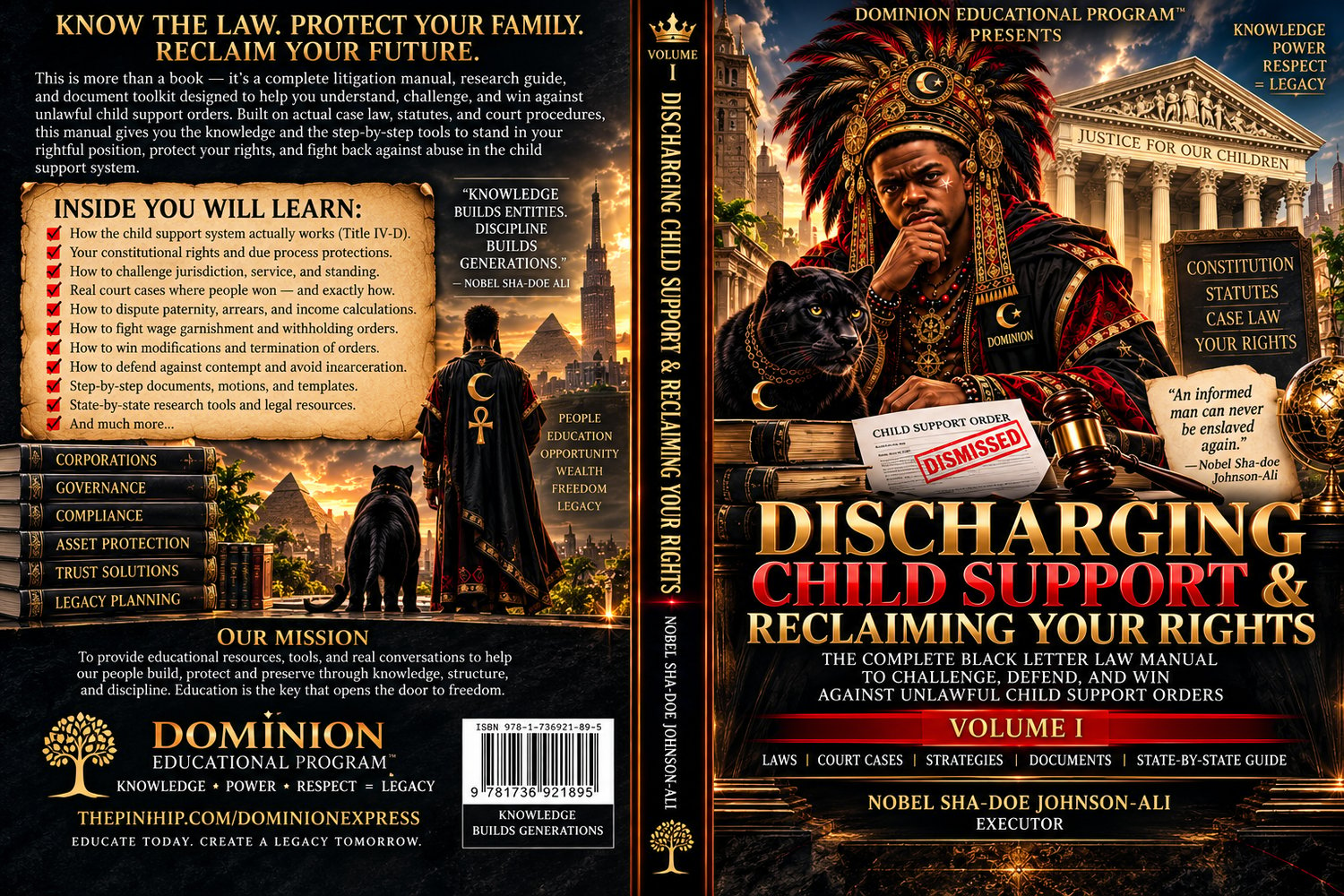
Discharging Child support & Reclaiming Your Rights
⚖️ DISCHARGING CHILD SUPPORT & RECLAIMING YOUR RIGHTS
Book Description
Discharging Child Support & Reclaiming Your Rights is a 79-page educational manual presenting an alternative administrative and commercial-law framework for challenging child-support obligations and enforcement actions. Written by NobEL Sha-doe Johnson-Ali, Executor, the book walks readers through the author's theories concerning status and standing, Title IV-D child-support enforcement, administrative presentments, recordkeeping, debt discharge, and courtroom procedure.
The manual lays out a structured five-presentment administrative process, beginning with an affidavit claim and fee schedule and progressing through a Notice of Fault and Opportunity to Cure, Notice of Default, Certificate of Non-Response/Affidavit of Default, and Letter of Cure. It also discusses document preparation, registered and certified mailing procedures, maintaining an administrative record, responding to agency rejection, federal-court filings, credit-report disputes, and enforcement concepts.
A major practical component is documentation and record preservation. The manual instructs readers to maintain organized records of agency correspondence, notices sent, mailing receipts, return receipts, telephone contacts, and court filings so that the history of the dispute can be reconstructed.
⚠️ Important educational notice
This book contains legal theories that should not be treated as established black-letter law without independent verification. In particular, claims that HJR 192 created a universal mechanism for discharging child support, that an ALL-CAPS name is a separate state-owned corporate fiction, or that an agency's failure to rebut an affidavit automatically converts private claims or fee schedules into enforceable judgments should be independently researched before anyone attempts to use them in an actual proceeding. Those propositions appear expressly in the manual.
For the Dominion Educational Program, this manual can therefore serve two purposes: teaching students how administrative documentation and recordkeeping work while also teaching them to separate legal theories from propositions actually supported by statutes, court rules, and binding precedent.
STUDY THE CLAIM.
VERIFY THE LAW.
BUILD THE RECORD.
UNDERSTAND THE PROCEDURE.
PROTECT YOUR RIGHTS LAWFULLY.