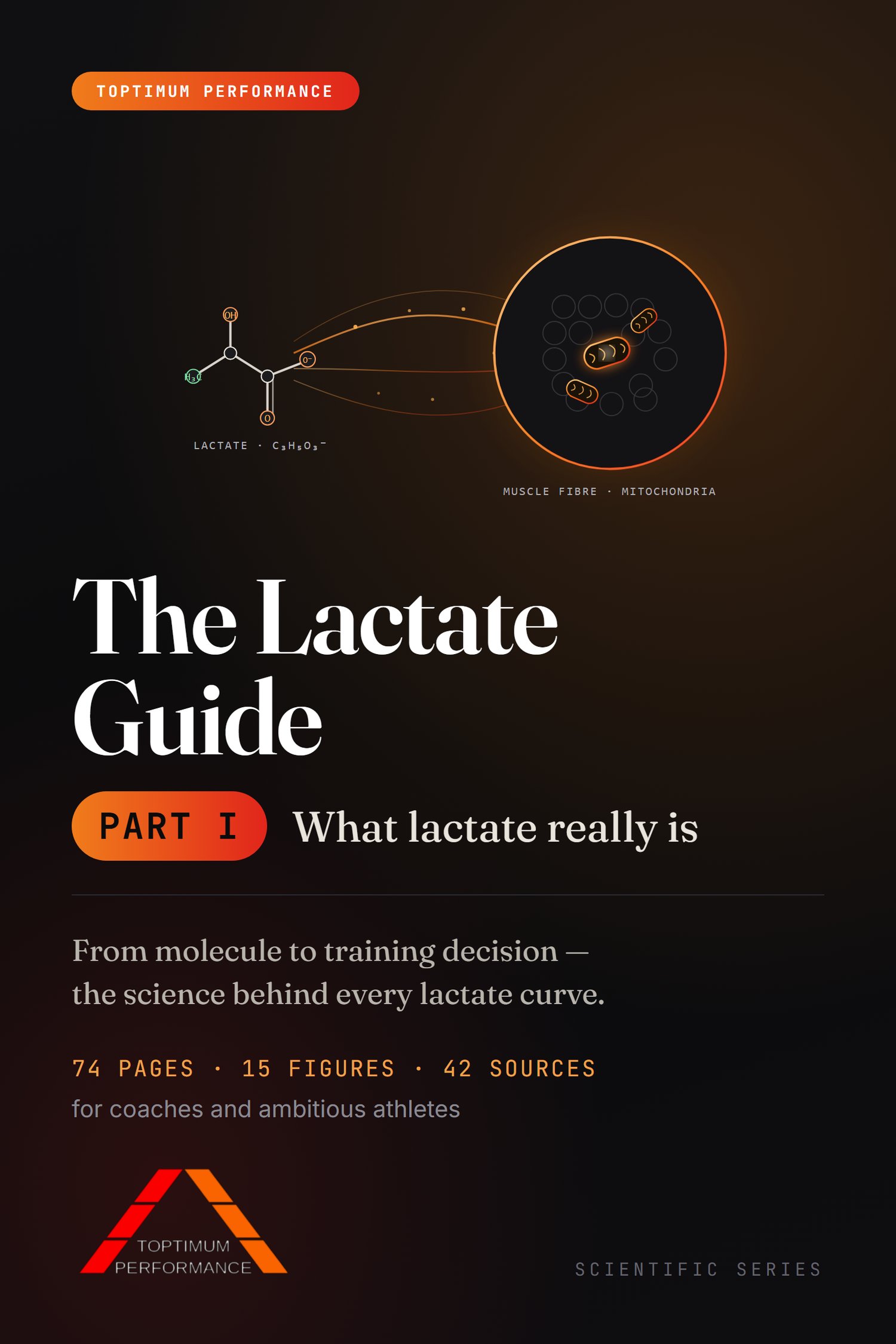
The Lactate Guide Part 1 - for coaches and ambitious athletes (EN)
** From molecule to training decision: what lactate really is, where it arises and what it does.**
Lactate is probably the most misunderstood molecule in sport. It is taken for a waste product, for the cause of acidification, for the sign that oxygen is falling short. None of those three holds up.
This first part builds the story the way physiology tells it: from the demand for ATP to glycolysis, from the pyruvate crossroads to the race between two enzymes that decides how much lactate appears. Along the way it becomes clear why lactate arises when the body works hard and not when it fails — and why a high lactate value and a large aerobic contribution do not rule each other out.
**What's inside**
- How lactate arises, and where and how much
- Lactate as the normal end product of glycolysis
- Lactate as fuel, shuttle and signalling molecule and why it is not a waste product
- Lactate, fatigue and the acid-base balance
- The balance between production and clearance
- Lactate in muscle, heart, liver, brain and mitochondria
- Why "lactic acid" is the wrong term, with the chemistry alongside: at the acidity of a muscle cell more than 99.7% of the substance is lactate, even in heavy fatigue
- The race between LDH and PDH: why lactate is the normal end product
- Why the "anaerobic distance" does not exist. With the measured energy distribution per distance, for men and for women
- cLaMax against VLaMax: the difference between a measurement and a modelled value, including the assumption hidden inside cLaMax itself
- A glossary in which every technical term is briefly explained
**For whom**
Coaches and ambitious athletes who want to understand what they measure. No prior knowledge is needed; only the willingness to let go of a few stubborn convictions.
**Extent**
74 pages
15 figures
42 scientific sources (with DOI where available)
Glossary