
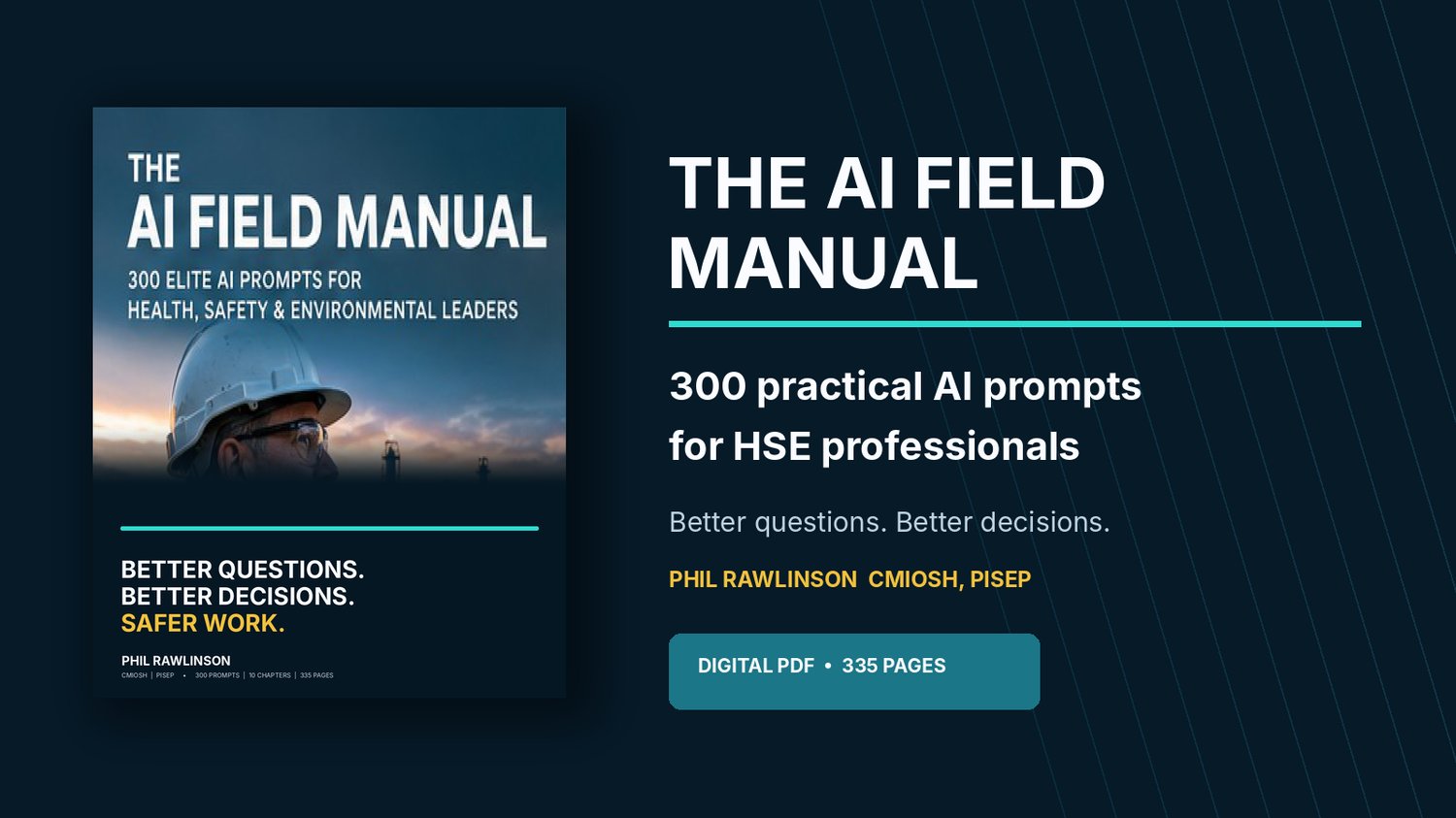
The AI Field Manual for Safety Professionals
300 AI Prompts. 10 Chapters. One Purpose: Better HSE Decisions.
AI can produce a convincing safety answer in seconds. That doesn't mean it's the right answer.
The real value of AI isn't in generating more paperwork. It's in helping us ask better questions, challenge assumptions, explore uncertainty and understand what's actually happening in the workplace.
The AI Field Manual for Safety Professionals puts that philosophy into practice.
Created by Phil Rawlinson CMIOSH, PISEP, this 335-page professional resource contains 300 structured, copy-ready AI prompts designed around the real challenges facing health, safety and environmental professionals.
This isn't another collection of generic instructions to "write me a risk assessment".
It's a practical toolkit for using AI as a critical-thinking partner — helping you examine evidence, challenge convenient conclusions and make more informed professional decisions.
What Can You Actually Do With It?
Use the prompts to:
- Investigate incidents differently — explore competing explanations, organisational influences and the conditions that shape everyday work.
- Challenge risk assessments — identify assumptions, overlooked exposures and the differences between procedures and reality.
- Make audits more meaningful — look beyond completion percentages, tick boxes and reassuring dashboards.
- Strengthen contractor management — examine responsibilities, coordination, communication and critical controls.
- Learn from normal work and near misses — understand adaptations, successful recoveries and emerging weaknesses before harm occurs.
- Challenge leadership decisions — explore safety culture, operational pressures, competing priorities and unintended consequences.
- Interrogate compliance — organise evidence, question legal assumptions and identify what needs competent verification.
- Improve occupational health and operational safety — examine practical controls, workplace exposures and how safeguards perform.
- Support strategic decisions — test investment proposals, governance arrangements, performance indicators and board-level assurance.
- Use AI more intelligently — challenge the quality, limitations and reliability of AI-generated advice itself.
More Than Just a Prompt
Every prompt is built around five practical elements:
1. The Situation — a recognisable professional challenge.
2. Copy-Ready AI Prompt — a structured instruction you can adapt and use with an appropriate AI assistant.
3. What to Provide — the workplace information needed to produce a meaningful response.
4. Stress Test — a question designed to challenge assumptions and expose weaknesses in the answer.
5. Field Verification — how to connect the AI output with real people, real evidence and real working conditions.
Because a convincing answer on a screen is not the same as an effective control in the workplace.
Who Is This Book For?
- Health and Safety Managers and Advisers
- HSE Directors and Senior Leaders
- Chartered and aspiring safety professionals
- Independent HSE Consultants
- Operational Managers with safety responsibilities
- Professionals exploring how AI can support better risk management
Whether you're beginning to experiment with AI or already using it professionally, the manual provides structured ways to move beyond basic questions and generic responses.
What's Included?
- 300 practical AI prompts
- 10 chapters
- 335-page downloadable PDF
- Searchable content and PDF navigation
- Immediate digital access after purchase
Written by Phil Rawlinson CMIOSH, PISEP, from a practitioner perspective, with an emphasis on understanding work, challenging simplistic explanations and making professional judgement more informed — not replacing it.
The Bottom Line
We don't need AI to help us produce more convincing safety paperwork. We need it to help us think more critically about risk, work and the decisions we make.
That's what The AI Field Manual is designed to do.
Get your copy and start asking better questions.
Digital PDF download. This is a UK-oriented professional decision-support resource, not a legal compliance certification or substitute for competent professional advice. AI-generated outputs must be checked against current applicable requirements and actual workplace conditions. Access to an AI assistant is not included.