

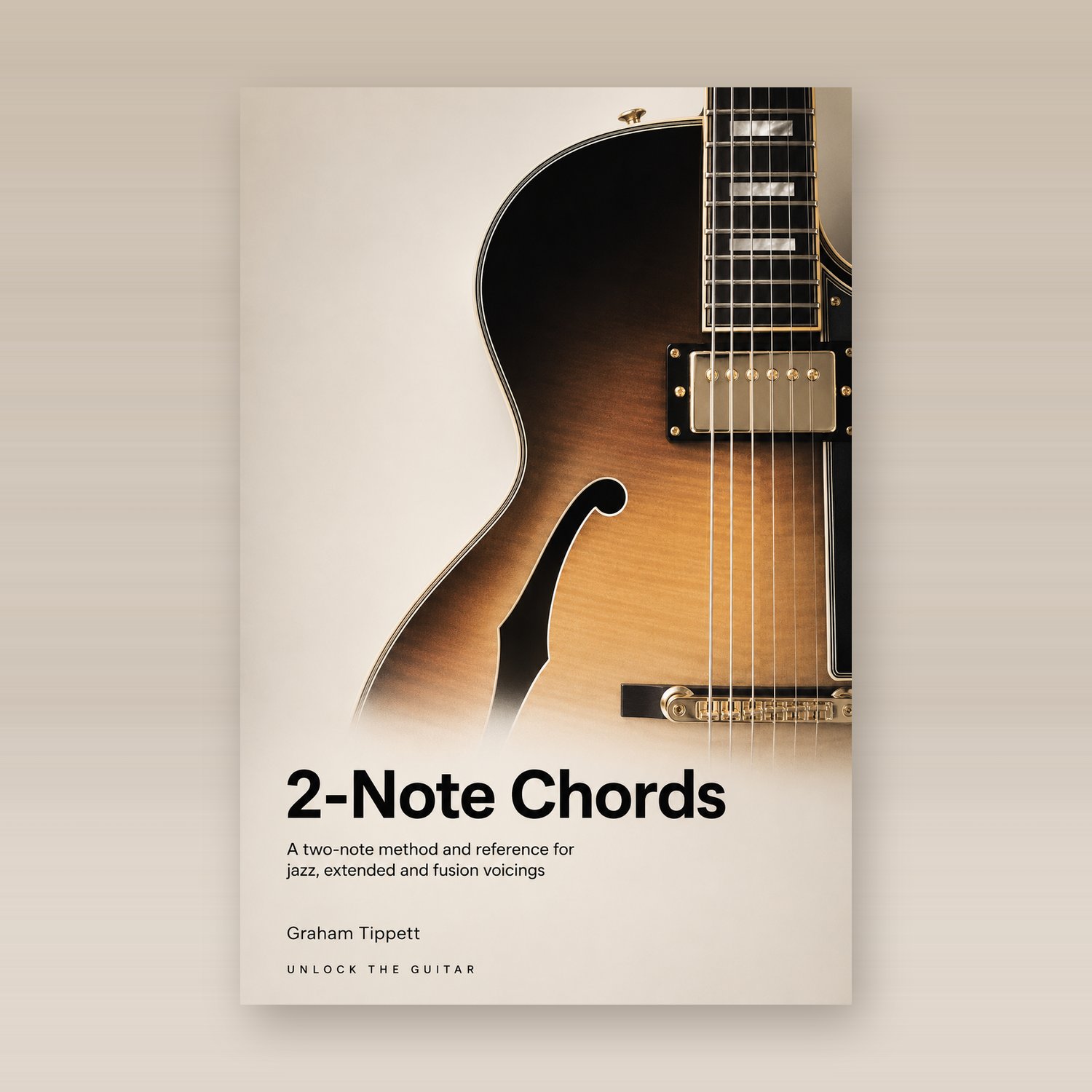
2-Note Chords - A two-note method and reference for jazz, extended and fusion voicings
Most guitarists who want to play jazz stall in the same place. Not on theory, and not on tunes. On the chords.
You look up a thirteen sharp eleven and what comes back is a five-note grip with a stretch in it and a fingering that takes a week. Learn twenty of those and you still can't comp, because comping isn't playing grips in sequence. It's moving between them, and a five-note grip has no moving parts.
So the usual advice arrives: learn shell voicings, drop the root, drop the fifth. Sound advice, framed badly, because it's framed as subtraction. Play less because your hands can't manage more.
This book takes the opposite position. Two notes chosen well aren't a reduced chord. They're a more precise one.
Nobody hears a stack of notes. What a listener tracks, when harmony moves, is the two or three notes that changed. A bass player supplies the root. The previous chord supplies the memory of where the harmony just was. The melody supplies the top. Most of the chord is already in the room before you play anything, and what you add is the part nobody else had.
Which is where the extended and altered chords stop being difficult. A thirteen flat nine is a nightmare as a grip and trivial as two notes, because the two notes that make it a thirteen flat nine are the only two you need. The same goes for the lydian dominant, the minor-major seventh and the half-diminished — the whole vocabulary that reads as advanced when it's written as a stack.
WHAT'S INSIDE
- 35 fretboard diagrams — two notes held still, with every bass note that renames them and the chord each one makes
- 150 chords indexed by symbol, so you can go from what a chart is asking for to the page that produces it
- No open strings — every shape is movable, so each diagram stands for twelve
- Organised by interval and string pair, not by key, because transposing is the one thing you can already do
- The method itself in a single table you'll stop needing inside a week
WHO IT'S FOR
Guitarists who read chord symbols and are moving into jazz, fusion and extended harmony. If you can play a barre chord and a blues but the charts in a real book stop you dead, this is aimed at you.
It isn't a beginner book, and it isn't a chord dictionary.
WHAT IT WON'T DO
Two notes can't state a plain diminished or augmented triad, and the altered dominants need a root somewhere to lean on. Solo guitar with no bass and no context needs more notes than this. That's said on page one of the book as well, because you should know before you buy rather than after.
For everything else — major, minor, all the seventh families, the sixths, the melodic minor material and the dominant colours — two notes is enough, and this is where they are.
FORMAT
PDF, 37 pages, 8.5" x 11". Instant download, yours to keep, readable on anything. Also available as a paperback on Amazon.