
ADHD College Student Daily Planner Template
ADHD College Student Daily Planner — A Practical Executive Function Planner for College Life
College is demanding enough without having to keep your entire schedule, assignments, lectures, deadlines, study sessions, meals, breaks, and “I need to remember this” thoughts inside your head.
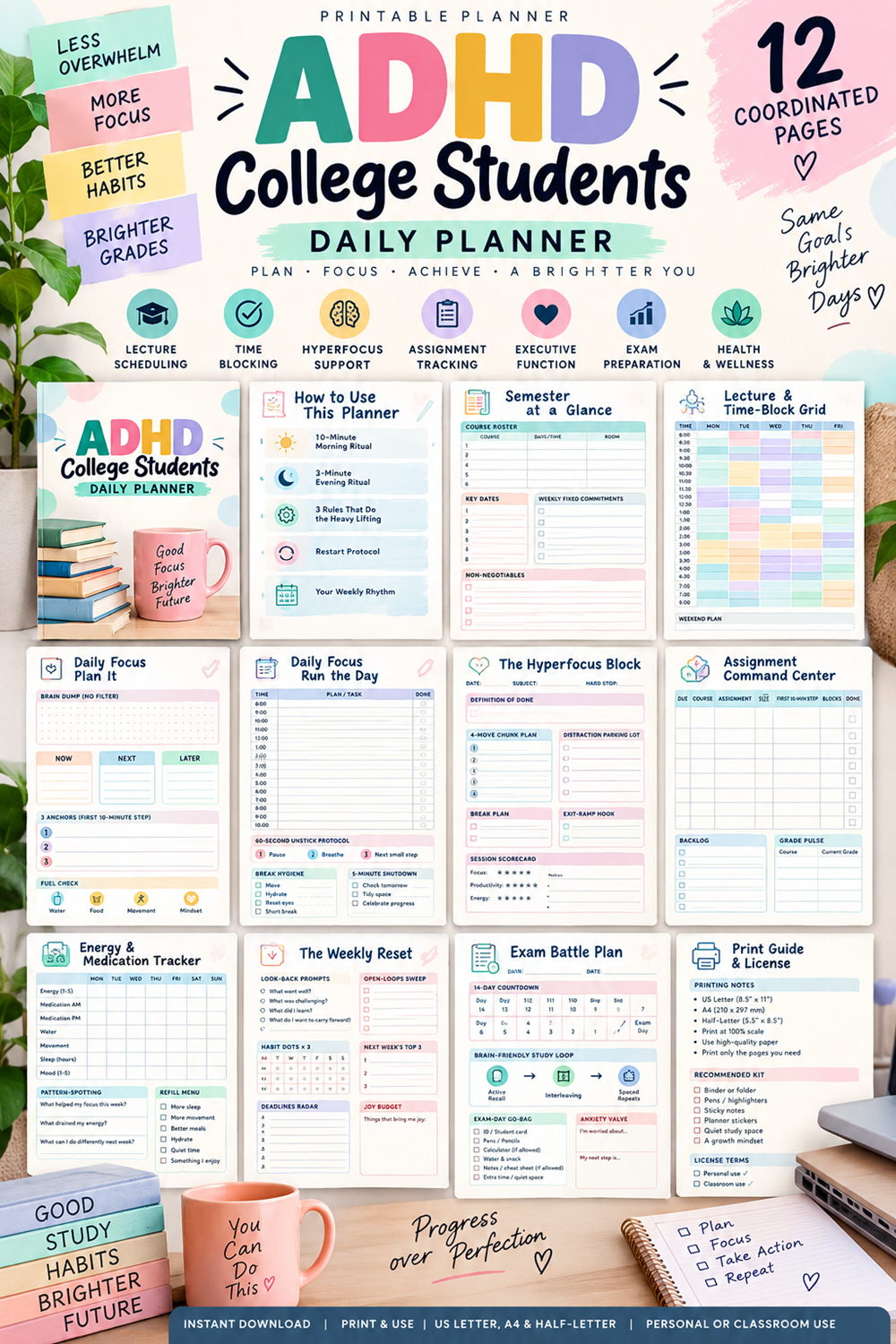
The ADHD College Student Daily Planner is designed specifically for students who want a more structured, visual, and realistic way to manage college life. Instead of relying on a generic daily planner, this specialized printable planner combines ADHD-friendly planning, executive function support, time blocking, lecture scheduling, hyperfocus management, task initiation, assignment tracking, study planning, weekly resets, and exam preparation in one coordinated system.
Whether you are managing six courses, trying to stay ahead of assignments, preparing for exams, balancing lectures with independent study, or simply trying to figure out what needs your attention next, this planner gives you dedicated space to capture, organize, prioritize, schedule, focus, reset, and move forward.
A College Planner Built Around How Your Day Actually Works
Traditional planners often give you a calendar, a to-do list, and a few empty boxes.
College students need more than that.
You may have a lecture at 10 AM, an assignment due at midnight, a reading that needs to be completed, a project that feels too large to start, and three other tasks competing for attention. At the same time, you may experience periods of intense concentration where you can work for hours—and other moments when even a small task feels difficult to begin.
This planner is built around those real-life planning challenges.
Instead of asking you to create a perfect schedule, it helps you break your day into manageable pieces using time blocks, first-step actions, priority sorting, focus blocks, breaks, transition cues, and restart routines.
The goal is simple: make the next useful action easier to see.
What's Inside — 12 Coordinated Planner Pages
1. Cover — A Planner That Feels Like Yours
The opening page creates a clean, purposeful introduction to your planning system with “ADHD College Students” branding and a color-coded daily ribbon representing the natural flow of your day:
Lectures → Fuel → Hyperfocus → Reset → Wind-down
There is also a personalized name-on-cover line so you can make the planner your own.
This isn't simply decoration. The visual organization establishes the planner's core rhythm from the first page.
2. How to Use This Planner
A planner only works when it is easy to use consistently.
The dedicated instruction page introduces a simple 10-minute morning ritual and 3-minute evening ritual, helping reduce the friction involved in figuring out where to begin.
You'll also find the 3 rules that do the heavy lifting, a practical restart protocol, and a weekly rhythm designed to help you return to planning even after an interrupted or unproductive day.
Missed a time block?
The system encourages you to restart from the current moment rather than trying to reconstruct an unrealistic perfect schedule.
That makes the planner more flexible for changing college schedules and unpredictable days.
3. Semester at a Glance
College planning becomes much easier when important information is visible in one place.
The Semester at a Glance page provides space for a 6-course roster, 8 key dates, weekly fixed commitments, and non-negotiables.
Use it to capture important academic information such as:
- Course schedules
- Major assignment deadlines
- Exams
- Projects
- Presentations
- Recurring commitments
- Important academic dates
- Other fixed responsibilities
Instead of keeping every deadline scattered across different apps, notebooks, syllabi, and messages, this page gives you a central planning reference.
4. Lecture & Time-Block Grid
College students often need to coordinate fixed lectures with flexible study time.
The Lecture & Time-Block Grid provides a Monday–Friday schedule from 8:00 AM through 8:30 PM, organized in 30-minute rows.
The visual grid makes it easier to see the relationship between:
Lectures + study blocks + meals + breaks + commitments + transition time
The five-color palette chips provide a simple visual organization system, while the weekend planning area gives you space to prepare for Saturday and Sunday.
This is especially useful for students who prefer visual schedules over long written task lists.
5. Daily Focus — Plan It
The Daily Focus planning page begins with a brain-dump dotted pad.
No filtering.
No need to organize everything immediately.
Simply capture the thoughts, reminders, assignments, errands, ideas, questions, and tasks competing for attention.
Then move them into the Now / Next / Later tri-column sort.
This creates an important distinction between:
What needs attention now?
What should happen next?
What can wait?
The page also includes three anchors with a first 10-minute step, encouraging you to turn large or vague tasks into concrete starting actions.
A fuel check provides another quick planning cue for the practical needs that support a productive college day.
6. Daily Focus — Run the Day
Planning is only half the process.
The next page helps you actually run the day.
A 15-row time-block schedule provides space to organize your day while keeping the plan visible and manageable.
When you get stuck, the 60-second unstick protocol gives you a quick reset instead of leaving you staring at an overwhelming task.
The page also includes:
- Break hygiene
- Transition support
- Focus blocks
- Practical stopping points
- A 5-minute shutdown routine
The shutdown section is particularly useful for creating a clear end to the academic day and identifying what should happen next.
7. The Hyperfocus Block
One of the most specialized pages in the planner is the Hyperfocus Block.
Rather than treating intense concentration as something that needs to be eliminated, this page provides structure around it.
The header includes:
Date + Subject + Hard Stop
You then define the definition of done, breaking the task into a four-move chunk table.
The page also includes a distraction parking lot, allowing you to capture unrelated thoughts without immediately abandoning the current task.
A dedicated break plan creates a stopping point, while the exit-ramp hook helps make it easier to transition away from the current activity and return later.
Finally, the session scorecard gives you a simple way to review the focus block.
This makes the page useful for studying, writing papers, completing projects, reading difficult material, coding, research, or other extended academic work.
8. Assignment Command Center
Assignments can become overwhelming when you only see the final deadline.
The Assignment Command Center turns each assignment into a visible sequence.
The 10-row tracker includes:
- Due date
- Course
- Assignment
- Size: S / M / L
- First 10-minute step
- Number of blocks
- Completion status
This approach helps transform “write my research paper” into something more actionable.
The page also includes a backlog section and a grade pulse, giving students a broader view of unfinished work and academic progress.
Instead of simply asking, “What is due?”, you can also ask:
What is the first step?
How large is the task?
How many focused work blocks might I need?
That distinction can make a large academic workload feel much more manageable.
9. Energy & Medication Tracker
Daily planning is not always about time.
The planner includes a 7-day energy tracker using a 1–5 scale, along with dedicated spaces for:
- AM / PM medication tracking
- Water
- Movement
- Sleep
- Mood
- Pattern-spotting questions
- Refill menu
The purpose is to give you a place to observe your own routines and patterns.
For students who already use prescribed medication, the medication area can serve as a personal tracking space. It is not intended to provide medical advice, dosage recommendations, or treatment instructions.
The broader goal is awareness: understanding how your daily routines and available energy may affect the way you plan your academic workload.
10. The Weekly Reset
A strong planning system needs a reset button.
The Weekly Reset page helps you look backward before planning forward.
You'll find prompts for:
- Weekly look-back
- Open-loops sweep
- Habit dots × 3
- Next week's Top 3
- Deadline radar
- Joy budget
Instead of simply creating another list of tasks, the weekly reset encourages you to notice what remained unfinished, what needs to carry forward, and what should no longer occupy your attention.
The joy budget also creates dedicated space for activities outside academic responsibilities.
College planning should not become an endless productivity checklist.
11. Exam Battle Plan
Exams require a different type of planning.
The Exam Battle Plan provides a 14-day countdown grid to help turn an approaching exam into smaller study sessions.
It includes a brain-friendly study loop featuring:
Active recall → Interleaving → Spaced repeats
You can use the countdown to divide preparation into manageable study blocks rather than leaving everything until the final days.
The page also includes an exam-day go-bag checklist and an anxiety valve section for capturing concerns and identifying practical next steps.
The objective is not to promise perfect exam preparation.
It is to make the preparation process visible, structured, and easier to begin.
12. Print Guide & License
The final page makes the planner easier to use in different environments.
Printing guidance is provided for:
- US Letter
- A4
- Half-letter
You'll also find a recommended kit and personal + classroom license terms so buyers understand how the printable resource can be used.
Designed for Real College Life
This ADHD daily planner is not built around the assumption that every day will go exactly according to plan.
Classes move.
Assignments change.
Energy fluctuates.
Unexpected responsibilities appear.
A study session can take longer than expected.
A deadline can suddenly become urgent.
Sometimes you simply lose your place.
That is why the planner emphasizes restart protocols, time blocking, first-step actions, distraction parking, hyperfocus boundaries, weekly resets, and flexible prioritization.
The system is designed to help you return to the plan rather than feel like you have failed the plan.
A Practical Executive Function Toolkit
At its core, this is more than a calendar.
It combines several planning functions in one coordinated printable system:
Daily planner for everyday scheduling.
College planner for academic commitments.
ADHD-friendly planner for visual organization and reduced planning friction.
Executive function planner for prioritization, task initiation, sequencing, and follow-through.
Time-block planner for assigning realistic periods to academic work.
Lecture planner for organizing classes and fixed commitments.
Study planner for focused academic sessions.
Assignment tracker for deadlines and project progress.
Hyperfocus planner for structured deep-work sessions.
Exam planner for multi-day preparation.
Weekly reset for reviewing and reorganizing your workload.
Instead of buying or maintaining several disconnected templates, students can use these coordinated pages as one complete planning workflow.
Print It. Write On It. Make It Yours.
The printable format gives you flexibility.
Print the pages you need.
Use them alongside your existing academic calendar.
Keep the daily pages in a binder.
Create a semester planning folder.
Print additional copies of your favorite pages.
Use the Hyperfocus Block when you need a deep-work session.
Use the Assignment Command Center when your workload starts piling up.
Use the Weekly Reset when you need to reorganize.
Use the Exam Battle Plan when assessment season approaches.
Your planner does not have to look perfect.
It simply needs to help you see what matters next.
Built for Students Who Want Less Mental Clutter and More Visible Structure
College requires students to manage much more than academic content.
You are also managing deadlines, schedules, transitions, communication, projects, study sessions, personal routines, and competing priorities.
The ADHD College Student Daily Planner brings these pieces together into one organized visual system.
With dedicated pages for lecture scheduling, executive function support, daily focus, hyperfocus blocks, assignment management, energy tracking, weekly planning, exam preparation, brain dumps, time blocking, task initiation, and resets, it is designed to become a practical companion throughout the semester.
Whether you're starting a new semester, preparing for a busy exam period, reorganizing an overloaded schedule, or looking for a more structured approach to daily college life, this printable planner gives you a place to put the plan on paper.
Capture the thoughts.
Choose the next action.
Block the time.
Protect the focus.
Take the break.
Reset when the day changes.
Keep moving forward.
Your semester does not need a perfect plan.
It needs a plan you can return to.