
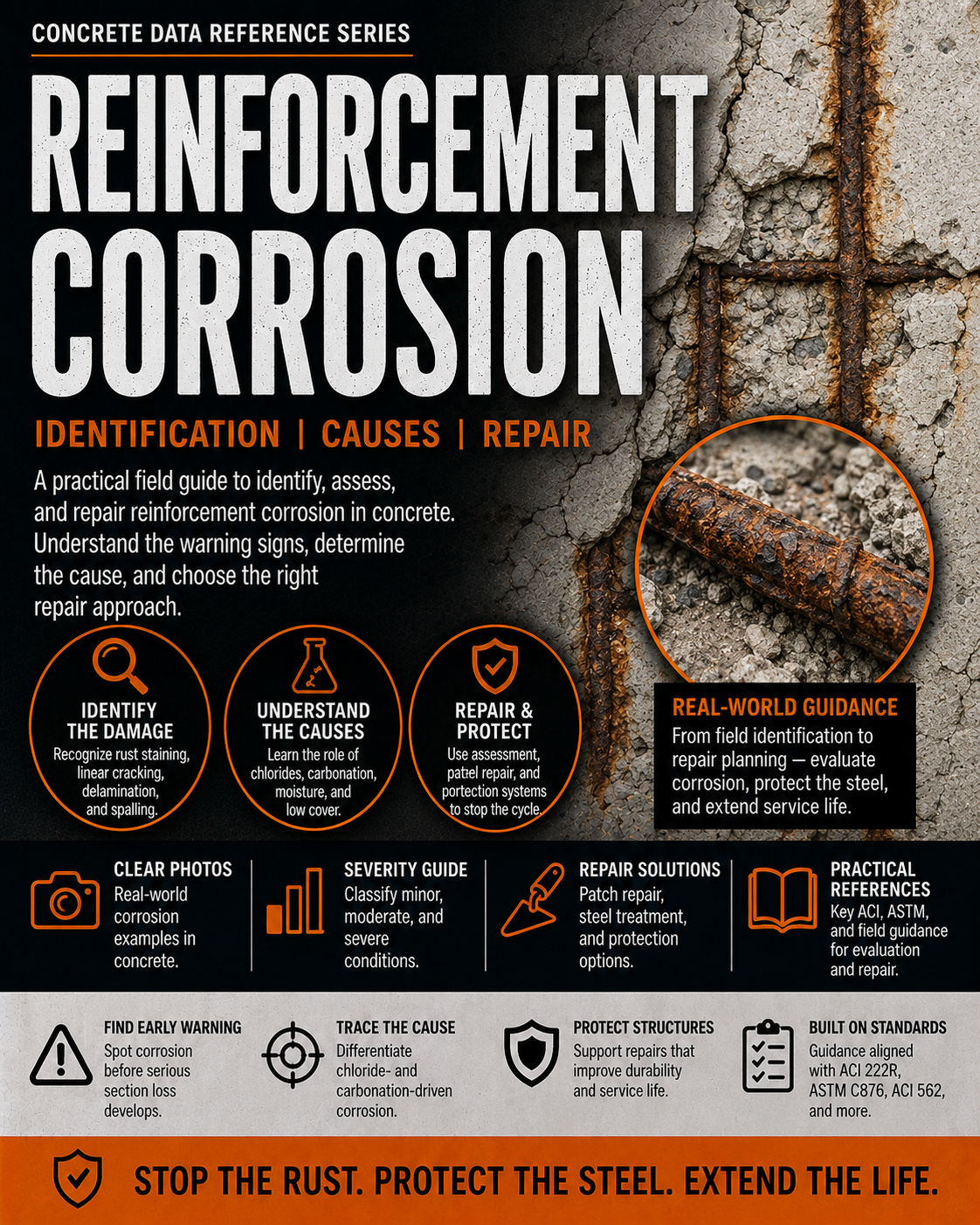
Concrete Defects - Reinforcement Corrosion
Reinforcement Corrosion Guide —
Identify reinforcement corrosion before rust staining turns into cracking, delamination, spalling, steel section loss, and expensive structural repair.
Reinforcement corrosion is one of the most common and costly durability problems in reinforced concrete. When chlorides or carbonation break down the concrete’s natural protection around embedded steel, the reinforcing steel begins to rust. As that rust expands, it creates internal pressure that cracks, delaminates, and eventually spalls the surrounding concrete.
The Reinforcement Corrosion Guide gives concrete professionals a practical, field-ready reference for recognizing corrosion-related distress, understanding the likely cause, assessing severity, and choosing the right next step.
This guide is built for inspectors, contractors, field technicians, QC professionals, repair crews, engineers, maintenance teams, and anyone evaluating reinforced concrete structures. It explains what reinforcement corrosion looks like, why it matters, what commonly causes it, how to identify it in the field, and when further testing or engineering evaluation is needed.
Inside, you’ll find guidance on common corrosion indicators such as rust staining, straight-line cracking over reinforcing bars, hollow-sounding delamination, spalling, exposed corroded steel, pitting, inadequate cover, chloride exposure, carbonation, and section loss. The guide also explains why visible surface damage often understates what is happening at the bar level.
What’s Included
- Clear explanation of what reinforcement corrosion is
- Field signs of corrosion-related concrete distress
- Common causes, including chlorides, carbonation, inadequate cover, high-permeability concrete, cracking, stray current, and galvanic effects
- Minor / moderate / severe severity classification
- Guidance for mapping rust staining, cracking, delamination, and spalling
- Recommendations for confirming activity and extent with half-cell surveys, chloride testing, cover measurement, and carbonation depth testing
- Universal escalation rules for higher-risk conditions
- Quick field decision path for monitoring, corrosion survey, corrosion assessment, or engineering review
- Prevention strategies for reinforced concrete durability
- Repair and mitigation options for corrosion-related damage
- Patch repair guidance, including removal around affected steel and evaluation of pitting / section loss
- Protection options such as sealers, corrosion inhibitors, anti-carbonation coatings, anti-chloride coatings, and cathodic protection
- Engineering evaluation triggers
- Cost impact if reinforcement corrosion is left unrepaired
- ASTM / ACI / ICRI reference list
- At-a-glance action table
- Field inspection checklist
Built for Real Field Use
This guide helps answer the questions that matter during a concrete inspection:
Is the staining just surface discoloration, or is it following the reinforcement?
Are cracks running directly over the bars?
Is there delamination or a hollow sound around the affected area?
Is the steel exposed, pitted, or losing section?
Should this be monitored, protected, tested further, repaired, or reviewed by an engineer?
The guide walks users through a practical decision path: if corrosion is suspected, check for exposed or pitted steel, section loss, active corrosion indicators, chloride exposure, carbonation, cover depth, and delamination before deciding on the next step.
Best For
- Concrete inspectors
- Field technicians
- Repair contractors
- Ready-mix and QC professionals
- Engineers and engineering support staff
- Bridge, deck, balcony, and parking garage inspectors
- Facility maintenance teams
- DOT and infrastructure inspection crews
- Anyone building a practical concrete defect reference library
Why This Guide Matters
Reinforcement corrosion is not just a cosmetic issue. It can reduce reinforcing steel cross-section, weaken structural capacity, create falling-concrete hazards, and lead to major rehabilitation costs if ignored. Rust staining and fine cracking may be the first visible warning signs, but the damage often progresses beneath the surface before major spalling appears.
This guide helps users recognize the signs early, document the condition properly, understand the likely corrosion driver, and avoid patching over active corrosion without addressing the cause. It also highlights when professional evaluation is required, including exposed or pitted steel, measurable section loss, widespread active corrosion, inadequate cover, extensive delamination, or uncertain extent of damage.
Important Note
This guide supports field identification and decision-making. It does not replace project specifications, engineering judgment, laboratory testing, ASTM standards, ACI documents, or qualified structural evaluation. Final repair scope should be based on the actual condition, test results, exposure environment, structural role of the member, and applicable standards.
Find the rust. Map the damage. Protect the steel.