
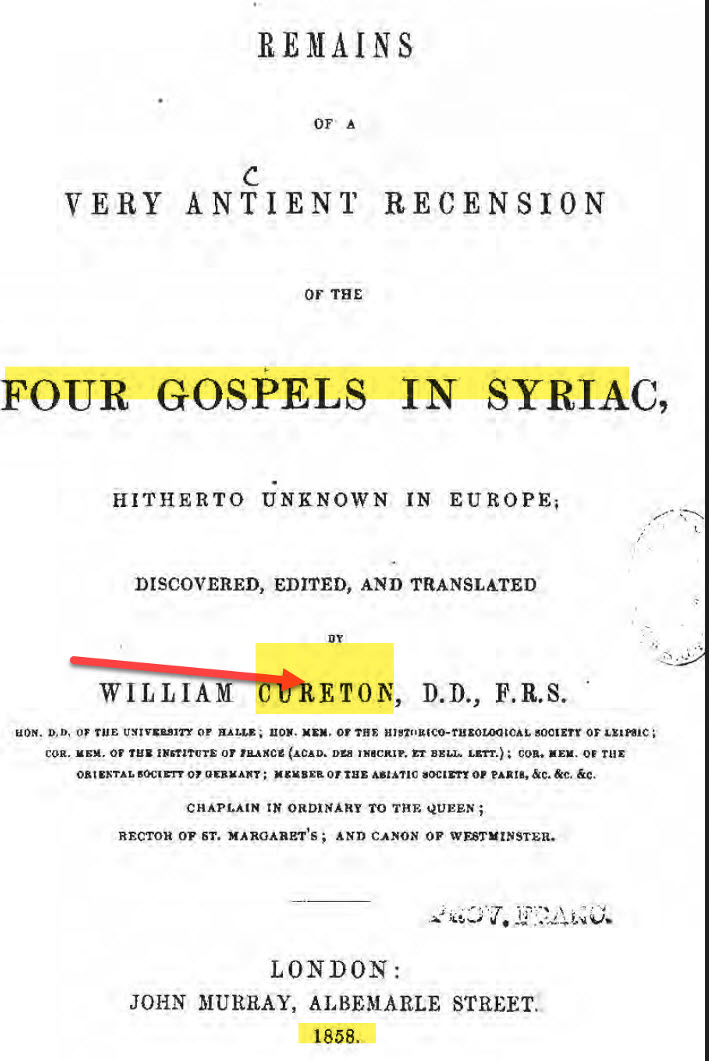
1858 Cureton Old Syriac 4 Gospels - Syr (cur)
In Wikipedia's "Cureton Gospels," at https://en.wikipedia.org/wiki/Curetonian_Gospels we learn:
The Curetonian Gospels, designated by the siglum syrcur, are contained in a manuscript of the four gospels of the New Testament in Old Syriac. Together with the Sinaiticus Palimpsest the Curetonian Gospels form the Old Syriac Version, and are known as the Evangelion Dampharshe ("Separated Gospels") in the Syriac Orthodox Church.[1]
The Gospels are commonly named after William Cureton who maintained that they represented an Aramaic Gospel and had not been translated from Greek (1858)[2] and differed considerably from the canonical Greek texts, with which they had been collated and "corrected". Henry Harman (1885) concluded, however, that their originals had been Greek from the outset.[3] The order of the gospels is Matthew, Mark, John, Luke. The text is one of only two Syriac manuscripts of the separate gospels that possibly predate the standard Syriac version, the Peshitta; the other is the Sinaitic Palimpsest. A fourth Syriac text is the harmonized Diatessaron. The Curetonian Gospels and the Sinaitic Palimpsest appear to have been translated from independent Greek originals.
So now we realize that Westcott & Hort by referring to one of the Old Syriac texts as "Cu" meant Syr cur, as scholarship fell in with a different abbreviatoin that Westcott & Hort utilized in the 1890s.
Cureton's conclusion that this was not translated from Greek signifies that that is OLDER and a PREDECESSOR Aramaic form to our Greek texts, and thus has greater priority to the Greek texts.
Also Cureton observed what he called The Great Omission right after Matthew 20:28. The quote below needs some background first which Cureton provides. Here is a synopsis of what Cureton explains with citations and evidence:.
- The Great Addition (Matt 20:28): The Curetonian Syriac contains a famous, lengthy paragraph instructing believers: "But you, seek ye that from little things..." (analogous to choosing the lower seat at a feast in Luke 14). This primitive block of teaching was known to early Latin writers like Juvencus and Hilary and exists in the Greek/Latin Codex Bezae.
The Great Omission (means a lengthy passage left out) - reads at page 30 of the Cureton text);
27 As the Son of man 28 came not that he should be ministered to, but that he should minister, and that he should give bis soul a ransom for many. [THE GREAT OMISSION] But you, seek ye that from little things ye may become great, and not from great things may become little. Whenever ye are invited to the house of a supper, be not sitting down in the honoured place, lest should come he that is more honoured than thou, and to thee the Lord of the supper should say, Come near below, and thou be ashamed in the eyes of the guests. But if thou sit down in the little place, and be that is less than thee should come, and to thee the Lord of the supper shall say, Come near, and come up and sit down, thou also shalt have more glory in the eyes of the guests. [END GREAT OMISSION]
So this appears worthy of the master. It was in the earliest texts. it fits the context and aligns with Luke 14 in part. So this a treasure, it appears.
Please enjoy
Doug Del Tondo