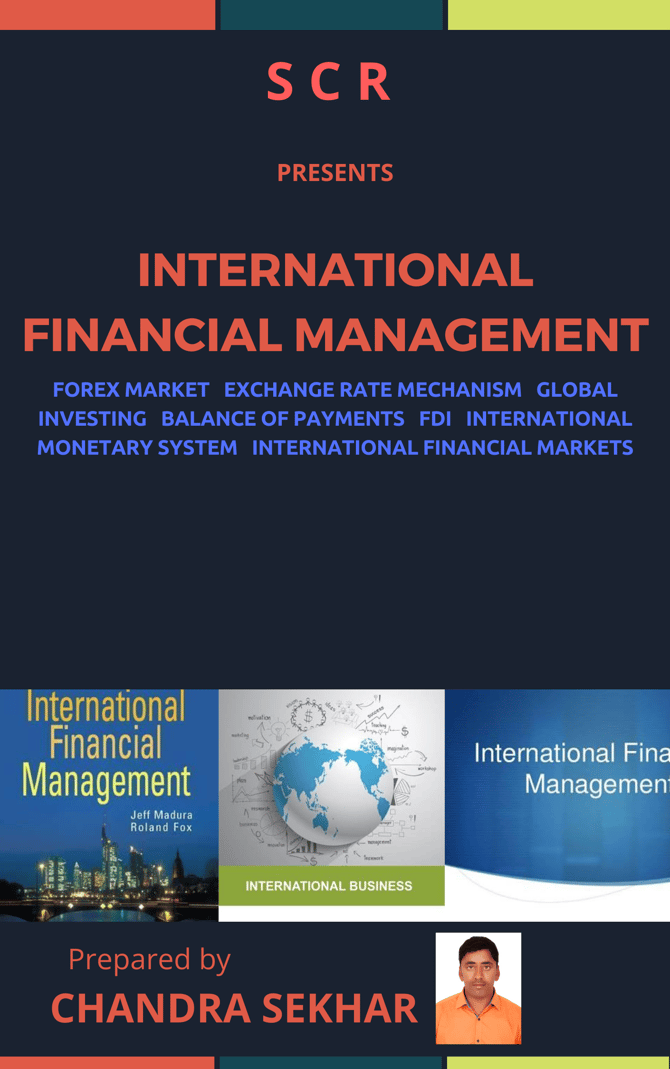
INTERNATIONAL FINANCIAL MANAGEMENT
I wrote this book International Financial Management with the following objectives.
· To demonstrate to readers that the subject of International Financial Management simple to understand, relevant in practice and interesting to learn.
· To help managers appreciate the logic for making better financial decisions.
· To explain the concepts and theories of financial derivatives in a simple way so readers could grasp them very easily and be able to put them in to practice.
· To provide a book that has a comprehensive coverage for financial derivatives and their analysis.
· To create a book that differentiates itself from other books in terms of coverage, presentation.
This book useful to Students, Job Interviews, Investors, Financial advisers, Financial managers and Fund managers to relate theories, concepts and data interpretation to practice.
This book International Financial Management aims to assist the reader to develop a thorough understanding of the concepts and theories in a systematic way. To accomplish this purpose, the recent thinking in the field of International Financial Management has been presented in a most simple, and precise manner.
The main features of the book are simple understanding and key concepts.
The book contains a comprehensive analysis of topics on International Financial Management i.e. Foreign Exchange market, Exchange rates, International Parity relationships, Foreign exchange risk, International monetary system, Balance of Payments, Global investments, Foreign Direct Investment and International financial markets with a view that readers understand financial decisions thoroughly well and are able to evaluate their implications for investors and traders.
This book begins with the Introduction of International Financial management, Foreign exchange market, Exchange rates. With this foundation, readers can easily understand the International finance.
The text material has been structured to focus on International Financial Management and discusses the theories, concepts and assumptions.
It is hoped that this will facilitate a better understanding of the subject matter.
CONTENTS
1. INTRODUCTION TO INTERNATIONAL FINANCIAL MANAGEMENT
2. FOREIGN EXCHANGE MARKET
Introduction to Foreign Exchange market
Structure of Foreign exchange market
Types of transactions and settlement dates
Participants in Foreign exchange market
Functions of Foreign exchange market
Segments of Foreign exchange market
3. FOREIGN EXCHANGE RATES
Foreign Exchange rate Quotations
Direct Quote
Indirect Quote
Spot Exchange rates
Cross rates
Bid-Ask Spread
Bid Price
Ask Price
Factors influencing Spread
Forward Exchange rates
4. INTERNATIONAL PARITY RELATIONSHIPS
Interest rate parity
Purchasing Power parity
Forward rates and expected future spot rate parity
International Fisher effect
5. FOREIGN EXCHANGE RISK
Transaction exposure
Economic exposure
Translation exposure
6. HEDGING FOREIGN EXCHANGE RISK
Instruments for hedging currency risk
Forward contract
Currency futures
Currency ETFs
Currency options
Money market operations
7. RISK MANAGEMENT
Definition
Steps in Risk management process
Types of Risk
8. GLOBAL INVESTMENT MANAGEMENT
Risks in Global investment
Benefits of Global investing
Why Global Investment
Where to invest
Factors influencing global investment decisions
9. INTERNATIONAL MONETARY SYSTEM
Introduction
Features of International monetary system
Stages of International monetary system
International Monetary Fund (IMF)
The World bank and its group
10. EXCHANGE RATE REGIME
Types of Exchange rate Regimes
Trends in Exchange rate regime
Who determine the exchange rates
Determinants (factors) of exchange rates
11. BALANCE OF PAYMENTS (BOP)
Definition
Importance of Balance of Payments
Components of BOP
Deficit
Surplus
Imbalances of balance of Payments
Causes of BOP imbalances
Statement of BOP
12. FOREIGN DIRECT INVESTMENT (FDI)
Introduction
Types of FDI
Methods of FDI
Forms of FDI incentives
Advantages of FDI
Disadvantages of FDI
FDI in India
Difference between FDI and FII
13. INTERNATIONAL FINANCIAL MARKETS
Definition of Financial markets
Types of Financial markets
Capital markets
Money markets
Sources of International finance/fund
Commercial banks
International Agencies
International capital markets
GDRs
ADRs
FCCBs
IDRs
ICDs
· To demonstrate to readers that the subject of International Financial Management simple to understand, relevant in practice and interesting to learn.
· To help managers appreciate the logic for making better financial decisions.
· To explain the concepts and theories of financial derivatives in a simple way so readers could grasp them very easily and be able to put them in to practice.
· To provide a book that has a comprehensive coverage for financial derivatives and their analysis.
· To create a book that differentiates itself from other books in terms of coverage, presentation.
This book useful to Students, Job Interviews, Investors, Financial advisers, Financial managers and Fund managers to relate theories, concepts and data interpretation to practice.
This book International Financial Management aims to assist the reader to develop a thorough understanding of the concepts and theories in a systematic way. To accomplish this purpose, the recent thinking in the field of International Financial Management has been presented in a most simple, and precise manner.
The main features of the book are simple understanding and key concepts.
The book contains a comprehensive analysis of topics on International Financial Management i.e. Foreign Exchange market, Exchange rates, International Parity relationships, Foreign exchange risk, International monetary system, Balance of Payments, Global investments, Foreign Direct Investment and International financial markets with a view that readers understand financial decisions thoroughly well and are able to evaluate their implications for investors and traders.
This book begins with the Introduction of International Financial management, Foreign exchange market, Exchange rates. With this foundation, readers can easily understand the International finance.
The text material has been structured to focus on International Financial Management and discusses the theories, concepts and assumptions.
It is hoped that this will facilitate a better understanding of the subject matter.
CONTENTS
1. INTRODUCTION TO INTERNATIONAL FINANCIAL MANAGEMENT
2. FOREIGN EXCHANGE MARKET
Introduction to Foreign Exchange market
Structure of Foreign exchange market
Types of transactions and settlement dates
Participants in Foreign exchange market
Functions of Foreign exchange market
Segments of Foreign exchange market
3. FOREIGN EXCHANGE RATES
Foreign Exchange rate Quotations
Direct Quote
Indirect Quote
Spot Exchange rates
Cross rates
Bid-Ask Spread
Bid Price
Ask Price
Factors influencing Spread
Forward Exchange rates
4. INTERNATIONAL PARITY RELATIONSHIPS
Interest rate parity
Purchasing Power parity
Forward rates and expected future spot rate parity
International Fisher effect
5. FOREIGN EXCHANGE RISK
Transaction exposure
Economic exposure
Translation exposure
6. HEDGING FOREIGN EXCHANGE RISK
Instruments for hedging currency risk
Forward contract
Currency futures
Currency ETFs
Currency options
Money market operations
7. RISK MANAGEMENT
Definition
Steps in Risk management process
Types of Risk
8. GLOBAL INVESTMENT MANAGEMENT
Risks in Global investment
Benefits of Global investing
Why Global Investment
Where to invest
Factors influencing global investment decisions
9. INTERNATIONAL MONETARY SYSTEM
Introduction
Features of International monetary system
Stages of International monetary system
International Monetary Fund (IMF)
The World bank and its group
10. EXCHANGE RATE REGIME
Types of Exchange rate Regimes
Trends in Exchange rate regime
Who determine the exchange rates
Determinants (factors) of exchange rates
11. BALANCE OF PAYMENTS (BOP)
Definition
Importance of Balance of Payments
Components of BOP
Deficit
Surplus
Imbalances of balance of Payments
Causes of BOP imbalances
Statement of BOP
12. FOREIGN DIRECT INVESTMENT (FDI)
Introduction
Types of FDI
Methods of FDI
Forms of FDI incentives
Advantages of FDI
Disadvantages of FDI
FDI in India
Difference between FDI and FII
13. INTERNATIONAL FINANCIAL MARKETS
Definition of Financial markets
Types of Financial markets
Capital markets
Money markets
Sources of International finance/fund
Commercial banks
International Agencies
International capital markets
GDRs
ADRs
FCCBs
IDRs
ICDs

 Save
Save
 Share
Share
 Tweet
Tweet