

Things Fall Apart Tests & Quizzes by Chinua Achebe | 100 Questions, Answer Keys | Grades 9–12
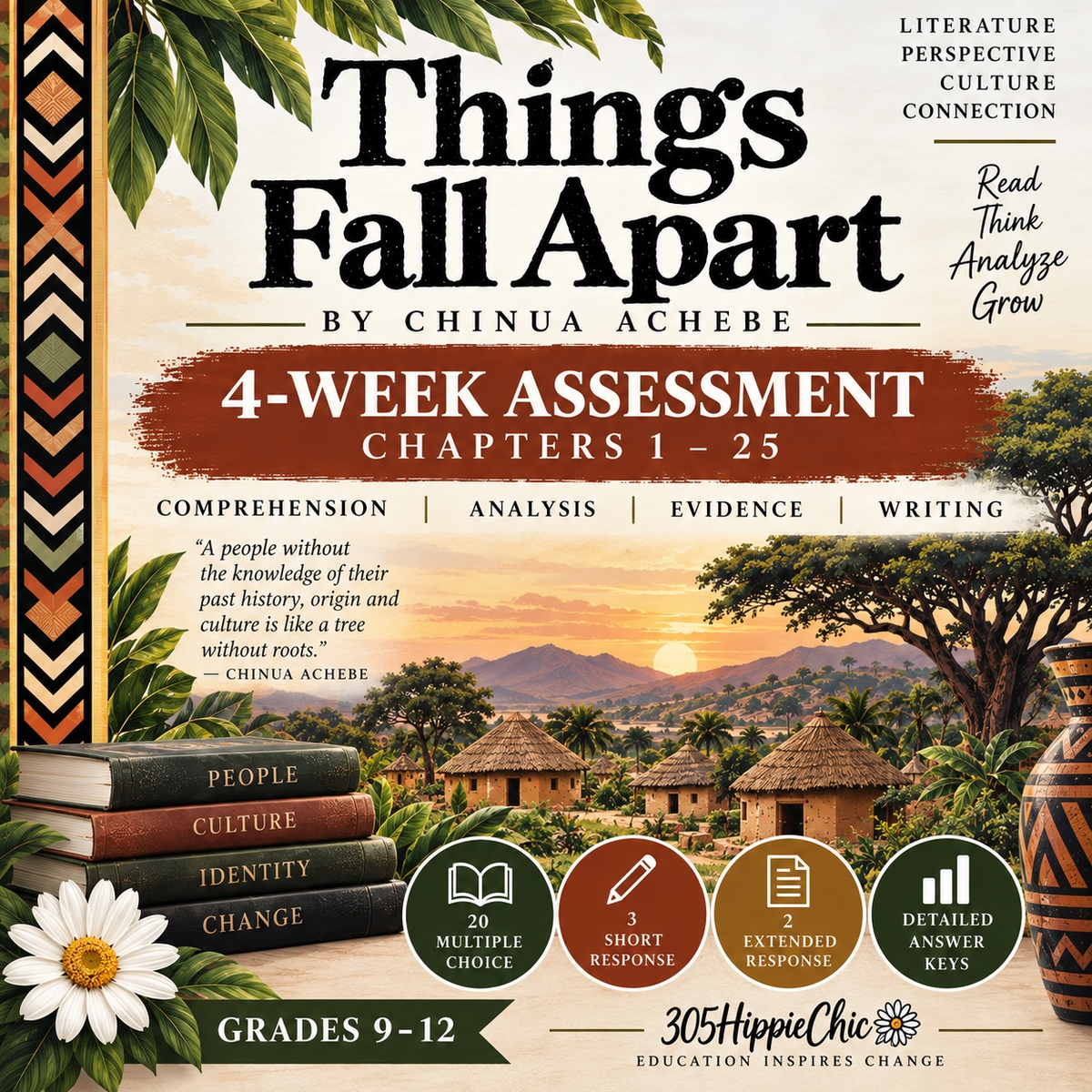
Things Fall Apart by Chinua Achebe | Complete 4-Week Novel Assessment | 100 Questions | Grades 9–12
Teaching Things Fall Apart by Chinua Achebe? Need ready-to-use chapter tests, reading comprehension quizzes, literary analysis questions, and detailed answer keys that assess more than basic plot recall?
This comprehensive 36-page Things Fall Apart assessment resource provides high school English teachers, homeschool educators, and parents with four structured weekly assessments covering all 25 chapters of Chinua Achebe’s celebrated novel.
Designed for grades 9–12, this resource includes 100 assessment questions, combining multiple-choice questions, short responses, and extended literary analysis prompts.
Each assessment encourages students to demonstrate reading comprehension while examining characterization, cultural traditions, personal identity, conflict, colonialism, and the consequences of individual choices.
Whether you’re teaching Things Fall Apart in a high school English classroom, introducing African literature in a world literature course, or guiding your homeschool student through a challenging literary work, these assessments provide a structured way to evaluate understanding and develop critical thinking skills.
Four weeks. Four assessments. 100 questions. Complete answer keys.
Everything you need to assess students’ understanding of Things Fall Apart in one convenient digital resource.
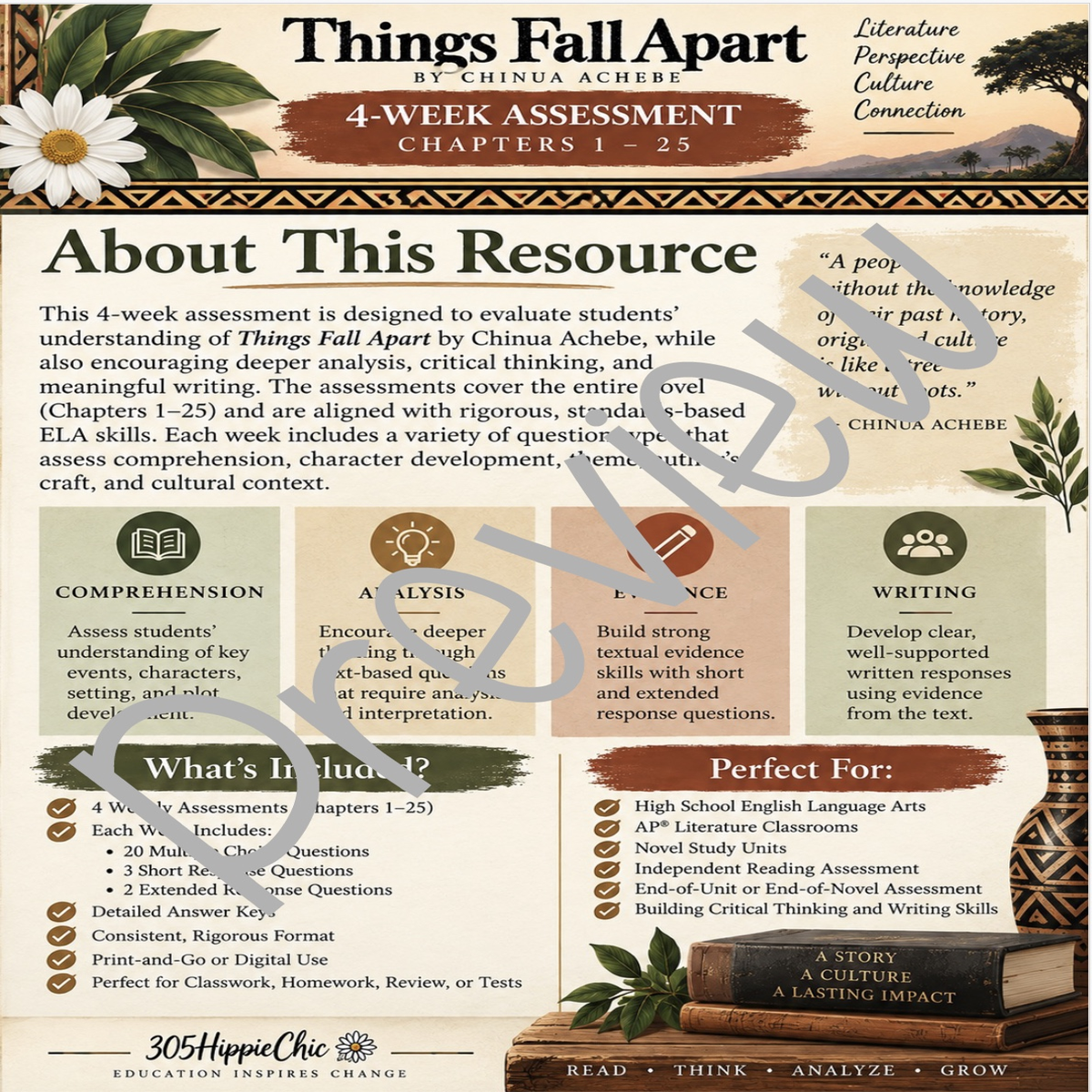
WHAT’S INCLUDED?
Four Complete Weekly Assessments
Each weekly assessment contains 25 questions, organized into three sections.
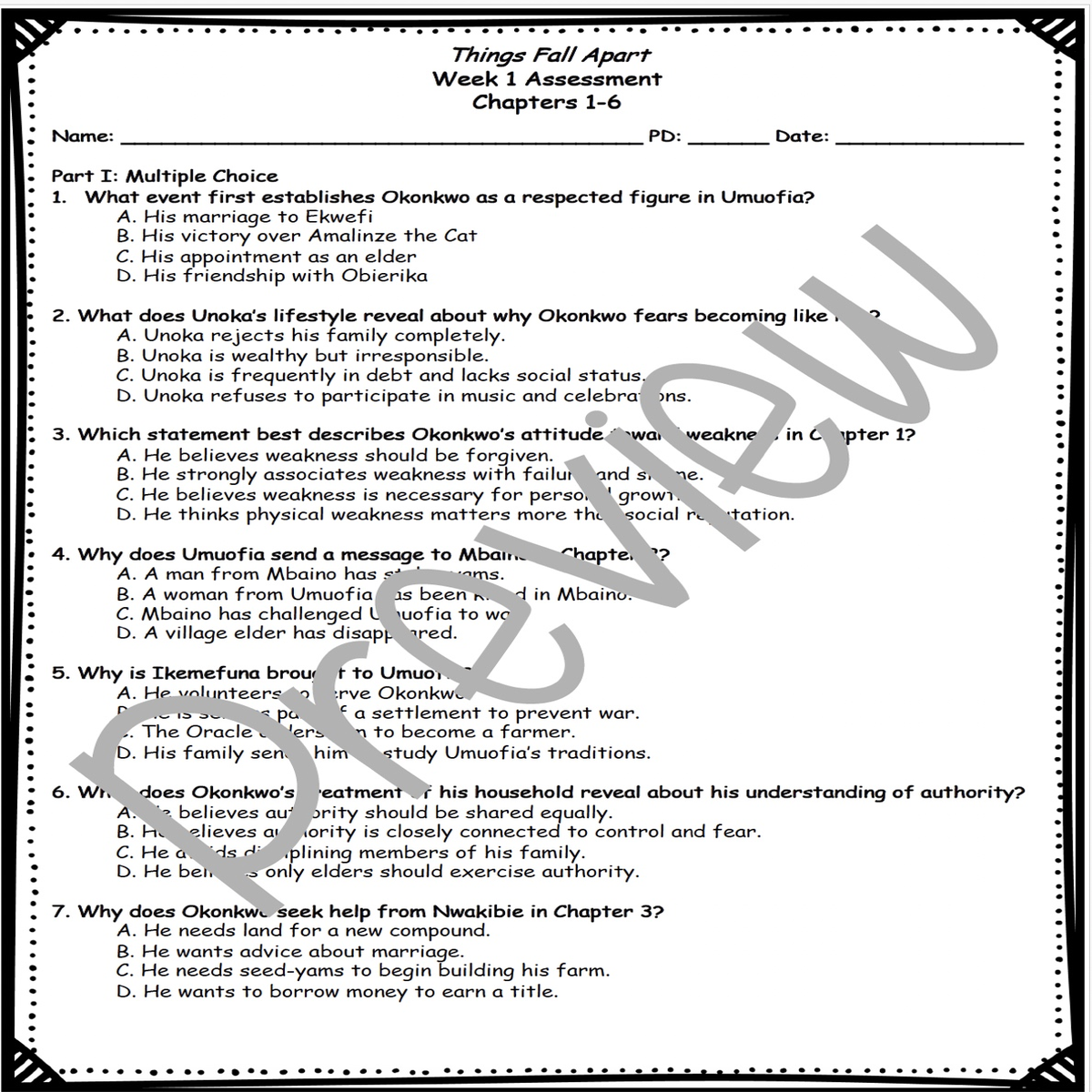
Part I: Reading Comprehension — 20 Multiple-Choice Questions
Students demonstrate their understanding of significant events, character relationships, cultural practices, and developing conflicts.
Questions assess:
- Understanding of important plot developments.
- Character motivations and decisions.
- Cause-and-effect relationships.
- Cultural traditions and social expectations.
- Character development and relationships.
- Central conflicts and emerging themes.
- Author’s purpose and literary interpretation.
Part II: Critical Thinking — 3 Short-Response Questions
Students move beyond identifying correct answers to explaining their interpretations.
Short-response questions encourage students to:
- Analyze character motivations and conflicts.
- Explain the significance of cultural practices.
- Examine how events contribute to thematic development.
- Make connections between characters and their experiences.
- Support interpretations with relevant textual evidence.
- Communicate ideas through clear, organized written responses.
Part III: Literary Analysis — 2 Extended-Response Questions
Each assessment concludes with two extended writing prompts that require students to develop more sophisticated literary interpretations.
Students analyze themes, characterization, cultural perspectives, and the consequences of characters’ decisions while incorporating specific evidence from the novel.
These writing tasks help students practice the analytical thinking and evidence-based writing expected in high school English Language Arts courses.
Detailed Teacher Answer Keys
Answer keys are included for all four assessments.
Each answer key provides:
- Correct answers for all multiple-choice questions.
- Suggested responses for short-answer questions.
- Detailed sample responses for extended literary analysis.
- Explanations that support meaningful feedback and classroom discussion.
The answer keys make this resource especially useful for homeschool educators and parents who want additional support evaluating literary analysis and written responses.
FOUR-WEEK ASSESSMENT BREAKDOWN
WEEK 1: CHAPTERS 1–6
Character Development, Igbo Culture, and Community Traditions
- The first assessment evaluates students’ understanding of Okonkwo’s character, his relationships, and the traditions that shape life in Umuofia.
- Students examine Okonkwo’s fear of weakness, his relationship with his father, Unoka, and the influence of cultural expectations on his decisions.
Assessment topics include:
- Okonkwo’s accomplishments and reputation.
- His relationship with Unoka.
- Ikemefuna’s arrival in Umuofia.
- The importance of farming and agricultural success.
- The Week of Peace.
- The Feast of the New Yam.
- Wrestling traditions and community celebrations.
- Okonkwo’s relationships with Ekwefi and Ezinma.
- Masculinity, authority, and personal identity.
Extended Literary Analysis Focus:
Students analyze how Okonkwo’s fear of weakness influences his behavior and how Achebe portrays Umuofia as a complex community with established cultural traditions.
WEEK 2: CHAPTERS 7–13
Character Conflict, Cultural Expectations, and Consequences
The second assessment focuses on increasingly serious conflicts and the consequences of Okonkwo’s decisions.
Students examine the relationships between Okonkwo, Ikemefuna, Nwoye, Ekwefi, and other important characters.
Assessment topics include:
- Ikemefuna’s death and its consequences.
- Nwoye’s changing relationship with Okonkwo.
- Okonkwo’s internal conflict.
- Ekwefi’s devotion to Ezinma.
- Chielo and the Oracle.
- The egwugwu judicial system.
- Marriage traditions and community participation.
- Ezeudu’s funeral.
- Okonkwo’s accidental killing.
- His seven-year exile from Umuofia.
Extended Literary Analysis Focus:
Students examine the relationship between personal choices and consequences while analyzing how Achebe presents different definitions of strength, courage, and responsibility.
WEEK 3: CHAPTERS 14–19
Tradition Versus Change, Religious Conflict, and Cultural Identity
The third assessment explores Okonkwo’s experiences in Mbanta and the arrival of Christian missionaries.
Students analyze the growing tensions between established Igbo traditions and new religious influences.
Assessment topics include:
- Okonkwo’s adjustment to exile.
- Uchendu’s teachings about family and resilience.
- The destruction of Abame.
- The arrival of Christian missionaries.
- Nwoye’s attraction to Christianity.
- Religious and cultural disagreements.
- The significance of the Evil Forest.
- The treatment of marginalized individuals.
- The growing division between traditional beliefs and Christianity.
- Okonkwo’s plans to return to Umuofia.
Extended Literary Analysis Focus:
Students analyze how Achebe develops the theme of tradition versus change and how Okonkwo, Uchendu, and Nwoye represent different perspectives on strength, identity, and belonging.
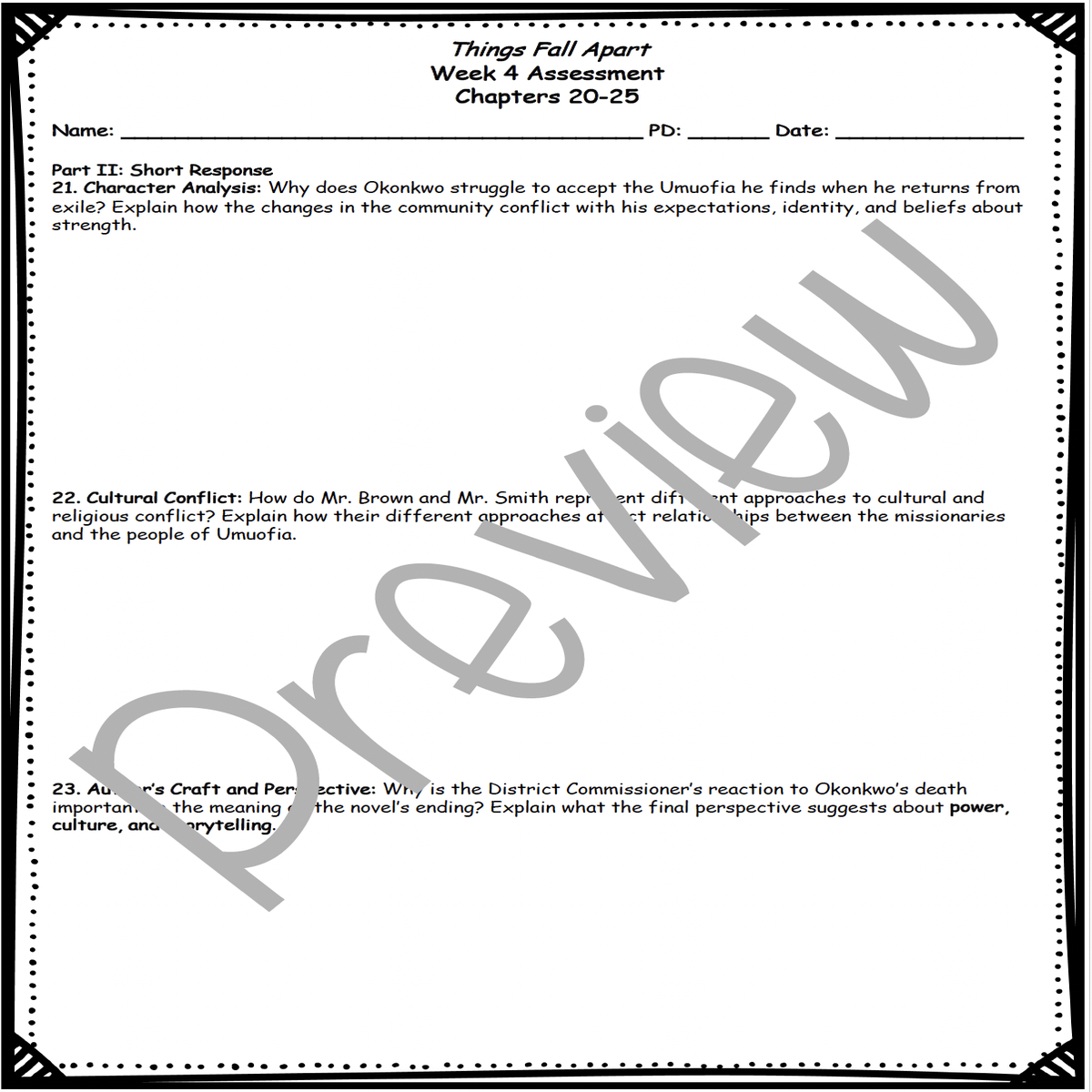
WEEK 4: CHAPTERS 20–25
Colonialism, Resistance, Tragedy, and Author’s Perspective
The final assessment evaluates students’ understanding of the novel’s conclusion and the impact of colonialism on Umuofia.
Students examine Okonkwo’s response to the changes within his community and the events leading to the novel’s tragic ending.
Assessment topics include:
- Okonkwo’s return to Umuofia.
- Changes in traditional community structures.
- Colonial authority and political control.
- Religious and cultural divisions.
- The District Commissioner.
- Resistance and conflict.
- Okonkwo’s increasing isolation.
- The consequences of cultural disruption.
- The novel’s tragic conclusion.
- Achebe’s use of narrative perspective and irony.
Extended Literary Analysis Focus:
Students evaluate how Achebe develops the novel’s central conflicts and how the conclusion challenges readers to consider the consequences of colonialism, cultural misunderstanding, and historical representation.
LITERARY SKILLS ASSESSED
These Things Fall Apart assessments evaluate essential high school English Language Arts skills, including:
Reading Comprehension
Students demonstrate understanding of significant events, character relationships, cultural practices, and important plot developments.
Character Analysis
Students analyze Okonkwo’s motivations, internal conflicts, relationships, and development throughout the novel.
Theme Analysis
Students examine major themes, including:
- Tradition versus change.
- Cultural identity and belonging.
- Masculinity and expectations of strength.
- Family relationships and responsibility.
- Individual choices and consequences.
- Colonialism and cultural conflict.
- Power, authority, and resistance.
- Fear, pride, and personal identity.
Literary Analysis
Students examine Achebe’s use of characterization, conflict, symbolism, foreshadowing, irony, and narrative perspective.
Textual Evidence
Students practice supporting interpretations with relevant examples and details from the novel.
Analytical Writing
Short-response and extended-response questions encourage students to organize their thinking, explain their reasoning, and communicate literary interpretations effectively.
Cultural and Historical Understanding
Students consider how Achebe portrays Igbo society and the effects of colonialism while developing a deeper understanding of the novel’s historical and cultural context.
COMMON CORE STATE STANDARDS ALIGNMENT
Designed to support Common Core English Language Arts standards for grades 9–12, including:
- CCSS.ELA-LITERACY.RL.9-10.1 — Cite strong and thorough textual evidence to support analysis.
- CCSS.ELA-LITERACY.RL.9-10.2 — Determine central themes and analyze their development throughout a literary work.
- CCSS.ELA-LITERACY.RL.9-10.3 — Analyze complex characters, their motivations, and their development.
- CCSS.ELA-LITERACY.RL.9-10.4 — Determine the meaning of words and phrases and analyze their impact.
- CCSS.ELA-LITERACY.RL.9-10.5 — Analyze how an author’s structural choices contribute to meaning.
- CCSS.ELA-LITERACY.RL.9-10.6 — Analyze cultural perspectives and points of view.
- CCSS.ELA-LITERACY.W.9-10.1 — Write arguments supported by valid reasoning and relevant evidence.
- CCSS.ELA-LITERACY.W.9-10.2 — Write informative and explanatory texts that examine complex ideas.
- CCSS.ELA-LITERACY.W.9-10.9 — Draw evidence from literary texts to support analysis and reflection.
- CCSS.ELA-LITERACY.SL.9-10.1 — Participate effectively in collaborative discussions.
These assessments can also support corresponding grades 11–12 literature and writing standards.
PERFECT FOR HIGH SCHOOL TEACHERS AND HOMESCHOOL EDUCATORS
High School English Language Arts Teachers
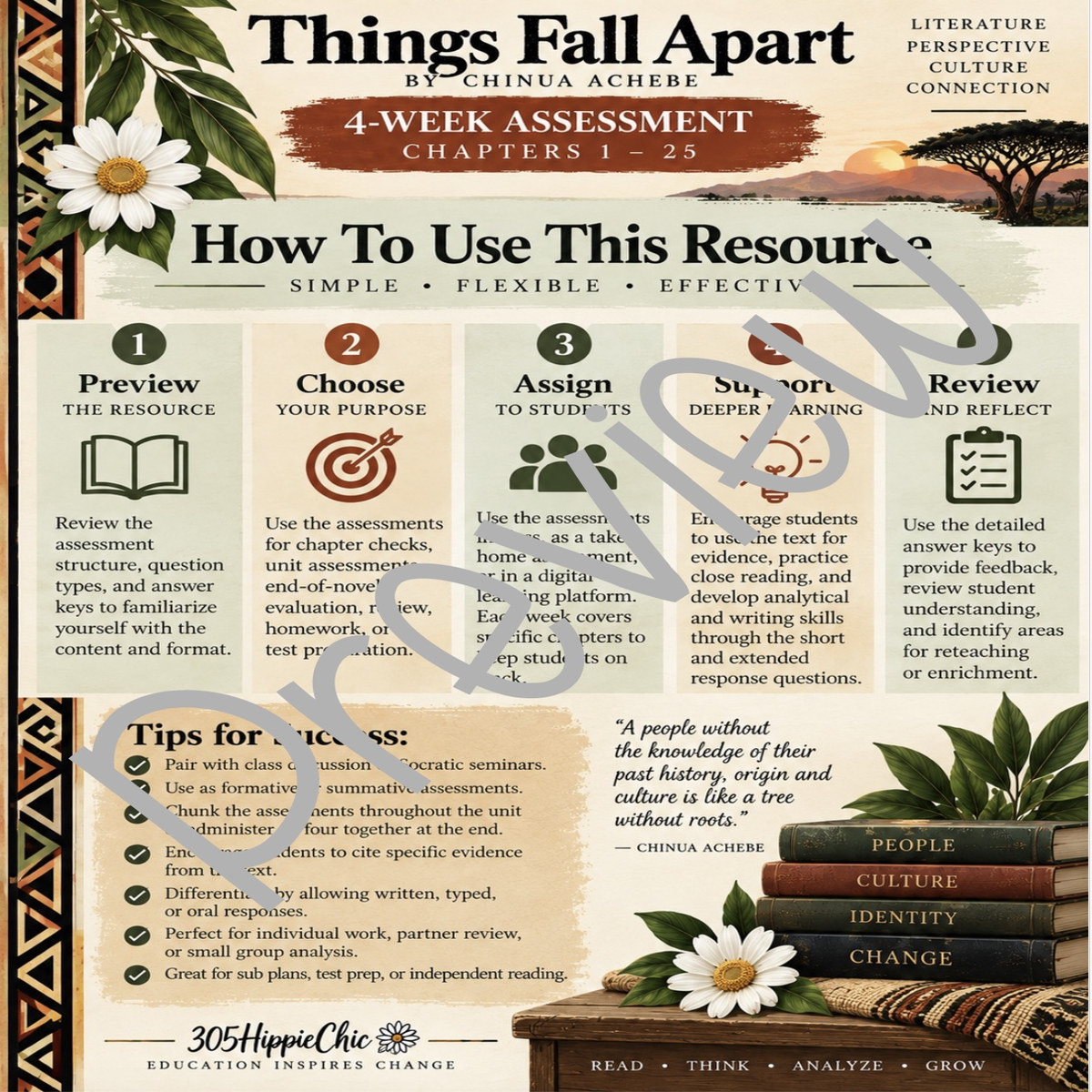
Use these assessments to evaluate reading comprehension, monitor student progress, and measure understanding throughout your Things Fall Apart literature unit.
Ideal for:
- Weekly chapter tests.
- Reading comprehension quizzes.
- Literary analysis assessments.
- Formative and summative assessments.
- Independent reading evaluations.
- Homework assignments.
- Test preparation.
- Substitute teacher assignments.
Homeschool Teachers and Parents
Teaching Things Fall Apart at home?
These assessments provide a structured way to evaluate your student’s understanding without creating your own tests.
The included answer keys and sample written responses help homeschool educators guide discussions, assess literary interpretations, and provide meaningful feedback.
Perfect for:
- High school homeschool English curriculum.
- World literature studies.
- Independent novel reading.
- Literature-based homeschooling.
- Reading comprehension practice.
- Analytical writing development.
- College-preparatory English instruction.
World Literature and African Literature Courses
Incorporate these assessments into units exploring African literature, cultural identity, colonialism, and the relationship between literature and historical perspective.
Students examine Achebe’s portrayal of Igbo society while analyzing the novel’s characters, conflicts, and themes.
WHY CHOOSE THIS THINGS FALL APART ASSESSMENT?
Save Valuable Preparation Time
Four complete assessments eliminate the need to create weekly tests, develop questions, and write answer keys from scratch.
Assess More Than Basic Recall
Questions require students to interpret character motivations, examine cultural traditions, analyze literary themes, and support conclusions with textual evidence.
Encourage Higher-Order Thinking
The combination of multiple-choice, short-response, and extended-response questions provides opportunities to assess different levels of understanding.
Support Meaningful Literary Analysis
Students examine how Achebe uses characterization, conflict, cultural perspective, and historical context to develop the novel’s central messages.
Make Grading and Feedback Easier
Detailed answer keys and sample responses provide instructional support for evaluating student work.
Flexible Classroom and Homeschool Use
Use assessments weekly, assign individual sections, or combine questions for review activities and cumulative testing.
Print or Assign Digitally
The downloadable PDF can be printed for traditional classroom use or distributed through a digital learning platform.
PRODUCT DETAILS
Novel: Things Fall Apart
Author: Chinua Achebe
Resource Type: Novel Assessments / Chapter Tests / Reading Comprehension Quizzes
Grade Levels: 9–12
Subject: English Language Arts / World Literature / African Literature
Duration: 4 Weeks
Chapter Coverage: Chapters 1–25
Total Pages: 36
Total Assessment Questions: 100
Number of Assessments: 4
Multiple-Choice Questions: 80
Short-Response Questions: 12
Extended-Response Questions: 8
Answer Keys: Included for all assessments
Format: Digital PDF Download
Delivery: Instant Digital Download
Please Note: This resource contains assessments and answer keys only. The novel Things Fall Apart by Chinua Achebe and the separate 4-week novel study are not included.
HELP STUDENTS READ, THINK, ANALYZE, AND GROW
Things Fall Apart challenges students to examine cultural identity, personal responsibility, tradition, colonialism, and the consequences of change.
These comprehensive assessments help educators determine whether students understand not only what happens in the novel but also why those events matter.
With 100 carefully structured questions, four weekly assessments, and detailed answer keys, this resource provides a practical way to evaluate comprehension, strengthen analytical writing, and encourage deeper engagement with Achebe’s work.
Add this ready-to-use Things Fall Apart assessment resource to your high school English or homeschool literature curriculum today!
305HippieChic — Education Inspires Change. 🌼