

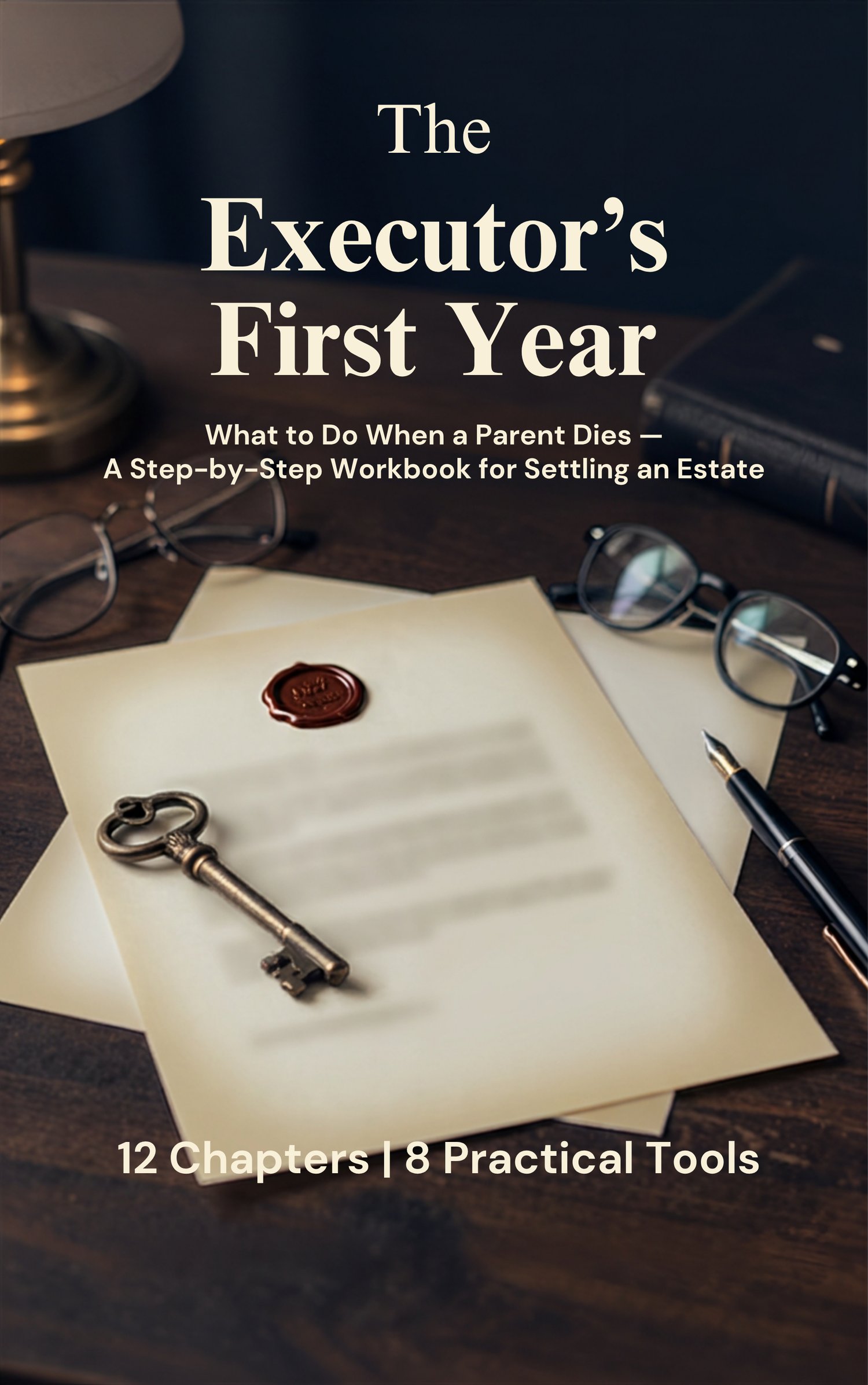


The Executor's First Year — What to Do When a Parent Dies
NOBODY TELLS YOU WHAT TO DO
Someone has to find the will. Notify the bank. Deal with the funeral. Cancel the standing orders. Clear the house.
The list feels endless, and nobody is in charge of it.
Meanwhile a bank won't discuss the account with you. An insurance company wants a document you've never heard of. Someone from a collection agency has implied you're personally responsible for a debt. A relative is asking when the money comes, and you don't know.
And you have a job. You're doing all of this in evenings, in the free moments, while you're also grieving.
You've never done this before. There's no reason you should know how — the person who could have explained it is the person who died.
Two things are probably true right now. You don't know where to start. And somewhere underneath that, you're worried you'll end up personally on the hook for their debts.
This book answers both. The second one first, because it's the one that keeps people awake: in most circumstances you are not personally liable for a parent's debts — and Chapter 8 shows you the exceptions that do exist, and the order debts must be paid in so you stay protected.
THE PROBLEM WITH MOST EXECUTOR PRODUCTS
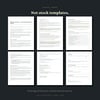
Search for help and you'll find spreadsheets. Estate trackers. Probate organizers. Asset inventory templates in Excel and Google Sheets.
They're all blank forms.
A blank form is useful to someone who already knows what they're doing. It gives you somewhere to write the answer. It never tells you the answer.
That isn't your problem right now. Your problem is:
What do I do this week? What order does any of this go in? And what am I not allowed to do yet?
WHAT THIS IS INSTEAD
You don't need another blank spreadsheet. You need to know what to do first.
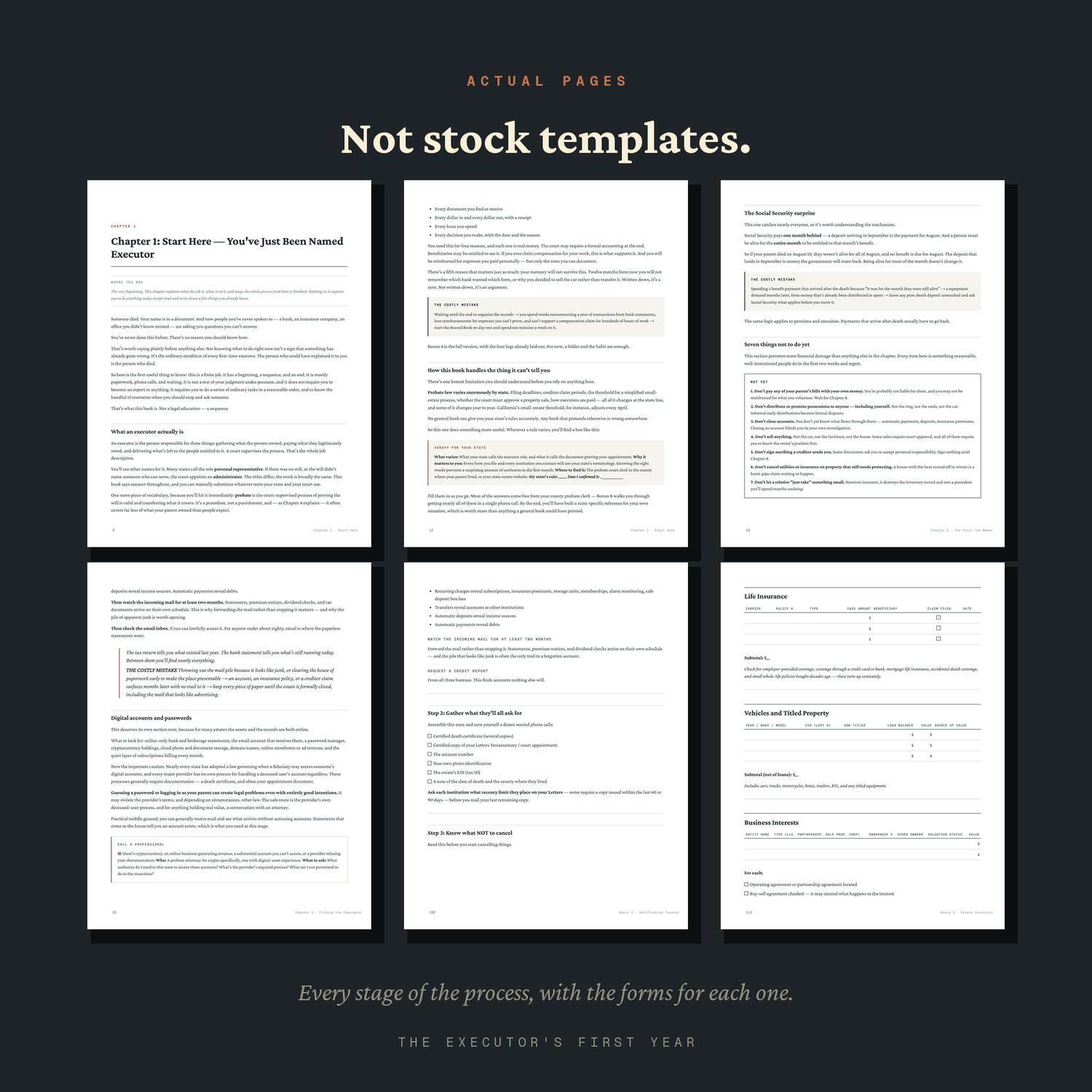
The Executor's First Year is the guidance and the forms — 170 pages, twelve chapters walking through the entire process in order, each with the worksheets for that stage built in.
The difference, concretely:
A tracker hands you an empty column labelled "Creditor Claims." This tells you not to pay a single creditor until you understand your state's claim window and priority order — because paying in the wrong sequence can make you personally liable for the shortfall. Then it gives you the log.
A spreadsheet has a tab for "Assets." This first tells you that much of what your parent owned may never go through probate at all, and how to sort which is which. For some readers that changes the next twelve months.
An organizer gives you a "Notifications" sheet. This tells you which accounts to cancel, which to keep alive, and which one will void the house insurance if you get it wrong.
WHAT'S INSIDE
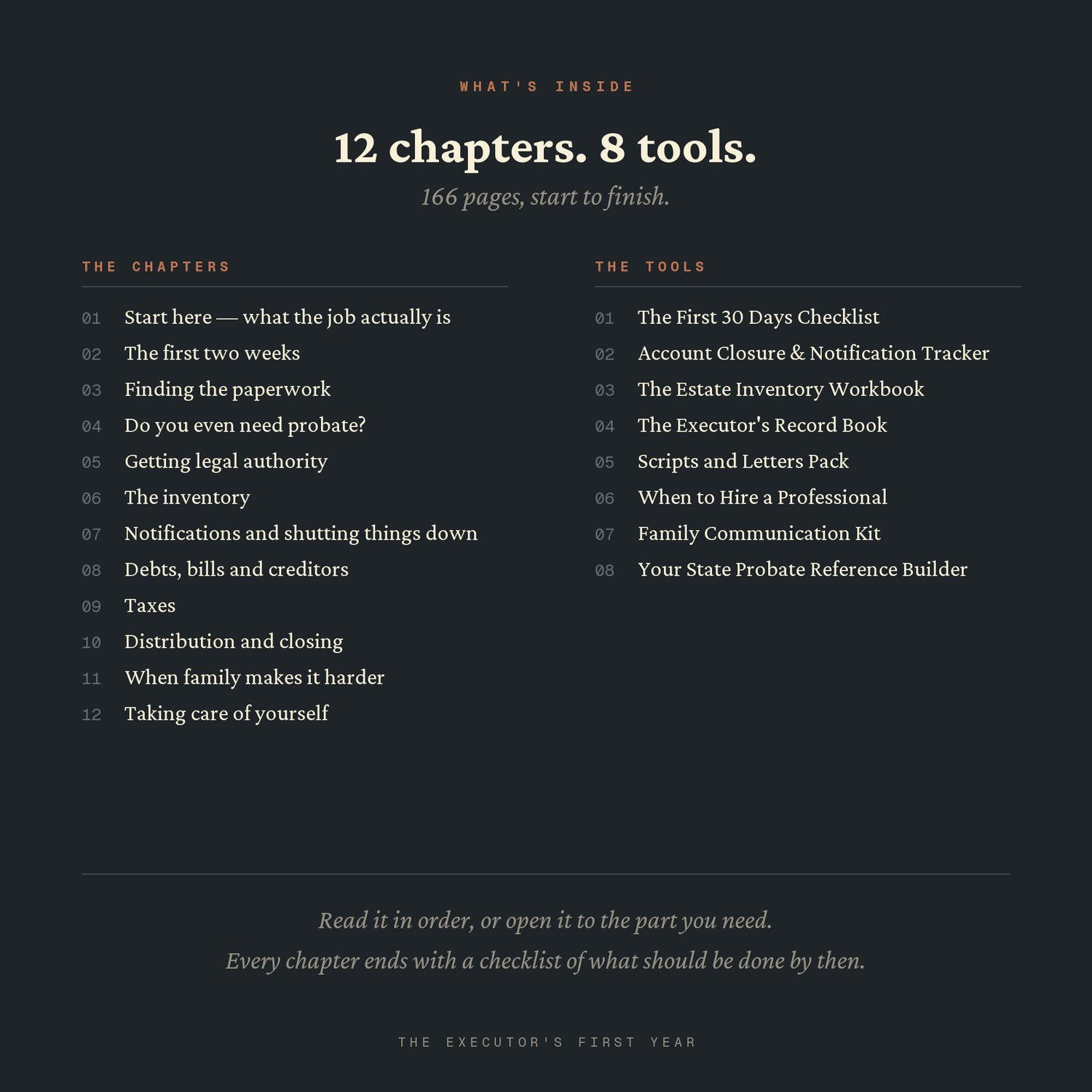
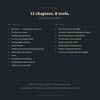
The 12 chapters, in the order the work actually happens:
Getting oriented
The first two weeks
Finding the paperwork
Whether you even need probate
Getting legal authority
The inventory
Notifications and account closures
Debts and creditors
Taxes
Distribution and closing
When family makes it harder
Taking care of yourself through it
The 8 tools:
1. The First 30 Days Checklist — week by week, including the seven things not to do yet
2. Account Closure & Notification Tracker — every organisation, plus how to find the accounts nobody told you about
3. The Estate Inventory Workbook — complete forms, with guidance on what actually needs an appraiser
4. The Executor's Record Book — the four logs that protect you if anyone questions your accounting
5. Scripts and Letters Pack — including exactly what to say when a debt collector calls
6. Do I Need a Lawyer? — a scored self-assessment, so you don't overpay or under-protect
7. Family Communication Kit — the habit that prevents most estate conflict
8. Your State Probate Reference Builder — build your own state's rules in about an hour, free
Plus three editable spreadsheets (Excel, Numbers or Google Sheets): the notification tracker totals what you've cancelled, the estate inventory runs a live solvency check, and the record book keeps running totals across all four logs.
THE STATE PROBLEM, HANDLED HONESTLY
Probate law varies enormously by state. Deadlines, creditor claim periods, small-estate thresholds, the order debts get paid — all different, and some change every year.
No general book can tell you your state's rules. Any book that claims to is wrong somewhere, and you won't know where.
So this one does something more useful. Every rule that varies is flagged, with exactly what to look up, where to look it up, and a blank for your answer. Bonus 8 walks you through getting nearly all of them in a single free phone call to your county probate clerk.
By the end you'll have built a reference for your own state worth more than anything a general book could have printed.
IF YOU DON'T LIVE NEARBY
A large share of executors are handling an estate from another city or another state, and almost nothing written for executors acknowledges it.
There's a section on the practical side — one local contact, forwarding the mail to your address, and the arithmetic on flying back versus hiring the work out. And a more consequential one: most states require an out-of-state executor to appoint a resident agent, many require a bond even when the will waives it, and a few permit a non-resident to serve only if they're related to the deceased. Worth knowing in week three rather than at your hearing.
WHAT THIS IS NOT
Not legal advice. It's general information and organisational tools. It tells you repeatedly when to call a professional — because knowing that is part of doing the job well, not a failure to manage alone.
Not state-specific. It shows you how to get your state's rules rather than pretending to know them.
Not a substitute for an attorney in a complicated estate. If the will is contested, the debts exceed the assets, there's a business interest, or there's property in two states, you need counsel — and the book says so plainly, in the chapters where it matters.
Written for United States estates and US federal tax forms.
QUESTIONS PEOPLE ASK
Will this replace hiring a lawyer?
Sometimes, and sometimes not — and the book helps you tell which. A simple estate with a clear will and a cooperative family can often be handled with a single consultation. A contested or insolvent estate needs counsel. Bonus 6 is a scored assessment for exactly that decision. Either way, professional fees are ordinarily paid by the estate, not by you personally.
I already bought a spreadsheet. Do I need this?
Keep the spreadsheet if you like it. This is the part that comes before it — what to do, in what order, and what not to do yet. The forms are included, so you're not choosing between them.
Does this work if there's no will?
Yes. Chapter 4 covers intestacy, and the process is broadly similar — the law rather than a document determines who inherits.
How long will I need it?
Most estates run somewhere between several months and a couple of years. The forms are designed to be used across that whole span.
Can I print it?
Yes. Everything is formatted for US Letter and designed to be written in by hand.
WHAT YOU GET
Instant download. The 170-page workbook as a PDF, plus three editable spreadsheets that open in Excel, Numbers or Google Sheets. Print it, write in it, keep it in one binder.
Nothing is shipped.
This is general information and an organisational tool, not legal, tax or financial advice. Probate rules vary by state and change over time. Please consult a probate attorney or CPA about your specific situation.