
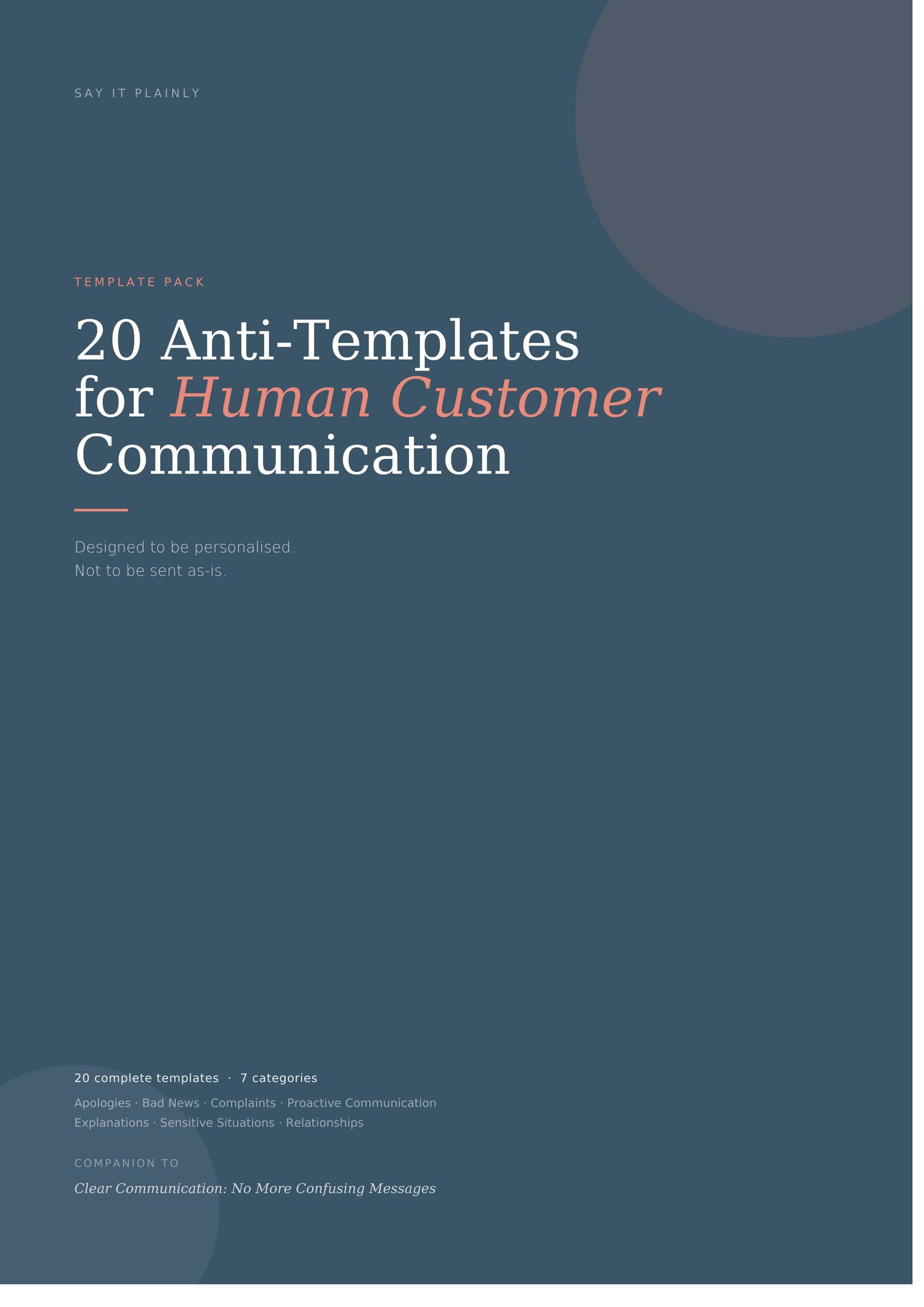
Say It Plainly: The Template Pack
20 anti-templates for human customer communication. Designed to be personalised. Not to be sent as-is.
What this is
Most template libraries make customer communication worse, not better. They give your team a way to send something quickly — and the customer on the other end can always tell.
This pack is the opposite. Every template is an anti-template: a carefully designed scaffold that prompts the thinking a real response requires, rather than replacing it.
It's the companion to Say It Plainly: Clear Communication — No More Confusing Messages, and it puts the book's principles directly into the hands of anyone who writes to customers for a living.
What's inside
A 27-page A4 PDF containing 20 complete templates across the seven situations customer teams face most often:
- Apologies — service failures, response delays, and serious incidents that need real ownership
- Bad news — declining a request, raising prices, retiring a feature or service
- Complaints — first responses, repeated contacts, formal acknowledgements
- Proactive communication — getting ahead of problems, follow-ups, outage and crisis comms
- Explanations — making the complex or confusing land clearly
- Sensitive situations — long-standing unresolved issues, customer hardship
- Relationships — welcoming new customers, retention conversations
Every template is built around a colour-coded system that makes thoughtless sending impossible: Red for required, Amber for conditional, Purple for the moments that call for judgment. Every template also includes a "When to use" guide, a "Never send without" checklist, and a Personalisation Guidance note explaining where templates most commonly go wrong.
Who it's for
- Customer support and success teams who want to raise the quality of their written communication without slowing down
- Founders and small business owners writing customer messages themselves and looking for a starting point that respects both their time and their customers
- Team leaders building or rebuilding a template library and want a model for what good looks like
- Anyone who has ever received a customer email that felt like it was written by no-one, and wants to make sure theirs doesn't
What you'll be able to do with it
- Respond faster, without sounding like nobody read the message
- Handle the difficult conversations — refusals, price increases, serious complaints — with clarity and genuine human warmth
- Build a template library that teaches your team to communicate well, instead of teaching them to take shortcuts
- Use as a standalone resource, or alongside Say It Plainly for full context on the thinking behind each template