
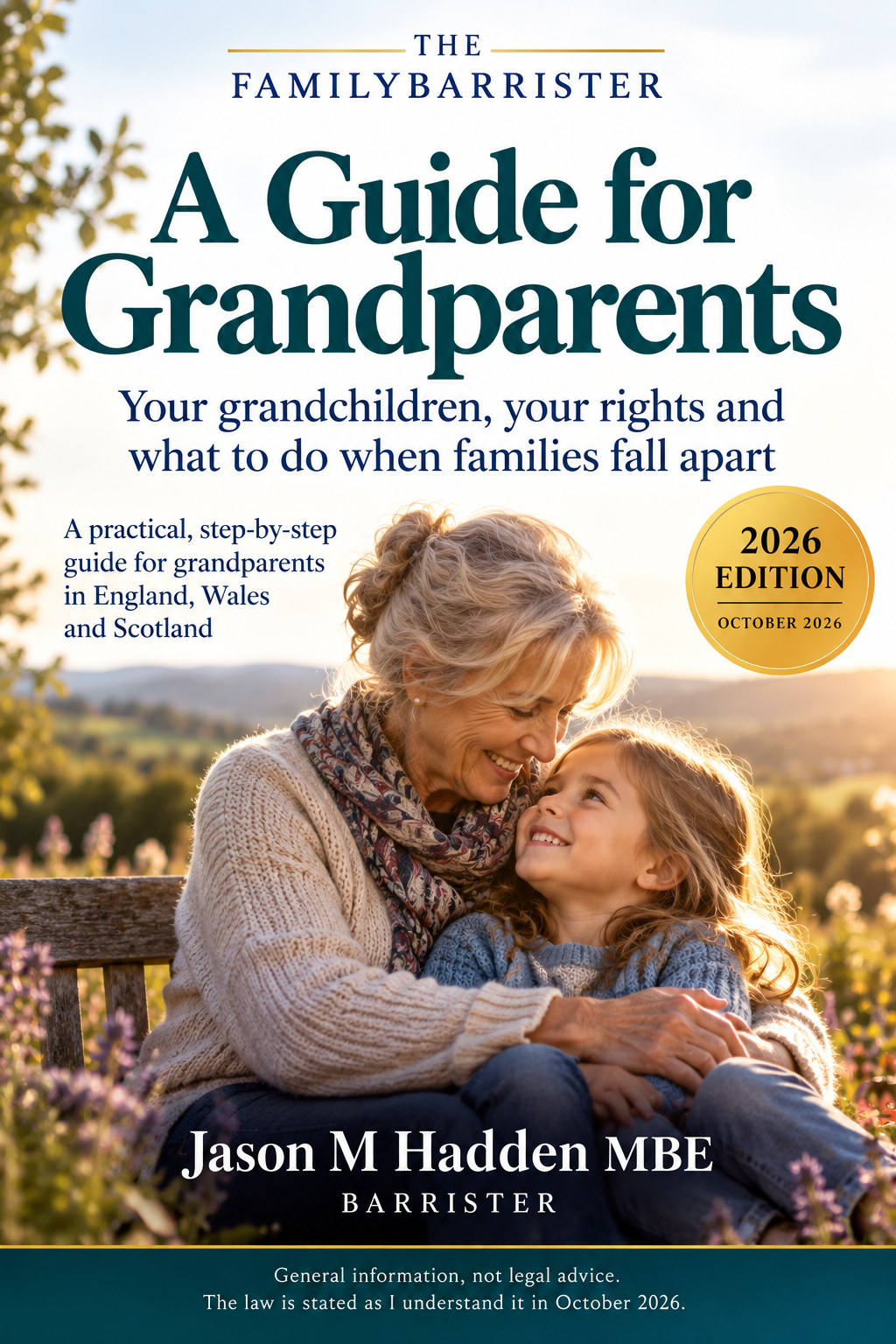
A Guide for Grandparents - Your grandchildren, your rights and what to do when families fall apart.
A Guide for Grandparents
Your grandchildren, your rights and what to do when families fall apart.
By Jason M Hadden MBE, Barrister and The FamilyBarrister
You love your grandchildren. But what happens when you are no longer allowed to see them?
Perhaps your son or daughter has stopped speaking to you. Perhaps a separation or family disagreement has left you shut out of your grandchildren's lives.
Perhaps you haven't seen them for one, two or even three years.
Or perhaps something even more frightening is happening. Social services are involved, your grandchild may be taken into care, and you are desperately trying to understand whether you can step forward to look after them.
Where do you begin? Who do you speak to? What are your rights? And what can you actually do?
This guide was written for you.
I am Jason M Hadden MBE, a family law barrister, and I have spent many years helping families navigate some of the most difficult moments of their lives.
I also know, personally, just how important grandparents can be. I was partly brought up by mine.
I believe that safe, loving grandparents have an enormously important place in children's lives. But I also know that the law can be confusing, expensive and, at times, rather unforgiving.
So I have written this guide to explain it properly. Not in complicated legal language. Not as a textbook. But as practical advice to help you understand your options and decide what to do next.
What will you learn?
If you have lost contact with your grandchildren:
- What legal rights grandparents have in England, Wales and Scotland.
- What to do when a parent refuses contact.
- How to approach your son, daughter or former son-in-law or daughter-in-law without making matters worse.
- How to rebuild a relationship after months or years apart.
- How mediation works and whether it might help.
- When going to court is appropriate and when it may not be.
- How to apply to the Family Court, step by step.
- What Cafcass does and how to prepare for its involvement.
- What happens at court hearings and what you should say.
- How to ask for visits, telephone calls, letters, photographs or other forms of contact.
- What to do if the court refuses your application.
If your grandchild may be taken into care:
- What to do immediately if social services become involved.
- How to put yourself forward as a potential family carer.
- What happens during care proceedings.
- How grandparents are assessed.
- The difference between kinship care, fostering, child arrangements orders and special guardianship.
- What financial and practical support may be available.
- What to do if an assessment is negative.
- How to make sure you are considered before decisions about long-term care or adoption are made.
More than an explanation of the law
This is a practical, step-by-step guide designed to help you take action.
Inside you will find:
- A first 14-day plan for grandparents who have been separated from their grandchildren.
- Example letters and messages to help reopen communication.
- Practical guidance on preparing for court.
- Questions to ask social workers and other professionals.
- Checklists, useful contacts and explanations of unfamiliar legal terms.
- Answers to 30 questions grandparents commonly ask.
- A separate section explaining the law and procedures in Scotland.
And throughout, I explain not simply what the law says, but what it might mean for you and your grandchild.
A word from me
I cannot promise that this guide will get you back into your grandchild's life. Nobody can.
Nor can I promise that every grandparent who offers to care for a child will be approved.
But I can help you understand the process, avoid some common mistakes, ask the right questions and make better-informed decisions.
Because when a family falls apart, grandparents can find themselves feeling completely powerless.
You may have more options than you realise.
And sometimes the first step towards rebuilding a relationship is simply understanding where to begin.
Jason M Hadden MBE
Barrister | The FamilyBarrister