The CFO's Strategic Financial Management and Corporate Finance Handbook
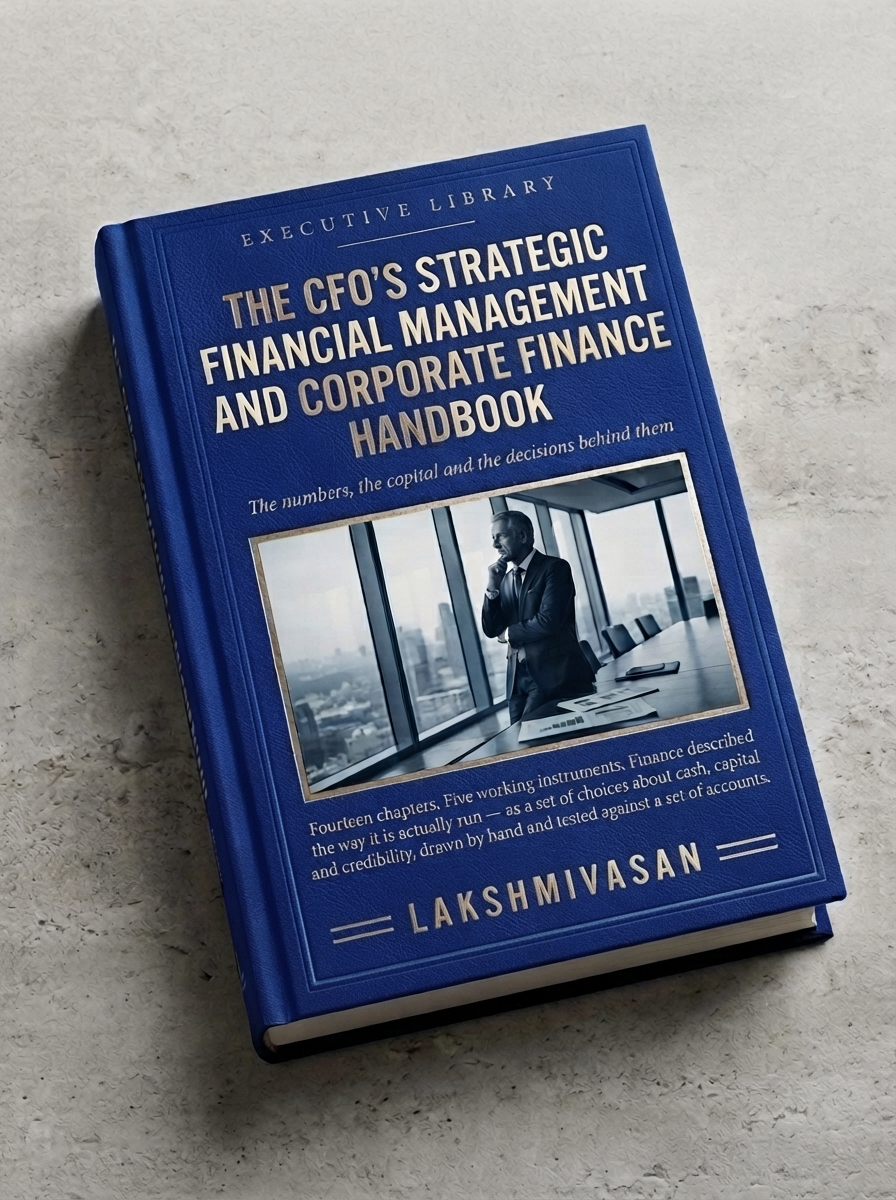
THE CFO'S STRATEGIC FINANCIAL MANAGEMENT AND CORPORATE FINANCE HANDBOOK
EXECUTIVE LIBRARY | BY LAKSHMIVASAN
FINANCE IS WHERE THE WHOLE BUSINESS MEETS.
A PRACTICAL CFO HANDBOOK FOR THE DECISIONS BEHIND CASH, CAPITAL AND PERFORMANCE.
Financial leadership is not simply about producing accurate reports, controlling expenditure, or explaining last month's results.
It is about understanding how financial decisions shape the future of the business.
How much capital should be committed? How should growth be funded? Where is working capital being consumed? Which investments genuinely create value? How should financial risk be managed? And how can finance become a stronger partner in strategic decision-making?
These are the questions that define the modern CFO's role.
The CFO's Strategic Financial Management and Corporate Finance Handbook is a practical executive reference designed to connect financial analysis with the decisions that influence business performance.
Across 14 chapters and five integrated parts, it brings together corporate financial strategy, financial planning, budgeting, working capital, capital structure, investment appraisal, cash flow optimization, profitability, financial risk, mergers and acquisitions, tax strategy, financial technology, and CFO leadership.
Rather than treating these subjects as isolated finance functions, the handbook connects them into one coherent financial management system.
It also includes five working tools within the handbook, fifteen hand-drawn figures, and five separate editable HTML worksheets to help translate financial concepts into practical planning, analysis, and review.
The objective is straightforward: help finance leaders understand the financial consequences of business decisions before those decisions are made.
A COMPLETE FINANCIAL MANAGEMENT FRAMEWORK FOR THE MODERN CFO
FROM FINANCIAL REPORTING TO STRATEGIC FINANCIAL LEADERSHIP
The CFO's responsibilities extend across the entire business.
Capital allocation affects growth. Working capital affects liquidity. Pricing and cost structures influence profitability. Financing decisions affect risk and financial flexibility. Investment decisions determine whether resources create or destroy value.
The handbook connects five essential dimensions of financial leadership.
Corporate financial strategy: Understand how financial objectives, business strategy, financial statement analysis, planning, and forecasting work together to support long-term performance.
Financial control and capital: Develop stronger budgeting practices, manage working capital, and evaluate capital structure and financing decisions.
Investment and cash: Improve capital budgeting, assess investment opportunities, and strengthen cash flow management.
Profitability, risk and transactions: Understand enterprise profitability, manage financial exposure, and evaluate the financial dimensions of mergers and acquisitions.
Tax, technology and leadership: Consider tax strategy, financial automation, digital transformation, and the CFO's role as a strategic business partner.
Together, these areas provide a broader view of financial management: not just what the business earns and spends, but how financial resources are allocated, protected, and converted into sustainable value.
WHAT MAKES THIS HANDBOOK DIFFERENT?
IT CONNECTS THE FINANCIAL DECISIONS THAT ARE OFTEN TREATED SEPARATELY.
Many financial management resources examine individual topics in isolation.
One resource explains financial statements. Another covers investment appraisal. Another focuses on working capital or budgeting.
But senior financial decisions rarely happen in isolation.
An investment decision affects cash flow, financing requirements, working capital, profitability, and ultimately the return generated on invested capital.
This handbook takes an integrated approach.
1. A CONNECTED VIEW OF CORPORATE FINANCE
Strategy, financial planning, capital allocation, cash management, profitability, financial risk, tax, and technology are treated as interconnected management disciplines.
Understand how one decision can influence several dimensions of financial performance.
2. THE WORKING BEHIND THE CONCEPTS
The financial examples carry a consistent operating case through important concepts, including:
- Return on Invested Capital (ROIC).
- Weighted Average Cost of Capital (WACC).
- Economic profit.
- Cash flow.
- The working capital cycle.
This helps connect financial concepts with the underlying business economics.
3. PRACTICAL FINANCIAL JUDGEMENT
The emphasis is not simply on understanding definitions or formulas.
It is on asking the right questions, evaluating assumptions, identifying financial consequences, and making better-informed decisions.
4. TOOLS THAT CAN BE USED IMMEDIATELY
The handbook includes five practical working instruments, supported by five separate editable HTML worksheets.
Use them for financial planning, liquidity monitoring, investment appraisal, budget analysis, and CFO performance reviews.
5. DESIGNED FOR DIGITAL AND OFFLINE USE
The handbook and companion worksheets are self-contained HTML files.
Open them in a modern web browser, work directly in the documents, save your completed worksheets, or print them for physical review.
No separate application, subscription, or internet connection is required after downloading.
WHAT'S INSIDE
14 CHAPTERS ACROSS FIVE PARTS OF STRATEGIC FINANCIAL MANAGEMENT
PART I — STRATEGY AND THE FINANCIAL MODEL
01. Corporate Financial Strategy
Understand the relationship between corporate strategy and financial objectives. Explore value creation, capital allocation, financial priorities, strategic trade-offs, and the CFO's contribution to business direction.
02. Financial Statement Analysis
Develop a structured approach to understanding the financial position and performance of an organization. Examine profitability, liquidity, leverage, efficiency, financial ratios, and the connections between the income statement, balance sheet, and cash flow statement.
03. Financial Planning and Forecasting
Understand how to translate business strategy into financial expectations. Explore financial assumptions, integrated planning, scenario analysis, forecasting discipline, and the importance of connecting operational drivers with financial outcomes.
PART II — CONTROL AND CAPITAL
04. Budgeting and Financial Control
Understand how to develop budgets, establish financial controls, monitor performance, investigate variances, and maintain accountability for financial outcomes.
05. Working Capital Management
Examine the financial importance of inventory, receivables, payables, and the operating cash conversion cycle. Understand how working capital decisions influence liquidity and operational flexibility.
06. Capital Structure and Financing
Explore the relationship between debt, equity, financing costs, leverage, financial flexibility, and the cost of capital. Understand the financial considerations behind funding business operations and long-term growth.
PART III — INVESTMENT AND CASH
07. Capital Budgeting and Investment Appraisal
Develop a structured approach to evaluating investment opportunities. Understand incremental cash flows, Net Present Value (NPV), Internal Rate of Return (IRR), payback, sensitivity analysis, and investment approval decisions.
08. Cash Flow Optimization
Understand the drivers of cash generation and consumption. Explore cash forecasting, liquidity planning, working capital improvements, cash management practices, and the importance of maintaining financial resilience.
PART IV — PROFITABILITY, RISK AND DEALS
09. Enterprise Profitability Analysis
Examine profitability across products, customers, business units, and operating activities. Understand cost allocation, contribution, operating leverage, return on invested capital, and economic profit.
10. Financial Risk Management
Understand the financial exposures that can affect business performance. Explore liquidity, credit, interest rate, foreign exchange, and operational financial risks, together with practical approaches to identifying and monitoring them.
11. Mergers and Acquisitions Finance
Examine the financial considerations behind acquisitions and corporate transactions. Understand valuation, deal economics, financing considerations, due diligence, synergies, and post-transaction financial performance.
PART V — TAX, TECHNOLOGY AND LEADERSHIP
12. Tax Strategy and Compliance
Understand the role of tax planning, tax governance, compliance responsibilities, and tax considerations in corporate financial decisions.
13. Financial Technology and Automation
Explore how digital financial systems, automation, data integration, reporting tools, and technology-enabled processes can strengthen financial management and decision-making.
14. CFO Leadership and Strategic Business Partnering
Understand the evolution of the CFO role from financial controller to strategic business partner. Explore executive communication, influencing decisions, financial leadership, cross-functional relationships, and building a finance function that contributes to business performance.
THE HANDBOOK'S BUILT-IN WORKING TOOLS
The handbook includes five practical financial management instruments designed to connect the chapters with real management activities.
- Financial Planning Model — Structure financial assumptions, forecast scenarios, and integrated outputs.
- Cash Flow Dashboard — Monitor liquidity, working capital, and short-term cash movements.
- Investment Appraisal Template — Evaluate incremental cash flows, NPV, IRR, and investment sensitivity.
- Budget Variance Analysis — Understand budget differences, identify causes, and establish corrective actions.
- CFO Performance Scorecard — Review financial and operational measures and evaluate the CFO's contribution.
These tools provide a practical bridge between financial understanding and management application.
FIVE EDITABLE BONUS WORKSHEETS INCLUDED
NOT JUST FINANCIAL KNOWLEDGE. FIVE WORKING INSTRUMENTS FOR YOUR FINANCE FUNCTION.
In addition to the five tools within the handbook, you receive five separate editable HTML worksheets.
Each worksheet is designed to be completed directly in your browser.
You can type into the fields, tick checkboxes, allow your answers to autosave in your browser, download a separate completed copy, or print the worksheet or save it as a PDF.
BONUS 01 — FINANCIAL PLANNING MODEL
A practical financial planning instrument for developing structured forecasts and evaluating alternative business scenarios.
What it helps you do:
- Establish driver-based financial assumptions.
- Organize key planning inputs.
- Develop alternative financial scenarios.
- Connect operating assumptions with financial outputs.
- Identify forecast triggers and changes in underlying conditions.
- Review the implications of different planning assumptions.
The outcome: A more structured approach to financial planning, scenario evaluation, and forward-looking decision-making.
BONUS 02 — CASH FLOW DASHBOARD
A practical liquidity monitoring tool for understanding the movement of cash and identifying potential short-term funding pressures.
What it helps you do:
- Record opening liquidity.
- Monitor a thirteen-week cash outlook.
- Review working capital drivers.
- Identify expected cash inflows and outflows.
- Monitor potential liquidity pressures.
- Record early-warning indicators and management actions.
The outcome: A clearer short-term view of liquidity and a structured approach to identifying potential cash pressures before they become urgent.
BONUS 03 — INVESTMENT APPRAISAL TEMPLATE
A structured instrument for evaluating capital expenditure and other investment proposals.
What it helps you do:
- Define the investment decision.
- Record incremental cash flow assumptions.
- Evaluate Net Present Value (NPV).
- Assess Internal Rate of Return (IRR).
- Conduct sensitivity analysis.
- Establish approval gates.
- Record post-investment review requirements.
The outcome: A more disciplined investment appraisal process that makes assumptions, expected returns, risks, and approval requirements visible.
BONUS 04 — BUDGET VARIANCE ANALYSIS
A practical tool for moving from financial reporting to meaningful variance investigation and corrective action.
What it helps you do:
- Compare original budgets with actual performance.
- Establish flexed budget expectations.
- Build a structured variance bridge.
- Identify root causes behind financial differences.
- Assign accountable corrective actions.
- Update the financial outlook.
The outcome: Better financial reviews, clearer explanations, and more actionable management responses to budget deviations.
BONUS 05 — CFO PERFORMANCE SCORECARD
A structured review instrument for evaluating financial performance and the broader contribution of the finance function.
What it helps you do:
- Monitor balanced financial and operational measures.
- Review performance monthly.
- Evaluate the CFO's contribution to business decisions.
- Reflect on financial leadership effectiveness.
- Identify improvement priorities.
- Establish quarterly review points.
The outcome: A more balanced perspective on CFO performance, connecting financial results with operational impact and strategic contribution.
WHY THE FIVE EDITABLE WORKSHEETS ADD VALUE
Financial leadership requires more than understanding financial theory.
It requires a repeatable process for planning, monitoring, evaluating, and communicating financial decisions.
The five worksheets provide a practical structure for those activities.
Editable worksheetPrimary applicationFinancial Planning ModelPlanning and scenario analysisCash Flow DashboardLiquidity and cash monitoringInvestment Appraisal TemplateCapital allocation decisionsBudget Variance AnalysisFinancial control and corrective actionCFO Performance ScorecardFinancial leadership review
DESIGNED TO BE USED, NOT JUST READ
Each worksheet is a separate HTML file with editable fields and interactive checkboxes.
- Type directly into the worksheet.
- Tick applicable items.
- Let your work autosave in your browser.
- Download a separate filled copy.
- Print the completed worksheet.
- Save a PDF for your records.
Your original blank worksheet remains available for future use.
No additional application or online account is required.
WHO SHOULD USE THIS HANDBOOK?
The CFO's Strategic Financial Management and Corporate Finance Handbook is designed for finance professionals and business leaders who need to understand how financial decisions influence the wider organization.
Chief Financial Officers and Finance Directors
You are responsible for financial strategy, capital allocation, cash, financial performance, and the overall direction of the finance function.
Use the handbook as a structured reference for connecting financial disciplines with corporate priorities and executive decision-making.
Financial Controllers Moving into Broader Leadership
You have experience with reporting, financial control, and accounting, but your responsibilities are expanding.
Develop a broader understanding of corporate finance, capital structure, investment appraisal, working capital, financial risk, and strategic business partnering.
Finance Business Partners
You work across functions and need to translate financial information into meaningful commercial insight.
Strengthen your ability to connect financial performance with operating decisions, challenge assumptions, and contribute to business planning.
General Managers and Senior Business Leaders
You are accountable for business performance and need a stronger understanding of the financial consequences of operational decisions.
Use the handbook to develop a more integrated perspective on profitability, capital, cash, investment, and financial risk.
WHAT YOU RECEIVE
THE COMPLETE EXECUTIVE LIBRARY HANDBOOK
The CFO's Strategic Financial Management and Corporate Finance Handbook
- 14 structured chapters across five parts.
- Integrated coverage of strategic financial management and corporate finance.
- 15 hand-drawn figures.
- Five practical working tools within the handbook.
- Consistent worked business examples.
- ROIC, WACC, economic profit, cash flow, and working capital analysis.
- Practical financial judgement and management applications.
- Self-contained HTML format.
- Designed for desktop and mobile reading.
- Works offline after download.
FIVE SEPARATE EDITABLE HTML WORKSHEETS
- Financial Planning Model.
- Cash Flow Dashboard.
- Investment Appraisal Template.
- Budget Variance Analysis.
- CFO Performance Scorecard.
Each worksheet supports direct browser editing, checkbox interaction, browser-based autosaving, downloading a completed copy, and printing or saving as PDF.
INSTANT DIGITAL ACCESS
Download the handbook and five companion worksheets.
Open them in a modern browser and use them on your preferred device.
No additional app, account, or internet connection is required after downloading.
FREQUENTLY ASKED QUESTIONS
1. What exactly do I receive?
You receive the complete CFO handbook as a self-contained HTML file, together with five separate editable HTML worksheets:
- Financial Planning Model.
- Cash Flow Dashboard.
- Investment Appraisal Template.
- Budget Variance Analysis.
- CFO Performance Scorecard.
The handbook also contains five working tools and fifteen hand-drawn figures.
2. Can I edit the five bonus worksheets?
Yes. The worksheets are designed for direct browser interaction.
Click into the available blank fields or lines, enter your information, and tick the relevant checkboxes. Your answers autosave in your browser.
You can also download a separate completed copy to retain your work.
3. Do I need to install an application?
No. The handbook and worksheets are HTML files that open in a modern web browser.
No specialist financial software or additional application is required.
4. Do I need an internet connection?
No. Once downloaded, the files are designed to work offline.
You can use the handbook and worksheets without an ongoing internet connection.
5. Can I print the handbook and worksheets?
Yes. Both the handbook and worksheets include print styles.
Use your browser's print function or save-as-PDF option. Check the page scaling and paper settings for A4 or US Letter.
6. Does the handbook cover corporate finance as well as financial management?
Yes. It connects corporate financial strategy, financial statement analysis, planning, budgeting, working capital, capital structure, investment appraisal, cash flow, profitability, financial risk, M&A, tax strategy, technology, and CFO leadership.
7. Does it include practical financial models and calculations?
Yes. It includes financial examples and worked concepts covering ROIC, WACC, economic profit, cash flow, and the working capital cycle, together with practical working instruments.
8. Who is this handbook intended for?
It is designed primarily for CFOs, finance directors, financial controllers moving into broader leadership, finance business partners, and general managers who need to connect operating decisions with financial outcomes.
9. Can I use the worksheets for my own organization?
Yes. The worksheets are intended as educational and planning instruments that you can populate with your own information and assumptions.
You should validate calculations, assumptions, and outputs against your organization's reporting policies, financial systems, and professional requirements.
10. Is this professional financial or investment advice?
No. The handbook and worksheets are educational resources. They do not constitute accounting, audit, legal, tax, investment, or financing advice.
Consult qualified professionals for decisions specific to your organization and jurisdiction.
MAKE THE NUMBERS USEFUL BEFORE THE DECISION IS MADE.
FINANCIAL LEADERSHIP IS NOT ABOUT KNOWING MORE NUMBERS. IT IS ABOUT MAKING BETTER DECISIONS WITH THEM.
The CFO's role sits at the intersection of strategy, operations, capital, cash, and business performance.
The quality of financial leadership is reflected in the decisions that follow the numbers.
How effectively is capital allocated?
How reliably is liquidity managed?
Are investments creating value?
Are budgets connected to operational reality?
Can the finance function anticipate problems rather than simply report them?
And is financial information helping the organization make better decisions?
The CFO's Strategic Financial Management and Corporate Finance Handbook brings these responsibilities together in one practical executive resource.
14 Chapters. 5 Working Instruments. 15 Hand-Drawn Figures. 5 Editable HTML Worksheets.
A connected framework for strategic financial management and corporate finance.
MAKE THE NUMBERS USEFUL BEFORE THE DECISION IS MADE.
GET THE HANDBOOK + 5 EDITABLE TOOLS
IMPORTANT DISCLAIMER
This handbook and its accompanying worksheets are provided for educational and informational purposes only.
They do not constitute accounting, audit, legal, tax, investment, or financing advice.
All financial figures, assumptions, calculations, and illustrative examples should be independently validated before being used in actual business decisions.
Readers should consult appropriately qualified professionals and follow the applicable accounting standards, organizational policies, statutory requirements, and laws of their jurisdiction.