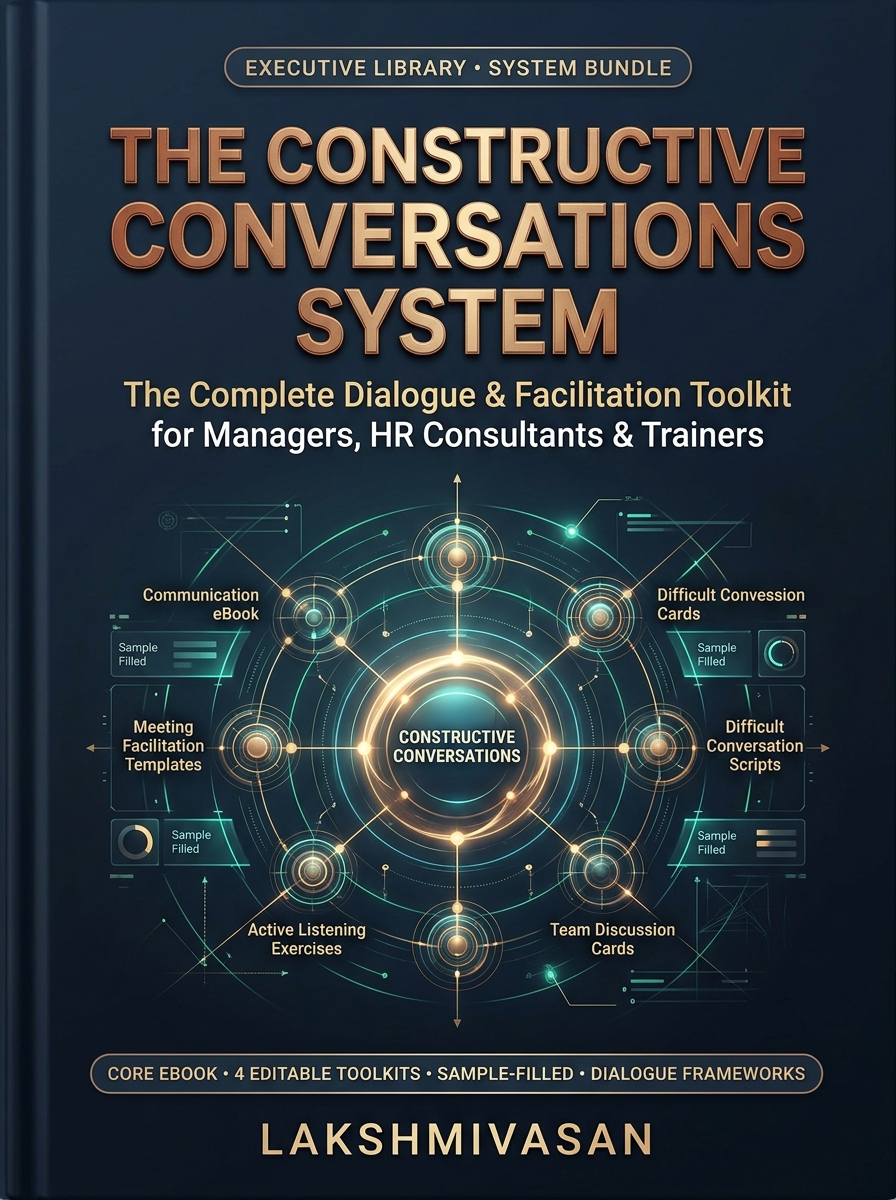
The Constructive Conversations System
EXECUTIVE LIBRARY | BY LAKSHMIVASAN
MOST COMMUNICATION PROBLEMS ARE STRUCTURE, NOT PERSONALITY.
AN EIGHT-CHAPTER SYSTEM FOR MEETINGS THAT DECIDE, FEEDBACK THAT LANDS AND CONVERSATIONS THAT DO NOT NEED A FOLLOW-UP APOLOGY.
Communication training usually teaches people to be nicer. The meeting is still undecided at the end, the disagreement is still unspoken in the room and voiced in the corridor, and the difficult conversation is still postponed until it becomes a performance issue.
What is missing is structure. A meeting designed around a decision produces one. A listening practice with levels produces better information. A difficult conversation prepared against a script produces a plan rather than a rupture. None of that requires a different personality; it requires a design and a rehearsal.
The Constructive Conversations System gives you both: the argument for each structure and the templates, scripts and cards that let a team practise it before the stakes are real.
It answers the questions that matter to the people who have to make it work:
- Why does communication fail by design in competent teams?
- What are the levels of listening, and how do you practise the higher ones?
- How do you design a meeting around a decision rather than around attendance?
- How do you make disagreement productive without making it personal?
- What does a difficult conversation look like, prepared in advance and held without escalation?
- How do discussion cards surface assumptions a normal agenda never reaches?
- What makes feedback specific enough to act on?
- How do you receive feedback without defending?
- Which measures show whether communication is improving?
- What does a ninety-day rollout look like for a single team?
People do not need to agree to decide together. They need a structure that lets disagreement do its work before the decision is taken.
EIGHT CHAPTERS, FIVE TOOLS
Part I · Diagnose
- The Communication Gap — why communication fails by design
- Locating the gap in your organisation
Part II · Practise
- Active Listening — the levels and the practice
- Meeting Facilitation — designing around the decision, making disagreement productive
- Difficult Conversations — preparing, then staying in the conversation
- Team Discussion Cards — surfacing assumptions, building the habit
Part III · Sustain
- Feedback That Lands — specific, timely, receivable
- Measuring Communication — balanced measures, then action
- The 90-day implementation roadmap and the worked case
THE WORKING TOOLS
Each practice is provided as a fillable page with a completed example, so a facilitator can see the finished standard before running the session.
- Active Listening Exercises — Six graded exercises that move a pair from polite listening to listening for the decision underneath.
- Meeting Facilitation Templates — Agendas, decision logs and disagreement protocols for the four meeting types teams actually hold.
- Difficult Conversation Scripts — Preparation sheets and opening lines for performance, conflict and bad-news conversations.
- Team Discussion Cards — A deck of prompts designed to surface assumptions before they become positions.
WHAT YOU RECEIVE
- communication-ebook.html — The full eBook: eight chapters, facilitator guide and worked case.
- active-listening-exercises.html — Six graded listening exercises with facilitator notes.
- meeting-facilitation-templates.html — Agendas, decision logs and disagreement protocols.
- difficult-conversation-scripts.html — Preparation sheets and opening scripts.
- team-discussion-cards.html — The prompt deck for surfacing assumptions.
- sample-filled-*.html — Completed versions of every practice.
- bundle-index.html — A single index page linking the whole set.
All files are self-contained HTML documents. They open in any modern browser on desktop, tablet or phone, print cleanly to PDF, and require no installation or account.
FREQUENTLY ASKED QUESTIONS
Is this soft-skills material?
It is practical material. Every chapter ends in a structure a team can run in its next meeting.
Who is it for?
Team leaders, managers, project leads and HR partners who facilitate conversations rather than give speeches.
Can we run it as a workshop?
Yes. The facilitator guide sequences the four practices into a half-day session or a six-week series.
Do we need a trainer?
No. A manager can facilitate from the guide, and the completed examples show the standard.
What format are the files?
Self-contained HTML pages that open in any browser, print to PDF and need no installation.
A NOTE ON THE EXAMPLES
The worked case follows a fictional product team of 24 people whose retrospective had become a status meeting in all but name. All dialogue and outcomes are illustrative; they demonstrate how a structure is used, not how your conversation should sound. Nothing here is a substitute for professional advice.
A constructive conversation is designed before it is held.
EXECUTIVE LIBRARY · LAKSHMIVASAN · FIRST EDITION, 2026