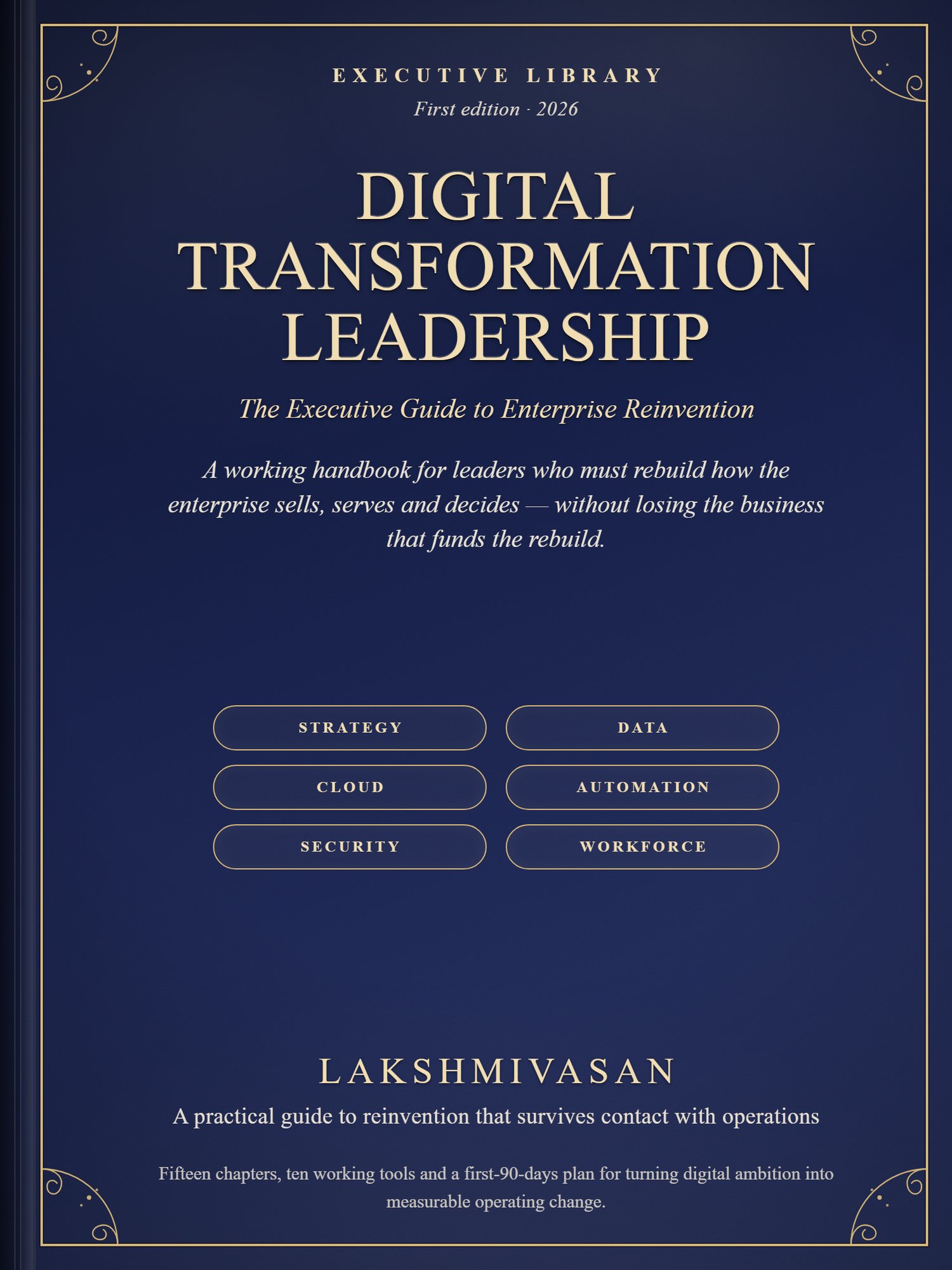
Digital Transformation Leadership: The Executive Guide to Enterprise Reinvention
EXECUTIVE LIBRARY | BY LAKSHMIVASAN
MAKE THE TECHNOLOGY CHANGE THE BUSINESS.
A CEO-LEVEL HANDBOOK FOR LEADING DIGITAL TRANSFORMATION — WITH 15 CHAPTERS, 10 WORKING TOOLS AND A FIRST-90-DAYS PLAN.
Most digital programmes are not short of technology.
They are short of a decision about where advantage actually comes from, a credible case for the money, an operating model that can act on the data, and a way of proving that the promised benefit reached the operating numbers.
Instead, the portfolio accumulates. A cloud migration. A new platform. A pilot that everyone admired and nobody adopted. A generative AI experiment announced before anyone asked what a confident wrong answer would cost. Each has a sponsor, a business case and a steering group. Collectively they do not change the economics of the business.
Digital Transformation Leadership is a practical executive handbook for closing that gap. It treats digital transformation as a management problem rather than a technology programme: a strategy that excludes something, an architecture that lowers the cost of the next change, an operating model that lets people decide, and a benefits mechanism that makes the promise visible in the accounts.
It addresses the questions that matter to CEOs, COOs, CFOs, board members, transformation leaders and technology executives:
- What makes a change transformational rather than merely digital?
- Where does digital advantage actually come from — and where does it not?
- What should a maturity assessment produce, beyond a coloured chart?
- How should AI and generative AI be governed before they are scaled?
- What must be true before data can be called an asset?
- Which architectural properties determine the cost of the next five years?
- How should a digital operating model allocate decision rights?
- When is automation the answer, and when does it simply industrialise a broken process?
- How is a technology investment priced against risk, run cost and exit?
- How do you measure transformation without mistaking activity for progress?
The central principle is straightforward:
Digital transformation is a change in the economics of the business, not the adoption of a technology estate.
This handbook provides a structured management method for making that change deliberate.
A COMPLETE FRAMEWORK FOR DIGITAL TRANSFORMATION LEADERSHIP
FROM STRATEGY AND CONSTRAINT TO PROOF IN THE ACCOUNTS
Transformation fails in recognisable ways. Ambition is set without a constraint. The roadmap is a project list rather than a dependency map. The operating model is reorganised without changing who decides. Benefits are claimed by the programme rather than owned by the line. And the review at the end measures delivery, not change.
An effective approach begins with the business outcome, then works backwards through the constraint, the sequence, the capability and the evidence. This handbook organises that approach into four interconnected parts.
PART I — FOUNDATIONS
Establish what the change is for and what currently prevents it.
Separate genuine transformation from digital activity, choose where advantage comes from and where it deliberately will not, convert a maturity score into a binding constraint, and govern AI and generative AI as a portfolio of decisions rather than a series of demonstrations.
PART II — THE OPERATING STACK
Examine the foundations on which every digital promise rests: data, architecture, operating model and process.
Data becomes an asset only when it is owned, defined, trusted and used in a decision with a cost. Architecture is the cost of the next change. Structure follows decision rights. And automating a broken process produces broken outcomes faster, and makes them harder to see.
PART III — TRUST, CUSTOMERS AND PEOPLE
Address the three relationships that determine whether the change is accepted and durable.
Digital transformation expands the attack surface faster than it expands the control function. The customer judges the digital experience against the best service they receive anywhere. And capability is built role by role, not campaign by campaign — with culture treated as a system, not a poster.
PART IV — MONEY, GOVERNANCE AND DELIVERY
Turn intention into funded, governed, sequenced work with evidence at the end.
Price investment against strategy, risk and run cost. Build the minimum governance that makes good decisions quickly. Sequence the roadmap by dependency and constraint. And measure transformation at four levels — activity, adoption, outcome and capability — without conflating them.
Together, these four parts provide an integrated management approach for leading reinvention from first diagnosis to proven result.
WHAT MAKES THIS HANDBOOK DIFFERENT?
IT STARTS FROM THE ECONOMICS, NOT THE TECHNOLOGY.
A technology estate can be modernised without changing how the business makes money, serves customers or decides. That is expenditure, not transformation.
Every chapter returns to the same test: what changes in cost, revenue, risk or speed, and who owns that line? If nothing does, the work is maintenance — legitimate, but not a transformation.
1. IT CONVERTS STRATEGY INTO EXCLUSIONS
A digital strategy that lists everything the organisation intends to do has not made a choice. The handbook treats strategy as a set of explicit decisions about where advantage will come from, what will be standardised, what will be bought rather than built, and what will deliberately not be pursued.
Exclusion is what makes the portfolio fundable and the architecture coherent.
2. IT TREATS THE MATURITY SCORE AS A CONSTRAINT, NOT A VERDICT
Assessments that produce an average produce comfort. The handbook scores capability against the strategy, records the evidence beside the score, and requires the output to be one binding constraint and one decision with a date.
A constraint is only real if it changes what gets funded next.
3. IT GOVERNS AI BEFORE IT SCALES IT
Generative AI makes a new failure mode cheap: a confident, well-written, wrong answer delivered at volume. The book separates use cases that can be governed from demonstrations that cannot, tests data readiness and the cost of a confident error, and refuses the use case that fails the risk test regardless of its value score.
4. IT PRICES INVESTMENT HONESTLY
Digital investment is usually justified on benefits that arrive after the sponsor has left. The handbook requires weighted criteria agreed in advance, run cost quantified, exit position recorded, and benefits baselined before the investment — with the financial line and its owner named.
5. IT SHOWS A FINISHED ANSWER, NOT JUST A BLANK TEMPLATE
The product includes a completed worked example in which all ten tools are filled end to end for the fictional Arclight Group — including the uncomfortable entries: a maturity assessment with one clear constraint, an AI portfolio where two cases are rejected, and a benefits tracker where part of the promise is at risk.
WHAT'S INSIDE
15 CHAPTERS ACROSS FOUR PARTS OF DIGITAL TRANSFORMATION
The handbook progresses from what transformation is for, through the operating stack and the people who must deliver it, to the money, governance and measurement that decide whether it lasts. The running case is Arclight Group, a 14,000-person distribution and wholesale business with 620 branches, roughly £4.2 billion of revenue and a board commitment to take digital revenue from 22% to 40% by 2028 inside a £180 million envelope.
PART I — FOUNDATIONS
01. Digital Transformation Fundamentals
Understand reinvention as a change in the economics of the business rather than the adoption of a technology estate. Examine the three failure modes that account for most programmes, and the test that separates transformation from digital activity.
02. Digital Business Strategy
Examine the four routes to digital advantage and how to choose between them. Explore turning the choice into a boundary: what will be standardised, what will be built, what will be bought, and what will deliberately not be done.
03. Enterprise Digital Maturity
Understand what to measure and what to ignore. Explore how a maturity assessment should be scored against the strategy on evidence, and how to convert the result into a constraint, a decision and a date.
04. Artificial Intelligence and Generative AI
Examine where AI value actually sits and why it is almost always downstream of unglamorous data and process work. Explore a governed portfolio of use cases rather than a demonstration list, and the cost of a confident error.
PART II — THE OPERATING STACK
05. Data-Driven Enterprise Management
Understand data as an asset only when it is owned, defined, trusted and used in a decision that has a cost. Explore ownership before platform, and decision use as the only credible test of data quality.
06. Cloud and Enterprise Architecture
Examine the three architectural properties that determine the cost of the next change, and why cloud is a means of lowering it — or raising it, if nothing else changes. Explore paying for change rather than for servers.
07. Digital Operating Models
Understand structure as a consequence of decision rights. Explore the product, platform and function model, how to design the interfaces between them, and what makes the model survive its second year.
08. Business Process Automation
Examine the sequence that works — simplify, standardise, then automate — and the economics nobody funds: exception handling, run cost and the maintenance of a process that was never fixed.
PART III — TRUST, CUSTOMERS AND PEOPLE
09. Cybersecurity and Digital Risk Governance
Understand why digital transformation expands the attack surface faster than it expands the control function. Explore risk that belongs to the business, and controls that survive delivery pressure.
10. Digital Customer Experience
Examine the promise, the proof and the recovery. Explore what the trade customer actually needs, and why the digital experience is judged against the best service the customer receives anywhere.
11. Workforce Reskilling and Digital Culture
Understand capability as something built role by role rather than campaign by campaign. Explore starting from roles rather than courses, and treating culture as the pattern of behaviour the incentive system rewards.
PART IV — MONEY, GOVERNANCE AND DELIVERY
12. Technology Investment and ROI
Examine what a credible case contains, and the numbers that actually change a decision. Explore staging investment, pricing the risk, and recording the run cost and exit position before capital is committed.
13. Digital Transformation Governance
Understand governance as a mechanism for making good decisions quickly rather than demonstrating diligence slowly. Explore the minimum viable structure and assurance without paralysis.
14. Digital Implementation Roadmaps
Examine sequencing by constraint rather than by enthusiasm. Explore waves that each end in something the business can use, with the dependency, owner and evidence of completion attached to every milestone.
15. Measuring Transformation Success
Understand the four levels of evidence — activity, adoption, outcome and capability — and why conflating them flatters a programme. Explore the honest review, and what to do when the answer is that the benefit has not arrived.
TEN EDITABLE BONUS WORKSHEETS INCLUDED
A COMPANION WORKBOOK WITH FILLABLE VERSIONS OF ALL TEN TOOLS
Understanding transformation is important.
Applying it to a live programme requires structured tools that produce a decision.
This product includes a separate interactive workbook containing fillable versions of all ten tools. Answers save automatically in your browser, each tool can be exported to CSV, and the whole workbook prints cleanly to PDF for a signed record.
The tools fall into four groups: see, decide, build and prove. Use only the ones that change a decision, a limit or an owner. A completed template is not an outcome.
SEE — MATURITY AND OPPORTUNITY
TOOL 01 — DIGITAL MATURITY ASSESSMENT
An evidence-based assessment of capability against the strategy, designed to expose the binding constraint rather than an average score.
- Score each dimension on evidence, not sentiment.
- Record the evidence beside every score.
- Identify the one constraint that limits the strategy.
- Convert the result into a decision with a date.
TOOL 02 — AI OPPORTUNITY MATRIX
A portfolio view that separates AI use cases which can be governed from demonstrations that cannot.
- Score business value and feasibility.
- Test data readiness before enthusiasm.
- Price the cost of a confident error.
- Reject any use case that fails the risk test, whatever its value.
TOOL 03 — DIGITAL TRANSFORMATION ROADMAP
A dependency map with dates, organised in waves that each end in something the business can use.
- Sequence by dependency and constraint, not preference.
- Define waves of six to nine months.
- Attach owner and evidence of completion to each milestone.
- Show what is deliberately deferred.
DECIDE — MONEY AND RISK
TOOL 04 — TECHNOLOGY INVESTMENT SCORECARD
A weighted case that prices an investment against strategy, risk and run cost before capital is committed.
- Agree the weights in advance.
- Score on evidence, not advocacy.
- Quantify run cost and state the exit position.
- Flag any high score with an unquantified run cost.
TOOL 05 — DIGITAL KPI DASHBOARD
Adoption, outcome and capability tracked together, so activity is not mistaken for progress.
- Define each indicator with source, owner and cadence.
- Set a target and a threshold for action.
- Record the action taken against each red.
- Keep the measure set small enough to be read.
TOOL 06 — ENTERPRISE DIGITAL RISK AND CYBERSECURITY ASSESSMENT
A structured assessment that connects technical exposure to business consequence, with an owner and a tested control.
- Start from the service that would stop.
- Record the dependency and the recovery expectation.
- Date the last end-to-end test.
- Assign an owner for the residual exposure.
BUILD — OPERATING MODEL, AUTOMATION AND SKILLS
TOOL 07 — DIGITAL OPERATING MODEL ASSESSMENT
A test of whether decision rights and team structure can deliver at the speed the strategy requires.
- Assess each dimension against a defined change.
- Name the constraint and the move that removes it.
- Measure change lead time before and after.
- Record the interfaces that must be designed.
TOOL 08 — BUSINESS PROCESS AUTOMATION PRIORITIZATION MATRIX
Ranks automation candidates by value, variability and the true cost of running them.
- Measure volume and effort rather than estimating.
- Score complexity and exception rate.
- Fund run cost at 20–30% of build.
- Record why each candidate was deferred.
TOOL 09 — DIGITAL WORKFORCE SKILLS AND READINESS ASSESSMENT
Identifies which role families carry the transformation and what they must be able to do.
- Assess capability by observed performance, not training completion.
- Identify the roles where the gap blocks delivery.
- Choose explicitly between buying, building, borrowing and redesigning the work.
- Set a date and an owner for each closure.
PROVE — VALUE REALISATION
TOOL 10 — DIGITAL TRANSFORMATION VALUE REALIZATION FRAMEWORK
Proves whether the promised benefit reached the operating numbers, and by which mechanism.
- Baseline before the investment is approved.
- Name the financial line and its owner.
- Track confidence and evidence quarterly.
- Retire the old path, or the benefit will not appear.
THE FIRST NINETY DAYS
A MODEST PLAN THAT PRODUCES A VISIBLE DECISION WITHIN A QUARTER
You do not need a new function to begin. You need a small number of decisions taken differently, with evidence attached and owners named.
Days 1–30 · See the constraint. Choose one strategic outcome the board has already funded. Score the four dimensions of maturity against it, on evidence, and write the constraint in one sentence. Audit the two business cases with the largest run cost. Identify every use case in the AI portfolio that could not survive a confident-error test.
Days 31–60 · Make the decision. Take one investment through the scorecard with the weights agreed before scoring. Name the financial line and its owner. Set the roadmap in waves, with evidence required at each milestone. Publish the KPI dashboard with at least one measure that is going the wrong way.
Days 61–90 · Prove and embed. Report the benefit that has actually arrived, not the benefit claimed. Test one critical service end to end and date the result. Close one capability gap by redesigning the work rather than buying a course. Put the value realisation review on a standing executive agenda.
What success looks like at day 90: one investment declined or reshaped by the scorecard; one constraint named and funded; one AI use case stopped before it scaled; one benefit visible in a line of the accounts with an owner who is not the programme; and a roadmap that senior managers can explain without the slides.
WHO THIS IS FOR
- CEOs, COOs and CFOs who must decide where digital investment earns its place and where it does not.
- Board members and non-executives who need to test a transformation case without being able to inspect the technology.
- Chief digital, information and technology officers who need a management method that survives contact with the operating business.
- Transformation directors and programme leaders accountable for sequencing, benefits and the honest review.
- Strategy, finance and risk professionals connecting technology spend to the operating plan and the risk register.
- Consultants and executive programmes that need a practical method rather than another capability model.
WHAT YOU RECEIVE
- The handbook — all 15 chapters, designed for screen reading and clean printing to PDF.
- The companion workbook — fillable versions of all ten tools, automatic browser saving, CSV export and print/PDF.
- The completed worked example — all ten tools filled end to end for Arclight Group, so the standard of a finished answer is visible before you start.
- The first-90-days plan — see the constraint, make the decision, prove and embed.
- Worked examples and working sketches — the Arclight Group programme used end to end, including the parts that did not go well.
- Boardroom questions — one at the end of every chapter, ready for the next executive meeting.
- A working glossary — so the same word means the same thing in the meeting.
- Instant access — available immediately after checkout, with no subscription.
All three files are self-contained HTML documents. They open in any modern browser on desktop, tablet or phone, print cleanly to PDF, and require no installation or account.
A NOTE ON THE EXAMPLES
The running case, Arclight Group, is fictional. It describes a 14,000-person distribution and wholesale business with roughly £4.2 billion of revenue, 620 branches, a trade counter network, a growing marketplace and a subscription service for facilities customers. Around 22% of revenue arrives through digital channels, and the board has committed to 40% by 2028 through a three-year programme with a £180 million envelope.
The strategy is credible, and it exposes the group to exactly the tensions this book describes. All figures, quotations and outcomes are illustrative. They are included to show how a tool is used, not to suggest a template answer. Nothing here is a substitute for legal, security, financial or technology advice.
The purpose of digital leadership is not to adopt technology. It is to change what the business can do — and to be able to prove it in the numbers.
Fifteen chapters. Ten working tools. Ninety days. One decision taken differently.
EXECUTIVE LIBRARY · LAKSHMIVASAN · FIRST EDITION, 2026