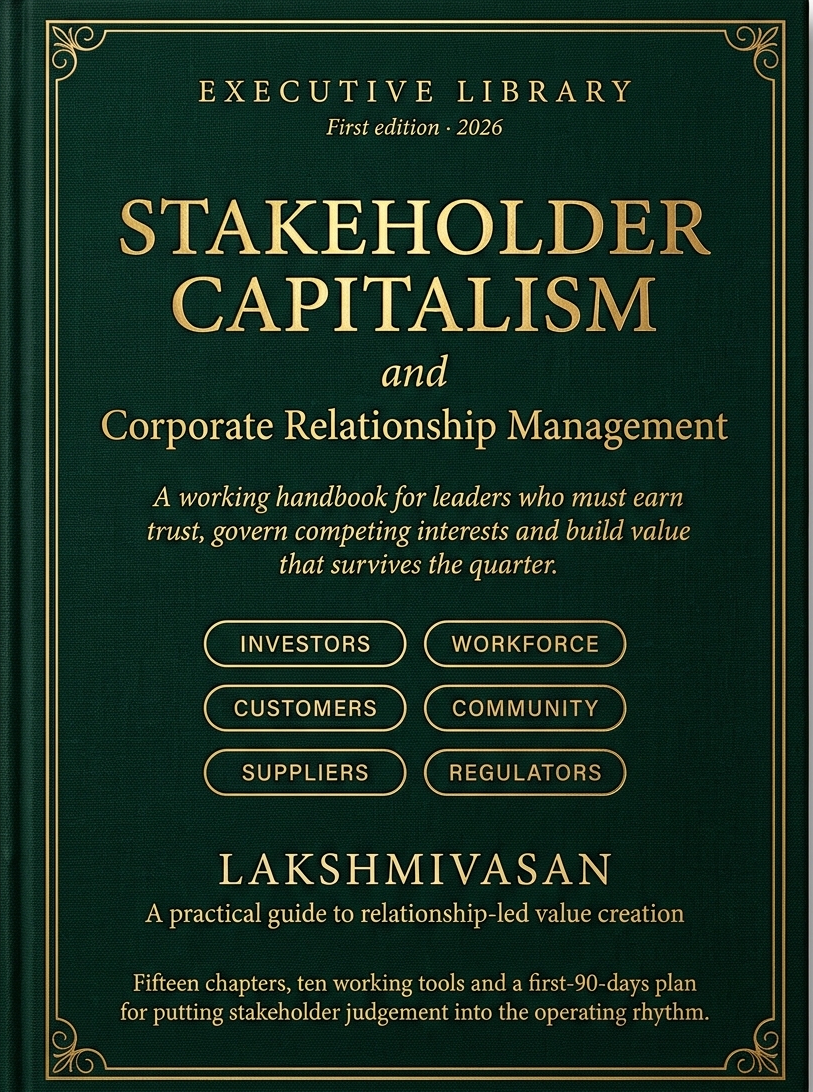
Stakeholder Capitalism and Corporate Relationship Management
EXECUTIVE LIBRARY | BY LAKSHMIVASAN
MAKE THE RELATIONSHIP WORK.
A CEO-LEVEL HANDBOOK FOR MANAGING THE RELATIONSHIPS AN ENTERPRISE DEPENDS ON — WITH 15 CHAPTERS, 10 WORKING TOOLS AND A FIRST-90-DAYS PLAN.
Every organisation depends on relationships.
Investors supply capital. Employees supply capability and judgement. Customers supply revenue. Suppliers supply continuity. Communities and regulators supply the licence to operate. When those relationships weaken, the damage rarely arrives as a single event. It appears as slower approvals, harder hiring, thinner margins and decisions that no longer survive scrutiny.
Yet many organisations still manage these relationships informally — a contact list, an annual event, a satisfaction survey, a sustainability report written for a deadline. Formal activity accumulates while the underlying system stays unchanged.
There is no shared view of who matters. No evidence about what people actually experience. No owner for the response. No consequence when a commitment quietly lapses.
Stakeholder Capitalism and Corporate Relationship Management is a practical executive handbook for closing that gap. It treats stakeholder management as an operating discipline: a decision, the people affected by it, evidence about their interests and impacts, a response with an accountable owner, and a review that tests what changed.
It addresses the questions that matter to CEOs, COOs, board members, strategy and risk leaders, and transformation professionals:
- Which groups can affect this decision, and which groups will carry its consequences?
- How should a stakeholder map be built so that someone else can challenge it?
- How do you prioritise attention without hiding serious impact behind low influence?
- What do investors, employees, customers, suppliers and regulators actually need from management?
- How should community engagement and reputation be handled before a crisis, not after it?
- Where should ESG and social responsibility commitments sit in the operating plan?
- How do you communicate a trade-off honestly without implying consent that was never given?
- How do you measure relationship performance using evidence rather than sentiment?
- What makes value durable beyond a single strategy cycle?
The central principle is straightforward:
The question is not whether an organisation has stakeholders. It is whether its decisions show that it knows who carries the consequences.
This handbook provides a structured management method for answering that question.
A COMPLETE FRAMEWORK FOR STAKEHOLDER CAPITALISM
FROM SEEING THE WHOLE RELATIONSHIP TO PROVING WHAT CHANGED
Stakeholder management is often approached as a communications activity attached to a decision that has already been made.
A project team prepares a briefing. A function commissions a survey. A report is written to a deadline. Consultation happens after the option is locked.
These activities may produce information without improving the decision.
An effective approach begins with the decision itself. It examines the choice, its timing, the people who will implement it, the groups who carry each consequence, the evidence available and the commitments that follow. Only then does communication make sense — because there is something true and specific to communicate.
This handbook organizes that approach into five interconnected parts.
PART I — FOUNDATIONS
Establish the basis for seeing the whole relationship.
Understand stakeholder management as a management system, identify who is affected and who the organisation depends on, and prioritise attention using impact severity, business dependence and voice — with a safeguard for groups that carry serious consequences and hold little influence.
PART II — CORE RELATIONSHIPS
Examine the relationships on which the enterprise most directly depends: investors and shareholders, the employee and workforce relationship, customers and partners, suppliers and ecosystems, and government and regulation.
Each relationship has its own currency, its own failure modes and its own obligations. Treating them as one undifferentiated audience is the most common source of avoidable damage.
PART III — LICENCE AND TRUST
Address the social and institutional conditions that allow an organisation to operate.
Examine community engagement, corporate reputation and ESG and social responsibility — including the difference between a commitment with an owner, funding and a date, and a sentence in a report.
PART IV — DIALOGUE AND PROOF
Turn principle into practice: communication strategy, conflict and expectations, and performance measurement.
This part covers sequencing and plain language, negotiating what can and cannot change, handling disputes without pretending consensus exists, and measuring relationship performance with definitions, sample sizes and limitations.
PART V — ENDURANCE
Ask what makes value durable beyond a single strategy cycle, and what leadership must protect when the quarter presses.
Together, these five parts provide an integrated management approach for understanding, improving and sustaining the relationships that create enterprise value.
WHAT MAKES THIS HANDBOOK DIFFERENT?
IT STARTS FROM THE DECISION, NOT THE REPORT.
A stakeholder map without a decision attached becomes a contact list that nobody uses.
Every chapter names the choice, its timing and the people who will implement it — then asks what evidence would change the answer. Communication explains the reasoning and opens a route to correct missing evidence. If the underlying choice cannot withstand those questions, better wording will not repair it.
1. IT SEPARATES INTERESTS, IMPACTS AND OBLIGATIONS
Interests are what a group wants or values, which may be negotiable. Impacts are what the organisation's activity does to people or environments, which must be assessed regardless of whether the group has leverage. Rights and obligations are what is owed under law, contract, policy or accepted standards, which is not a matter of balancing convenience.
Much of the criticism aimed at stakeholder language comes from organisations that treat rights as interests. This handbook keeps the three distinct.
2. IT REFUSES TO RANK PEOPLE BY POWER ALONE
Prioritisation allocates attention. It is not a verdict on human worth and not a licence to ignore a quiet group experiencing serious harm.
The handbook assesses impact significance, business dependence and voice — and marks a safeguard zone for groups with high exposure and low influence, where action follows impact rather than leverage.
3. IT CLOSES EVERY LOOP
Every meaningful engagement should produce a response: a changed option, a commitment with an owner, a reason for no change, or a referral. Silence teaches people that speaking is pointless.
The commitment register is reviewed with the operating plan — not filed after the meeting.
4. IT IS BUILT AROUND EXECUTIVE REVIEW
Each chapter ends with a boardroom question that connects the subject to a live decision and to management discussion.
The tools provide structured records for assessment, planning, governance, measurement and improvement follow-up. The intention is to make stakeholder judgement a management discipline rather than a sequence of disconnected engagements.
5. IT IS HONEST ABOUT MISUSE
Stakeholder language can be used to delay a decision, dilute accountability or imply consent that was never given.
“We consulted stakeholders” is not a defence if the consultation excluded the most affected group, arrived after the choice was locked, or had no route into the decision. Each chapter includes the failure mode to watch for.
WHAT'S INSIDE
15 CHAPTERS ACROSS FIVE PARTS OF STAKEHOLDER MANAGEMENT
The handbook progresses from understanding the whole relationship to governing trade-offs, communicating honestly, measuring performance and creating durable value.
PART I — FOUNDATIONS
01. Stakeholder Management Fundamentals
Understand the discipline as a management system rather than a communications activity. Examine dependencies and impacts, the five-part management loop connecting decision, affected groups, evidence, response and review, and the accountability test that separates a system from a statement.
02. Stakeholder Identification and Mapping
Examine how organisations can build a map that widens the field of view instead of reflecting the organisation chart. Explore boundaries across place, time and value chain, five lenses for a fuller map — dependency, impact, voice, proximity and time — and how to record a map so that it can be audited and challenged.
03. Stakeholder Prioritisation
Understand how attention should be allocated when resources are finite. Explore impact significance, business dependence and voice, the misuse of influence as a single axis, and the safeguard zone where serious impact outranks low leverage.
PART II — CORE RELATIONSHIPS
04. Investors and Shareholders
Examine the capital relationship: expectations, disclosure, the difference between explaining a trade-off and defending a result, and how short-term pressure is handled without abandoning durable value.
05. Employee and Workforce
Understand the workforce relationship beyond headcount. Explore voice and representation, role and shift differences, restructuring and transition, and the operational cost of treating people as a line item.
06. Customers and Partners
Examine trust, service promises and what customers actually need. Explore the commercial consequences of misreading customer requirements, partner dependence and the claims an organisation is prepared to stand behind.
07. Suppliers and Ecosystems
Understand dependencies that sit several tiers from the contract. Explore payment discipline, supplier capacity and investment, multi-tier exposure, contractor labour and the difference between a contractual relationship and a resilient one.
08. Government and Regulation
Examine permits, obligations and regulatory relationships. Explore the difference between compliance and constructive engagement, the evidence authorities require, and the cost of treating approval as a formality.
PART III — LICENCE AND TRUST
09. Community Engagement
Understand community relationships where effects are local, cumulative and unevenly distributed. Explore access barriers, absent voices, consultation rights, mitigation and the groups who carry consequences without a channel to complain.
10. Corporate Reputation
Examine reputation as an outcome rather than a message. Explore the gap between sentiment tracking and actual impact, the sources that shape perception, and how credibility is rebuilt after a failure.
11. ESG and Social Responsibility
Understand how social and environmental commitments connect to the operating plan. Explore materiality, targets with owners and funding, honest reporting of misses, and the risk of disclosure without operational change.
PART IV — DIALOGUE AND PROOF
12. Communication Strategy
Examine sequencing, plain language and consistency across teams. Explore briefing the frontline before external communication, explaining limits clearly, and publishing commitments people can actually rely on.
13. Conflict and Expectations
Understand how disagreement is handled when interests genuinely conflict. Explore negotiating what can and cannot change, escalation routes, dispute handling and the difference between consensus and consent.
14. Performance Measurement
Examine how relationship performance is measured without self-congratulation. Explore decision-linked measures, definitions and baselines, sample sizes and limitations, and reporting at least one miss.
PART V — ENDURANCE
15. Long-Term Value Creation
Bring the major concepts together. Examine how relationship quality contributes to resilience, productivity, licence and durable enterprise value — and what leadership must protect when short-term pressure increases.
TEN EDITABLE BONUS WORKSHEETS INCLUDED
A COMPANION WORKBOOK WITH FILLABLE VERSIONS OF ALL TEN TOOLS
Understanding stakeholder management is important.
Applying it to a live decision requires structured tools.
This product includes a separate interactive workbook containing fillable versions of all ten tools. Answers save automatically in your browser, each tool can be exported to CSV, and the whole workbook prints cleanly to PDF for a signed record.
The tools fall into four groups: see, plan, govern and prove. Use only the ones that change a decision, a commitment or an owner. A completed template is not an outcome.
SEE — MAPPING AND PRIORITISATION
TOOL 01 — STAKEHOLDER MAPPING MATRIX
A decision-specific inventory of who is affected, who the organisation depends on, what matters and how the evidence will be checked.
- Name the decision, scope, boundary and owner.
- Record each group's effect or dependency.
- Identify evidence and voice routes.
- Flag unknowns and access barriers.
- Assign a review trigger.
TOOL 02 — POWER–INTEREST GRID
A view of influence and active interest used alongside, never instead of, an impact and vulnerability assessment.
- Rate power and interest against a named decision.
- Record impact severity and voice barriers separately.
- Choose an approach and a safeguard for each group.
- Escalate serious impact regardless of grid position.
TOOL 03 — STAKEHOLDER ENGAGEMENT PLAN
A short plan connecting a decision, a group, a two-way method, a commitment owner and a feedback loop.
- State the purpose and the open questions.
- Say plainly what can and cannot change.
- Record method, access and safeguards.
- Assign commitments, owners and dates.
- Define success evidence and escalation.
PLAN — DIALOGUE AND SCHEDULE
TOOL 04 — STAKEHOLDER COMMUNICATION CALENDAR
A forward schedule of disclosures, dialogue, decision points and follow-up, with room for urgent events.
- Set dates and triggers across the year.
- Name the audience and purpose for each entry.
- Assign channel and owner.
- Record the response route and next update.
TOOL 05 — STAKEHOLDER SATISFACTION DASHBOARD
A balanced view of relationship health, process quality, delivered commitments and stakeholder outcomes.
- Define each measure, source and cadence.
- Set thresholds that trigger investigation.
- Pair perception data with operational evidence.
- Record limitations and suppression rules.
TOOL 06 — STAKEHOLDER INFLUENCE AND IMPACT ASSESSMENT
A structured assessment separating how a group can affect the decision from what it may experience.
- Identify the actual influence pathways.
- Rate impact severity and likelihood.
- Rate the quality of evidence behind both.
- Record the judgement and response tier.
GOVERN — RISK AND GRIEVANCE
TOOL 07 — STAKEHOLDER RISK AND OPPORTUNITY MATRIX
A forward view of what could go wrong or right in a relationship, with early indicators and an accountable response.
- Assess likelihood and impact for each entry.
- Name an early indicator, not just a worry.
- Assign a response and an owner.
- Set the escalation trigger.
TOOL 08 — STAKEHOLDER FEEDBACK AND GRIEVANCE MANAGEMENT
A designed route for concerns that is accessible, safe, timely, recorded and connected to remedy.
- Specify multiple channels and language access.
- Add anonymity, anti-retaliation and protection.
- Define acknowledgement times by severity.
- Record investigation, remedy and learning.
PROVE — RELATIONSHIP PERFORMANCE AND VALUE
TOOL 09 — RELATIONSHIP MANAGEMENT SCORECARD
A periodic assessment of a specific relationship, scored against evidence rather than impression.
- Score trust, reliability and communication.
- Score fair dealing, issue resolution and future alignment.
- Require a source for every score.
- Name the single most important action.
TOOL 10 — STAKEHOLDER VALUE CREATION AND PERFORMANCE EVALUATION
A structured account of what value is created, for whom, at what cost and how durable it is.
- Record what the stakeholder contributes and receives.
- Record what the enterprise gains and gives up.
- Test distribution and fairness.
- State what would invalidate the case.
THE FIRST NINETY DAYS
A MODEST PLAN THAT PRODUCES VISIBLE CHANGE WITHIN A QUARTER
You do not need a new function to begin. You need a small number of decisions taken differently, with evidence attached and owners named.
Days 1–30 · See clearly. Choose one live decision with a deadline inside the quarter. Map it using Tool 1, including contractors, indirect effects and at least one group nobody in the room has met. Test the map with a sceptic. Audit the evidence behind the three highest-impact groups. Name an executive sponsor with authority to change the decision.
Days 31–60 · Act differently. Build engagement plans for the two most exposed groups and state what can and cannot change before the first meeting. Open one route that reaches people outside the existing channel. Create the commitment register with owners and dates. Run the risk and opportunity matrix on the decision. Brief the frontline before any external communication.
Days 61–90 · Prove and embed. Report what changed as a result of the engagement. Publish the dashboard with definitions and at least one miss. Score the key relationship and agree one action on its weakest dimension. Put the commitment register on a standing board agenda. Change one process so the learning survives.
What success looks like at day 90: a decision improved by evidence it would not otherwise have had; at least one group that can describe how its concern reached a decision-maker; a commitment register that is reviewed rather than filed; and a board conversation that is specific about trade-offs rather than general about values.
WHO THIS IS FOR
- CEOs, COOs, CFOs and general managers who need a defensible basis for allocating attention and making trade-offs visible.
- Board members and non-executives who must ask better questions about consequences and commitments.
- Strategy, risk and sustainability leaders connecting stakeholder commitments to the operating plan and the risk register.
- Operations and people leaders handling restructuring, site changes, supplier transitions and workforce consequences.
- Consultants and graduate programmes that need a practical method rather than another framework diagram.
WHAT YOU RECEIVE
- The handbook — all 15 chapters, designed for screen reading and clean printing to PDF.
- The companion workbook — fillable versions of all ten tools, automatic browser saving, CSV export and print/PDF.
- The first-90-days plan — see, act differently and prove, with named owners and review dates.
- Worked examples and working sketches — the Aster Works consolidation case used end to end.
- Boardroom questions — one at the end of every chapter.
- A glossary of terms — so the same word means the same thing in the meeting.
- Instant access — available immediately after checkout, with no subscription.
Both files are self-contained HTML documents. They open in any modern browser on desktop, tablet or phone, print cleanly to PDF, and require no installation or account.
A NOTE ON THE EXAMPLES
The running case, Aster Works, is fictional. It describes a mid-sized industrial group weighing the consolidation of two facilities: a decision with commercial logic, workforce consequences, community effects and a long approval tail.
The numbers, quotations and outcomes are illustrative. They are included to show how a tool is used, not to suggest a template answer. Names, figures and outcomes are not a substitute for legal, regulatory or professional advice. Decisions involving rights, permits, employment law or human rights should be reviewed with qualified advisers.
Operational performance is determined not only by the people performing the work, but by the relationships the enterprise chooses to manage — and by whether its decisions show that it knows who carries the consequences.
Fifteen chapters. Ten working tools. Ninety days. One decision taken differently.
EXECUTIVE LIBRARY · LAKSHMIVASAN · FIRST EDITION, 2026