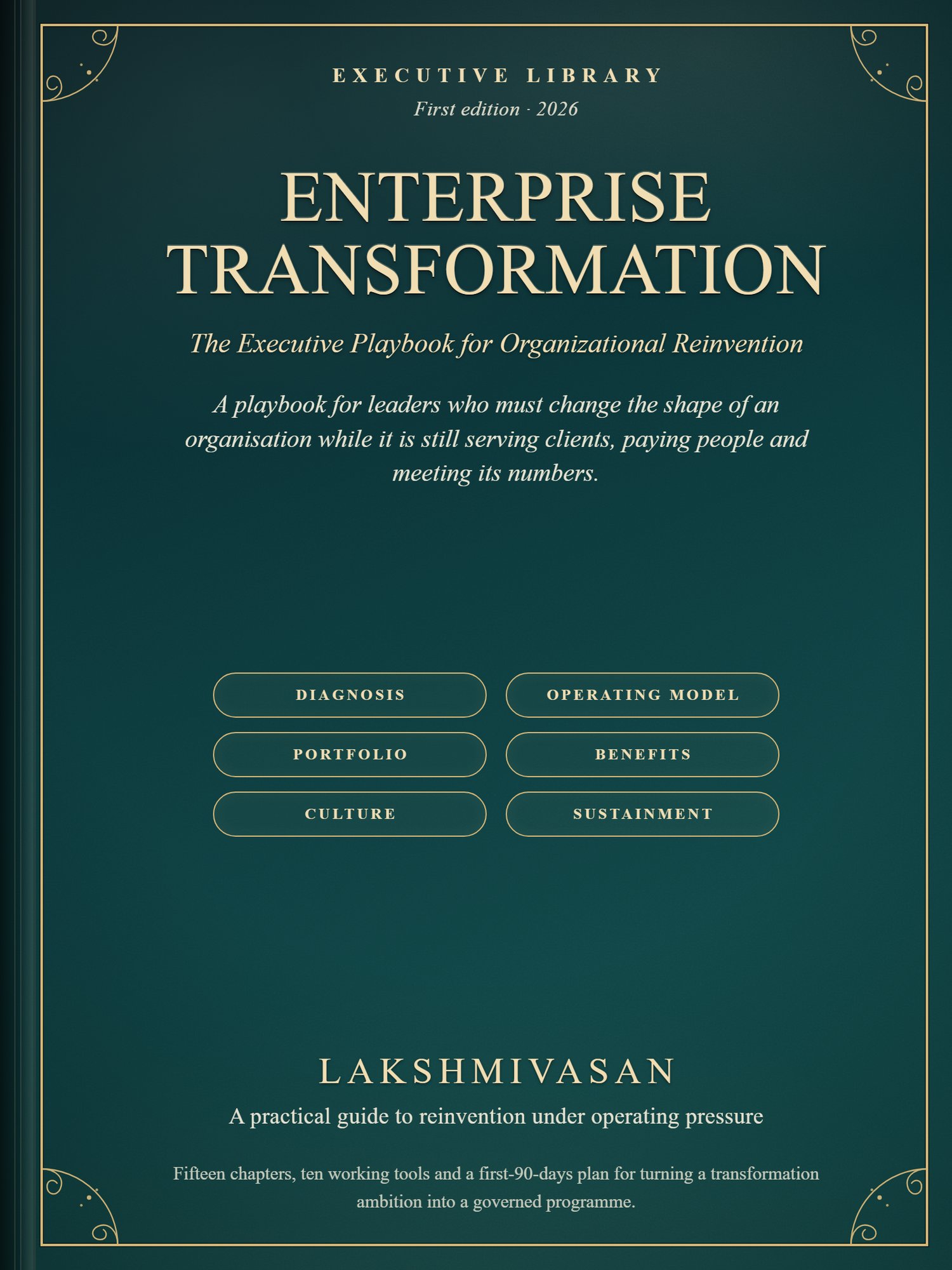
Enterprise Transformation: The Executive Playbook for Organizational Reinvention
EXECUTIVE LIBRARY | BY LAKSHMIVASAN
TRANSFORMATION IS A SET OF CHOICES, NOT A PROGRAMME.
AN EXECUTIVE PLAYBOOK FOR ORGANIZATIONAL REINVENTION — WITH 15 CHAPTERS, 10 WORKING TOOLS AND A FIRST-90-DAYS PLAN.
Most transformations do not fail because the ambition was too small.
They fail because the diagnosis was a list of symptoms, the vision excluded nothing, the operating model was reorganised without changing who decides, the benefits were owned by the programme rather than the line, and the capability left with the consultants.
Meanwhile the organisation is not short of activity. There is a programme office, a change network, a communications plan, a benefits register, a weekly steering group and a set of methods named after somebody's book. What is missing is a defensible answer to the question the board actually asks: what will be different in the accounts, in the operating model and in the way people work — and who owns each of those changes?
Enterprise Transformation is a practical playbook for executives who must deliver reinvention rather than announce it. It treats transformation as a set of choices with a diagnosis behind them: a constraint that explains several symptoms, a vision that excludes work, a design that specifies decision rights before structure, and a delivery mechanism that makes the benefit visible in a line of the accounts.
It addresses the questions that matter to CEOs, COOs, CFOs, board members, transformation directors and operating leaders:
- What are the three tests of a genuine transformation, and why do most programmes fail the second one?
- How do you separate an evidenced driver from a story that justifies a decision already taken?
- What does a diagnosis look like when it finds a constraint rather than a symptom list?
- How should a vision exclude work, rather than inspire people for a morning?
- Which four design choices must be made before the structure is drawn?
- What does restructuring cost, and why is it the part people remember?
- How is leadership alignment tested, beyond agreement in a workshop?
- Which change method should you choose, and on what basis other than ideology?
- How should a transformation portfolio set limits rather than collect projects?
- What makes a benefit real, and what makes results survive the programme that created them?
The central principle is straightforward:
Transformation changes the economics and the operating logic of the enterprise, not just its processes.
This playbook provides a structured method for making that change deliberate, sequenced and durable.
A COMPLETE FRAMEWORK FOR ENTERPRISE TRANSFORMATION
FROM DIAGNOSIS AND DESIGN TO DELIVERY THAT SURVIVES
Transformation work has a recognisable shape. Diagnose before designing. Design before restructuring. Align leadership before asking for sacrifice. Sequence by dependency and capacity rather than enthusiasm. Engineer the benefit. And hand over a capability, not a closure report.
This playbook organises that shape into four interconnected parts.
PART I — DIAGNOSIS AND DIRECTION
Establish why the current model cannot continue, and what the organisation is actually capable of absorbing.
Separate the drivers that compel change from the story that justifies it, find the structural constraint that explains several symptoms at once, and write a vision that excludes work rather than adding ambition.
PART II — DESIGN
Turn direction into choices about where to play, how work flows and who decides.
Strategy is a portfolio with owners and money. The operating model specifies the unit of work, decision rights, standardisation and measures before structure is drawn. Restructuring is a consequence of design — and the part people remember, which is why it must be done once, deliberately.
PART III — LEADERSHIP AND PEOPLE
Address the conditions under which people deliver a change they did not design.
Alignment is consistency between what leaders say, fund and reward. Culture is the pattern of behaviour that survives when nobody is watching the programme. Technology enables a process change but cannot substitute for one. And methods are useful in proportion to how much they change decisions, not how many artefacts they produce.
PART IV — DELIVERY AND DURABILITY
Run the portfolio as a set of bets with limits, and leave behind something that continues without you.
A benefit is a change in a line of the accounts, owned by the person who controls that line. Resistance is information about the cost of the change to the people who must deliver it. And results survive when the new way of working has owners, budgets, measures and routines that outlast the programme.
Together, these four parts provide an integrated approach for leading reinvention from first diagnosis to sustained result.
WHAT MAKES THIS PLAYBOOK DIFFERENT?
IT DIAGNOSES BEFORE IT DESIGNS.
A design produced without a diagnosis is a preference with a timeline attached. The playbook requires the constraint to be written in one sentence, with evidence, before any operating model work begins — because a constraint that cannot be stated cannot be removed.
1. IT TREATS THE VISION AS A SET OF EXCLUSIONS
A vision that includes everything inspires nobody and funds nothing. The book asks what the organisation will stop doing, which customers or segments it will no longer serve, which capability it will build rather than buy, and which initiatives the vision rules out.
Exclusion is what makes the portfolio coherent and the sequencing possible.
2. IT SPECIFIES DECISION RIGHTS BEFORE STRUCTURE
Reorganising without changing who decides produces a new diagram and the same lead time. The target operating model defines the unit of work, the decision rights, the standardisation choices and the measures — then tests the design against three real scenarios before anyone is moved.
3. IT ENGINEERS THE BENEFIT RATHER THAN CLAIMING IT
Benefits do not arrive because a programme delivered a deliverable. They arrive when an operational change removes cost, releases capacity, changes a price or prevents a loss — and when the old path is retired so the new one is used.
The tracker names the account line, its owner, the mechanism and the evidence, and separates realised from expected from at-risk.
4. IT READS RESISTANCE AS INFORMATION
Rational, political, emotional and capability resistance each require a different response. Treating all four as attitude produces a communications campaign where a redesign was needed.
Tool 9 classifies resistance and records the response, the owner and the review date.
5. IT SHOWS A FINISHED ANSWER, NOT JUST A BLANK TEMPLATE
The product includes a completed worked example in which all ten tools are filled end to end for the fictional Calder & Voss — including the uncomfortable entries: a readiness assessment with a weak dimension, a benefits tracker where two lines are at risk, and a resistance matrix that names partners, not just front-line staff.
WHAT'S INSIDE
15 CHAPTERS ACROSS FOUR PARTS OF TRANSFORMATION
The playbook progresses from diagnosis, through design and leadership, to the delivery machinery that decides whether the result survives. The running case is Calder & Voss, a fictional engineering and advisory partnership of 7,000 people across 32 offices, with £1.3 billion of revenue, a nine-partner leadership group and a programme — C&V 2030 — that moves the firm from time-and-materials billing at 22% of revenue to outcome-based engagements at a target of 45%, inside a £95 million envelope over three years.
PART I — DIAGNOSIS AND DIRECTION
01. Enterprise Transformation Fundamentals
Understand transformation as a change in the economics and operating logic of the enterprise. Examine the three tests of a genuine transformation, and why programmes fail in a predictable order of frequency.
02. Understanding Transformation Drivers
Examine the five drivers that actually compel change, and how to separate an evidenced driver from a story that justifies a decision already taken.
03. Organizational Diagnosis
Understand diagnosis as the discipline of finding the constraint that explains several symptoms at once. Explore where to look, and how to move from a symptom list to a single sentence with evidence.
04. Enterprise Transformation Vision
Examine what a usable vision contains, and how to communicate it without dilution. Explore the vision as a set of exclusions that makes the portfolio fundable.
PART II — DESIGN
05. Transformation Strategy Design
Understand strategy as choices about where to play and what to stop, expressed as a portfolio with owners and money. Explore how the choices are paid for, and what is deliberately not pursued.
06. Operating Model Redesign
Examine the four design choices that must be made before structure: the unit of work, decision rights, standardisation and measures. Explore how to design the interfaces between units, and how to test the model against real scenarios.
07. Organizational Restructuring
Understand restructuring as a consequence of design rather than a substitute for it. Explore sequencing, selection and how to restructure without losing the capability you will need next year.
PART III — LEADERSHIP AND PEOPLE
08. Leadership Alignment and Sponsorship
Examine what sponsorship actually requires, and why alignment is not agreement in a workshop. Explore the distributed ownership problem, and how to test alignment against decisions, funding and rewards.
09. Culture and Behavioural Transformation
Understand the four levers that change behaviour, and how to read culture without a survey. Explore culture as the pattern of behaviour that survives when nobody is watching the programme.
10. Process and Technology Transformation
Examine sequence and scope in process change, and why technology enables a process change but cannot substitute for one. Explore adoption as the real definition of delivery.
11. Change Management Methodologies
Understand what the established methods agree on, and how to choose one without ideology. Explore methods judged by how much they change decisions, not by how many artefacts they produce.
PART IV — DELIVERY AND DURABILITY
12. Transformation Portfolio Management
Understand a portfolio as a set of bets with limits rather than a list of projects with owners. Explore limits, gates and stopping rules — and how a stop decision is actually taken.
13. Benefits Realization and Value Tracking
Examine how the benefit is engineered rather than claimed. Explore naming the account line and its owner, baselining before the change, and tracking without self-deception.
14. Transformation Risk and Resistance Management
Understand resistance as information about the cost of the change to the people who must deliver it. Explore the four types of resistance, and the risk that belongs on the programme register.
15. Sustaining Transformation Results
Examine the handover that determines durability, and how to keep the capability alive after the programme team leaves. Explore owners, budgets, measures and routines that outlast the change effort.
TEN EDITABLE BONUS WORKSHEETS INCLUDED
A COMPANION WORKBOOK WITH FILLABLE VERSIONS OF ALL TEN TOOLS
Understanding transformation is important.
Applying it to a live programme requires structured tools that change a decision.
This product includes a separate interactive workbook containing fillable versions of all ten tools. Answers save automatically in your browser, each tool can be exported to CSV, and the whole workbook prints cleanly to PDF for a signed record.
The tools fall into four groups: diagnose, design, deliver and sustain. Use only the ones that change a decision, a limit or an owner. A completed template is not an outcome.
DIAGNOSE — READINESS AND CONSTRAINT
TOOL 01 — ENTERPRISE TRANSFORMATION READINESS ASSESSMENT
Tests whether the organisation can absorb the change it is proposing, before it is committed.
- Assess each dimension on evidence, not aspiration.
- Identify the weakest dimension and what it blocks.
- Decide what must be built before the programme scales.
- Record the evidence behind each rating.
TOOL 06 — ORGANIZATIONAL DIAGNOSTIC AND GAP ANALYSIS FRAMEWORK
Finds the structural constraint that explains several symptoms at once.
- Examine work flow, decision rights, incentives, capability and measures.
- Write the constraint as one sentence with evidence.
- Separate symptoms from causes.
- Name what would change if the constraint were removed.
TOOL 03 — STAKEHOLDER IMPACT ANALYSIS MATRIX
Identifies who is affected by the change, how, and what engagement they require.
- Assess impact and influence separately.
- Record the specific concern each group holds.
- Choose an engagement approach and an owner.
- Flag groups carrying serious impact with little voice.
DESIGN — OPERATING MODEL AND LEADERSHIP
TOOL 07 — TARGET OPERATING MODEL DESIGN FRAMEWORK
Specifies the unit of work, decision rights, standardisation and measures before structure.
- Make the four design choices explicitly.
- Define the interfaces between units.
- Test the model against three real scenarios.
- Record what the model deliberately does not do.
TOOL 08 — LEADERSHIP ALIGNMENT AND ACCOUNTABILITY MATRIX
Makes leadership commitments explicit and testable, including behaviour under pressure.
- Name each leader's commitment and the decision they own.
- State the behaviour expected when the quarter presses.
- Record the evidence of delivery.
- Review the matrix with the executive team, not the programme office.
TOOL 02 — ENTERPRISE CHANGE ROADMAP
Sequences the change by dependency and capacity, with evidence at each phase.
- Organise in phases that each end in an operating change.
- Attach dependency, owner and evidence to every milestone.
- Show capacity, not just sequence.
- State what is deliberately deferred.
DELIVER — BENEFITS, RISK AND PROGRESS
TOOL 04 — BENEFITS REALIZATION TRACKER
Connects each promised benefit to an operational change, a measure and a line owner.
- Baseline before the change begins.
- Name the accounts line and its owner.
- Track realised, expected and at-risk separately.
- Record the mechanism that produces the benefit.
TOOL 05 — ENTERPRISE TRANSFORMATION SCORECARD
Reports progress at four levels — activity, adoption, outcome and capability — without conflating them.
- Keep six to eight measures across the four levels.
- Set targets and record actuals.
- Name an action for every red.
- Show at least one measure that is going the wrong way.
TOOL 09 — TRANSFORMATION RISK AND RESISTANCE MANAGEMENT MATRIX
Distinguishes rational, political, emotional and capability resistance, and records the response.
- Name the risk or resistance and classify it.
- Record the response, the owner and the date.
- Review the top five each month.
- Treat resistance as information, not attitude.
SUSTAIN — DURABILITY
TOOL 10 — TRANSFORMATION SUSTAINABILITY AND CONTINUOUS IMPROVEMENT FRAMEWORK
Ensures the capability survives the programme through ownership, funding, measures and routines.
- Complete each element before programme closure.
- Evidence that the line can continue without the programme team.
- Name the budget that continues and the measure that holds.
- Record what would cause the old way of working to return.
THE FIRST NINETY DAYS
A MODEST PLAN THAT PRODUCES A VISIBLE DECISION WITHIN A QUARTER
You do not need a new programme office to begin. You need a small number of decisions taken differently, with evidence attached and owners named.
Days 1–30 · Diagnose. Interview ten leaders and read the last two years of programme reviews. Write the constraint in one sentence and test it against three symptoms it should explain. Complete the readiness assessment. Identify the two benefits that no line owner has agreed to.
Days 31–60 · Design and align. Make the four operating model choices explicitly and test the design against three real scenarios. Build the leadership alignment matrix with the executive team, including the behaviour expected under pressure. Reduce the portfolio to the bets that survive a limit. State what the vision excludes.
Days 61–90 · Deliver and evidence. Baseline two benefits and name their account lines. Stand up the scorecard at four levels, with one red and an action attached. Classify the top five resistances and change one response as a result. Agree the handover conditions for the first workstream before it closes.
What success looks like at day 90: one constraint named with evidence; one operating model choice made before the structure; one benefit with a line owner who is not the programme; one resistance reclassified as a design problem; and a portfolio limit that stopped something.
WHO THIS IS FOR
- CEOs, COOs and CFOs who must decide what the transformation is for and what it will stop doing.
- Board members and non-executives who need to test a transformation case without running the programme.
- Transformation and programme directors accountable for diagnosis, sequencing, benefits and the stop decision.
- Operating leaders and function heads who must change how work flows and who decides, not just how it is reported.
- HR, change and communications leaders connecting capability, culture and adoption to the operating change.
- Consultants and executive programmes that need a practical method rather than another maturity model.
WHAT YOU RECEIVE
- The playbook — all 15 chapters, designed for screen reading and clean printing to PDF.
- The companion workbook — fillable versions of all ten tools, automatic browser saving, CSV export and print/PDF.
- The completed worked example — all ten tools filled end to end for Calder & Voss, so the standard of a finished answer is visible before you start.
- The first-90-days plan — diagnose, design and align, deliver and evidence.
- Worked examples and working sketches — the C&V 2030 programme used end to end, including the parts that did not go well.
- Boardroom questions — one at the end of every chapter, ready for the next executive meeting.
- A working glossary — so the same word means the same thing in the meeting.
- Instant access — available immediately after checkout, with no subscription.
All three files are self-contained HTML documents. They open in any modern browser on desktop, tablet or phone, print cleanly to PDF, and require no installation or account.
A NOTE ON THE EXAMPLES
The running case, Calder & Voss, is fictional. It is an engineering and advisory partnership of 7,000 people across 32 offices, with £1.3 billion of revenue and a partnership heritage in which senior consultants hold equity. Its transformation, C&V 2030, moves the firm from time-and-materials billing, at 22% of revenue, to outcome-based engagements at a target of 45%. The programme has a £95 million envelope over three years and a leadership group of nine partners. Utilisation is 71%, attrition 18%, and the average engagement margin is under pressure.
All figures and outcomes are illustrative. They are included to show how a tool is used, not to suggest a template answer. Nothing here is a substitute for legal, financial, employment or professional advice.
A transformation is judged by what survives it: the new economics, the new operating logic, and the capability that no longer needs the programme.
Fifteen chapters. Ten working tools. Ninety days. One decision taken differently.
EXECUTIVE LIBRARY · LAKSHMIVASAN · FIRST EDITION, 2026