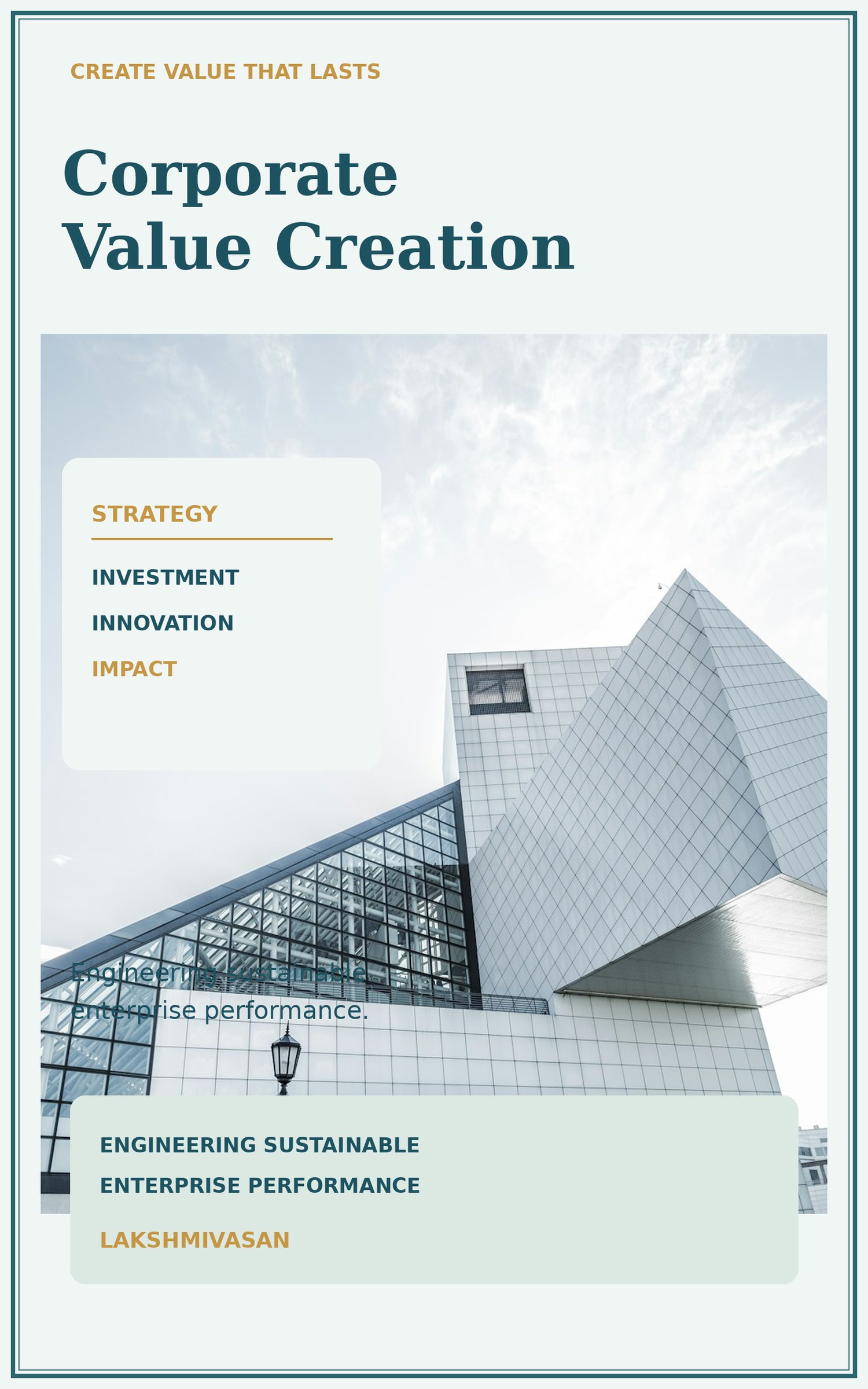
Corporate Value Creation
CORPORATE VALUE CREATION
Engineering Sustainable Enterprise Performance
15 Chapters. 5 Working Tools. 18 Hand-Drawn Figures. 5 Fillable Planners.
PROFIT IS NOT THE SAME AS VALUE CREATION.
A company can report growing profits and still destroy shareholder value.
Revenue can increase. Operating margins can improve. Earnings can exceed expectations. Yet if the return generated by the business does not adequately compensate for the capital invested, the enterprise may be creating less value than its financial statements suggest.
This is the distinction that matters.
Corporate Value Creation moves beyond conventional financial performance reporting to examine what a business actually earns relative to the cost of the capital employed to generate those earnings.
It addresses a more important management question:
How much economic value is the enterprise creating, where is that value coming from, and what must change to improve it?
The book brings together the financial logic, analytical frameworks, management decisions, and practical working tools required to understand and engineer sustainable enterprise performance.
This is not simply a book about financial ratios.
It is a practical framework for understanding the economics of the enterprise and translating financial analysis into management action.
WHY THIS BOOK IS DIFFERENT
It answers the second question.
Most companies report profit.
Fewer systematically examine what that profit represents after accounting for the cost of the capital required to generate it.
Corporate Value Creation focuses on the difference between accounting performance and economic performance.
It examines:
- What is the return generated by the operating business?
- What is the full cost of the capital employed?
- Is the business earning more than its cost of capital?
- Which segments are creating economic value?
- Which investments are consuming capital without adequate returns?
- What happens to the economic value spread next year?
- Where should management allocate additional capital?
The objective is to move from reporting financial outcomes to understanding and managing the economics that produce them.
The arithmetic is shown.
Financial concepts are useful only when they can be translated into actual business calculations.
The book works through the essential mechanics of value creation.
Economic Value Added (EVA)
EVA is developed through Net Operating Profit After Tax (NOPAT) and the capital charge.
EVA = NOPAT − (Invested Capital × Cost of Capital)
The calculation demonstrates how accounting operating profit is converted into an economic measure of value creation.
Return on Invested Capital (ROIC)
ROIC is examined through its two fundamental operating drivers:
ROIC = NOPAT Margin × Invested Capital Turns
This helps management understand whether returns are being generated through operating profitability, capital efficiency, or both.
Economic Value Spread
The difference between the return generated on invested capital and the cost of capital becomes a central measure of economic performance.
Value Spread = ROIC − WACC
The spread is examined not merely as a historical number but as a management variable whose future direction matters.
Synergies and Cost to Achieve
Strategic initiatives and business combinations are evaluated by considering the economic benefits alongside the costs required to achieve them.
The focus is on net value creation, not headline synergy estimates.
Each concept is connected to worked calculations using consistent financial units.
WHAT YOU WILL GET
15 Comprehensive Chapters
A structured examination of corporate value creation, financial performance, capital productivity, economic returns, and management decisions.
The chapters develop the analytical understanding needed to move from conventional profit reporting to economic value management.
5 Practical Working Tools
Five working tools help translate the book's concepts into structured management analysis.
They support the application of financial frameworks to business evaluation, capital allocation, and performance improvement.
18 Hand-Drawn Figures
Visual explanations of the relationships between operating performance, invested capital, returns, capital costs, economic spreads, and value creation.
The illustrations are designed to make financial relationships easier to understand and communicate.
5 Fillable Planners
Practical planning resources designed to help translate financial analysis into management priorities, action plans, and capital allocation decisions.
15 chapters. 5 working tools. 18 figures. 5 planners. One integrated approach to engineering enterprise value.
FROM FINANCIAL MEASUREMENT TO MANAGEMENT ACTION
Understanding value creation is only the beginning.
The real challenge is deciding what management should do with the information.
A business segment may generate substantial accounting profit but earn inadequate returns on the capital employed.
Another may generate modest profits but deliver attractive returns with relatively little capital.
A third may require operational restructuring before it can achieve an acceptable economic return.
These businesses should not automatically receive the same management response.
Corporate Value Creation connects financial analysis with four practical management verdicts.
GROW
Increase investment where the business demonstrates attractive economic returns and sustainable value creation opportunities.
FIX
Address operating weaknesses, capital inefficiency, margin problems, or inadequate returns where the business has credible improvement potential.
HOLD
Maintain capital allocation where the business generates acceptable returns but has limited opportunities or uncertain prospects for further expansion.
EXIT
Consider releasing capital from activities that cannot generate adequate economic returns or offer a credible improvement pathway.
The emphasis is on making capital allocation decisions in actual currency, rather than leaving recommendations at the level of general principles.
WHAT YOU WILL EXPLORE INSIDE
The book develops the financial and managerial dimensions of sustainable enterprise performance.
Economic Value Creation
Understand the difference between accounting profit and economic profit, and why capital costs must be considered when evaluating performance.
NOPAT and EVA
Examine operating profitability after tax and calculate the economic charge associated with invested capital.
ROIC Analysis
Understand the relationship between operating margins, capital turnover, and the returns generated by the enterprise.
Cost of Capital
Examine the role of the required return on capital in determining whether business activities generate economic value.
Economic Value Spread
Understand how the difference between ROIC and the cost of capital influences value creation.
Capital Productivity
Examine how effectively the business employs its invested capital to generate operating returns.
Business Segment Evaluation
Assess individual business segments based on their economic contribution rather than relying exclusively on revenue or accounting profit.
Synergy Evaluation
Evaluate strategic synergies after considering the costs necessary to achieve them.
Performance Improvement
Identify the operating and financial drivers that can improve returns and strengthen economic value creation.
Capital Allocation
Translate economic analysis into practical decisions about where capital should be invested, retained, redirected, or withdrawn.
Forward-Looking Value Creation
Examine how current performance and management decisions influence the economic spread and future value creation.
THE FRAMEWORKS ARE DESIGNED TO BE USED, NOT JUST READ
Corporate value creation requires more than understanding financial definitions.
Management must connect financial calculations with actual business decisions.
That means moving through a sequence:
- Establish the operating earnings generated by the business.
- Determine the capital employed to generate those earnings.
- Calculate the economic cost of that capital.
- Measure the returns generated above or below that cost.
- Identify the operating and capital drivers behind the result.
- Determine the appropriate management response.
- Translate the decision into future financial performance.
The book uses worked examples and visual explanations to make this process more understandable and applicable.
The objective is not simply to calculate EVA or ROIC.
It is to understand what the calculations mean for the future of the enterprise.
WHO SHOULD READ THIS BOOK?
Corporate Value Creation is designed for professionals responsible for financial performance, business economics, investment decisions, and enterprise-level management.
It is particularly relevant for:
- Chief Executive Officers and Managing Directors.
- Chief Financial Officers and Finance Directors.
- Corporate strategy and business planning professionals.
- Business unit and segment heads.
- Financial controllers and management accountants.
- Corporate development and investment professionals.
- Management consultants and business advisors.
- MBA students and finance professionals seeking a deeper understanding of value-based management.
Whether you manage an entire enterprise or an individual business segment, the book provides a structured way to examine whether the resources employed are generating adequate economic returns.
WHAT MAKES THIS RESOURCE DIFFERENT?
Many financial management resources explain how to calculate profitability.
Others focus on financial ratios, valuation, budgeting, or performance reporting.
Corporate Value Creation takes a different approach.
It connects the economics of the business with the decisions management must make.
It does not stop at asking whether profits have increased.
It asks whether returns exceed the cost of capital.
It does not stop at calculating ROIC.
It examines the operating margin and capital turnover responsible for that return.
It does not stop at identifying potential synergies.
It considers the costs necessary to achieve them.
And it does not stop at reporting the performance of business segments.
It translates the results into decisions: grow, fix, hold, or exit.
The difference is the movement from financial measurement to economic judgment, and from economic judgment to capital allocation.
YOUR COMPLETE CORPORATE VALUE CREATION RESOURCE
IncludedWhat it provides15 ChaptersStructured knowledge and analytical frameworks5 Working ToolsPractical application of the concepts18 Hand-Drawn FiguresVisual explanations of financial relationships5 Fillable PlannersStructured planning and management application
A practical resource for understanding the financial mechanics of value creation and applying them to enterprise performance.
FREQUENTLY ASKED QUESTIONS
1. What is Corporate Value Creation about?
It is a practical business and financial management resource focused on understanding how enterprises generate economic returns relative to the cost of the capital they employ.
2. How is this different from a conventional financial management book?
It goes beyond accounting profitability and examines economic profit, ROIC, EVA, capital productivity, economic value spreads, and management decisions.
3. Does the book explain EVA calculations?
Yes. It explains EVA through NOPAT and the capital charge, supported by worked calculations.
4. Does it cover ROIC?
Yes. ROIC is examined through operating margin and invested capital turnover, helping readers understand the underlying drivers of returns.
5. Are practical examples included?
Yes. The financial concepts are supported by worked examples using consistent financial units.
6. What are the five working tools?
They are practical resources intended to support the application of the book's analytical frameworks.
7. Are visual illustrations included?
Yes. The resource includes 18 hand-drawn figures explaining important financial and managerial relationships.
8. What are the fillable planners used for?
They provide structured formats for applying the concepts to business analysis, performance evaluation, and management planning.
9. Who will benefit most from this book?
CEOs, CFOs, finance professionals, business unit heads, corporate strategists, consultants, and management students.
10. Is this a physical book?
This is a digital product. The available download formats and delivery details will be provided at the point of purchase.
THE MOST IMPORTANT QUESTION IS NOT HOW MUCH PROFIT THE BUSINESS REPORTED.
IT IS HOW MUCH VALUE THE BUSINESS CREATED.
A profitable business is not necessarily an economically successful business.
Capital has a cost. Returns must compensate for that cost. Investments must justify the resources committed to them.
And management must continuously decide where the next unit of capital will create the greatest economic value.
Corporate Value Creation brings these questions together in one practical resource.
Understand the numbers.
Examine the economics.
Identify the drivers.
Make the decisions.
15 Chapters. 5 Working Tools. 18 Hand-Drawn Figures. 5 Fillable Planners.
ENGINEER SUSTAINABLE ENTERPRISE PERFORMANCE.
Get your copy of Corporate Value Creation today.