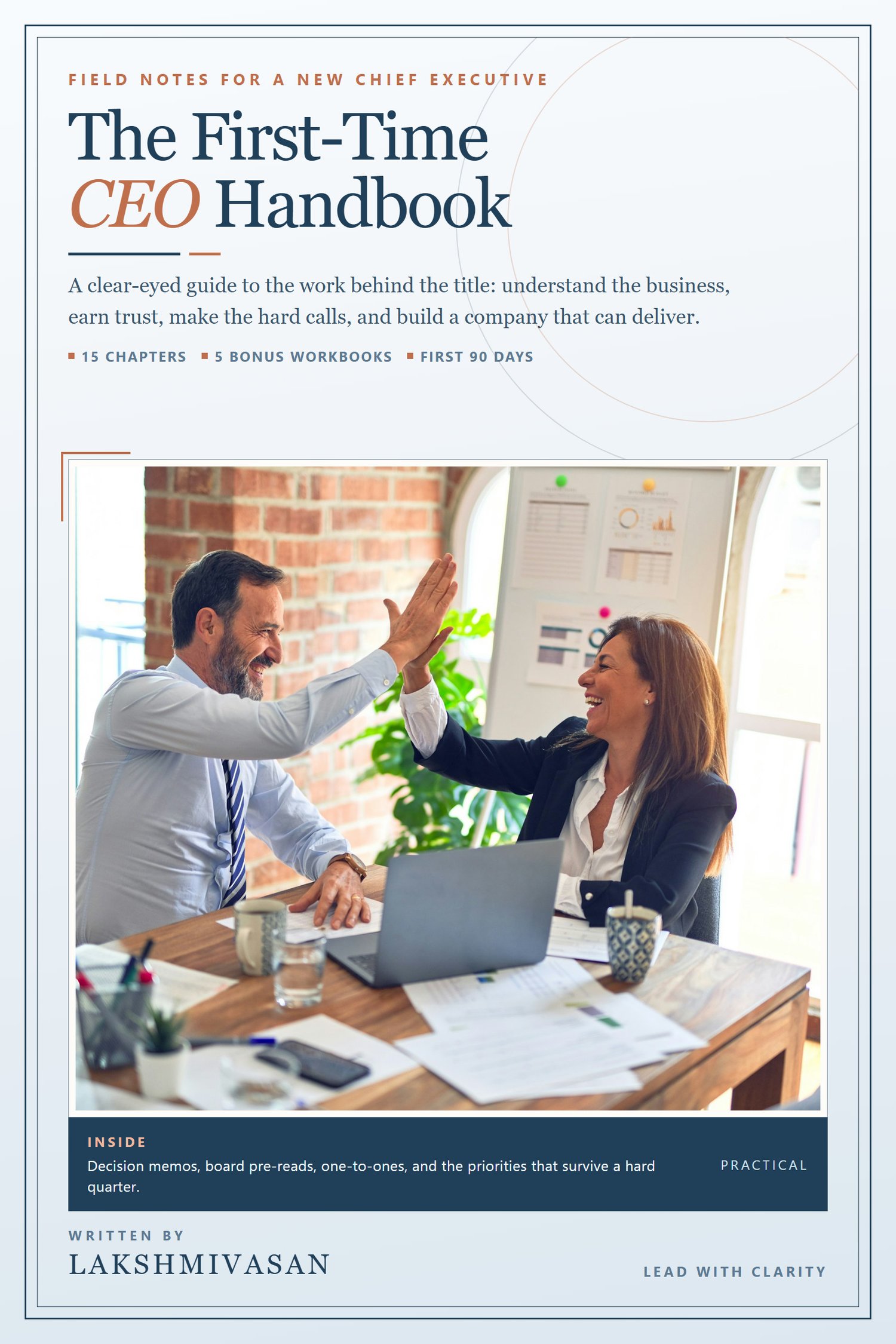
The First-Time CEO Handbook
THE FIRST-TIME CEO HANDBOOK
A Field Guide for the First Year
YOUR FIRST YEAR AS CEO IS NOT ABOUT HAVING ALL THE ANSWERS. IT IS ABOUT LEARNING TO ASK THE RIGHT QUESTIONS, MAKE THE RIGHT DECISIONS, AND GET THE ORGANIZATION MOVING TOGETHER.
Stepping into the CEO role changes everything.
You are no longer responsible only for your own function, team, or area of expertise. You are responsible for helping the entire organization understand where it stands, where it needs to go, and how it will get there.
The expectations are different. The decisions are bigger. The consequences travel further.
And often, the transition comes without a complete instruction manual.
What should you focus on first?
How do you understand a business you have inherited?
When should you listen, and when should you act?
How do you build credibility with an established leadership team?
What should your relationship with the board look like?
How do you balance strategy, customers, people, cash, and execution without becoming the bottleneck?
The First-Time CEO Handbook is designed to help you navigate these questions.
It is a practical, plain-spoken field guide to the work of leading an organization during your first year as CEO.
Across 15 short chapters, it takes you through the essential responsibilities of the role, from understanding your mandate and listening to the organization to setting priorities, leading change, managing risk, and building a sustainable operating rhythm.
This is not leadership theory for the bookshelf.
It is a guide designed to be used in the conversations, meetings, decisions, and moments that define your first year.
THE CHALLENGE IS NOT GETTING THE TITLE. IT IS LEARNING TO LEAD THE WHOLE BUSINESS.
Your first year will test several capabilities simultaneously.
You must understand the business before making major commitments.
You must build relationships while establishing authority.
You must listen carefully without allowing uncertainty to become inaction.
You must make difficult choices without losing the confidence of the people who need to execute them.
You must communicate with employees, customers, investors, and the board while ensuring that the business continues to perform.
The most effective first-time CEOs approach this transition deliberately.
They understand their mandate. They develop an evidence-based view of the business. They establish a small number of priorities. They build a leadership team capable of acting independently. And they create a management rhythm that turns information into decisions.
This handbook provides a structured approach to doing exactly that.
WHAT YOU WILL LEARN
15 CHAPTERS. ONE PRACTICAL GUIDE TO YOUR FIRST YEAR.
01. Understanding Your CEO Mandate
Understand the expectations attached to your appointment, the authority you have been given, the outcomes you are expected to deliver, and the constraints within which you must operate.
02. Listening Before You Lead
Learn how to conduct early conversations with employees, executives, customers, directors, and other stakeholders before committing to major organizational changes.
03. Understanding the Business Fundamentals
Develop a clear view of the business through customers, products, operations, financial performance, cash, and competitive position.
04. Choosing Priorities and Making Trade-offs
Move beyond long lists of initiatives. Identify the few priorities that matter most and make explicit choices about what the organization will not pursue.
05. Building Your Leadership Team
Understand the importance of leadership capability, trust, accountability, decision rights, delegation, and constructive disagreement.
06. Establishing Your Operating Cadence
Create a management rhythm that connects metrics, decisions, execution, and follow-through. Ensure that important issues are surfaced early rather than allowed to deteriorate in silence.
07. Managing Board Relationships
Build a productive relationship with the board through transparent communication, decision-ready information, appropriate escalation, and clear expectations.
08. Leading Yourself
Manage the demands of the CEO role, protect your attention, develop sound judgment, and establish personal practices that support effective leadership.
09. Navigating Your First 90 Days
Translate early discovery into informed decisions, initial priorities, visible commitments, and evidence of progress through a structured 13-week approach.
10. Leading Culture and Change
Understand organizational culture, recognize resistance, communicate the reasons for change, and build commitment through consistent leadership behavior.
11. Understanding Customers and Products
Keep the customer close to executive decision-making. Examine customer needs, product relevance, experience, differentiation, and the quality of the value proposition.
12. Managing Risk and Crisis
Develop an approach to identifying material risks, escalating critical issues, preparing for disruption, and making decisions under pressure.
13. Communicating as CEO
Communicate with clarity, consistency, and credibility. Adapt your messages to employees, executives, customers, boards, and other stakeholders.
14. Building Sustainable Growth
Understand the conditions for growth, the choices involved in scaling a business, and the capabilities required to sustain performance.
15. Bringing It All Together
Connect the mandate, strategy, people, operating system, communication, and execution into a coherent approach to leading the enterprise beyond the first year.
Each chapter concludes with questions and practical formats you can use in your next one-to-one, leadership meeting, or board update.
FIVE BONUS WORKBOOKS INCLUDED
PRACTICAL TOOLS TO HELP YOU PUT THE HANDBOOK INTO ACTION
Your purchase includes five companion workbooks designed to help translate the handbook's principles into real leadership practices.
BONUS 01 — THE FIRST 90 DAYS PLANNER
Turn your first quarter into evidence of progress.
<image-placeholder/> A structured 13-week calendar for discovery, decisions, priorities, and visible follow-through.
Use it to:
- Organize your first-quarter activities.
- Structure stakeholder conversations.
- Identify critical business questions.
- Schedule important decisions.
- Establish and track early priorities.
- Review progress and adjust your approach.
The goal is to make your first 90 days produce meaningful evidence rather than simply a calendar full of activity.
BONUS 02 — THE CEO WEEKLY OPERATING SYSTEM
Build a weekly rhythm that keeps the business moving.
A ready-to-adapt operating framework for managing decisions, metrics, customers, and protected leadership focus.
Use it to:
- Establish a consistent weekly management rhythm.
- Review business performance.
- Identify emerging issues.
- Keep customer conversations visible.
- Track important decisions.
- Protect time for strategic thinking.
Designed to prevent important information and difficult news from aging in silence.
BONUS 03 — LEADERSHIP TEAM ALIGNMENT WORKBOOK
Build a leadership team that leaves meetings with commitments, not impressions.
A facilitated working session covering outcomes, decision rights, difficult topics, and leadership commitments.
Use it to:
- Align the team around shared outcomes.
- Clarify roles and decision responsibilities.
- Surface difficult conversations.
- Identify unresolved disagreements.
- Establish accountability.
- Record commitments and owners.
The objective is a leadership team that knows what it must achieve and how it will work together.
BONUS 04 — BOARD COMMUNICATION TOOLKIT
Make every board conversation more candid and decision-ready.
Practical frameworks for board updates, pre-reads, and meetings, including how to communicate a missed target, emerging risk, or difficult development.
Use it to:
- Structure executive board updates.
- Prepare concise board pre-reads.
- Present important decisions.
- Communicate performance gaps.
- Raise risks and concerns transparently.
- Clarify where board guidance is required.
Designed to help establish a relationship based on credibility, preparation, and trust.
BONUS 05 — STRATEGY & PRIORITIES WORKBOOK
Turn strategic ambition into choices and accountable execution.
An evidence-led exercise for identifying strategic choices, making explicit trade-offs, and translating priorities into execution.
Use it to:
- Examine strategic opportunities.
- Assess available evidence.
- Identify competing priorities.
- Make explicit trade-offs.
- Assign accountability.
- Develop a reusable one-page priority format for quarterly reviews.
The result is a more disciplined approach to deciding what the organization will focus on and what it will deliberately leave aside.
WHY THE FIVE BONUSES MATTER
Reading about leadership is valuable.
Applying leadership practices consistently is what changes the way an organization operates.
The five companion workbooks address five essential dimensions of the CEO role:
Bonus resourceManagement challengeFirst 90 Days PlannerStarting with clarityCEO Weekly Operating SystemMaintaining execution disciplineLeadership Team Alignment WorkbookBuilding collective accountabilityBoard Communication ToolkitCreating board confidenceStrategy & Priorities WorkbookMaking choices and delivering results
Together, they help turn the handbook into a working leadership resource rather than a one-time reading experience.
WHO SHOULD READ THIS HANDBOOK?
This resource is designed for:
New and First-Time CEOs
Executives taking responsibility for an entire organization and navigating the expectations, decisions, and challenges of their first year.
Founders Stepping into the CEO Role
Entrepreneurs moving from building a business to leading a growing organization with greater complexity, people, processes, and governance responsibilities.
Executives Moving into Company Leadership
Senior functional leaders transitioning into enterprise-wide responsibility for strategy, performance, culture, and organizational outcomes.
Aspiring CEOs
Experienced leaders preparing for a future CEO appointment who want to understand the demands of the role before taking it on.
Leadership and Executive Development Professionals
Professionals supporting executives through leadership transitions and organizational development.
A PRACTICAL GUIDE, NOT ANOTHER LEADERSHIP THEORY BOOK
The First-Time CEO Handbook is built around the realities of the job.
It recognizes that:
- You cannot make good decisions without understanding the business.
- You cannot build trust without listening.
- You cannot execute strategy without priorities and trade-offs.
- You cannot delegate effectively without clear decision rights.
- You cannot lead a team without addressing difficult issues.
- You cannot build board confidence without honest communication.
- You cannot sustain performance without a disciplined operating rhythm.
The emphasis is on questions to ask, conversations to have, decisions to make, and practical formats to use.
It is deliberately designed to be plain-spoken, accessible, and useful in the middle of a demanding working week.
WHAT YOU RECEIVE
Your purchase includes:
The Main Handbook
- 15 short, practical chapters.
- A structured guide to the first year as CEO.
- Questions and working formats at the end of each chapter.
- Guidance for reading in sequence or using as a reference.
Five Companion Bonus Workbooks
- The First 90 Days Planner.
- The CEO Weekly Operating System.
- Leadership Team Alignment Workbook.
- Board Communication Toolkit.
- Strategy & Priorities Workbook.
Digital Format
- Instant-access digital handbook.
- Single self-contained web page.
- Readable on desktop, tablet, and mobile.
- Five companion bonus workbooks included.
FREQUENTLY ASKED QUESTIONS
Is this handbook only for people who have just become CEOs?
It is primarily designed for first-time CEOs, but it is also useful for founders stepping into the role, aspiring CEOs, and senior executives preparing for enterprise-wide leadership.
Is this a theoretical leadership book?
No. It is a practical field guide focused on the actual responsibilities of the CEO role, with questions and working formats that can be used in meetings and management conversations.
What does the handbook cover?
It covers 15 areas, including the CEO mandate, early listening, business fundamentals, priorities, leadership teams, operating cadence, board relationships, self-leadership, the first 90 days, culture, customers, risk, communication, and growth.
What are the five bonus workbooks?
The First 90 Days Planner, CEO Weekly Operating System, Leadership Team Alignment Workbook, Board Communication Toolkit, and Strategy & Priorities Workbook.
How do I access the handbook?
It is delivered as an instant-access digital handbook in a single self-contained web page, designed for desktop, tablet, and mobile reading.
Can I read it on a tablet or mobile phone?
Yes. The handbook is designed to be readable across desktop, tablet, and mobile devices.
Do I need to read it from beginning to end?
Reading in sequence provides a structured understanding of the first-year CEO journey. However, individual chapters can also be used as a working reference when a particular leadership challenge arises.
Does the handbook replace professional advice?
No. It is a practical leadership guide and does not substitute for situation-specific legal, financial, HR, or other professional advice.
YOUR FIRST YEAR DESERVES A BETTER START.
You do not need to have every answer on your first day.
But you do need a way to find the important answers, make sound decisions, build the right relationships, and help the organization move forward.
Your first year will shape how people understand your leadership, how your team works together, and how the organization approaches its future.
Approach that responsibility with clarity, discipline, and a practical plan.
15 Chapters. 5 Companion Workbooks. One Field Guide for Your First Year.
STEP INTO THE CEO ROLE WITH CLARITY AND CONFIDENCE.
Get The First-Time CEO Handbook today.