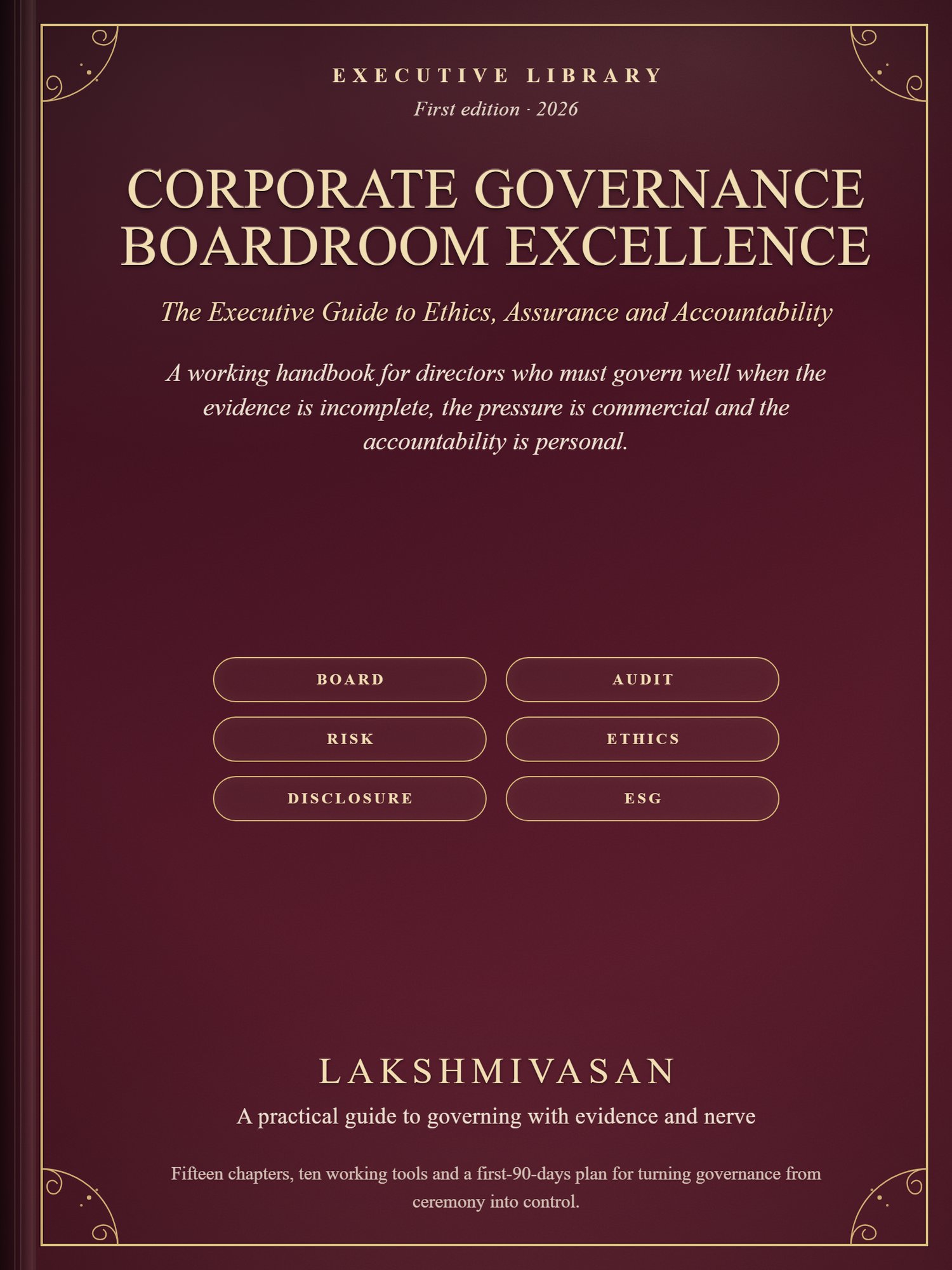


Corporate Governance and Boardroom Excellence
EXECUTIVE LIBRARY | BY LAKSHMIVASAN
GOVERNANCE IS A DECISION, NOT A DOCUMENT.
A BOARD-LEVEL HANDBOOK FOR ETHICS, ASSURANCE AND ACCOUNTABILITY — WITH 15 CHAPTERS, 10 WORKING TOOLS AND A FIRST-90-DAYS PLAN.
Most boards can produce a governance framework within a month.
Far fewer can explain, in a single meeting, which decisions only the board can take, what evidence proves the controls are operating, how a conflict was managed on a live transaction, and what happened to the person who raised a concern about a senior colleague.
The framework is the artefact. The judgement is the discipline. When the judgement is missing, committees become briefing receptions, the risk register fills with operational hazards and omits the board's own failure modes, and the code of conduct sits unread beside an incentive scheme that rewards the opposite behaviour.
Corporate Governance and Boardroom Excellence is a practical handbook for directors and executives who must make authority, assurance and accountability real. It treats governance as the allocation of decision rights and the evidence that they were used well — not the paperwork that records them afterwards.
It addresses the questions that matter to chairs, non-executives, CEOs, CFOs, company secretaries, audit and risk leaders:
- What are the four questions governance exists to answer, and which of them only the board can answer?
- How are roles separated so that challenge is possible rather than performative?
- What should each committee own, and what should never be delegated to it?
- How should a board apply a governance code without outsourcing its judgement to a checklist?
- What makes an ethics programme an operating system rather than a document?
- How is compliance managed as a risk with owners, rather than absorbed by a function?
- What separates a control from the evidence that the control operates?
- How should conflicts be declared, assessed, managed and recorded?
- When does a disclosure decision become a governance failure?
- What does a speak-up system look like when it is judged by outcomes for the people who use it?
The central principle is straightforward:
Governance is the allocation of authority and accountability — not the paperwork that records it.
This handbook provides a structured method for making that allocation deliberate, evidenced and durable.
A COMPLETE FRAMEWORK FOR CORPORATE GOVERNANCE
FROM AUTHORITY AND ASSURANCE TO INTEGRITY UNDER PRESSURE
Governance failures are rarely caused by a missing policy. They are caused by authority that was never clearly allocated, information that never reached the people who could act on it, assurance that tested design rather than operation, and a culture in which the cost of raising a concern exceeded the cost of silence.
This handbook organises the response into four interconnected parts.
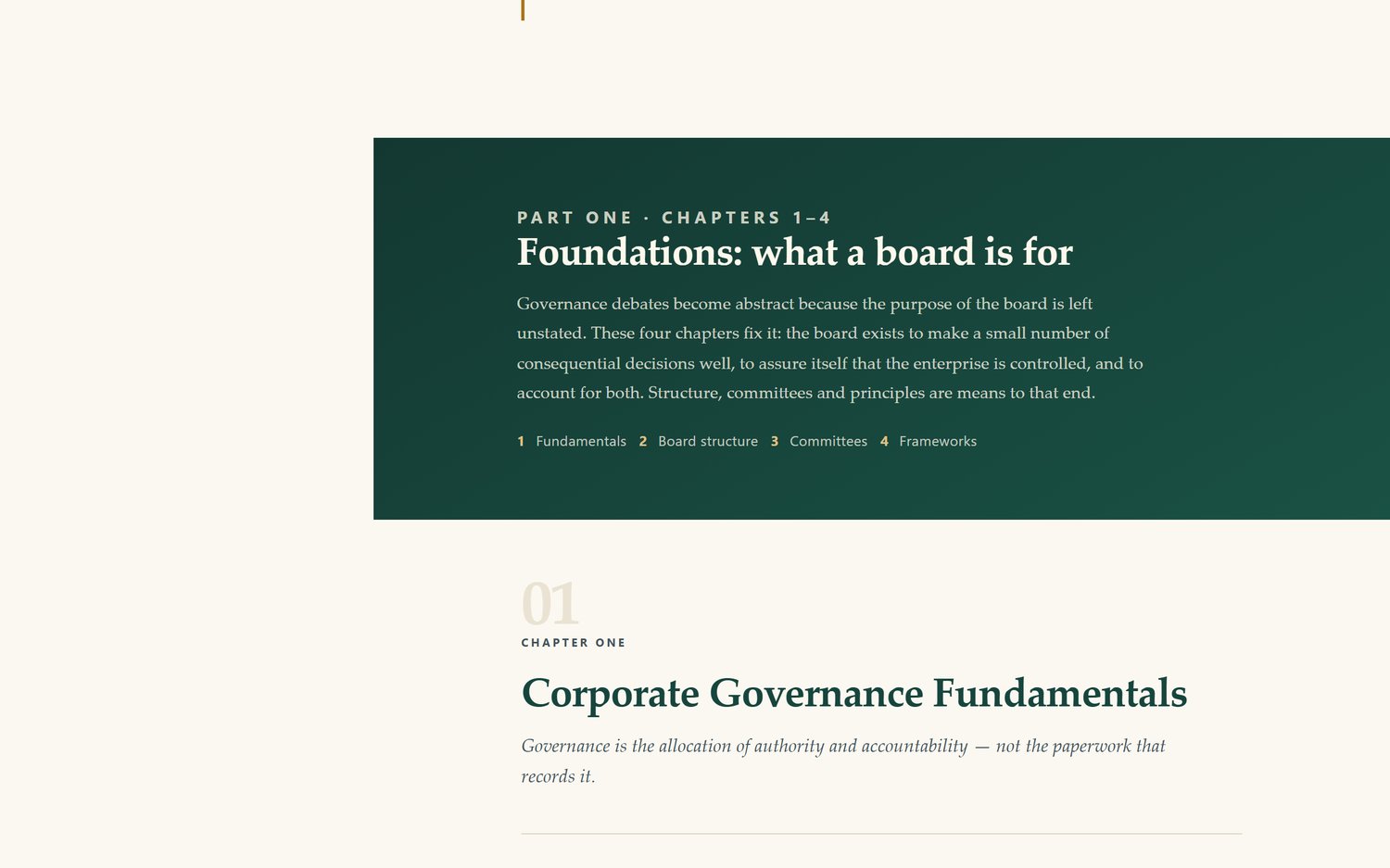
PART I — FOUNDATIONS
Establish what the board is for and how it must be built.
Separate the four questions governance answers from the ones management owns, design a board whose independence is produced by structure, information and time, and make committees do technical work properly rather than remove difficult subjects from the main meeting.
PART II — ETHICS, COMPLIANCE AND ASSURANCE
Examine the mechanisms that determine whether stated standards survive contact with commercial pressure.
Ethics as an operating system of incentives, decisions, escalation and consequence. Compliance as a managed risk with owners. Internal control as a claim about behaviour, with assurance as the evidence that the claim holds. And an audit committee that becomes technically competent rather than delegating its judgement to the auditor.
PART III — INTEGRITY IN PRACTICE
Address the three situations in which governance is tested most sharply.
Conflicts of interest are normal; undeclared conflicts are the failure. Disclosure is a judgement about materiality and timing made under pressure, with personal consequences for getting it wrong. And a speak-up system is judged by what happens to the people who use it, not by the number of channels offered.
PART IV — GOVERNING FOR THE LONG TERM
Turn governance into a durable capability rather than an annual ritual.
Sustainability commitments are governance commitments: they allocate capital, create obligations and expose the company to challenge. The board's own failure modes belong on the risk register. Evaluation must change something. And maturity is the reliability of judgement under pressure, not the volume of documentation.
Together, these four parts provide an integrated approach to board effectiveness, assurance and accountability.
WHAT MAKES THIS HANDBOOK DIFFERENT?
IT SEPARATES ASSURANCE FROM MANAGEMENT.
The board assures itself; it does not run controls. Confusing the two produces boards that ask for more reporting instead of better evidence, and executives who treat governance as a reporting obligation rather than a decision hierarchy.
Every chapter returns to the same distinction: what the board must decide, what it must assure itself of, and what management must simply do.
1. IT TREATS INDEPENDENCE AS A DESIGN PROBLEM
Independence is a state of mind, but it is produced by structure, information and time. A director with no sector experience, no access to unfiltered information and no time to read the papers is not independent in any useful sense, whatever the register says.
The handbook examines composition, information flows, tenure and the practical conditions under which challenge becomes possible.
2. IT DISTINGUISHES A CONTROL FROM ITS EVIDENCE
A control is a claim about behaviour. Assurance is the evidence that the claim holds. The book separates design from operating effectiveness, dates every test result, and treats a stale or bypassed control as partial — because that is what it is.
3. IT PUTS THE BOARD'S OWN FAILURES ON THE REGISTER
Information risk, composition risk, process risk, conduct risk, succession risk and disclosure risk are governance risks. They are rarely recorded, and they explain a large share of the failures that later get attributed to management.
Tool 6 exists to make them explicit, with owners, controls and residual exposure.
4. IT JUDGES A SPEAK-UP SYSTEM BY OUTCOMES
Channel counts measure intention. Outcomes measure design. The handbook asks what happened to the person who raised the concern, how long it took, who investigated, what the remedy was, and what the audit committee saw.
5. IT SHOWS A FINISHED ANSWER, NOT JUST A BLANK TEMPLATE
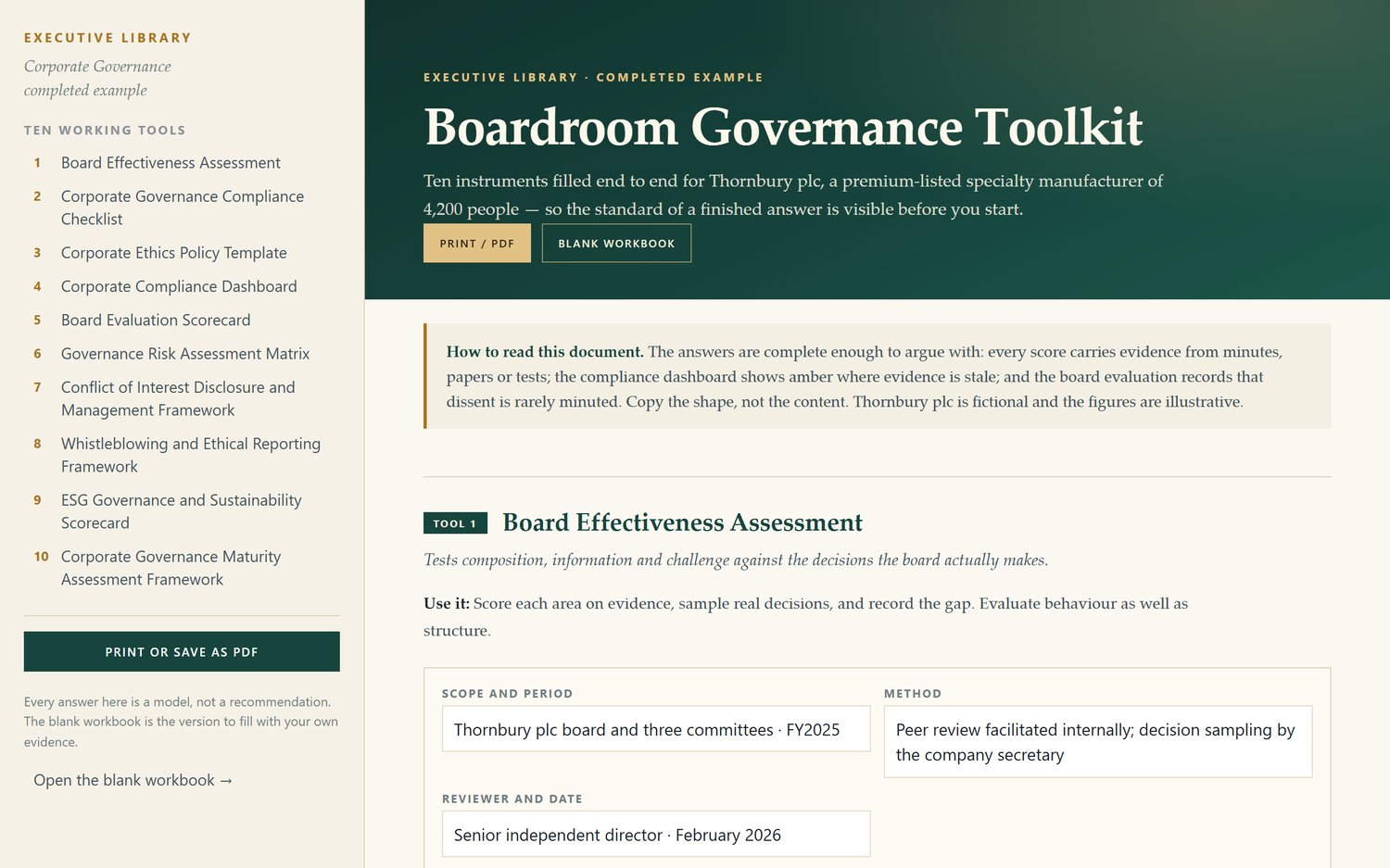
The product includes a completed worked example in which all ten tools are filled end to end for the fictional Thornbury plc — including the uncomfortable entries: a board effectiveness assessment with a genuine weakness, a governance risk matrix with the board's own failure modes, and a whistleblowing case involving a senior person.
WHAT'S INSIDE
15 CHAPTERS ACROSS FOUR PARTS OF BOARD GOVERNANCE
The handbook progresses from what a board is for, through the ethics, assurance and integrity mechanisms, to the long-term capability that determines whether governance survives pressure. The running case is Thornbury plc, a premium-listed specialty manufacturer with 4,200 employees, five divisions, £1.1 billion of revenue and a founding family holding of 26% — a company whose year includes a late supplier-quality disclosure, an internal control weakness and a whistleblowing case that tests the speak-up system.
PART I — FOUNDATIONS
01. Corporate Governance Fundamentals
Understand governance as the allocation of authority and accountability rather than the paperwork that records it. Examine the four questions governance answers, and which of them only the board can answer.
02. Board Structure and Responsibilities
Examine the roles that must remain distinct, and how independence is produced by structure, information and time. Explore composition, board papers, tenure and the conditions under which challenge is real.
03. Board Committees and Effectiveness
Understand what each committee actually owns, and what must never be delegated to it. Explore how committees do technical work properly without removing difficult subjects from the board.
04. Governance Frameworks and Principles
Examine the principles that survive translation across jurisdictions, and how to apply a code as a checklist of questions rather than a substitute for judgement. Explore comply-or-explain honestly.
PART II — ETHICS, COMPLIANCE AND ASSURANCE
05. Corporate Ethics and Integrity
Understand ethics as an operating system: incentives, decisions, escalation and consequence. Examine the four mechanisms that determine whether a code of conduct describes the company or flatters it.
06. Regulatory Compliance Management
Examine compliance as a managed risk with owners rather than a function that absorbs liability for the executive. Explore the obligation register, regulatory horizon and the evidence authorities expect.
07. Internal Controls and Assurance
Understand the difference between a control and the evidence that it operates. Explore the three lines honestly described, and how to build a test programme that survives pressure.
08. Audit Committee Responsibilities
Examine the judgements that matter to an audit committee, and the relationship with the external auditor. Explore how the committee becomes technically competent rather than outsourcing its judgement.
PART III — INTEGRITY IN PRACTICE
09. Conflict of Interest Management
Understand conflicts as normal and undeclared conflicts as the governance failure. Explore declaration, assessment, record and management — and why the register nobody reads is worse than no register.
10. Transparency and Corporate Disclosure
Examine the disclosure decision as a judgement about materiality and timing made under pressure. Explore how to write disclosure that survives hindsight, and what late disclosure costs.
11. Whistleblowing and Ethical Reporting
Understand a speak-up system as something judged by outcomes for the people who use it. Explore design that protects the reporter, and what to do when the concern is about a senior person.
PART IV — GOVERNING FOR THE LONG TERM
12. ESG Governance
Examine sustainability commitments as governance commitments that allocate capital, create obligations and expose the company to challenge. Explore targets with funded capital, defined metrics and assured numbers.
13. Governance Risk Assessment
Understand the board's own failure modes as a category of risk, and why they are rarely on the register. Explore how to assess information, composition, process, conduct, succession and disclosure risk.
14. Board Performance Evaluation
Examine evaluation as a mechanism for changing decision quality and behaviour rather than measuring satisfaction. Explore five levels of evaluation, honestly applied, and a three-year improvement rhythm.
15. Governance Maturity and Continuous Improvement
Understand maturity as the reliability of judgement under pressure rather than the volume of documentation. Explore how to place a board on a maturity scale using evidence, and choose one move for the coming year.
TEN EDITABLE BONUS WORKSHEETS INCLUDED
A COMPANION WORKBOOK WITH FILLABLE VERSIONS OF ALL TEN TOOLS
Understanding governance is important.
Applying it in a live board cycle requires structured tools that produce a decision or a piece of evidence.
This product includes a separate interactive workbook containing fillable versions of all ten tools. Answers save automatically in your browser, each tool can be exported to CSV, and the whole workbook prints cleanly to PDF for a signed record.
The tools fall into four groups: assess, assure, conduct and mature. Use only the ones that change a decision, a control or an owner. A completed template is not assurance.
ASSESS — THE BOARD AND ITS RISKS
TOOL 01 — BOARD EFFECTIVENESS ASSESSMENT
Tests composition, information and challenge against the decisions the board actually makes.
- Score each area on evidence, not impression.
- Sample real decisions from the last twelve months.
- Evaluate behaviour as well as structure.
- Record the gap and the action that closes it.
TOOL 05 — BOARD EVALUATION SCORECARD
Turns evaluation into measures of decision quality and behaviour rather than satisfaction.
- Score each measure from minutes, decision samples and attendance.
- Separate process from judgement.
- Agree one change for every measure below target.
- Record who owns the change and when it will be reviewed.
TOOL 06 — GOVERNANCE RISK ASSESSMENT MATRIX
Puts the board's own failure modes on the register, with owners and controls.
- Assess information, composition, process, conduct, succession and disclosure risk.
- Record the control and the residual exposure.
- Act on the top two, not the easiest six.
- Review the matrix with the risk committee each year.
ASSURE — COMPLIANCE AND CONTROLS
TOOL 02 — CORPORATE GOVERNANCE COMPLIANCE CHECKLIST
Confirms the structures and disclosures the company must maintain, and identifies what replaces any deviation.
- Work through each element against evidence.
- Note the deviation and the alternative control.
- Explain rather than conceal where practice differs.
- Record the date the position was last verified.
TOOL 04 — CORPORATE COMPLIANCE DASHBOARD
Shows the state of material obligations, incidents and remediation in one view.
- Track only obligations that could stop the business or create director liability.
- Record the evidence date and the owner for each.
- Show open incidents and remediation progress.
- Report the same measures to every committee.
TOOL 09 — ESG GOVERNANCE AND SUSTAINABILITY SCORECARD
Connects published sustainability commitments to capital, controls and assurance.
- Identify the material issues and the capital allocated.
- Define each metric with an owner and a method.
- Assure the reported numbers to the same standard as financial data.
- Record what is not yet measured and why.
CONDUCT — ETHICS, CONFLICTS AND SPEAKING UP
TOOL 03 — CORPORATE ETHICS POLICY TEMPLATE
Sets conduct standards in the language of the business, with examples and consequences.
- Keep it short enough to be read.
- Make each standard specific to a real situation.
- Connect every standard to how performance is rewarded.
- State the consequence of breach plainly.
TOOL 07 — CONFLICT OF INTEREST DISCLOSURE AND MANAGEMENT FRAMEWORK
Makes declaration routine, assessment consistent and management recordable.
- Require declaration at appointment, annually and at any relevant paper.
- Assess materiality to the specific decision.
- Record the management option chosen.
- Review the register with the board, not only the company secretary.
TOOL 08 — WHISTLEBLOWING AND ETHICAL REPORTING FRAMEWORK
Designs a speak-up system judged by outcomes for the people who use it.
- Provide independent routes and language access.
- Acknowledge quickly and investigate independently.
- Record the outcome and the remedy.
- Report themes — and cases involving senior people — to the audit committee.
MATURE — IMPROVEMENT OVER TIME
TOOL 10 — CORPORATE GOVERNANCE MATURITY ASSESSMENT FRAMEWORK
Places the board on a maturity scale using evidence rather than documentation.
- Assess each dimension against described levels.
- Cite the evidence for each rating.
- Distinguish documentation from operating practice.
- Choose one move for the coming year and fund it.
THE FIRST NINETY DAYS
A MODEST PLAN THAT PRODUCES VISIBLE GOVERNANCE CHANGE WITHIN A QUARTER
You do not need a new framework to begin. You need a small number of decisions taken differently, with evidence attached and owners named.
Days 1–30 · See the board's own exposure. Read the last twelve months of minutes and list the decisions only the board could have taken. Assess the information the board receives against the decisions it must make. Complete the governance risk matrix and name the two failure modes nobody has been discussing. Establish what evidence exists that the top three controls operated last year.
Days 31–60 · Make one thing evidenced. Take one control from design to operating evidence, with a dated test result. Review the conflict register against the last year's related-party decisions. Test the speak-up route from the reporter's side and record how long acknowledgement took. Put the obligation register in front of the audit committee with owners attached.
Days 61–90 · Change the rhythm. Run an evaluation that produces one agreed change per weak measure. Report the disclosure decision process, including a case where timing was contested. Fund one capability gap on the board or in the secretariat. Put the governance risk matrix on the annual board calendar.
What success looks like at day 90: one control with dated operating evidence; one board failure mode on the risk register with an owner; one conflict managed and recorded before the decision; one disclosure decision documented as it was made; and a speak-up case that reached the audit committee with a remedy attached.
WHO THIS IS FOR
- Chairs, non-executive directors and committee members who need to test whether the board's authority, information and assurance are real.
- CEOs, CFOs and executive directors who must separate what the board decides from what management owns.
- Company secretaries and governance professionals running the board cycle, the registers and the evaluation.
- Audit, risk and compliance leaders who need a shared language for control evidence and reporting.
- ESG and sustainability leads connecting published commitments to capital, controls and assurance.
- Consultants and director-development programmes that need a practical method rather than another code summary.
WHAT YOU RECEIVE
- The handbook — all 15 chapters, designed for screen reading and clean printing to PDF.
- The companion workbook — fillable versions of all ten tools, automatic browser saving, CSV export and print/PDF.
- The completed worked example — all ten tools filled end to end for Thornbury plc, so the standard of a finished answer is visible before you start.
- The first-90-days plan — see the board's exposure, make one thing evidenced, change the rhythm.
- Worked examples and working sketches — the Thornbury plc year used end to end, including a late disclosure and a senior-person concern.
- Boardroom questions — one at the end of every chapter, ready for the next board meeting.
- A working glossary — so the same word means the same thing in the meeting.
- Instant access — available immediately after checkout, with no subscription.
All three files are self-contained HTML documents. They open in any modern browser on desktop, tablet or phone, print cleanly to PDF, and require no installation or account.
A NOTE ON THE EXAMPLES
The running case, Thornbury plc, is fictional. It is a premium-listed specialty manufacturer with 4,200 employees, £1.1 billion of revenue, five divisions and a founding family holding of 26%. Its board has nine directors, four of them independent, and the usual three committees. In the year the book describes, a supplier quality issue was disclosed later than it should have been, an internal control weakness was found in a division, and a whistleblowing case tested the speak-up system.
All names, figures and outcomes are illustrative. They are included to show how a tool is used, not to suggest a template answer. Nothing here is a substitute for legal, regulatory, financial or professional advice, and no jurisdiction's code is reproduced.
Governance is not the volume of documentation. It is the reliability of judgement when the pressure is real.
Fifteen chapters. Ten working tools. Ninety days. One decision taken differently.
EXECUTIVE LIBRARY · LAKSHMIVASAN · FIRST EDITION, 2026
IMPORTANT DISCLAIMER
This product is provided for educational, analytical and decision-support purposes. All figures, estimates and results depend on the inputs and assumptions you supply, and on third-party data such as rates, prices and exchange rates, which change over time.
Nothing here is financial, legal, tax or customs advice, and no specific outcome, saving or result is guaranteed. Verify applicable rates, regulations and contractual terms with the relevant authorities and qualified professionals before acting on any result.