The Chief Human Resources Officer's Handbook
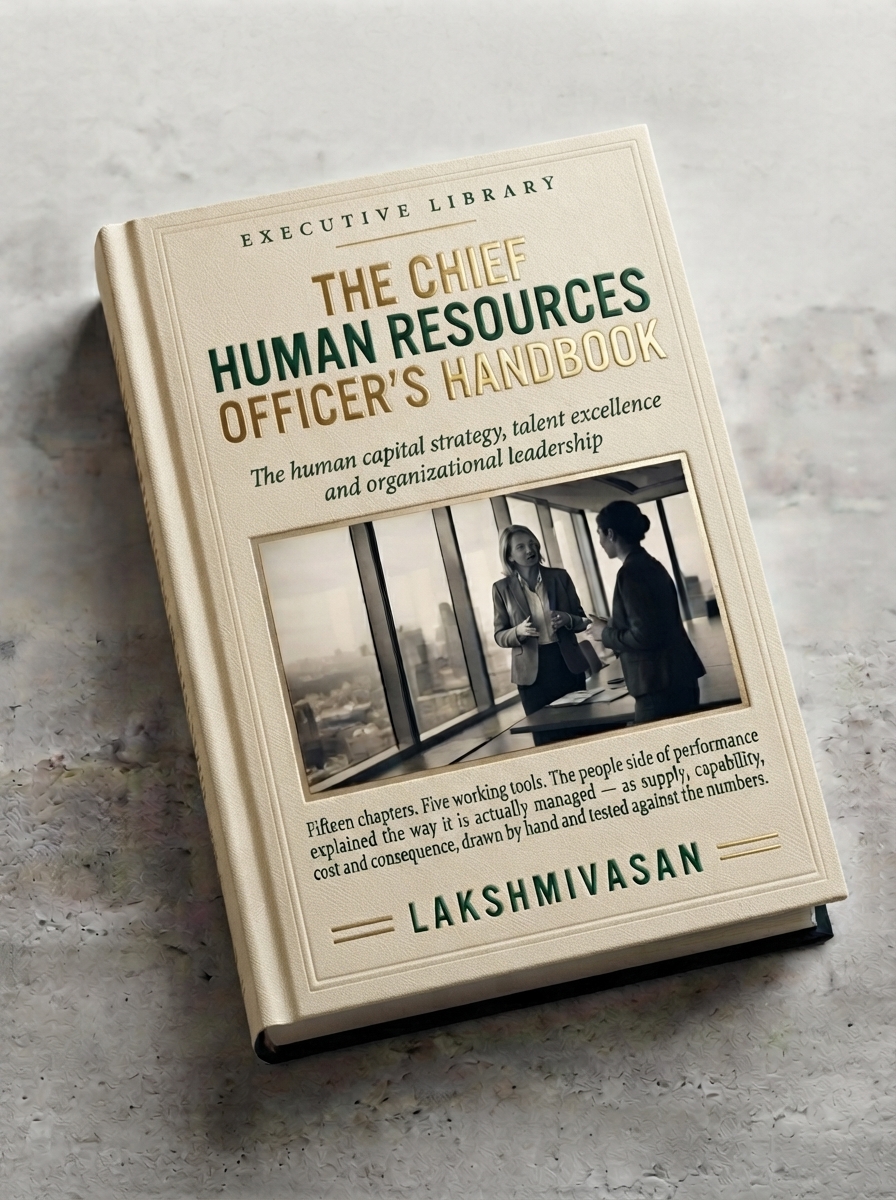
THE CHIEF HUMAN RESOURCES OFFICER'S HANDBOOK
HUMAN CAPITAL STRATEGY, TALENT EXCELLENCE AND ORGANIZATIONAL LEADERSHIP
EXECUTIVE LIBRARY | BY LAKSHMIVASAN
HUMAN CAPITAL IS A COST LINE UNTIL SOMEONE MANAGES IT AS A SUPPLY CHAIN.
A PRACTITIONER'S HANDBOOK FOR THE PEOPLE SIDE OF PERFORMANCE — CAPABILITY, COST AND CONSEQUENCE — WITH FIVE EDITABLE TOOLS FOR THE MEETINGS WHERE THOSE DECISIONS ARE ACTUALLY MADE.
The workforce is one of the largest investments an organization makes.
Yet workforce decisions are often made without the same discipline applied to capital expenditure, procurement, operational capacity, or financial planning.
Organizations recruit before understanding their capability gaps. Succession plans identify names without establishing readiness. Leadership development programmes measure participation rather than behavioural change. Engagement surveys produce scores without clear ownership of the actions that follow.
The result is a gap between the people strategy an organization describes and the workforce it actually needs.
The Chief Human Resources Officer's Handbook is a practical executive reference for the strategic management of human capital, organizational capability, talent, leadership, and workforce performance.
Across 15 chapters and six parts, it examines how the people function can move beyond programme administration and become a more effective contributor to organizational strategy.
It addresses the questions that matter to CHROs, HR directors, chief executives, CFOs, and business leaders:
- What workforce capabilities will the organization need to execute its strategy?
- Where should those capabilities come from?
- Which skills should the organization develop, recruit, acquire externally, or automate?
- How should workforce demand be translated into a realistic supply plan?
- How do you distinguish employee performance from potential?
- How do you identify successors and establish genuine readiness?
- How should leadership capability be defined and assessed?
- How do you connect employee engagement with measurable business outcomes?
- How should compensation, fairness, inclusion, and employee wellbeing be managed?
- How can workforce analytics improve decisions rather than simply produce more reports?
- How should organizations respond to technology, automation, and artificial intelligence?
- How do you understand the return on investment in human capital?
The handbook takes a practical position:
People decisions deserve the same quality of evidence, financial discipline, and strategic thinking as every other major business decision.
That does not mean treating employees as interchangeable resources. It means understanding the capabilities people bring, the conditions in which they perform, the investment required to develop them, and the organizational outcomes that depend on them.
A COMPLETE HUMAN CAPITAL MANAGEMENT FRAMEWORK
FROM HR PROGRAMMES TO STRATEGIC WORKFORCE LEADERSHIP
The modern CHRO is responsible for more than recruitment, employee relations, training, and performance reviews.
The role connects workforce capability with business strategy, organizational design, financial priorities, leadership continuity, culture, technology, and long-term performance.
This handbook brings those responsibilities together across six dimensions.
Strategy and workforce supply: Translate business strategy into workforce requirements, understand talent supply and demand, and develop practical workforce plans.
Leadership and organizational consequence: Build leadership capability, establish succession processes, and connect performance management with organizational expectations.
Engagement and culture: Understand employee experience, manage culture transformation, and develop learning systems that strengthen organizational capability.
Reward, fairness and wellbeing: Examine compensation, inclusion, employee relations, and wellbeing as interconnected dimensions of organizational effectiveness.
Data, technology and the future: Use workforce analytics, HR technology, and emerging AI capabilities to improve decision-making and prepare for changing work requirements.
Practical application: Convert the principles into five working instruments covering workforce planning, talent calibration, succession, leadership competencies, and engagement.
The result is an integrated view of human capital management that connects people decisions with organizational requirements and business performance.
WHAT MAKES THIS HANDBOOK DIFFERENT?
IT ANSWERS THE BOARD'S QUESTION, NOT JUST THE FUNCTION'S.
A traditional HR agenda often focuses on activities:
How many people were recruited? How many employees completed training? What was the engagement score? How many performance reviews were completed?
These measures may be useful, but they do not necessarily answer the questions that matter most to the organization.
What capability will the business need? Where will it come from? What will it cost? What risks arise if the capability is unavailable? And how will the organization know whether the investment is working?
This handbook takes a more strategic approach.
1. IT CONNECTS PEOPLE STRATEGY WITH BUSINESS STRATEGY
Workforce planning begins with the operating plan, not simply last year's headcount.
Understand how business priorities translate into role requirements, skills, leadership capacity, and workforce investment.
2. IT TREATS TALENT AS A SUPPLY DECISION
Not every capability needs to be developed internally.
Some capabilities should be built through development and internal progression. Others may be acquired through recruitment, borrowed through external partnerships, or supported by automation.
The handbook explores the build, buy, borrow, and automate approach as a practical workforce strategy.
3. IT BRINGS EVIDENCE INTO TALENT DECISIONS
Performance, potential, succession readiness, and leadership capability require more than impressions.
Develop clearer evidence standards, improve calibration discussions, and distinguish current performance from future capability.
4. IT CONNECTS EMPLOYEE EXPERIENCE WITH BUSINESS OUTCOMES
Engagement is not simply a survey score.
The handbook explores how employee experience can be evaluated alongside workforce stability, productivity, performance, retention, and other relevant organizational measures.
5. IT IS BUILT FOR PRACTICAL USE
Each chapter leads towards a management decision.
The five working instruments convert the concepts into practical resources for planning, talent review, succession, leadership development, and engagement management.
6. IT RECOGNIZES THE HUMAN REALITY
Managing human capital strategically is not about reducing people to financial calculations.
It is about making better decisions concerning capability, opportunity, fairness, development, workload, leadership, and organizational performance.
People deserve more than intuition and an annual survey. They deserve thoughtful management supported by meaningful evidence.
WHAT'S INSIDE
15 CHAPTERS ACROSS SIX PARTS OF STRATEGIC HUMAN CAPITAL MANAGEMENT
PART I — STRATEGY AND SUPPLY
01. Strategic Human Capital Management
Understand how human capital strategy supports corporate objectives. Explore the CHRO's strategic responsibilities, workforce capability, organizational priorities, and the relationship between people investment and business performance.
02. Workforce Strategy and Planning
Translate operating requirements into workforce demand and supply. Understand role families, capability gaps, attrition, workforce scenarios, capacity requirements, and the build, buy, borrow, and automate approach.
03. Talent Acquisition and Employer Brand
Develop a strategic approach to attracting and acquiring talent. Explore workforce requirements, recruitment planning, employer positioning, candidate experience, selection, and the relationship between hiring decisions and long-term organizational capability.
PART II — LEADERSHIP AND CONSEQUENCE
04. Leadership Development
Understand how to develop leadership capability at different organizational levels. Explore leadership competencies, development priorities, practical assignments, coaching, and the connection between leadership behaviour and organizational results.
05. Executive Succession
Develop a structured approach to leadership continuity. Understand critical roles, succession coverage, readiness assessment, emergency replacement planning, development assignments, and succession risk.
06. Performance Management
Build performance management practices that connect individual contribution with organizational objectives. Explore expectations, accountability, feedback, performance calibration, development, and fair management of performance concerns.
PART III — ENGAGEMENT AND CULTURE
07. Employee Engagement and Experience
Understand the factors that influence employee experience, commitment, motivation, and organizational participation. Explore measurement, feedback, manager accountability, employee listening, and meaningful follow-through.
08. Culture Transformation
Understand how organizational culture influences behaviour, decision-making, collaboration, and performance. Explore culture assessment, leadership alignment, organizational change, and the practical work of embedding desired behaviours.
09. Learning and Development
Connect learning investment with organizational capability requirements. Explore skills development, learning needs analysis, development planning, leadership learning, and the evaluation of learning effectiveness.
PART IV — REWARD, FAIRNESS AND WELLBEING
10. Compensation and Rewards
Understand how compensation structures, incentives, recognition, and benefits influence talent attraction, retention, motivation, and organizational cost. Explore reward principles, internal consistency, external competitiveness, and performance alignment.
11. Diversity, Equity and Inclusion
Examine how organizations can build fairer and more inclusive working environments. Explore representation, opportunity, access, inclusive leadership, workforce practices, and meaningful approaches to measuring progress.
12. Employee Relations and Wellbeing
Understand the importance of employee relations, workplace trust, wellbeing, organizational responsibilities, and fair treatment. Explore how managers and HR leaders can address concerns while respecting applicable employment requirements and organizational policies.
PART V — DATA, TECHNOLOGY AND THE FUTURE
13. Workforce Analytics and HR Technology
Develop a more evidence-based approach to human capital decisions. Explore workforce metrics, analytical thinking, HR information systems, data quality, technology integration, and responsible use of employee information.
14. The Future of Work and Artificial Intelligence
Understand how technology, automation, AI, changing skill requirements, and new working arrangements influence organizational capability. Explore workforce adaptation, reskilling, technology adoption, and the changing responsibilities of HR leadership.
15. Measuring Human Capital ROI
Connect workforce investment with organizational outcomes. Explore human capital costs, productivity, capability development, retention, workforce effectiveness, and the challenge of evaluating returns from people-related investment.
PART VI — THE PRACTICAL TOOLKIT
The final part brings the handbook's ideas into five practical working instruments, each supported by a worked example.
- Workforce Planning Model.
- Talent Review Matrix.
- Succession Planning Template.
- Leadership Competency Framework.
- Engagement Dashboard.
These instruments help translate strategic thinking into structured workforce decisions.
FIVE EDITABLE BONUS WORKSHEETS INCLUDED
FIVE PRACTICAL TOOLS FOR THE PEOPLE DECISIONS THAT SHAPE BUSINESS PERFORMANCE
The handbook includes five working instruments within its chapters.
You also receive five separate editable HTML worksheets, rebuilt so that you can apply the frameworks using your own workforce information.
Each worksheet can be completed directly in a modern browser.
Type into the fields, tick the relevant boxes, allow your entries to autosave in your browser, download a completed copy, or print and save as PDF.
BONUS 01 — WORKFORCE PLANNING MODEL
A structured tool for connecting workforce demand with available talent supply and future capability requirements.
What it helps you do:
- Translate the operating plan into workforce demand.
- Estimate talent supply after expected attrition.
- Identify workforce gaps by role family.
- Assess internal development and external recruitment options.
- Evaluate build, buy, borrow, and automate alternatives.
- Consider fully loaded workforce costs.
- Establish dated downside triggers and review points.
The outcome: A more disciplined workforce plan that connects business demand, talent availability, capability gaps, cost, and practical sourcing decisions.
BONUS 02 — TALENT REVIEW MATRIX
A structured framework for improving talent calibration and making clearer decisions about employee performance and potential.
What it helps you do:
- Assess performance against potential.
- Define the evidence required to support assessments.
- Structure the nine-box talent review.
- Connect each position with an appropriate development or management decision.
- Record movement between review periods.
- Challenge assumptions and subjective labels.
- Establish more consistent calibration discussions.
The outcome: More evidence-based talent reviews, clearer development priorities, and better-quality discussions about future capability.
BONUS 03 — SUCCESSION PLANNING TEMPLATE
A practical instrument for identifying critical-role continuity requirements and developing future leadership readiness.
What it helps you do:
- Identify roles requiring succession coverage.
- Separate emergency cover from ready-now succession capability.
- Record potential successors and readiness evidence.
- Identify capability gaps.
- Assign a meaningful stretch assignment to each development candidate.
- Define evidence required to demonstrate readiness.
- Review succession progress before a vacancy occurs.
The outcome: A more practical succession process that distinguishes immediate continuity from genuine future leadership capability.
BONUS 04 — LEADERSHIP COMPETENCY FRAMEWORK
A working framework for defining and evaluating leadership behaviours across different organizational levels.
What it helps you do:
- Identify four or five important leadership competencies.
- Describe observable behaviour at three levels.
- Establish competency requirements by role.
- Record evidence of capability and development limitations.
- Identify individual development priorities.
- Define one practical development commitment per person.
- Review leadership progress over time.
The outcome: A clearer and more consistent approach to leadership assessment and development, based on observable behaviour rather than vague descriptions.
BONUS 05 — ENGAGEMENT DASHBOARD
A practical dashboard for connecting employee experience measures with organizational outcomes and management accountability.
What it helps you do:
- Track relevant employee experience measures.
- Pair engagement indicators with meaningful business outcomes.
- Review information at team level.
- Establish named owners for follow-up actions.
- Define thresholds that trigger attention.
- Maintain an action log.
- Retire measures that no longer support useful decisions.
The outcome: A more actionable engagement management process that moves beyond survey results and focuses on ownership, improvement, and follow-through.
WHY THESE FIVE TOOLS MATTER
Workforce decisions are often discussed in meetings but not translated into consistent management processes.
A workforce plan may exist without a clear supply strategy. A talent review may produce labels without development actions. A succession discussion may identify names without establishing readiness. An engagement survey may generate feedback without accountability.
The five worksheets help address these gaps.
Editable worksheetManagement applicationWorkforce Planning ModelWorkforce demand, supply and capability gapsTalent Review MatrixPerformance, potential and talent calibrationSuccession Planning TemplateLeadership continuity and readinessLeadership Competency FrameworkLeadership standards and developmentEngagement DashboardEmployee experience and management action
Together, they provide a practical foundation for five recurring CHRO responsibilities.
DESIGNED AROUND YOUR OWN WORKFORCE DATA
These are not static illustrations that you can only read.
They are editable HTML tools designed to accept your own information, definitions, thresholds, and assumptions.
You can:
- Enter information directly into the worksheets.
- Tick interactive checkboxes.
- Save entries automatically in your browser.
- Download your completed worksheet as a separate file.
- Print your completed work or save it as PDF.
- Use the original blank worksheet again for another review.
Your completed files remain in your browser environment rather than being submitted to a vendor's server.
Because workforce information may include personal data, you remain responsible for appropriate access controls, secure storage, retention, and deletion.
WHO SHOULD USE THIS HANDBOOK?
The Chief Human Resources Officer's Handbook is designed for senior HR professionals and business leaders who need a more strategic and commercially grounded approach to workforce management.
Chief Human Resources Officers and HR Directors
You are responsible for workforce strategy, organizational capability, leadership development, succession, engagement, and the overall direction of the people function.
Use the handbook to connect HR priorities with business strategy and strengthen the role of human capital in executive decision-making.
HR Business Partners
You work directly with operational and functional leaders and need to translate people issues into practical business decisions.
Develop stronger workforce planning, talent calibration, performance, engagement, and analytical capabilities.
Financial and Business Leaders
You need to understand the people implications of organizational growth, restructuring, workforce investment, productivity, and capability requirements.
Use the handbook to connect workforce decisions with financial and operational realities.
Chief Executives and Business Owners
You are responsible for ensuring that the organization has the people and leadership capability required to execute its strategy.
Use the handbook to understand workforce supply, leadership continuity, human capital investment, and organizational performance.
Managers Responsible for Talent and Succession
You lead teams and participate in performance reviews, talent calibration, succession discussions, and employee engagement activities.
Use the practical tools to establish more structured and evidence-based management practices.
WHAT YOU RECEIVE
THE COMPLETE EXECUTIVE LIBRARY HANDBOOK
The Chief Human Resources Officer's Handbook
- 15 practical chapters.
- Six structured parts covering strategic human capital management.
- 18 hand-drawn figures.
- Five working instruments within the handbook.
- Worked examples for all five practical tools.
- Workforce strategy and planning.
- Talent acquisition and employer brand.
- Leadership development and executive succession.
- Performance management.
- Employee engagement and culture.
- Compensation, inclusion, and wellbeing.
- Workforce analytics and HR technology.
- The future of work and artificial intelligence.
- Human capital return on investment.
- Self-contained HTML format.
- Designed for desktop and mobile reading.
- Works offline after download.
FIVE SEPARATE EDITABLE HTML WORKSHEETS
- Workforce Planning Model.
- Talent Review Matrix.
- Succession Planning Template.
- Leadership Competency Framework.
- Engagement Dashboard.
Each worksheet supports direct browser editing, checkbox interaction, browser-based autosaving, downloading a completed copy, and printing or saving as PDF.
INSTANT DIGITAL ACCESS
Download the handbook and five separate worksheets.
Open the files in a modern browser and use them on your preferred device.
No additional app, account, or internet connection is required after downloading.
FREQUENTLY ASKED QUESTIONS
1. What exactly do I receive?
You receive the complete handbook as a self-contained HTML file and five separate editable HTML worksheets:
- Workforce Planning Model.
- Talent Review Matrix.
- Succession Planning Template.
- Leadership Competency Framework.
- Engagement Dashboard.
The handbook also contains five working instruments, eighteen hand-drawn figures, and worked examples.
2. Can I edit the five bonus worksheets?
Yes. The worksheets are designed for direct browser editing.
Click into a blank field or line, enter your information, and tick the applicable boxes. Your answers autosave in your browser.
You can use the Download Filled Copy function to save your completed work as a separate file.
3. Do I need an application or internet connection?
No. A modern browser is sufficient.
The HTML files are self-contained and designed to work offline after downloading.
4. Can I print the handbook and worksheets?
Yes. Each file includes print styles.
Use the browser's print function or save-as-PDF option. Check the page scaling and paper settings for A4 or US Letter.
5. Can I use the worksheets with my own workforce data?
Yes. That is their intended purpose.
The examples are illustrative. Replace them with your own workforce data, organizational definitions, assessment criteria, and thresholds.
6. Can the talent and succession tools hold employee names?
Yes. You can use employee names or role codes where appropriate.
However, completed worksheets containing identifiable employee information should be treated as personal data. Restrict access, store the files securely under your organization's retention rules, and delete them when the exercise closes.
7. Is the handbook suitable for HR professionals who are not CHROs?
Yes. It is relevant to HR directors, HR business partners, talent leaders, workforce planning professionals, and other practitioners preparing for broader strategic responsibilities.
8. Does it cover workforce planning and human capital analytics?
Yes. It covers workforce strategy, demand and supply planning, role-family gaps, workforce analytics, HR technology, engagement measures, and human capital ROI.
9. Does it address artificial intelligence and the future of work?
Yes. One chapter examines the future of work, artificial intelligence, automation, changing skill requirements, and the implications for workforce capability and HR leadership.
10. Is this professional or legal advice?
No. This is a general management reference and working aid, not legal, tax, accounting, employment, immigration, regulatory, or other professional advice.
Frameworks, thresholds, and worked numbers are illustrative. Validate them against your workforce data, operating model, jurisdiction, and legal obligations.
PLAN THE CAPABILITY BEFORE YOU RECRUIT FOR IT.
THE FUTURE OF YOUR BUSINESS DEPENDS ON THE CAPABILITY OF THE PEOPLE WHO WILL RUN IT.
A workforce strategy should answer more than how many people an organization needs.
It should explain which capabilities matter, where they will come from, what they will cost, how leadership continuity will be protected, and how the organization will know whether its people investments are producing meaningful results.
That requires a more disciplined approach to workforce planning, talent decisions, leadership development, succession, engagement, and organizational performance.
The Chief Human Resources Officer's Handbook brings these responsibilities together in one practical executive resource.
15 Chapters. 18 Hand-Drawn Figures. 5 Working Instruments. 5 Editable HTML Worksheets.
A connected framework for human capital strategy, talent excellence, and organizational leadership.
PLAN THE CAPABILITY BEFORE YOU RECRUIT FOR IT.
GET THE HANDBOOK + 5 EDITABLE TOOLS
Instant download. Works offline.
IMPORTANT DISCLAIMER
This handbook and its accompanying worksheets are provided as a general management reference on human capital, people strategy, and organizational practice.
They do not constitute legal, tax, accounting, employment, immigration, regulatory, or other professional advice.
Frameworks, assessment criteria, thresholds, and worked figures are illustrative. Recalculate and validate them against your own workforce data, operating model, organizational policies, jurisdiction, and applicable legal obligations.
Particular care should be taken when handling employee names, talent assessments, succession information, performance records, and engagement data.
All decisions taken on the basis of this material remain the responsibility of the reader and the reader's organization.