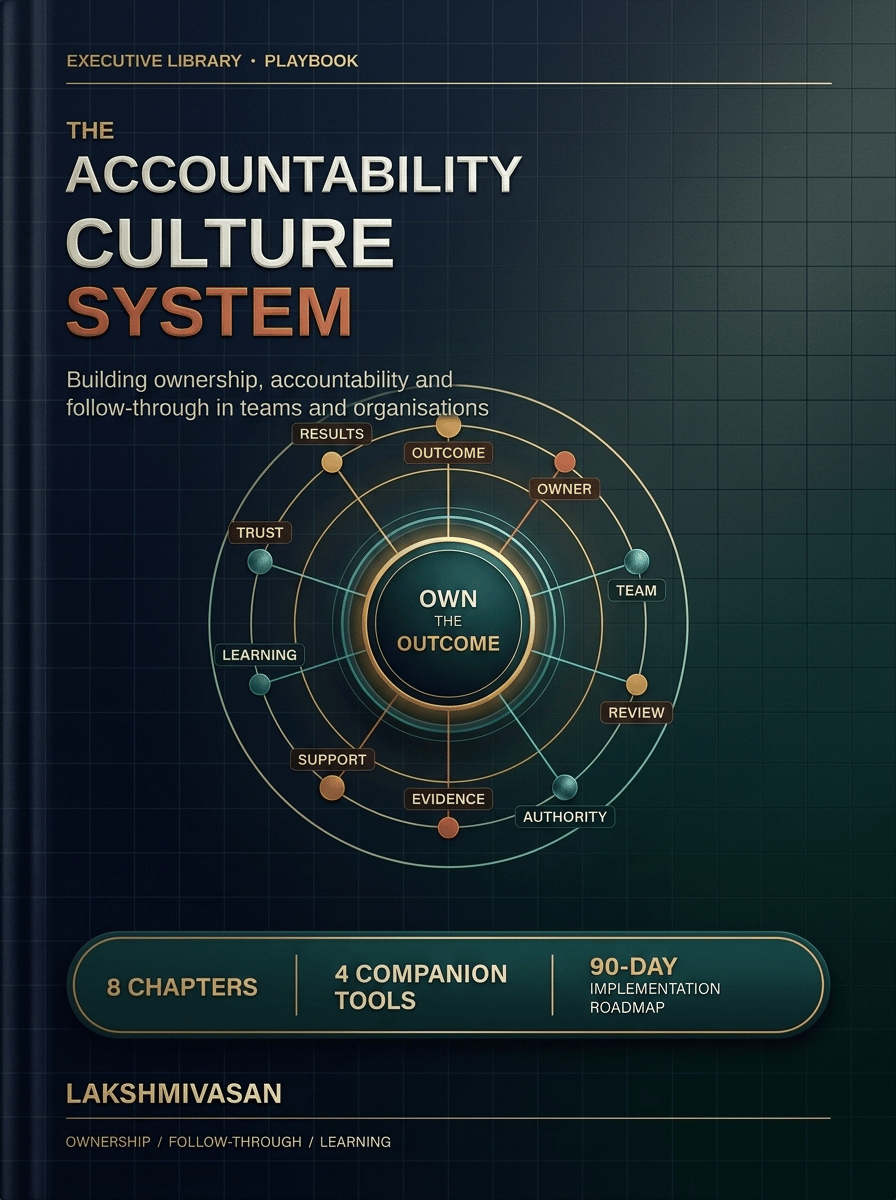



The Accountability Culture System
EXECUTIVE LIBRARY | BY LAKSHMIVASAN
ACCOUNTABILITY IS A DESIGN PROBLEM, NOT A CHARACTER TRAIT.
AN EIGHT-CHAPTER PLAYBOOK FOR LEADERS WHO ARE TIRED OF CHASING COMMITMENTS — WITH FOUR WORKING TOOLS AND A 90-DAY ROLLOUT.
Most accountability problems are diagnosed as attitude. Somebody is not committed, not detailed enough, not senior enough to care. The remedy is a conversation, a firmer tone, a reminder in the weekly meeting, and three weeks later the same commitment is late again.
The pattern repeats because the cause was never attitude. It was design. The outcome was never defined in terms a person could own, the authority did not match the consequence, the commitment lived in someone's memory rather than in a visible register, and the consequence for missing it was indistinguishable from the consequence for hitting it.
The Accountability Culture System treats accountability as something you build rather than something you demand. It moves from diagnosis to design to rhythm: find where ownership actually breaks, define outcomes and commitments so that they can be tracked, match decision rights to responsibility, and run a conversation cadence that coaches instead of interrogates.
It answers the questions that matter to the people who have to make it work:
- Why does accountability fail by design in otherwise competent organisations?
- How do you tell the difference between task completion and genuine ownership?
- What are the five ingredients every accountable commitment needs?
- Why does authority have to match consequence, and what happens when it does not?
- How should an accountability conversation run, so that it produces a plan rather than defensiveness?
- What counts as a fair consequence, and when should you repair rather than replace?
- How do you make accountability work across teams, at hand-offs and shared outcomes?
- Which measures reveal an accountability system that is working — and which distort it?
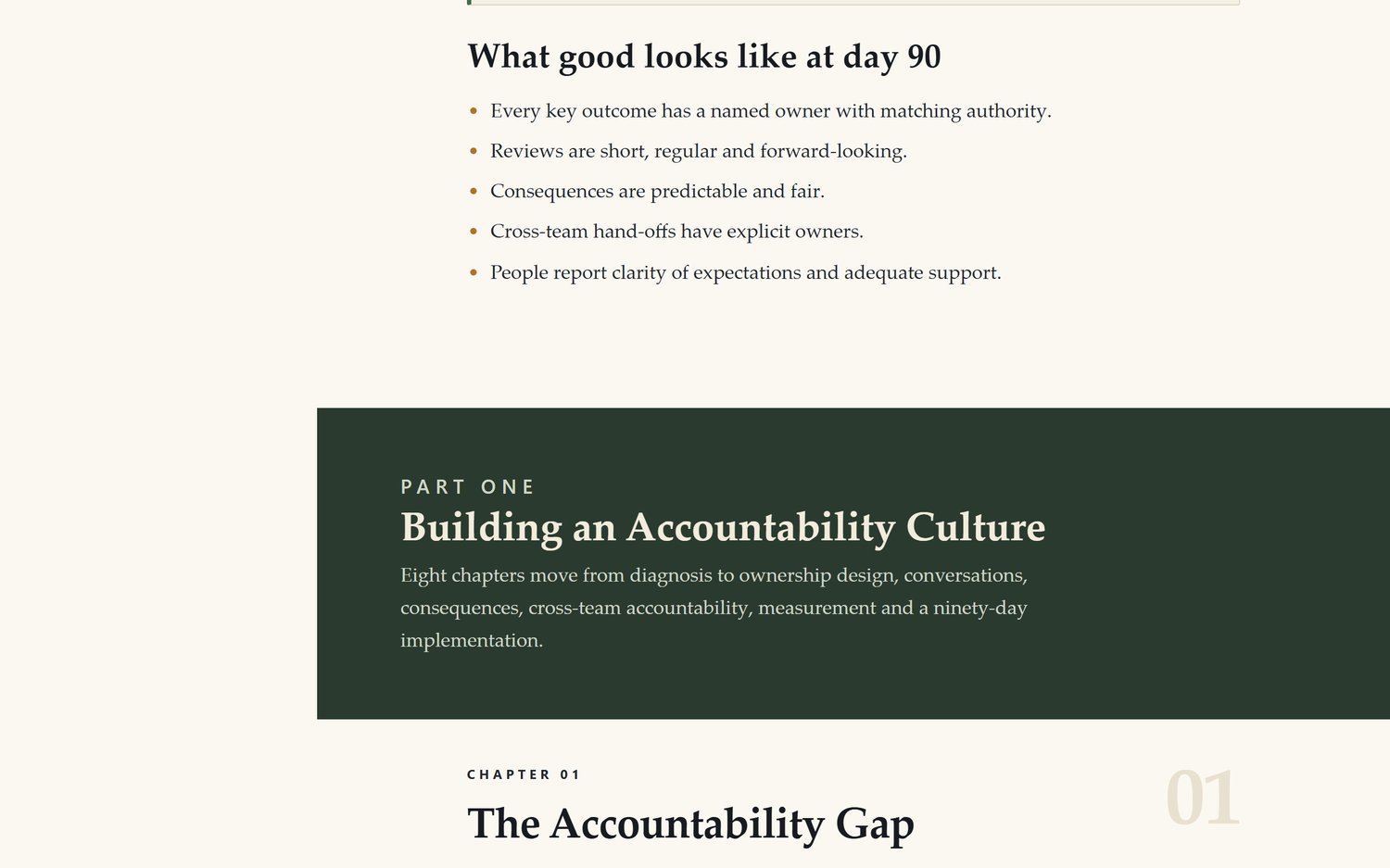
- What does a ninety-day rollout look like, week by week?
People own what they can see, decide and be measured on. Everything else is a task with a deadline attached.
EIGHT CHAPTERS, FROM DIAGNOSIS TO A WORKING RHYTHM
Part I · Diagnose
- The Accountability Gap — why accountability fails by design
- Locating the gap in your own organisation, with evidence rather than anecdote
- Ownership vs. task completion — the difference that changes the conversation
- Making commitments visible so that they can be kept
Part II · Design
- The five ingredients of an accountable commitment
- Matching authority to consequence — and the cost of the mismatch
- The accountability conversation — coaching, not interrogating
- Frequency and rhythm: the cadence that replaces chasing
- Fair consequences, and repairing before replacing
Part III · Sustain
- Accountability across teams: shared outcomes with named owners
- Hand-offs as accountability moments
- Measuring accountability with balanced measures
- Reading the system before acting on the person
- The 90-day implementation roadmap in three phases
THE WORKING TOOLS
Each tool is provided as a fillable HTML page, with a second copy already completed so that you can see what a finished answer looks like before you write your own.
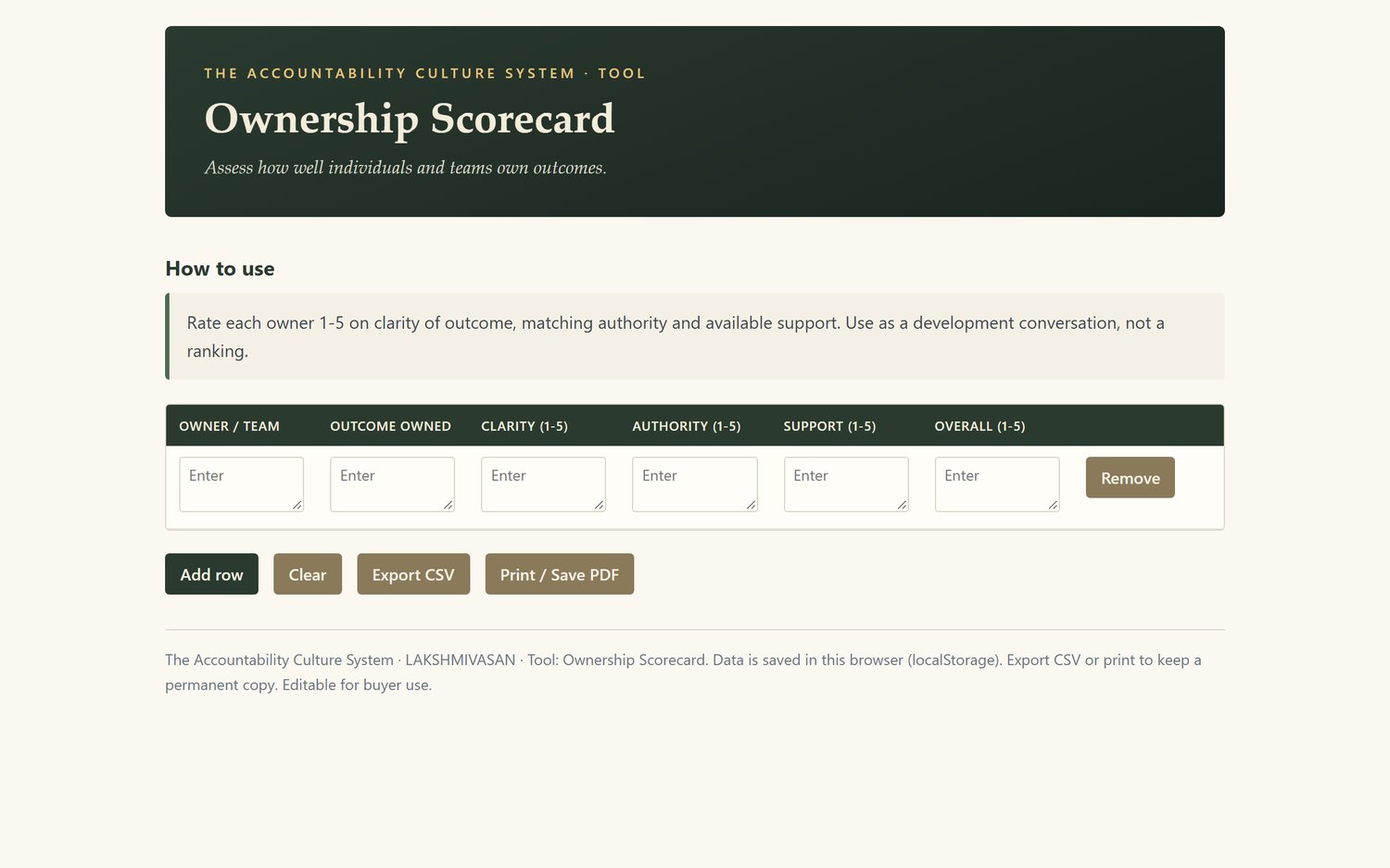
- Ownership Scorecard — Score outcomes against ownership behaviours across a team or function, and see where task completion is masking a gap.
- Performance Tracker — A twelve-week commitment register: owner, outcome, date, evidence, status and the consequence agreed up front.
- Problem-Solving Templates — Three structured templates for the situations accountability usually collapses into: a missed commitment, a recurring defect and a cross-team hand-off.
- Team Accountability Implementation Guide — The facilitator's sequence for rolling the system out with a leadership team, including the kick-off agenda and the first four conversations.
WHAT YOU RECEIVE
- accountability-playbook.html — The full playbook: eight chapters, facilitator guide, guardrails, worked case and glossary.
- ownership-scorecard.html — The blank ownership scorecard, ready to fill in.
- performance-tracker.html — The blank twelve-week commitment register.
- problem-solving-templates.html — Three blank templates for missed commitments, recurring defects and hand-offs.
- sample-filled-*.html — Completed versions of all four tools, filled in for a worked example.
- bundle-index.html — A single index page linking the whole set.
All files are self-contained HTML documents. They open in any modern browser on desktop, tablet or phone, print cleanly to PDF, and require no installation or account.
FREQUENTLY ASKED QUESTIONS
Who is this for?
Senior managers, operations leaders, HR partners and founders who are accountable for delivery and tired of re-chasing the same commitments.
Is it a book or a set of templates?
Both. The eight chapters supply the method; the four tools and their completed examples are what you actually use in the meeting.
Do I need special software?
No. Every file is self-contained HTML. It opens in any modern browser, prints to PDF, and needs no account or installation.
How long does it take to implement?
The roadmap is written for ninety days. Most teams get the baseline and the commitment register running in the first three weeks.
Can I reuse it with my own team?
Yes. The tools are yours to copy, adapt and reuse inside your organisation.
A NOTE ON THE EXAMPLES
The running case is a fictional distribution business of 420 people, mid-way through a service turnaround, where commitments are routinely made in meetings and quietly renegotiated afterwards. All figures and outcomes are illustrative. They show how a tool is used, not a template answer, and nothing here substitutes for legal, employment or professional advice.
Ownership is designed, then practised. Start with one commitment register and one honest conversation.
EXECUTIVE LIBRARY · LAKSHMIVASAN · FIRST EDITION, 2026
IMPORTANT DISCLAIMER
This product is provided for educational, analytical and decision-support purposes. All figures, estimates and results depend on the inputs and assumptions you supply, and on third-party data such as rates, prices and exchange rates, which change over time.
Nothing here is financial, legal, tax or customs advice, and no specific outcome, saving or result is guaranteed. Verify applicable rates, regulations and contractual terms with the relevant authorities and qualified professionals before acting on any result.