Enterprise Process Optimization
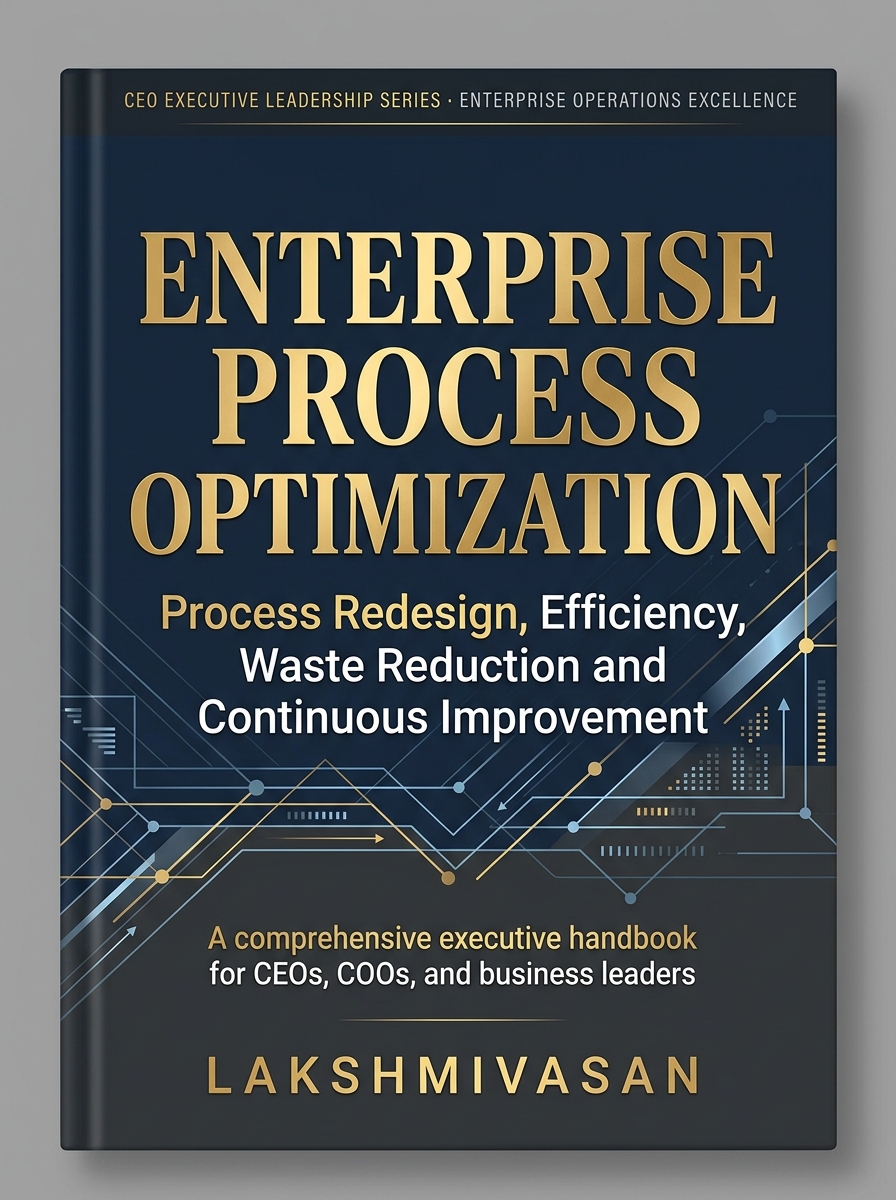
ENTERPRISE PROCESS OPTIMIZATION
PROCESS REDESIGN, EFFICIENCY, WASTE REDUCTION AND CONTINUOUS IMPROVEMENT
EXECUTIVE LIBRARY | BY LAKSHMIVASAN
MAKE THE WORK WORK BETTER.
A CEO-LEVEL HANDBOOK FOR REDESIGNING HOW WORK MOVES THROUGH THE ENTERPRISE — WITH 30 EDITABLE TOOLS FOR PROCESS ASSESSMENT, REDESIGN, AUTOMATION AND SUSTAINED IMPROVEMENT.
Every organization depends on processes.
Orders must be received and fulfilled. Customers must be served. Information must move between departments. Decisions must be made. Resources must be allocated. Products and services must be delivered. Financial, operational and administrative activities must be completed.
These activities collectively determine how an organization performs.
Yet many enterprises continue to operate with processes that have developed over time rather than being deliberately designed.
Work moves through unnecessary approval stages. Departments maintain overlapping responsibilities. Information is repeatedly entered into different systems. Employees spend time correcting avoidable errors. Decisions wait for handoffs. Manual activities continue even when better alternatives may exist.
Individual departments may appear productive while the overall process remains slow, expensive or difficult to manage.
The result is operational friction that affects cost, productivity, service quality, customer experience and organizational capacity.
The problem is not necessarily that employees are working inefficiently.
Often, the work itself has not been designed effectively.
Enterprise Process Optimization is a practical executive handbook for examining how work moves through an organization, identifying the conditions that limit performance and establishing a disciplined approach to process improvement.
It brings together process architecture, process assessment, workflow mapping, operational redesign, Lean management, Six Sigma, waste reduction, automation, performance measurement, governance and continuous improvement.
Across 25 chapters and five structured parts, the handbook examines how organizations can move from fragmented departmental activities towards integrated, measurable and better-controlled business processes.
It addresses the questions that matter to CEOs, COOs, managing directors, operations leaders and transformation professionals:
- How can an organization identify its most important enterprise processes?
- How should processes be mapped across departmental boundaries?
- Where do delays, unnecessary handoffs and duplicated activities occur?
- How can process performance be assessed using reliable operational evidence?
- How should organizations identify and eliminate avoidable waste?
- When is process improvement sufficient, and when is complete redesign necessary?
- How can Lean and Six Sigma methods support operational improvement?
- How should organizations establish standard operating procedures and process controls?
- Which processes are suitable for automation?
- How should digital transformation be connected to actual operational requirements?
- Which KPIs demonstrate improvements in cycle time, productivity, quality and cost?
- How should process risks, internal controls and accountability be managed?
- How can continuous improvement become part of everyday management?
- What should CEOs and executive teams review to maintain process performance?
The central principle is straightforward:
Operational performance is determined not only by the people performing the work, but also by the way the work is designed, connected, controlled and continuously improved.
This handbook provides a structured management perspective for examining that system.
A COMPLETE FRAMEWORK FOR ENTERPRISE PROCESS OPTIMIZATION
FROM PROCESS UNDERSTANDING TO SUSTAINED OPERATIONAL PERFORMANCE
Process optimization is often approached as a collection of isolated efficiency projects.
One department attempts to reduce costs. Another introduces automation. A third revises its procedures. A fourth introduces new performance indicators.
These initiatives may produce local improvements without necessarily improving the overall enterprise process.
An effective process optimization approach begins with the complete flow of work.
It examines the customer outcome, the activities required to deliver it, the departments involved, the information exchanged, the controls applied, the resources consumed and the results achieved.
This handbook organizes that approach into five interconnected management dimensions.
PART I — UNDERSTAND AND DESIGN
Establish the foundations of process optimization.
Understand enterprise process architecture, identify critical processes, assess their importance and document how work currently moves through the organization.
PART II — IMPROVE FLOW AND QUALITY
Examine how processes can be redesigned to improve operational flow, eliminate unnecessary activities, reduce errors and establish consistent working methods.
Explore Lean management, Six Sigma, DMAIC, standardization and operational control.
PART III — DIGITAL, DATA AND VALUE
Connect process improvement with technology, automation, performance measurement, cost management, workforce productivity, supply chain effectiveness and customer experience.
Evaluate technology according to the process problem it is intended to address.
PART IV — PEOPLE, RISK AND GOVERNANCE
Recognize the importance of workforce capabilities, employee involvement, internal controls, process ownership, risk management and organizational accountability.
PART V — LEAD, TRANSFORM AND SUSTAIN
Establish the leadership, governance and continuous improvement arrangements required to maintain process performance over time.
Examine enterprise transformation, benchmarking, process innovation and long-term value creation.
Together, these dimensions provide an integrated management approach for understanding, redesigning and managing enterprise processes.
WHAT MAKES THIS HANDBOOK DIFFERENT?
IT LOOKS AT THE COMPLETE PROCESS, NOT JUST INDIVIDUAL DEPARTMENTS.
Many improvement initiatives begin with a departmental problem.
A department experiences delays, so its workflow is revised. A function has high administrative costs, so automation is introduced. A team experiences quality problems, so additional checks are added.
However, the original problem may exist somewhere else in the process.
The delay may be caused by an approval dependency in another department. The administrative cost may result from duplicated information requirements. The quality problem may originate much earlier in the workflow.
This handbook takes an enterprise-wide perspective.
1. END TO END, NOT DEPARTMENT BY DEPARTMENT
A process should be understood from the initial requirement to the final outcome.
The handbook examines how organizations can identify process boundaries, map activities, understand handoffs and evaluate the relationship between departments.
It considers the complete sequence of work rather than optimizing one function at the expense of another.
The objective is to improve the overall process outcome, not simply increase the apparent efficiency of individual departments.
2. EVIDENCE BEFORE OPINION
Process improvement should begin with a clear understanding of current performance.
An organization cannot reliably evaluate an improvement without understanding its existing baseline.
The handbook examines the importance of establishing measures such as:
- Process cycle time.
- Processing and waiting time.
- First-pass yield.
- Error and rework rates.
- Cost per transaction or process.
- Resource utilization.
- Workforce effort.
- Service-level performance.
- Customer experience.
- Operational and control risks.
It emphasizes defining the measurement method, data source, baseline and assumptions before proposing improvement targets.
An improvement proposal should be supported by operational evidence rather than an unsupported estimate of potential savings.
3. WASTE IDENTIFICATION AND PROCESS REDESIGN
Not every operational problem requires additional resources, software or employees.
Sometimes the better approach is to remove unnecessary activities, simplify approvals, reduce repeated data entry, clarify responsibilities or redesign the sequence of work.
The handbook explores waste identification, Lean management, process reengineering, root cause analysis and structured improvement methods.
It distinguishes between correcting symptoms and addressing the underlying causes of process problems.
4. AUTOMATION AFTER PROCESS UNDERSTANDING
Automating an inefficient process does not automatically make it an efficient process.
A poorly designed workflow can become more difficult to manage when unnecessary steps and unclear responsibilities are embedded in technology.
The handbook examines how organizations should evaluate automation opportunities against process complexity, transaction volume, exception frequency, data quality, control requirements and expected business value.
The emphasis is on improving the process before determining which activities should be automated.
5. BUILT AROUND EXECUTIVE REVIEW
Process optimization is not solely a technical or operational activity.
It requires management decisions about priorities, resources, responsibilities, performance expectations and acceptable risks.
Each chapter concludes with an executive review question to help connect the subject matter with management discussion and practical organizational decisions.
The accompanying worksheets provide structured records for assessment, redesign, implementation, performance monitoring and improvement follow-up.
The intention is to make process improvement a management discipline rather than a series of disconnected operational projects.
WHAT'S INSIDE
25 CHAPTERS ACROSS FIVE PARTS OF ENTERPRISE PROCESS MANAGEMENT
The handbook progresses from understanding enterprise processes to improving flow, integrating technology, strengthening governance and sustaining operational performance.
PART I — UNDERSTAND AND DESIGN
01. Foundations of Process Optimization
Understand the principles, objectives and organizational importance of process optimization. Examine the relationship between process performance, operational efficiency, productivity, service quality, cost management and customer outcomes.
02. Enterprise Process Architecture
Understand how business processes fit together across an enterprise. Explore process hierarchies, core processes, supporting processes, management processes, process ownership and the relationship between organizational functions and end-to-end workflows.
03. Process Identification and Assessment
Examine how organizations identify critical processes and determine which require improvement. Explore process selection, operational significance, customer impact, performance gaps, complexity, risk and improvement priorities.
04. Process Mapping and Documentation
Understand how existing processes can be documented and analyzed. Explore process boundaries, activities, decisions, roles, handoffs, inputs, outputs, information flows and process mapping techniques.
PART II — IMPROVE FLOW AND QUALITY
05. Process Redesign and Reengineering
Examine how organizations can redesign existing processes to achieve more effective outcomes. Explore current-state assessment, future-state design, process simplification, elimination of unnecessary activities, workflow restructuring and business process reengineering.
06. Operational Efficiency
Understand how organizations evaluate the relationship between operational resources and process outputs. Explore capacity utilization, throughput, cycle time, productivity, bottlenecks, operational constraints and efficiency improvement.
07. Waste Identification and Elimination
Examine common forms of operational waste and their impact on process performance. Explore unnecessary movement, waiting, overprocessing, defects, excess inventory, unnecessary transportation, overproduction and underutilized human capabilities.
08. Lean Management
Understand the principles and practical application of Lean management. Explore value identification, value streams, flow, pull systems, continuous improvement and the removal of non-value-adding activities.
09. Six Sigma and DMAIC
Examine the Six Sigma approach to process quality and variation reduction. Explore the Define, Measure, Analyze, Improve and Control methodology and its application to structured process improvement initiatives.
10. Standardization and Operational Control
Understand how organizations establish consistent processes through documented procedures, operating standards, control points, responsibilities, performance requirements and monitoring arrangements.
PART III — DIGITAL, DATA AND VALUE
11. Automation and Digital Process Optimization
Examine how workflow automation, robotic process automation and digital process management can improve selected business activities. Explore automation suitability, process readiness, exceptions, controls and implementation considerations.
12. Technology Integration
Understand how enterprise systems and digital platforms support process coordination. Examine system integration, data exchange, workflow connectivity, information quality, interoperability and the relationship between technology and operational design.
13. Process KPIs and Performance Measurement
Explore how organizations measure process effectiveness using operational indicators. Examine cycle time, throughput, first-pass yield, error rates, productivity, service levels, cost and customer-related measures.
14. Process Cost and Productivity Management
Understand how process activities consume resources and generate operational costs. Examine process costing, cost drivers, workforce effort, productivity measurement, capacity utilization and evidence-based efficiency improvement.
15. Supply Chain and Procurement Optimization
Examine how procurement, sourcing, inventory, supplier management and supply chain processes influence enterprise performance. Explore coordination, process reliability, supplier performance, lead times and operational dependencies.
16. Customer-Centric Process Design
Understand how customer requirements should influence process design. Examine customer journeys, service delivery, customer touchpoints, process friction, service quality and the relationship between internal processes and customer experience.
PART IV — PEOPLE, RISK AND GOVERNANCE
17. Human Capital and Workforce Productivity
Examine the role of employee capabilities, workforce allocation, skills, role clarity and organizational engagement in process performance. Understand how process redesign affects responsibilities and working practices.
18. Process Risk and Internal Controls
Understand how operational risks arise within enterprise processes. Explore control activities, segregation of duties, authorization, documentation, process exceptions, monitoring, risk ownership and the balance between operational efficiency and appropriate control.
PART V — LEAD, TRANSFORM AND SUSTAIN
19. Continuous Improvement
Examine how organizations establish an ongoing improvement discipline. Explore improvement cycles, employee participation, problem identification, corrective actions, performance monitoring and the management of improvement opportunities.
20. CEO Leadership for Process Excellence
Understand the CEO's role in setting operational priorities, supporting process redesign, removing organizational barriers and ensuring executive attention to enterprise process performance.
21. Process Governance and Accountability
Examine the management structures required to maintain process ownership and accountability. Explore process owners, governance forums, decision rights, escalation arrangements, performance reporting and process compliance responsibilities.
22. Enterprise Process Transformation
Understand how large-scale process improvement programmes are planned and managed. Explore transformation priorities, implementation sequencing, organizational readiness, stakeholder involvement, change management, resource requirements and programme oversight.
23. Process Benchmarking
Examine how organizations compare process performance with internal standards, historical results and relevant external benchmarks. Explore comparison criteria, performance gaps, data limitations and the application of benchmarking insights.
24. Process Innovation
Understand how organizations identify opportunities for fundamentally better ways of working. Explore emerging technologies, new operating models, process experimentation, innovation governance and the evaluation of new approaches.
25. Long-Term Value Creation Through Process Optimization
Bring the major concepts together into a sustained operational management approach. Examine how process improvements contribute to organizational capacity, customer outcomes, operational resilience, productivity and long-term business value.
THIRTY EDITABLE BONUS WORKSHEETS INCLUDED
30 PRACTICAL TOOLS FOR PROCESS ASSESSMENT, REDESIGN, IMPLEMENTATION AND CONTROL
Understanding process optimization is important.
Applying it systematically across the enterprise requires structured tools.
The handbook includes thirty separate editable HTML worksheets designed to support practical process management activities.
They provide working formats for process assessment, mapping, redesign, quality improvement, automation evaluation, KPI monitoring, cost analysis, risk management, governance and executive review.
You can enter your organization's own process information, operational data, performance measures, responsibilities, findings and improvement actions.
DIAGNOSE AND MAP — SIX WORKSHEETS
BONUS 01 — ENTERPRISE PROCESS ASSESSMENT FRAMEWORK
A structured framework for evaluating the current condition of enterprise processes.
What it helps you do:
- Identify important business processes.
- Evaluate process performance and operational significance.
- Assess efficiency, quality and service issues.
- Identify process weaknesses and dependencies.
- Prioritize improvement opportunities.
- Record assessment findings and proposed actions.
BONUS 02 — BUSINESS PROCESS INVENTORY
A working register for documenting the organization's business processes.
What it helps you do:
- List core, supporting and management processes.
- Identify process owners.
- Record departments and functions involved.
- Define process inputs and outputs.
- Identify systems and resources used.
- Establish process documentation status.
BONUS 03 — ENTERPRISE PROCESS ARCHITECTURE MAP
A structured mapping tool for understanding the relationships between enterprise processes.
What it helps you do:
- Organize processes into meaningful categories.
- Identify relationships between core and supporting activities.
- Connect major organizational functions.
- Identify upstream and downstream dependencies.
- Establish process ownership.
- Identify opportunities for integration and simplification.
BONUS 04 — SIPOC MAPPING
A process definition tool using Suppliers, Inputs, Process, Outputs and Customers.
What it helps you do:
- Identify process suppliers.
- Document required inputs.
- Define the major process stages.
- Identify expected outputs.
- Clarify internal and external customers.
- Establish a common understanding of process boundaries.
BONUS 05 — BUSINESS PROCESS FLOWCHART
A practical instrument for documenting the sequence of activities and decisions within a process.
What it helps you do:
- Record process activities.
- Identify decision points.
- Document handoffs and responsibilities.
- Identify delays and unnecessary steps.
- Examine alternative process paths.
- Support current-state and future-state analysis.
BONUS 06 — VALUE STREAM MAPPING
A working tool for examining how value moves through a process.
What it helps you do:
- Identify process stages.
- Record processing and waiting time.
- Examine information and material flows.
- Identify bottlenecks and non-value-adding activities.
- Assess overall process flow.
- Identify opportunities for improvement.
REDESIGN AND QUALITY — ELEVEN WORKSHEETS
BONUS 07 — PROCESS REDESIGN ASSESSMENT MATRIX
A structured instrument for comparing current process conditions with improvement requirements.
What it helps you do:
- Evaluate existing process activities.
- Identify unnecessary complexity.
- Assess handoffs and approval requirements.
- Examine process performance gaps.
- Compare redesign opportunities.
- Prioritize proposed changes.
BONUS 08 — BUSINESS PROCESS REENGINEERING CHECKLIST
A checklist for evaluating opportunities to fundamentally redesign business processes.
What it helps you do:
- Identify processes requiring major redesign.
- Examine existing assumptions and constraints.
- Challenge unnecessary activities.
- Evaluate alternative process structures.
- Assess organizational and technology implications.
- Record redesign decisions.
BONUS 09 — OPERATIONAL EFFICIENCY ASSESSMENT
A structured assessment of how effectively processes use organizational resources.
What it helps you do:
- Assess process throughput and cycle time.
- Evaluate workforce and resource utilization.
- Identify operational bottlenecks.
- Examine delays and rework.
- Assess productivity and output quality.
- Identify efficiency improvement priorities.
BONUS 10 — EIGHT WASTES CHECKLIST
A practical checklist for identifying common forms of operational waste.
What it helps you do:
- Examine unnecessary transportation.
- Identify excess inventory.
- Assess unnecessary movement.
- Identify waiting time.
- Examine overproduction.
- Assess overprocessing.
- Identify defects and rework.
- Examine underutilized employee capabilities.
BONUS 11 — LEAN IMPLEMENTATION ROADMAP
A planning instrument for structuring Lean improvement initiatives.
What it helps you do:
- Identify the process selected for improvement.
- Define the improvement objective.
- Establish implementation stages.
- Assign responsible owners.
- Record required resources.
- Track milestones and improvement evidence.
BONUS 12 — SIX SIGMA DMAIC PROJECT TEMPLATE
A structured project template based on the five DMAIC stages.
What it helps you do:
- Define the process problem.
- Measure current performance.
- Analyze potential root causes.
- Plan and document improvement actions.
- Establish control arrangements.
- Record project outcomes and follow-up requirements.
BONUS 13 — ROOT CAUSE ANALYSIS
A structured instrument for investigating the underlying causes of process problems.
What it helps you do:
- Define the observed problem.
- Record available evidence.
- Identify contributing factors.
- Examine possible underlying causes.
- Distinguish causes from symptoms.
- Document corrective actions.
BONUS 14 — 5 WHYS
A practical questioning tool for examining why a process problem occurs.
What it helps you do:
- State the initial problem.
- Record successive why questions.
- Examine causal relationships.
- Identify potential root causes.
- Validate findings against evidence.
- Establish corrective actions.
BONUS 15 — FISHBONE DIAGRAM
A structured cause-and-effect analysis tool for organizing potential sources of a process problem.
What it helps you do:
- Define the problem or effect.
- Group potential contributing causes.
- Examine people, methods, machines, materials, measurement and environment.
- Organize investigation findings.
- Identify causes requiring validation.
- Record improvement priorities.
BONUS 16 — SOP TEMPLATE
A standard operating procedure template for documenting consistent process execution.
What it helps you do:
- Define the procedure and its purpose.
- Identify scope and responsibilities.
- Record required inputs and resources.
- Document process steps.
- Establish control and verification requirements.
- Record approval and revision information.
BONUS 17 — PROCESS STANDARDIZATION CHECKLIST
A checklist for evaluating whether processes are consistently documented and controlled.
What it helps you do:
- Review process documentation.
- Evaluate role clarity.
- Examine standard work requirements.
- Assess control arrangements.
- Identify inconsistent practices.
- Establish standardization actions.
DIGITAL AND PERFORMANCE — SEVEN WORKSHEETS
BONUS 18 — AUTOMATION OPPORTUNITY MATRIX
A structured assessment tool for identifying and evaluating processes that may be suitable for automation.
What it helps you do:
- Identify repetitive process activities.
- Evaluate transaction volumes.
- Examine process stability and exceptions.
- Assess data and technology readiness.
- Identify control and integration requirements.
- Prioritize potential automation opportunities.
BONUS 19 — DIGITAL TRANSFORMATION ASSESSMENT
An assessment framework for evaluating the organization's readiness and requirements for digital process improvement.
What it helps you do:
- Review existing digital capabilities.
- Assess process and system integration.
- Identify information gaps.
- Examine automation requirements.
- Evaluate organizational readiness.
- Establish digital improvement priorities.
BONUS 20 — PROCESS PERFORMANCE KPI DASHBOARD
A working dashboard for monitoring operational process performance.
What it helps you do:
- Define process performance indicators.
- Record baselines and targets.
- Monitor cycle time and throughput.
- Track error and rework rates.
- Evaluate productivity and service levels.
- Record performance gaps and management actions.
BONUS 21 — ENTERPRISE COST REDUCTION MATRIX
A structured instrument for evaluating cost improvement opportunities across enterprise processes.
What it helps you do:
- Identify major process cost drivers.
- Examine avoidable operational expenditure.
- Assess resource consumption.
- Evaluate proposed cost improvement actions.
- Record assumptions and expected effects.
- Monitor actual results against established baselines.
BONUS 22 — WORKFORCE PRODUCTIVITY ASSESSMENT
A practical framework for evaluating workforce contribution and resource utilization within operational processes.
What it helps you do:
- Examine workload distribution.
- Assess resource utilization.
- Identify capability and skills gaps.
- Evaluate avoidable administrative effort.
- Identify workload imbalances.
- Establish workforce productivity improvement actions.
BONUS 23 — SUPPLY CHAIN OPTIMIZATION SCORECARD
A scorecard for assessing process performance across procurement, supplier coordination and supply chain activities.
What it helps you do:
- Evaluate procurement and sourcing processes.
- Assess supplier performance.
- Examine lead times and delivery reliability.
- Review inventory and material flows.
- Identify supply chain bottlenecks.
- Record improvement priorities.
BONUS 24 — CUSTOMER JOURNEY OPTIMIZATION
A working instrument for assessing and improving the processes that shape customer experience.
What it helps you do:
- Identify customer journey stages.
- Document customer touchpoints.
- Examine service delays and friction.
- Identify repeated information requirements.
- Assess service quality and customer effort.
- Establish customer journey improvement actions.
RISK, GOVERNANCE AND LEADERSHIP — SIX WORKSHEETS
BONUS 25 — PROCESS RISK REGISTER
A structured register for identifying and managing operational process risks.
What it helps you do:
- Identify process-related risks.
- Record potential causes and consequences.
- Assess likelihood and impact.
- Assign risk ownership.
- Document mitigation and control actions.
- Establish monitoring and review requirements.
BONUS 26 — PROCESS GOVERNANCE AND ACCOUNTABILITY MATRIX
A responsibility framework for establishing process ownership and management accountability.
What it helps you do:
- Identify key enterprise processes.
- Assign process owners.
- Define decision responsibilities.
- Establish supporting functions.
- Clarify escalation arrangements.
- Record governance and review responsibilities.
BONUS 27 — CONTINUOUS IMPROVEMENT ACTION TRACKER
A practical register for monitoring process improvement initiatives and corrective actions.
What it helps you do:
- Record improvement opportunities.
- Define required actions.
- Assign action owners.
- Establish deadlines and milestones.
- Monitor implementation progress.
- Record evidence of completion and follow-up.
BONUS 28 — ENTERPRISE BENCHMARKING SCORECARD
A structured scorecard for comparing enterprise process performance.
What it helps you do:
- Identify processes for benchmarking.
- Define comparison criteria.
- Record internal and external reference measures.
- Identify performance gaps.
- Examine improvement opportunities.
- Track benchmarking-related actions.
BONUS 29 — CEO PROCESS EXCELLENCE REVIEW
An executive review instrument for evaluating the organization's process optimization performance.
What it helps you do:
- Review critical enterprise processes.
- Examine operational efficiency and quality.
- Evaluate cost and productivity trends.
- Identify significant process constraints.
- Review transformation and improvement initiatives.
- Record executive decisions and accountability.
BONUS 30 — PROCESS OPTIMIZATION MATURITY ASSESSMENT
An assessment framework for evaluating the maturity of enterprise process management.
What it helps you do:
- Assess process documentation and architecture.
- Evaluate process ownership and governance.
- Examine measurement and performance management.
- Review improvement capabilities.
- Assess technology and automation practices.
- Identify maturity gaps and development priorities.
WHY THESE THIRTY WORKSHEETS MATTER
Process improvement requires more than identifying problems.
Organizations must establish what is happening, understand why it is happening, determine what should change and evaluate whether the changes have produced the intended result.
The thirty worksheets provide structured formats for these activities.
Worksheet groupManagement applicationDiagnose and map — 6Understanding, documenting and assessing enterprise processesRedesign and quality — 11Removing waste, redesigning workflows and improving qualityDigital and performance — 7Evaluating automation, technology, cost and operational performanceRisk, governance and leadership — 6Managing accountability, risks, improvement actions and executive oversight
DESIGNED FOR ACTUAL PROCESS WORK
These are not simply reading materials or static examples.
Each worksheet is a separate editable HTML tool intended for direct use in process assessment, improvement projects, operational reviews and management discussions.
You can:
- Fill in information directly on screen.
- Enter your own operational data and process descriptions.
- Tick interactive checkboxes.
- Allow worksheet entries to autosave in your browser.
- Download a completed copy.
- Print completed worksheets or save them as PDF.
- Reuse the original blank worksheets for future assessments.
The worksheets are designed for desktop and browser-based use without requiring a separate application or online subscription.
WHO SHOULD USE THIS HANDBOOK?
Enterprise Process Optimization is designed for executives and professionals responsible for operational performance, process improvement, business transformation and enterprise-wide efficiency.
CEOs, MANAGING DIRECTORS AND CHIEF OPERATING OFFICERS
You are responsible for ensuring that the organization has the operational capability to deliver its strategic objectives.
Use the handbook to examine process performance, identify organizational constraints, establish improvement priorities and strengthen enterprise-wide operational accountability.
OPERATIONS AND PROCESS EXCELLENCE LEADERS
You manage the processes that determine operational throughput, quality, productivity and service delivery.
Use the handbook to structure process assessments, workflow redesign, Lean initiatives, performance measurement and continuous improvement.
TRANSFORMATION AND CONTINUOUS IMPROVEMENT LEADERS
You coordinate initiatives intended to improve how the organization operates.
Use the frameworks and worksheets to assess current processes, prioritize improvement projects, coordinate implementation and monitor results.
FUNCTIONAL HEADS AND DEPARTMENTAL LEADERS
Your processes frequently depend on information, decisions and activities from other departments.
Use the handbook to identify process dependencies, improve handoffs, standardize activities and address operational inefficiencies that cross functional boundaries.
SUPPLY CHAIN, PROCUREMENT AND SERVICE LEADERS
You manage activities that influence cost, reliability, responsiveness and customer satisfaction.
Use the relevant chapters and worksheets to evaluate supplier processes, procurement, inventory, service delivery and supply chain performance.
CONSULTANTS AND INTERNAL MANAGEMENT ADVISERS
You support organizations undertaking process reviews, operational improvement programmes and business transformation.
Use the handbook as a practical reference for structuring assessments, documenting findings, facilitating improvement discussions and monitoring implementation.
WHAT YOU RECEIVE
THE COMPLETE ENTERPRISE PROCESS OPTIMIZATION HANDBOOK
Enterprise Process Optimization
- 25 comprehensive chapters.
- Five structured parts.
- Enterprise process architecture and assessment.
- Process identification, mapping and documentation.
- Process redesign and business process reengineering.
- Operational efficiency and waste reduction.
- Lean management and Six Sigma.
- DMAIC and root cause analysis.
- Standardization and operational control.
- Automation and digital process optimization.
- Technology integration.
- Process KPIs and performance dashboards.
- Cost and workforce productivity management.
- Supply chain and customer journey optimization.
- Process risk and internal controls.
- Continuous improvement and process governance.
- CEO leadership and enterprise transformation.
- Benchmarking, process innovation and long-term value creation.
- Executive review questions throughout the chapters.
- Self-contained HTML format.
- Designed for browser-based reading and offline access.
THIRTY SEPARATE EDITABLE HTML WORKSHEETS
- Enterprise Process Assessment Framework.
- Business Process Inventory.
- Enterprise Process Architecture Map.
- SIPOC Mapping.
- Business Process Flowchart.
- Value Stream Mapping.
- Process Redesign Assessment Matrix.
- Business Process Reengineering Checklist.
- Operational Efficiency Assessment.
- Eight Wastes Checklist.
- Lean Implementation Roadmap.
- Six Sigma DMAIC Project Template.
- Root Cause Analysis.
- 5 Whys.
- Fishbone Diagram.
- SOP Template.
- Process Standardization Checklist.
- Automation Opportunity Matrix.
- Digital Transformation Assessment.
- Process Performance KPI Dashboard.
- Enterprise Cost Reduction Matrix.
- Workforce Productivity Assessment.
- Supply Chain Optimization Scorecard.
- Customer Journey Optimization.
- Process Risk Register.
- Process Governance and Accountability Matrix.
- Continuous Improvement Action Tracker.
- Enterprise Benchmarking Scorecard.
- CEO Process Excellence Review.
- Process Optimization Maturity Assessment.
All thirty worksheets are editable in a modern browser and support autosaving, downloading completed copies and printing.
INSTANT DIGITAL DOWNLOAD
Receive the handbook and all thirty worksheets in one digital download.
Open the files in a modern browser and use them on your preferred device.
No additional application, account or internet connection is needed after downloading.
FREQUENTLY ASKED QUESTIONS
1. WHAT DO I RECEIVE AFTER PURCHASE?
You receive one self-contained HTML handbook containing 25 chapters and thirty separate editable HTML worksheet files.
The handbook covers enterprise process architecture, assessment, mapping, redesign, Lean, Six Sigma, automation, performance management, governance and continuous improvement.
2. CAN I USE MY OWN PROCESS DATA?
Yes.
The worksheets are designed for your own organizational information.
You can enter process names, operational data, cycle times, cost information, performance indicators, responsibilities, risk assessments, findings and improvement actions.
3. ARE ALL THIRTY WORKSHEETS EDITABLE?
Yes.
The worksheets support direct browser-based editing, interactive checkboxes and autosaving.
You can download a filled copy while retaining the original blank version for subsequent use.
4. DOES IT WORK WITHOUT AN INTERNET CONNECTION?
Yes.
The handbook and worksheets are designed to work offline after downloading.
Open the HTML files in any modern browser. No separate application or online subscription is required.
5. CAN I PRINT THE WORKSHEETS?
Yes.
Print styles are included for A4 and US Letter paper.
You can print completed worksheets directly or save them as PDF using your browser.
6. DOES THE HANDBOOK COVER LEAN AND SIX SIGMA?
Yes.
It includes dedicated coverage of Lean management, waste identification, Six Sigma, DMAIC, root cause analysis, 5 Whys, Fishbone analysis, process standardization and continuous improvement.
7. DOES IT COVER AUTOMATION AND DIGITAL TRANSFORMATION?
Yes.
It examines automation opportunities, digital process optimization, technology integration, process readiness and the evaluation of digital improvements against business requirements.
The emphasis is on understanding and improving the process before automating it.
8. DOES IT COVER PROCESS COST AND PRODUCTIVITY?
Yes.
The handbook addresses process cost drivers, workforce productivity, resource utilization, operational efficiency and performance measurement.
It also includes worksheets for cost reduction assessment and workforce productivity evaluation.
9. IS IT SUITABLE FOR ORGANIZATIONS WITH MULTIPLE DEPARTMENTS?
Yes.
The handbook takes an enterprise-wide perspective and examines how processes move across functions, departments and organizational boundaries.
The process architecture, SIPOC, flowchart, governance and accountability tools can be adapted to different organizational structures.
10. CAN CONSULTANTS USE THE WORKSHEETS?
The worksheets can be used as practical working tools for process assessment, improvement planning and internal management activities. Any external distribution or commercial use should be consistent with the applicable purchase terms.
11. IS THIS PROFESSIONAL ADVICE?
No.
This is a general management reference and educational resource.
It does not replace professional, legal, financial, safety, compliance or other specialist advice.
All process changes, control arrangements, operational decisions and implementation activities should be evaluated against the organization's actual circumstances and applicable obligations.
THE WORK IS THE OPERATING SYSTEM. REDESIGN IT DELIBERATELY.
An organization's operating performance is shaped by the way its work is structured.
The sequence of activities, quality of information, number of handoffs, decision requirements, use of resources and effectiveness of controls all influence the final outcome.
Improving individual tasks is not always enough.
Organizations must understand the complete process, identify the causes of operational friction and redesign the work where necessary.
They must also establish reliable measures, clarify ownership, manage operational risks and maintain improvement after implementation.
Enterprise Process Optimization brings these management requirements together in one practical executive resource.
25 Chapters.
Five Parts.
30 Working Tools.
30 Editable Worksheets.
A structured reference for the processes that influence enterprise cost, speed, quality, productivity and service.
MAKE YOUR PROCESSES WORK BETTER.
GET THE HANDBOOK + 30 EDITABLE TOOLS
IMPORTANT DISCLAIMER
This handbook and its accompanying worksheets are provided for general educational and management reference purposes.
They do not constitute legal, financial, safety, regulatory, compliance, engineering or other professional advice.
The methods, examples, assessment criteria, performance measures and improvement frameworks are general management references. They should be adapted and validated against the organization's operating environment, process requirements, applicable legislation, safety obligations, internal controls and governance arrangements.
All baseline figures, cost estimates, productivity assumptions, risk assessments and projected benefits must be independently validated before decisions are made.
Process changes should be reviewed for their operational, workforce, safety, quality, financial, technology and compliance implications before implementation.
The use of these materials does not guarantee cost savings, productivity improvements, successful transformation or improved business performance.
Responsibility for process design, approval, implementation, monitoring and operational outcomes remains with the organization and its authorized decision-makers.
© LAKSHMIVASAN | EXECUTIVE LIBRARY