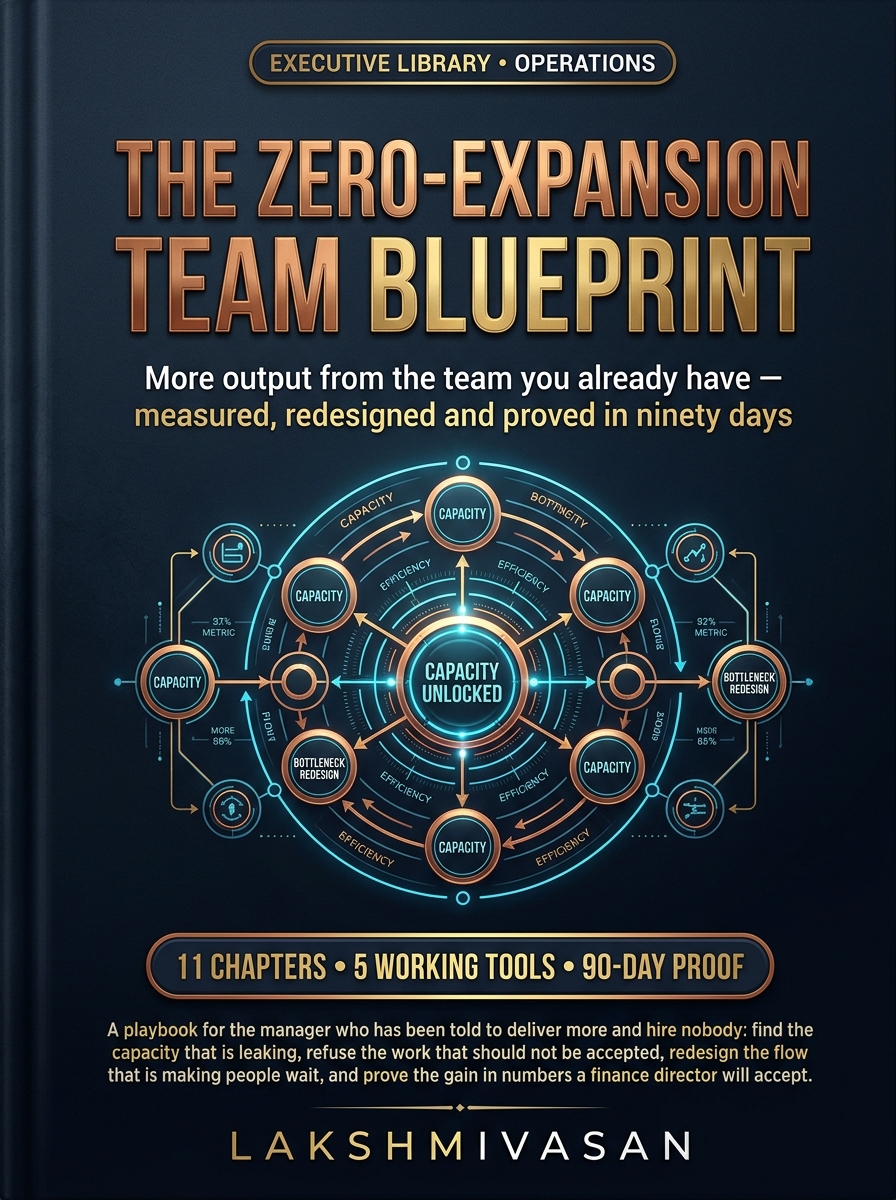
The Zero-Expansion Team Blueprint
EXECUTIVE LIBRARY | BY LAKSHMIVASAN
THE CAPACITY YOU NEED IS ALREADY ON THE PAYROLL.
A PRACTICAL BLUEPRINT FOR MORE OUTPUT WITHOUT MORE HEADCOUNT — FIVE TOOLKITS, A CAPACITY LEDGER AND A NINETY-DAY PLAN.
Every capacity conversation starts in the same place: the team is stretched, the queue is growing, and the answer proposed is another hire. Sometimes that answer is right. More often it is the least examined one, because hiring is visible, defensible and slow enough that nobody has to redesign the work.
The capacity that is missing is rarely the capacity that is absent. It is lost to demand that was never gated, work in progress that was never limited, hand-offs that were never costed, and managers who absorb the work instead of multiplying the team.
The Zero-Expansion Team Blueprint treats capacity as an equation you can move: demand in, flow through, capability underneath. It gives you the audit that finds the leak, the ledger that proves the gain, and the ninety-day plan that makes the gain hold when the next urgent request arrives.
It answers the questions that matter to the people who have to make it work:
- What does the capacity equation actually contain, and which term do most teams ignore?
- Where does hidden capacity leak in a team that believes it is at full stretch?
- How do you gate demand without becoming the department that says no to everything?
- Why does limiting work in progress increase output, and where should the limit sit?
- What is the integration tax on a hand-off, and how do you measure it?
- Which operating cadence protects capacity rather than consuming it?
- How do you build a two-deep bench without a training budget?
- Where does automation genuinely return capacity, and where does it just move the work?
- What makes a manager a multiplier rather than a bottleneck?
- How do you prove the gain in a ledger the finance team will accept?
Capacity improves when you change what enters the system, how it flows and who is allowed to decide — not when you ask people to work harder.
FOURTEEN CHAPTERS ACROSS FOUR MOVEMENTS
Movement I · See it
- The Capacity Equation — output, demand, flow and capability
- The Hidden-Capacity Audit — finding the leak with evidence
Movement II · Protect it
- Demand Discipline — gates, criteria and the cost of yes
- Work in Progress and the Queue — why limits raise throughput
- Handoffs and the Integration Tax — costing the seams
- The Operating Cadence — a rhythm that protects the week
Movement III · Build it
- Skill Architecture and the Two-Deep Bench
- Automation and the Machine Colleague — where the hours actually return
- The Manager as Capacity Multiplier
Movement IV · Prove it
- Protecting Capacity once the urgent request arrives
- The Capacity Ledger and the Ninety-Day Plan
- Five working tools, a one-page review and the measures that define them
THE WORKING TOOLS
Each toolkit is a fillable HTML instrument with a completed twin, so the standard of evidence is visible before your team writes anything.
- Toolkit 01 · Capacity Leak Audit — Trace where hours actually go across the week, and separate structural loss from discretionary loss.
- Toolkit 02 · Demand Gate and Ledger — A gate with published criteria, plus the ledger that records what was admitted, deferred and refused.
- Toolkit 03 · Flow Board and WIP Limits — A board with explicit work-in-progress limits per stage, and the rule for what happens when a limit is reached.
- Toolkit 04 · Capability Matrix and Bench Plan — Map coverage per critical skill and name the second and third person who can carry it.
- Toolkit 05 · Ninety-Day Zero-Expansion Plan — The sequenced plan: baseline, gates, flow, bench, then the ledger that proves the gain.
WHAT YOU RECEIVE
- zero-expansion-team-blueprint.html — The full blueprint: fourteen chapters, five tools, the capacity review and the measures.
- toolkit-blueprint-01..05.html — The five toolkits, blank and ready to fill in.
- sample-filled-toolkit-*.html — All five toolkits completed for a worked example.
All files are self-contained HTML documents. They open in any modern browser on desktop, tablet or phone, print cleanly to PDF, and require no installation or account.
FREQUENTLY ASKED QUESTIONS
Is this a hiring-freeze argument?
No. It is an argument for diagnosing before hiring. Some teams genuinely need people; the blueprint shows you how to prove it either way.
Who is it written for?
Operations leaders, department heads, programme managers and founders running a team that is at or beyond its comfortable limit.
How technical is the flow material?
Not very. The board and the limits are explained in plain language, with the arithmetic shown in the ledger.
Do I need software to use the toolkits?
No. They are self-contained HTML pages that open in any browser, print to PDF and need no account.
How quickly can we start?
The audit and the demand gate can run in the first fortnight. The ninety-day plan sequences the rest.
A NOTE ON THE EXAMPLES
The worked example follows a fictional customer operations group of 68 people carrying a backlog that grew for three consecutive quarters. All figures are illustrative and rounded. They demonstrate how a toolkit is used, not what your numbers should be, and nothing here is a substitute for professional advice.
More output is usually a design change, not a headcount change.
EXECUTIVE LIBRARY · LAKSHMIVASAN · FIRST EDITION, 2026