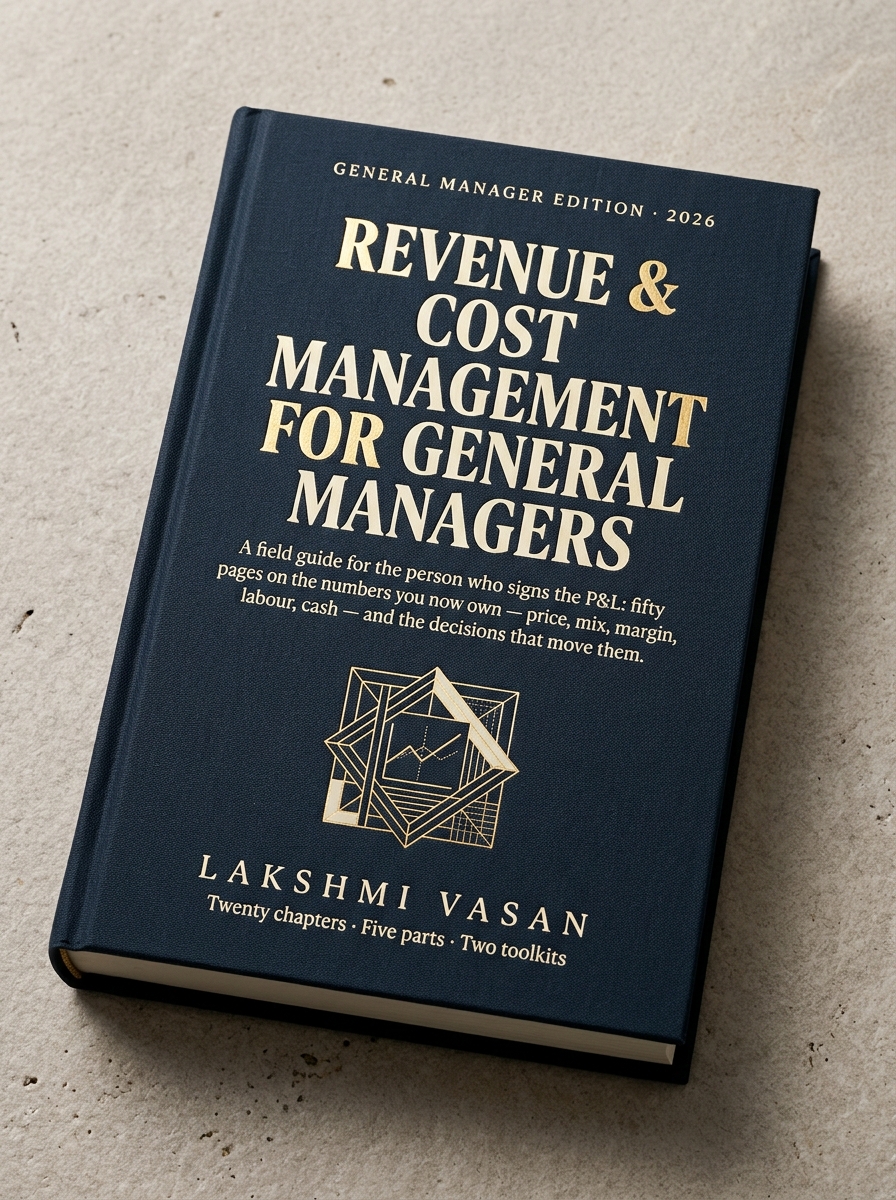
Revenue & Cost Management for General Managers
REVENUE AND COST MANAGEMENT FOR GENERAL MANAGERS
A PRACTICAL FIELD GUIDE FOR THE PERSON WHO SIGNS THE P&L
YOU ARE ACCOUNTABLE FOR THE NUMBERS. BUT DO YOU KNOW WHAT THEY ARE REALLY TELLING YOU?
You were not appointed general manager simply because you could read a profit and loss statement.
You were appointed because you could run a business, manage operations, lead people, solve problems, and deliver results.
But now the monthly finance pack arrives.
Two hundred lines of figures. Variances against budget. Revenue explanations. Cost movements. Margin percentages. Cash movements.
And somewhere in that report is a question you are expected to answer:
What is happening to the business, why is it happening, and what are you going to do about it?
Knowing whether revenue increased is not the same as knowing whether the business became more profitable.
Knowing that costs exceeded budget is not the same as understanding what caused the increase.
And reporting a positive profit does not necessarily mean the business has enough cash to operate comfortably.
Revenue and Cost Management for General Managers is a practical, unsentimental field guide for managers who are responsible for commercial performance and need to understand the financial consequences of their operational decisions.
Across 20 chapters and five parts, it explains how to read the numbers, understand revenue and margins, control costs, manage budgets, forecast performance, and build the financial discipline required to run a profitable and sustainable operation.
It addresses the questions every commercially accountable general manager should be able to answer:
- How do you read a P&L to understand business performance rather than simply report the figures?
- Which financial numbers actually matter, and which ones deserve less attention?
- How do you calculate contribution margin, break-even, and flow-through?
- How do you identify the real drivers of revenue?
- Why is pricing often more powerful than increasing sales volume?
- How does product, customer, and channel mix affect profitability?
- How do you forecast revenue when actual performance rarely follows the plan?
- Where does margin disappear without anyone noticing?
- How do you distinguish fixed, variable, and step costs?
- How do you manage labour costs without damaging service or productivity?
- How do you challenge suppliers and procurement costs effectively?
- How do you build a budget based on operational drivers rather than simply increasing last year's numbers?
- How do you explain budget variances without making excuses?
- How do you manage weekly trading performance and short-term cash?
- How do you make cost reductions without repeatedly damaging the operation?
This is not an accounting textbook.
It is a working management guide for understanding the commercial realities behind the numbers and taking action before small problems become expensive ones.
THE GENERAL MANAGER'S COMMERCIAL TOOLKIT
FIVE ESSENTIAL DIMENSIONS OF REVENUE AND COST MANAGEMENT
Running a commercially successful business requires more than achieving a revenue target or keeping expenditure within budget.
You need to understand how the different financial and operational drivers interact.
This guide connects five essential areas of commercial management.
Understanding the numbers: Learn to read financial statements for meaning, understand unit economics, identify contribution and break-even points, and recognize the indicators that signal future performance.
Managing revenue: Understand revenue drivers, pricing, sales mix, forecasting, customer behaviour, and the hidden revenue leaks that reduce profitability.
Managing costs: Develop practical control over fixed, variable, and step costs, labour, procurement, waste, cost-to-serve, and capital expenditure.
Running the business financially: Build driver-based budgets, explain variances, establish trading reviews, manage cash flow, and make better commercial decisions.
Leading through the numbers: Make financial performance part of everyday management, involve people in commercial accountability, and establish a consistent twelve-month management rhythm.
The objective is to help you move beyond reporting financial results to actively managing the business that produces them.
WHAT YOU WILL LEARN
20 PRACTICAL CHAPTERS COVERING THE COMMERCIAL RESPONSIBILITIES OF A GENERAL MANAGER
PART I — THE NUMBERS: UNDERSTANDING THE BUSINESS
01. Reading the P&L for Meaning, Not Compliance
Learn how to interpret a profit and loss statement as a management tool. Understand the relationship between revenue, direct costs, gross profit, operating expenses, and operating profit. Identify what the numbers reveal about the health of your business and what they fail to explain.
02. Unit Economics: Contribution, Break-Even and Flow-Through
Understand the financial mechanics behind every unit sold or service delivered. Learn how contribution margin, break-even points, and flow-through help you evaluate commercial decisions and understand how additional revenue affects profitability.
03. The Five Figures That Predict Next Month
Move beyond historical reporting and identify the operational indicators that provide early warning of future financial performance. Understand how leading indicators can help you anticipate revenue, labour, margin, and cash pressures.
PART II — THE REVENUE: GROWING THE RIGHT WAY
04. Where Revenue Actually Comes From
Break revenue into its underlying drivers. Understand volume, price, customer frequency, capacity, conversion, and channel performance. Identify which activities genuinely generate commercial value.
05. Pricing: The Cheapest Lever You Own
Understand the relationship between price, contribution, customer behaviour, and profitability. Learn how to evaluate price changes and avoid discounting without understanding the financial consequences.
06. Sales Mix: The Margin You Cannot See in Total Revenue
Understand how product, service, customer, and channel mix influence overall profitability. Learn why increasing sales can sometimes reduce margins and how to identify the revenue streams that contribute most effectively.
07. Forecasting When You Will Never Forecast Accurately
Develop a practical approach to revenue forecasting. Understand seasonality, demand patterns, assumptions, forecast accuracy, and the importance of continuously updating your expectations.
08. The Seven Revenue Leaks That Cost More Than You Think
Identify the common sources of lost commercial value, including discount leakage, poor conversion, missed capacity, cancellations, billing failures, customer attrition, and weak revenue discipline.
PART III — THE COST: PROTECTING PROFITABILITY
09. Understanding Fixed, Variable and Step Costs
Learn to distinguish different cost behaviours and understand how expenditure changes as business activity increases or decreases. Recognize the full-cost trap and why average cost can lead to poor decisions.
10. Labour: Your Largest Weekly Controllable Cost
Understand labour as both a financial and operational responsibility. Learn to connect staffing levels, productivity, demand, scheduling, overtime, and service requirements.
11. Procurement Without Theatre
Develop a practical approach to supplier management and procurement. Understand total cost, negotiation, specifications, purchasing behaviour, contract terms, and the difference between a lower price and a genuinely better deal.
12. Waste, Efficiency and Cost-to-Serve
Identify the hidden costs associated with inefficiency, rework, poor processes, waste, and customer servicing. Learn how to assess the true cost of delivering products and services.
13. Capital Expenditure: The Payback Test
Understand how to evaluate investment decisions before committing business resources. Learn to assess payback, expected benefits, operating costs, assumptions, and the financial consequences of capital expenditure.
PART IV — RUNNING THE NUMBERS: FINANCIAL CONTROL AND DECISION-MAKING
14. Building a Budget from Operational Drivers
Move away from budgets based entirely on last year's performance plus a percentage. Learn to build financial expectations around volume, price, capacity, staffing, productivity, and other business drivers.
15. Explaining Variances Without Making Excuses
Develop a structured approach to financial variance analysis. Understand the difference between price, volume, mix, timing, and cost movements. Learn how to explain what happened, why it happened, and what action follows.
16. The 45-Minute Weekly Trading Rhythm
Establish a practical weekly review that connects sales, margin, labour, operational performance, and immediate actions. Turn financial information into decisions rather than allowing it to become another reporting exercise.
17. Cash Flow: The Thirteen-Week View
Understand why profit and cash are different. Learn the purpose of a rolling thirteen-week cash forecast and how to identify upcoming cash pressures before they become operational problems.
18. Cost Reduction: Cut Once and Cut Properly
Learn to distinguish sustainable cost improvement from repeated short-term cuts. Identify structural inefficiencies, prioritize savings, understand operational consequences, and avoid damaging the business through indiscriminate reductions.
PART V — THE GENERAL MANAGER: MAKING THE NUMBERS WORK
19. Bringing the Numbers into the Room
Develop a practical approach to making financial performance part of everyday team management. Communicate commercial information clearly, build ownership, and involve people in improving the numbers without creating an atmosphere of constant financial inspection.
20. The General Manager's Twelve-Month Financial Cadence
Bring the different disciplines together into an annual management rhythm. Understand the recurring responsibilities involved in budgeting, forecasting, reviewing performance, managing cash, evaluating investment, and preparing for the next financial year.
Every chapter is designed to connect financial understanding with practical management decisions.
You will find worked arithmetic using invented but internally consistent business examples, important formulas, practical exercises, and scripts for the financial conversations general managers need to have.
FIVE BONUS WORKBOOKS INCLUDED
TURN FINANCIAL UNDERSTANDING INTO BETTER COMMERCIAL DECISIONS
The main field guide explains the financial disciplines of effective general management.
The five companion workbooks help you apply those disciplines to your own business.
BONUS 01 — THE ONE-PAGE DASHBOARD BUILDER
A practical tool for identifying and monitoring the financial indicators that matter most.
Use it to:
- Identify the five essential financial and operational lines to monitor.
- Understand the relationship between revenue, margin, labour, operating costs, and cash.
- Structure information so that performance can be reviewed quickly.
- Read the dashboard from top to bottom and across the relevant periods.
- Identify emerging problems before they become month-end surprises.
- Create a concise management view of business performance.
The outcome: A one-page dashboard that helps you understand the state of the business in minutes rather than spending unnecessary time navigating a lengthy finance pack.
BONUS 02 — THE PRICING AND MIX WORKBOOK
A practical workbook for understanding what your selling prices and revenue mix actually contribute to the business.
Use it to:
- Evaluate the financial impact of price changes.
- Calculate contribution from additional units sold.
- Understand the difference between revenue growth and profit improvement.
- Compare the contribution of different products, services, and channels.
- Identify unprofitable or low-contribution sales patterns.
- Understand the margin implications of discounting.
- Evaluate pricing decisions using practical arithmetic.
The outcome: Better pricing decisions and a clearer understanding of which revenue streams genuinely improve profitability.
BONUS 03 — THE MARGIN LEAK AUDIT
A structured audit for identifying the small, recurring losses that gradually erode business profitability.
Use it to:
- Review seven common sources of margin leakage.
- Conduct a practical one-week business audit.
- Identify where commercial value is being lost.
- Record the financial impact of each identified issue.
- Prioritize corrective actions.
- Track recovered margin and monitor progress.
The outcome: A practical method for identifying avoidable losses and converting hidden margin opportunities into measurable improvements.
BONUS 04 — THE FORECAST AND SEASONALITY PLANNER
A practical resource for developing more realistic revenue and labour forecasts.
Use it to:
- Build a seasonality index using your own historical information.
- Identify recurring business patterns.
- Establish assumptions behind your forecast.
- Apply three practical tests to assess forecast quality.
- Connect expected demand with labour requirements.
- Identify potential gaps between operational capacity and expected activity.
- Update forecasts as actual performance develops.
The outcome: More realistic forecasts, improved staffing alignment, and earlier visibility of potential commercial pressures.
BONUS 05 — THE SUPPLIER AND COST REVIEW KIT
A practical framework for understanding supplier expenditure and making better cost-management decisions.
Use it to:
- Evaluate the true cost of products and services.
- Understand the costs involved beyond the quoted purchase price.
- Apply five cost-management levers in a practical order.
- Review supplier performance and commercial terms.
- Identify opportunities for efficiency and cost improvement.
- Prepare for supplier renewals and negotiations.
- Complete a structured supplier renewal review sheet.
The outcome: Better procurement decisions, improved supplier accountability, and a clearer understanding of what your business is actually paying for.
WHY THESE FIVE BONUS TOOLS MATTER
Financial knowledge becomes valuable when it changes the way you run the business.
The five companion workbooks address the practical activities that connect financial analysis with day-to-day commercial control.
Bonus resourceWhat it helps you achieveOne-Page Dashboard BuilderSee business performance clearlyPricing and Mix WorkbookUnderstand revenue contributionMargin Leak AuditIdentify and recover lost marginForecast and Seasonality PlannerAnticipate demand and costsSupplier and Cost Review KitImprove purchasing and cost control
Together, they provide a practical toolkit for managing the financial performance of a business, not simply reporting its historical results.
WHO SHOULD READ THIS FIELD GUIDE?
Revenue and Cost Management for General Managers is designed for people who carry responsibility for business performance, profitability, operating costs, and financial outcomes.
Newly Appointed General Managers
You have recently taken responsibility for a business, site, branch, hotel, dealership, clinic, restaurant, or operating unit.
Learn how to understand the financial position, identify the commercial drivers, manage costs, and take responsibility for the P&L.
Department Heads Moving into P&L Responsibility
You understand your department's operations, but you are now expected to understand how your decisions affect revenue, margins, expenditure, and overall business performance.
Develop the commercial understanding needed to move from functional management to full business accountability.
Operations and Commercial Managers
You are expected to explain financial performance, not simply report what happened.
Learn to connect operational activity with financial results, investigate variances, identify margin opportunities, and develop practical corrective actions.
Owners and Entrepreneurs
Your business may be growing, but increasing sales does not automatically improve profitability or cash flow.
Understand the difference between growth, profit, and cash, and develop a more disciplined approach to financial management.
Managers Responsible for Multi-Department Operations
You coordinate people, processes, suppliers, budgets, and operational targets.
Develop a consistent framework for understanding financial performance and managing the commercial relationships between different parts of the business.
WHAT MAKES THIS FIELD GUIDE DIFFERENT?
Many finance resources explain accounting concepts, financial terminology, and reporting methods.
These are important, but a general manager needs something more practical.
You need to know what the numbers mean for the operation and what decisions should follow.
This guide takes a management-first approach.
It explains financial performance in operational language.
The focus is not on producing financial statements. It is on understanding what is happening in the business and identifying the operational causes behind the results.
It connects revenue with contribution and profitability.
Increasing sales is not automatically a good outcome. Understanding pricing, mix, contribution, and discounting helps you recognize the difference between more business and better business.
It treats costs as something you manage continuously.
Labour, procurement, waste, cost-to-serve, and capital expenditure are examined as practical management responsibilities rather than isolated accounting categories.
It moves beyond backward-looking reporting.
Forecasting, seasonality, leading indicators, and rolling cash forecasts help you anticipate future pressures rather than waiting for the monthly report to explain the past.
It makes financial management practical.
The guide includes nine important formulas, worked arithmetic, five practical exercises using your own figures, a one-page dashboard, a variance note, a seasonality index, and a cash forecast.
The central principle is simple:
A general manager should not simply explain what happened to the numbers. A general manager should understand what caused them, what happens next, and what the business must do differently.
THE NUMBERS YOU NEED TO KNOW
The guide is deliberately designed for practical use during the working month.
You can use it when:
- Reviewing the monthly P&L.
- Preparing for a budget meeting.
- Investigating a decline in gross margin.
- Evaluating a proposed price increase.
- Reviewing product and customer mix.
- Planning labour requirements for the coming weeks.
- Preparing for a supplier negotiation.
- Identifying waste and unnecessary expenditure.
- Evaluating an investment proposal.
- Explaining a financial variance to senior management.
- Reviewing weekly trading performance.
- Preparing a rolling cash forecast.
- Developing a cost-reduction plan.
- Establishing the financial priorities for the next quarter.
The intention is to make financial management part of the way you run the business, rather than something that happens only when the finance department sends a report.
THE FIVE FINANCIAL PRINCIPLES EVERY GENERAL MANAGER SHOULD REMEMBER
The entire guide is built around five important management principles.
1. Profit Is a Small Difference Between Large Numbers
A relatively small change in revenue, pricing, or costs can have a significant impact on operating profit. Understand the relationship between the numbers before making decisions.
2. Price Is Often the Cheapest Lever You Own
A well-considered price improvement can create contribution without requiring the same additional resources as increased sales volume. Understand customer sensitivity and competitive conditions before making pricing decisions.
3. Know Your Contribution Margin Before You Discount
Revenue does not tell you how much value a sale leaves behind. Understand variable costs and contribution before approving discounts or chasing volume.
4. Shape Labour Weekly
Labour is one of the most important operating costs you can influence through scheduling, productivity, capacity planning, and demand management. Do not wait until month-end to discover the consequences of poor labour planning.
5. Treat Cash as a Separate Discipline
Profitability and liquidity are not the same thing. A business can be profitable, growing, and still experience serious cash pressure. Understand cash movements and plan ahead.
These five principles provide the foundation for a more commercially disciplined approach to general management.
WHAT YOU RECEIVE
THE MAIN DIGITAL FIELD GUIDE
Revenue and Cost Management for General Managers
- 20 practical chapters.
- Five structured parts covering the commercial responsibilities of general management.
- Practical P&L interpretation.
- Unit economics, contribution, break-even, and flow-through.
- Revenue, pricing, and mix management.
- Forecasting and seasonality.
- Seven common margin leaks.
- Fixed, variable, and step-cost analysis.
- Labour and procurement management.
- Waste and cost-to-serve.
- Capital expenditure and payback.
- Driver-based budgeting.
- Variance analysis and weekly trading reviews.
- Thirteen-week cash forecasting.
- Practical financial management scripts.
- Nine essential formulas.
- Worked examples using invented but arithmetically consistent businesses.
- Five practical exercises using your own figures.
- One-page dashboard, variance note, seasonality index, and cash forecast.
FIVE COMPANION BONUS WORKBOOKS
- The One-Page Dashboard Builder.
- The Pricing and Mix Workbook.
- The Margin Leak Audit.
- The Forecast and Seasonality Planner.
- The Supplier and Cost Review Kit.
DIGITAL ACCESS
- Instant-access digital handbook.
- Single self-contained web page.
- Large-type reading edition.
- Designed for desktop, tablet, and mobile.
- Print-friendly styles.
- Five companion bonus workbooks included.
- Suitable for sequential reading or use during real month-end and weekly trading reviews.
FREQUENTLY ASKED QUESTIONS
1. Is this guide suitable for someone without a finance background?
Yes. It is written for general managers and operational leaders rather than accountants. It explains the financial concepts through practical business situations, worked arithmetic, and management applications.
2. Do I need to understand accounting before reading it?
No. Basic familiarity with business operations is sufficient. The guide introduces the financial concepts needed to understand revenue, costs, margins, budgets, and cash.
3. Does it explain how to read a P&L?
Yes. It covers how to interpret a profit and loss statement, understand its major components, evaluate performance, and connect reported figures with operational activity.
4. Does it cover pricing and profitability?
Yes. It explores pricing, contribution margin, discounting, product and channel mix, and the financial consequences of revenue decisions.
5. Does it cover cost control and labour management?
Yes. It includes fixed, variable, and step costs, labour scheduling, productivity, procurement, waste, cost-to-serve, and capital expenditure.
6. Does it explain budgeting and forecasting?
Yes. It covers driver-based budgeting, practical revenue forecasting, seasonality, variance analysis, and a rolling thirteen-week cash forecast.
7. Are the five bonus workbooks included?
Yes. All five companion workbooks are included with the main field guide.
8. Can I apply the examples to my own business?
Yes. The guide uses illustrative businesses and worked calculations to explain the concepts. It also includes five practical exercises that encourage you to apply the methods to your own business figures.
9. Is it suitable for hotels, restaurants, dealerships, clinics, and manufacturing businesses?
Yes. The management principles are applicable across different operating environments. The guide is particularly relevant to managers responsible for a site, branch, department, or business unit.
10. Is this an accounting or financial compliance manual?
No. It is a practical commercial management field guide, not an accounting manual or professional financial advice. Statutory reporting, group accounting policies, tax requirements, and applicable local laws always take precedence. Where a method conflicts with your finance team's requirements, follow your finance team and clarify the underlying reason.
PROFITABILITY DOES NOT HAPPEN BY ACCIDENT.
IT COMES FROM UNDERSTANDING THE NUMBERS, MANAGING THE DRIVERS, AND MAKING BETTER DECISIONS EVERY WEEK.
You do not need to become an accountant to become a financially effective general manager.
But you do need to understand how your business makes money, where it loses money, what drives its costs, and why cash can tell a very different story from profit.
You need to be able to challenge a forecast, question a price, investigate a margin decline, understand a labour variance, evaluate a supplier, and explain what happens next.
Most importantly, you need to make those decisions before the month-end report tells you that something has gone wrong.
Revenue and Cost Management for General Managers gives you a practical framework for doing exactly that.
20 Chapters. 5 Practical Workbooks. 9 Essential Formulas. One Field Guide to Managing the P&L.
STOP REPORTING THE NUMBERS. START MANAGING THE BUSINESS BEHIND THEM.
Get Revenue and Cost Management for General Managers and take a more informed, disciplined, and commercially effective approach to your P&L.