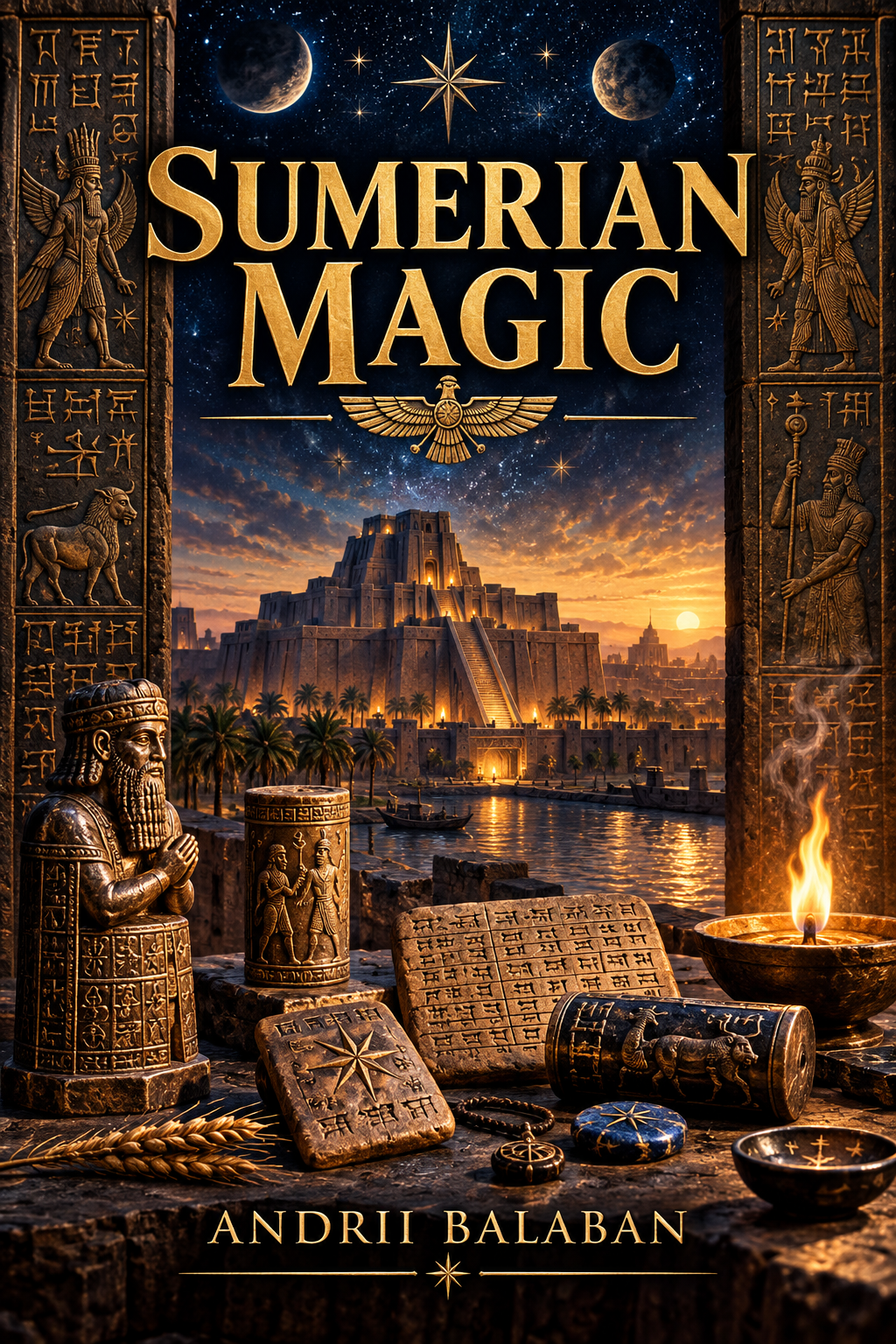
Sumerian magic
Contents
Chapter 1. Sumer and the Origins of Mesopotamian Magic
The opening chapter introduces ancient Sumer, its major cities, historical periods, writing system, temples, surviving texts, and the cultural environment in which some of humanity’s earliest recorded magical practices appeared. It explains what scholars mean by Sumerian and Mesopotamian magic and establishes the essential distinction between Sumerian material and later Akkadian, Babylonian, and Assyrian traditions. The chapter also introduces the principal categories of evidence from which ancient magical practices can be reconstructed and establishes the historical method that will guide the entire book.
Chapter 2. The Sumerian Universe: Gods, Humans, Fate, and the Sacred Order
This chapter explores the structure of the Sumerian cosmos and the relationship between divine power, humanity, nature, cities, temples, fate, and sacred order. Particular attention is given to the concept of the me, divine authority, the organization of the cosmos, and the idea that disorder in human life could possess religious and ritual dimensions. The reader will learn why understanding Sumerian cosmology is necessary before attempting to understand the logic of Sumerian magical practice.
Chapter 3. The Gods and Goddesses of Sumerian Magic
The principal divine powers of the Sumerian world are examined through their myths, cults, symbols, cities, and spheres of influence. An, Enlil, Enki, Inanna, Utu, Nanna, Ninhursag, Ereshkigal and other important deities are considered not as characters in a simple standardized pantheon but as divine personalities whose importance and relationships changed across places and historical periods. The chapter also explains how divine names, epithets, hymns, offerings, and invocations can function within ritual practice.
Chapter 4. Temples, Ziggurats, Priests, and Sacred Space
Sumerian religion was inseparable from the temple, which functioned simultaneously as a sacred institution, economic center, political force, and dwelling of a deity. This chapter examines temples, ziggurats, altars, cult statues, priestly roles, offerings, purification and the organization of sacred space. The practical section develops principles for creating a modern ritual space inspired by Mesopotamian concepts without pretending that a private contemporary altar is identical to an ancient temple.
Chapter 5. Spirits, Demons, Ghosts, and the Invisible World
Ancient Mesopotamian texts describe a complex invisible world populated by gods, protective beings, dangerous entities, wandering spirits and the dead. This chapter investigates these categories while avoiding the misleading assumption that every supernatural being can simply be classified according to later concepts of “good” and “evil.” The reader will explore ancient ideas concerning spiritual danger, haunting, impurity, protection and the boundaries between the human and invisible worlds, together with ritual methods designed to restore order when those boundaries were believed to have been disturbed.
Chapter 6. Cuneiform Magic: Incantations, Sacred Words, and Ritual Speech
Words were among the most important instruments of Mesopotamian ritual. This chapter examines the structure and function of incantations, divine names, epithets, commands, petitions, repetitions, mythological precedents and spoken ritual formulas. It explains why writing itself could acquire sacred significance and how clay tablets preserved magical language across generations. The practical section teaches the reader how to construct historically informed modern invocations while clearly distinguishing them from translated ancient texts.
Chapter 7. Clay, Water, Fire, Oil, Plants, and Ritual Materials
Sumerian and later Mesopotamian rituals were intensely material. Clay could receive form, water could cleanse, fire could destroy or transform, oil could purify or consecrate, and plants, grain, wool, figurines and other objects could become components of ritual action. This chapter examines the symbolic and practical functions of these materials and demonstrates how physical actions create the structure of a ceremony. Safe and responsible modern adaptations are presented alongside explanations of their ancient foundations.
Chapter 8. Purification, Protection, and the Removal of Evil
Purification was one of the central themes of Mesopotamian ritual practice. This chapter explores ritual washing, water, fumigation, protective objects, figurines, boundaries, spoken formulas and actions intended to remove impurity or hostile influence. Ancient concepts are distinguished from modern interpretations, while the practical section develops structured rites for personal purification, protection of a dwelling, symbolic removal of misfortune and restoration of ritual order.
Chapter 9. Healing Magic and the Restoration of the Person
In ancient Mesopotamia, illness could be interpreted through physical, social, divine and supernatural frameworks that were not always separated from one another. This chapter examines the relationship between healing, incantation, ritual specialists, medicinal substances, prayer and symbolic actions. It presents historically informed healing rites as forms of spiritual and ritual support while maintaining a clear distinction between such practices and modern medical treatment. The central theme is restoration: returning the person from disorder toward stability, participation in life and renewed strength.
Chapter 10. Love, Fertility, Sexuality, Prosperity, and Personal Desire
Not all ancient magic concerned demons, illness or protection. Human beings also sought love, fertility, sexual attraction, success, abundance and favorable circumstances. This chapter examines texts and traditions connected with personal desire and the divine powers associated with sexuality, fertility and prosperity, particularly the complex figure of Inanna. Practical rituals focus on expressing intention, cultivating desirable qualities, strengthening relationships and directing personal action while avoiding claims that ritual can erase another person’s autonomy.
Chapter 11. Dreams, Omens, Divination, and Messages from the Gods
Mesopotamian civilization developed extraordinarily elaborate traditions for interpreting signs. Dreams, celestial events, unusual occurrences, animal behavior and many other phenomena could be understood as meaningful within systems of divination. This chapter distinguishes specifically Sumerian evidence from later highly developed Babylonian and Assyrian omen traditions. The reader will learn methods of recording dreams and observations, separating observation from interpretation, asking useful questions and approaching divination as a disciplined practice rather than an endless search for reassuring signs.
Chapter 12. The Dead, the Netherworld, Ancestors, and Funerary Magic
Death did not end the relationship between the living and the dead in ancient Mesopotamian thought. This chapter explores the Netherworld, Ereshkigal, the condition of the dead, funerary obligations, offerings, restless ghosts and the importance of maintaining proper relations between generations. Myths and ritual evidence are examined alongside modern commemorative practices inspired by ancient principles. The practical work emphasizes remembrance, closure, continuity and respect rather than attempts to manufacture frightening supernatural experiences.
Chapter 13. Reconstructing Sumerian Ritual Practice
After examining the individual components of the tradition, this chapter asks how an entire Sumerian-inspired ritual can responsibly be reconstructed. The reader learns to distinguish direct historical evidence from inference, later Mesopotamian parallels and modern adaptation. A complete ritual structure is developed step by step: determining the purpose, selecting the divine context, preparing the practitioner, establishing sacred space, arranging materials, purification, invocation, offering, symbolic action, incantation, petition, thanksgiving, closure and recording the result. Several reconstructed ceremonies demonstrate how these principles can be combined without falsely claiming an uninterrupted secret tradition.
Chapter 14. The Complete Practice of Sumerian Magic
The final chapter brings the entire book together as a coherent practical system. Gods, sacred space, clay, water, fire, offerings, incantations, protective symbolism, divination, purification and ritual documentation are integrated into a disciplined cycle of practice. The reader learns how to develop daily, periodic and purpose-specific rites and how to maintain a personal record separating historical source material, personal interpretation and practical experience. The book culminates in a complete ceremonial working inspired by ancient Mesopotamian principles, moving from purification and the establishment of sacred order through invocation, offering, spoken formula and symbolic action to thanksgiving and formal closure. The purpose of the final ceremony is not to pretend that the modern practitioner has become an ancient Sumerian priest, but to demonstrate how knowledge preserved for thousands of years can be approached with historical respect, practical intelligence and a clear understanding of the boundary between what has survived from antiquity and what must necessarily be reconstructed in the present.