
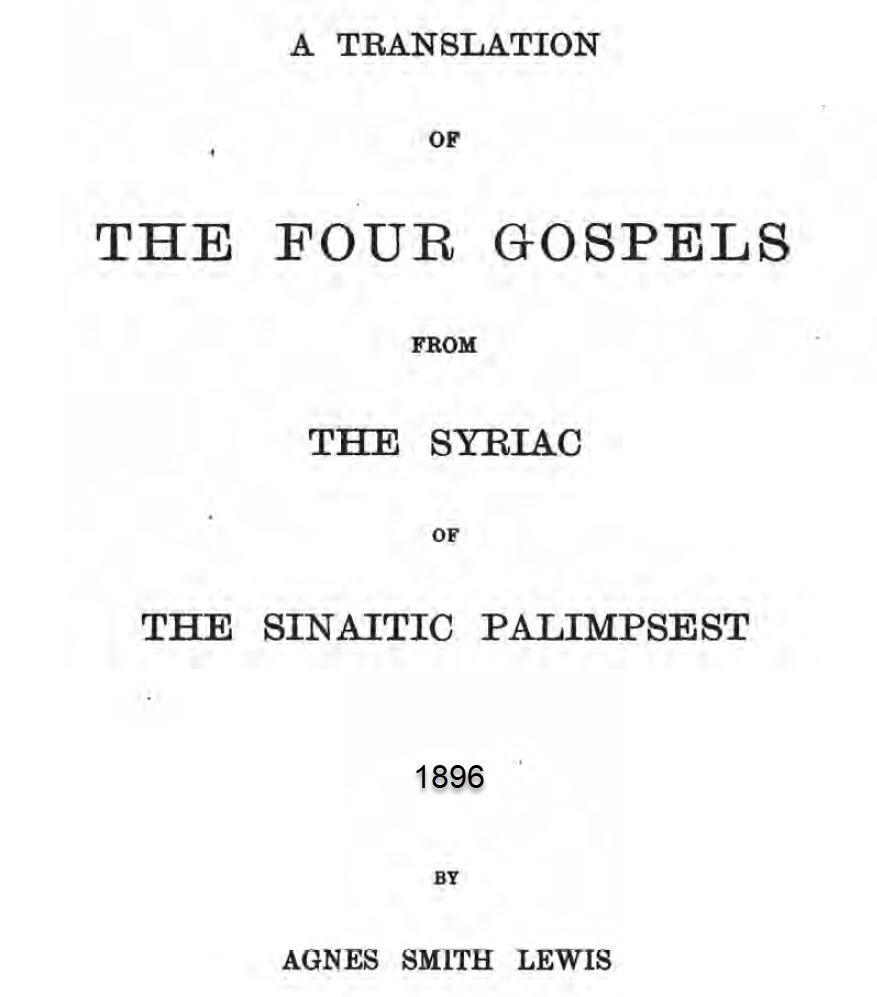
1896 Syriac Sinaiticus - English Translation - by Agnes Lewis
Unlocking the Earliest Semitic Witness: Agnes Smith Lewis’s 1896 Translation of the Syriac Sinaiticus
Have you ever wondered if our modern English Bibles have lost some of the raw, original flavor of the Eastern world in which Jesus walked and talked? Or worse, have modern textual editors accidentally introduced contradictions that make the Messiah look like a hypocrite?
For the first time, you can own a digital copy of the most explosive, authentic, and pristine early witness to the Gospel text: Agnes Smith Lewis’s 1896 English Translation of the Syriac Sinaiticus (the Sinai Palimpsest).
For just $10.00, this indispensable volume will completely transform your study, your preaching, and your understanding of the Gospels.
The Remarkable Discovery that Shook the Academic World
In 1892, twin sisters Agnes Smith Lewis and Margaret Dunlop Gibson rode camels across the treacherous Sinai desert to the ancient Convent of St. Katharine [2]. There, hidden in a dark closet, Agnes spotted a dirty, neglected manuscript [4]. Looking closely, she realized it was a palimpsest—a vellum book whose original Gospel text had been scraped away in A.D. 778 by a monk named John the Recluse to write stories of female saints.
Using her pioneering knowledge of Semitic tongues, Agnes realized that beneath the medieval ink lay the oldest copy of the Four Gospels in Syriac (the Eastern dialect of Aramaic spoken by Jesus and His disciples). It is a text that by over a century pre-dates the forms of our oldest Greek codices and represents a window straight back into the 100s - 120 to pre-160 CE.
Why This Translation is Worth Far More Than $10
Most English Bibles are translated from Greek manuscripts that were edited, harmonized, and standardized centuries after the apostles died. The Syriac Sinaiticus bypasses centuries of Hellenistic philosophical additions and scribe-mangling.
Here are the shocking, text-restoring differences you will discover in this translation:
1. Rescuing Jesus from the Charge of Hypocrisy (Matthew 5:22)
In almost all modern English translations (such as the ESV, NASB, and NET), Matthew 5:22 is translated like this:
"But I say to you that everyone who is angry with his brother will be liable to judgment..."
Modern textual critics deleted the phrase "without a cause", claiming the "best and oldest Alexandrian Greek manuscripts" lack it. But look at the devastating logical trap this creates:
- If being angry is per se a sin, then Jesus Himself sinned when He looked at the hard-hearted Pharisees "with anger" (Mark 3:5), or when He furiously drove the moneychangers out of the Temple.
- By deleting this phrase, modern Bibles expose Jesus to the charge of direct hypocrisy—He condemned anger but practiced it.
The Syriac Sinaiticus to the rescue! This ancient Semitic witness—the earliest translation of the Gospels in existence—explicitly preserves the phrase: "That whosoever is angry with his brother without a cause shall be condemned..." [18, 149]. The Semitic church never lost this vital qualification. With this book, you can instantly defeat this common skeptical attack and restore the logical consistency of Jesus' sermon.
2. Dating the Original Gospels: Pre-dating A.D. 160
How do we know how old the Gospel text is? In her companion work, Light on the Four Gospels, Agnes Smith Lewis demonstrates that the translation underlying this manuscript must date to between A.D. 120 and A.D. 150 [8].
The proof is in what is not there:
- The Longer Ending of Mark (Mark 16:9-20) is entirely missing! [7, 111] In this manuscript, the text ends lat verse 8 with the words: "and they said nothing to any man; for they were afraid. [HERE] ENDETH THE GOSPEL OF MARK" [46].
- Around A.D. 160, the writer Tatian compiled his Diatessaron (a harmony of the four gospels) and created or imported the longer ending of Mark. Because this ending is completely absent from the Syriac Sinaiticus, it proves this text represents a pristine stage of the Gospels before Tatian's additions ever occurred!
3. Restoring Lost Geographical Accuracy (John 1:28)
For centuries, readers of John's Gospel have been confused by John 1:28, which in Greek manuscripts places John the Baptist's ministry at "Bethany beyond the Jordan." This is highly problematic because the only famous Bethany is a suburb of Jerusalem, nowhere near the Jordan River.
- The Syriac Sinaiticus reads: "Beth 'Abara beyond Jordan..." [66].
- "Bethabara" literally means "the house of crossing." This ancient Semitic reading preserves the exact historical and geographical spot where Israel crossed the Jordan with Joshua, and where the true baptismal ministry of John took place—a detail that Hellenized Greek scribes completely mangled into "Bethany."
4. Pure Textual Preservation: Deleting Later Pious Myths
Scribes in the late 4th and 5th centuries frequently added dramatic details to "help" the story. The Syriac Sinaiticus is famously concise, omitting these late additions [7]:
- The Gethsemane Bloody Sweat (Luke 22:43-44): This passage describing an angel strengthening Jesus and His sweat falling like great drops of blood is completely omitted [127]. This proves the text is in its primitive, raw state before scribes added these graphic details to combat early heresies.
- The Woman Taken in Adultery (John 7:53 - 8:11): This famous but highly disputed story is completely missing from this ancient manuscript [7]. It is not there because it was not in the original Gospel of John!
What Scholars Said About This Text:
"It is and remains the oldest demonstrable Gospel of the Syrian Church."
— Dr. Theodor Zahn, world-renowned German theologian and textual critic [9]
"The earliest translation of the Gospels into Syriac, on which the Diatessaron and the Curetonian are both founded."
— Dr. Eberhard Nestle, editor of the Nestle-Aland Greek New Testament [8]
What You Receive with Your Purchase:
For just $10, you will receive the complete, digitized edition of Agnes Smith Lewis’s 1896 Translation of the Four Gospels from the Sinaitic Palimpsest [1]. This digital volume includes
:
- The Full English Translation of Matthew, Mark, Luke, and John directly from the palimpsest, showing the unique Semitic phrasing of the early Eastern Church [1, 2].
- Detailed Critical Appendices listing every word and phrase omitted or added in the Syriac Sinaiticus compared to the standardized Westcott & Hort Greek text [2, 85, 147].
- Agnes's Original Critical Notes, explaining the translation decisions and the linguistic slips made by late Greek translators [2, 162].
Whether you are a pastor preparing your next sermon series, a home-schooling parent teaching your children biblical history, or a serious student of the Bible who wants the unpolished truth of the earliest manuscripts—this is an indispensable addition to your library.