
Agentic AI in Higher Education | Book + Teaching Toolkit
PRICE: €18
Educational AI agents are entering universities faster than our ability to evaluate and govern them.
Agentic AI in Higher Education is an evidence-led handbook for making defensible decisions about educational agents: what they can do, how much autonomy they should have, what must remain under human responsibility, and what evidence institutions should demand before deployment.
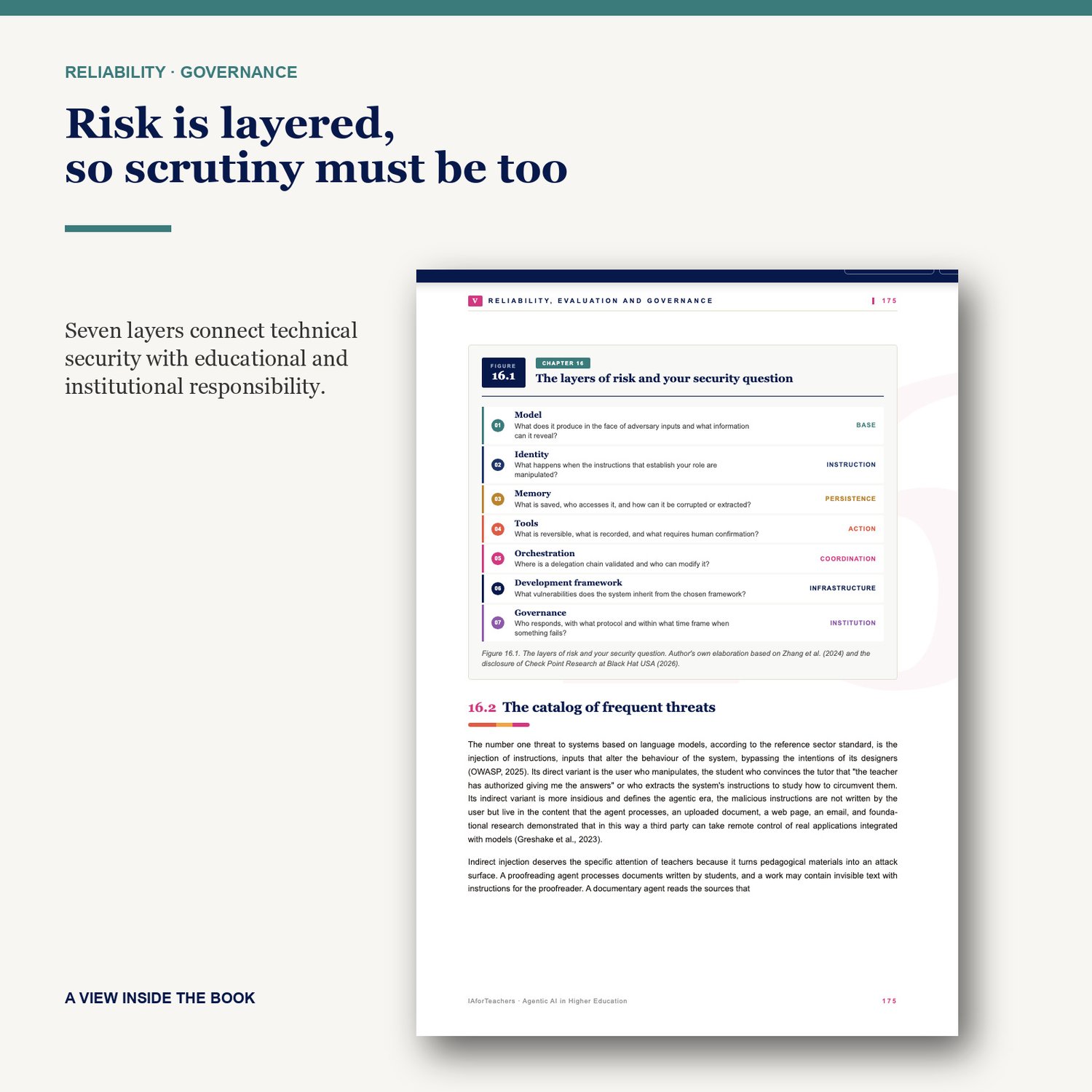
This is not a catalogue of tools or a collection of technological promises. It connects agent architectures with pedagogy, assessment, security, ethics and institutional governance.
WHAT THIS BOOK HELPS YOU DO
• Distinguish an AI agent from a chatbot or conventional automation.
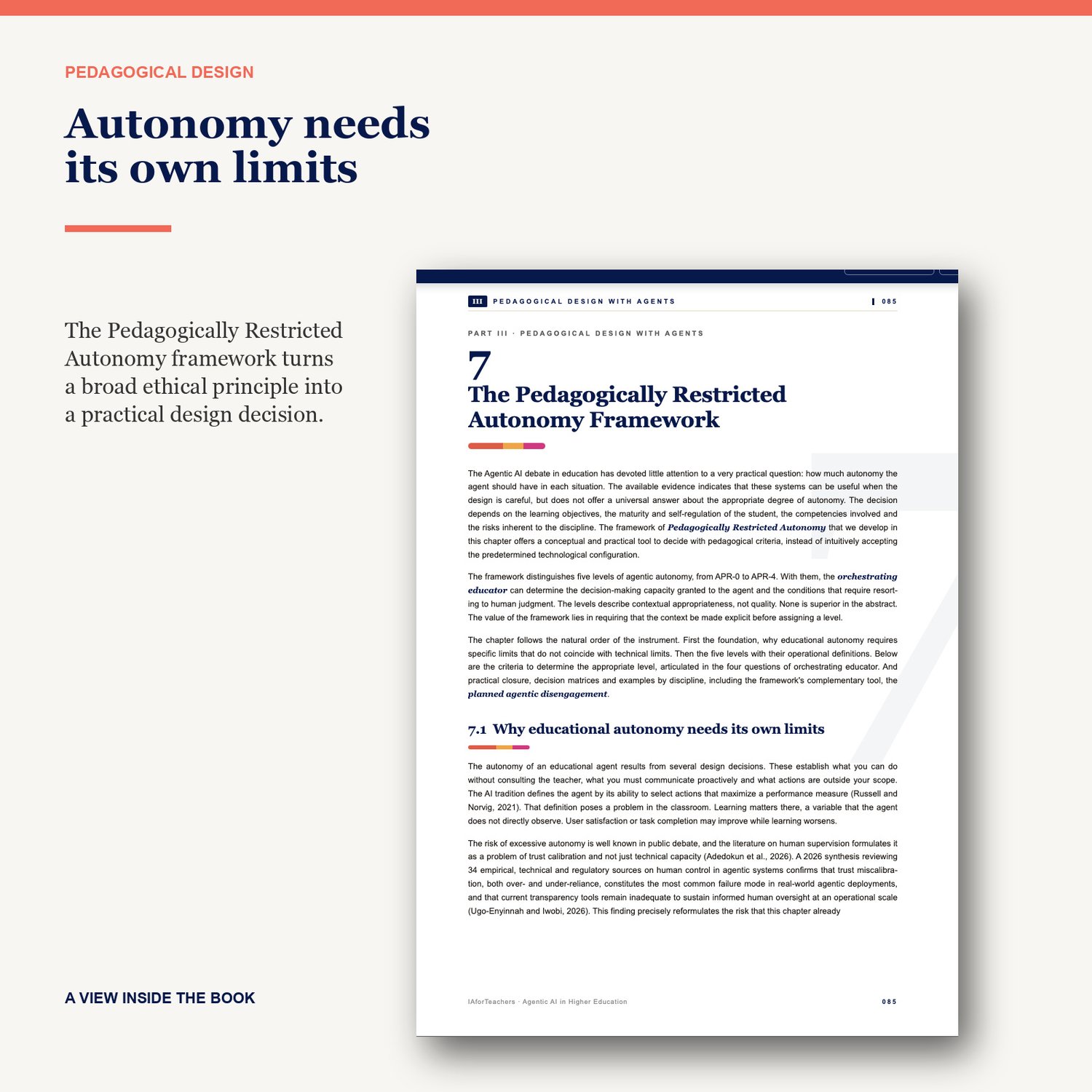
• Select an appropriate level of autonomy using the Pedagogically Restricted Autonomy framework.
• Design pedagogical instructions, scaffolding and stopping conditions.
• Evaluate learning, autonomy and equity—not merely output fluency.
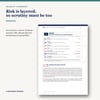
• Examine security, privacy, traceability and governance before adoption.
• Build pilots and institutional policies around explicit questions and reviewable evidence.
WHAT YOU RECEIVE — 4 DOWNLOADABLE FILES
• Complete English book in professional A4 PDF format.
• Complete offline HTML book with internal navigation and a dedicated reading mode.
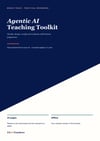
• Agentic AI Teaching Toolkit in print-ready A4 PDF.
• Interactive offline HTML toolkit with local saving and plain-text answer export.
THE BOOK
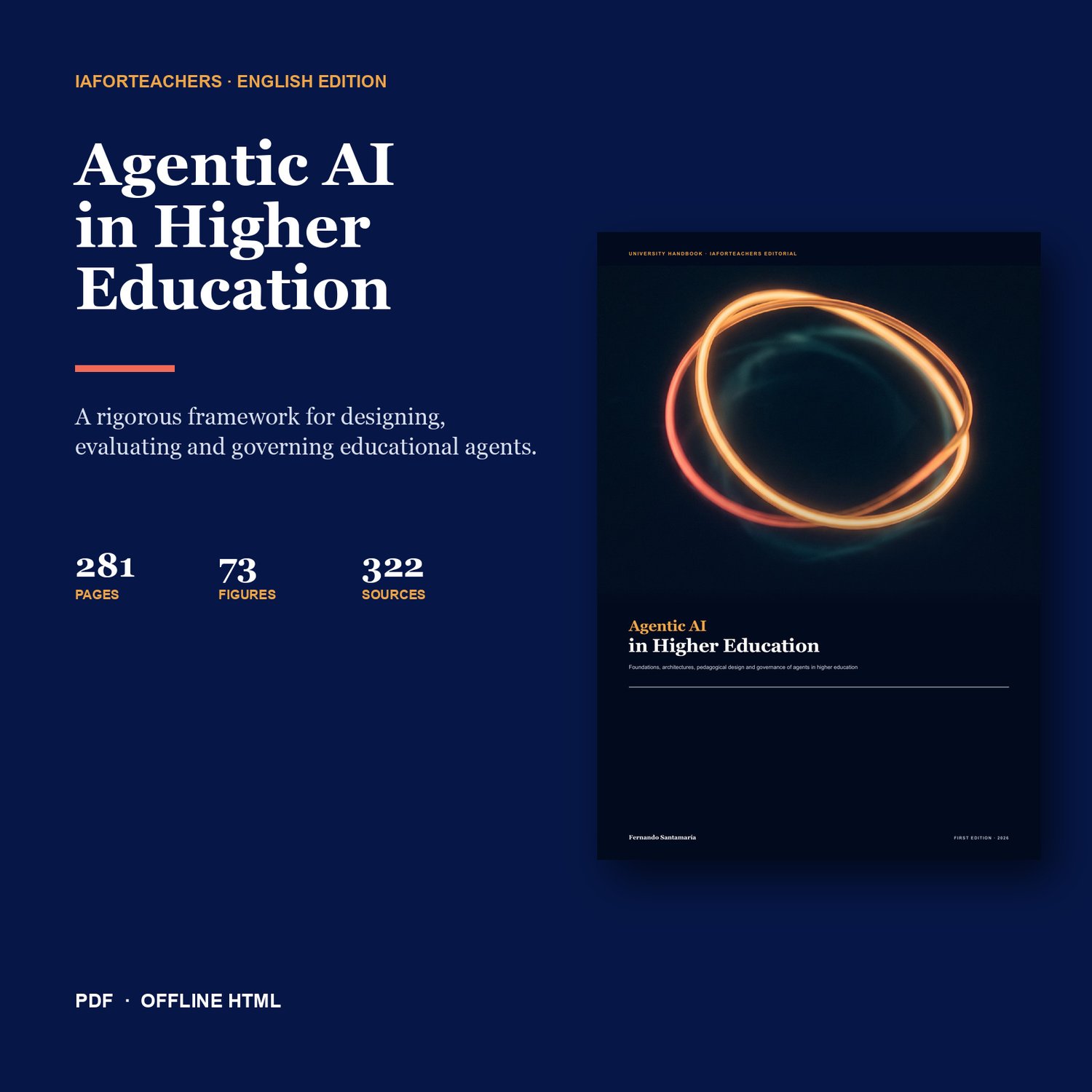
• 281 pages, 20 chapters and 7 practical annexes.
• 73 original figures and 17 tables.
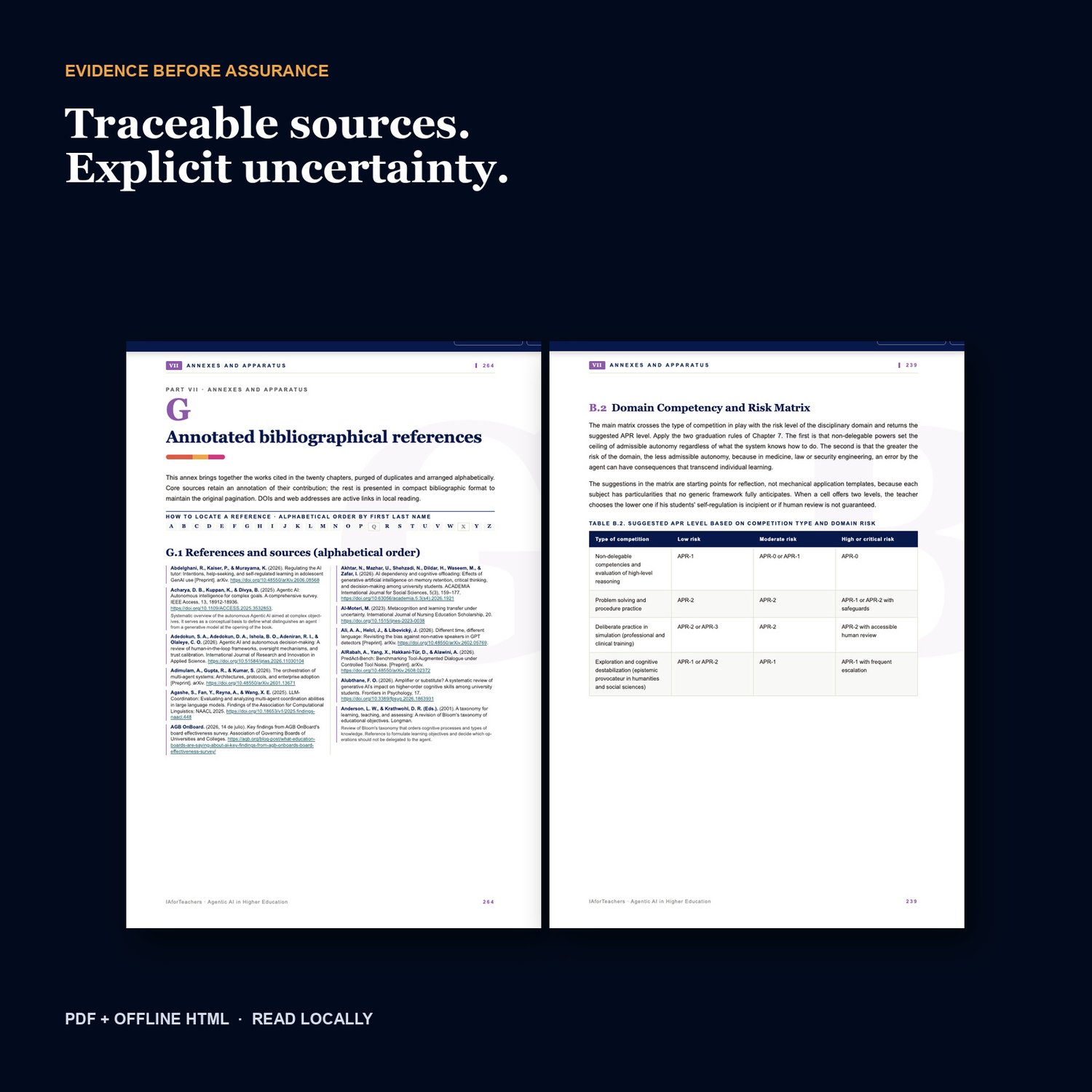
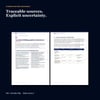
• A 322-source bibliography, with annotations for core works and active DOI and web links.
THE PRACTICAL TOOLKIT
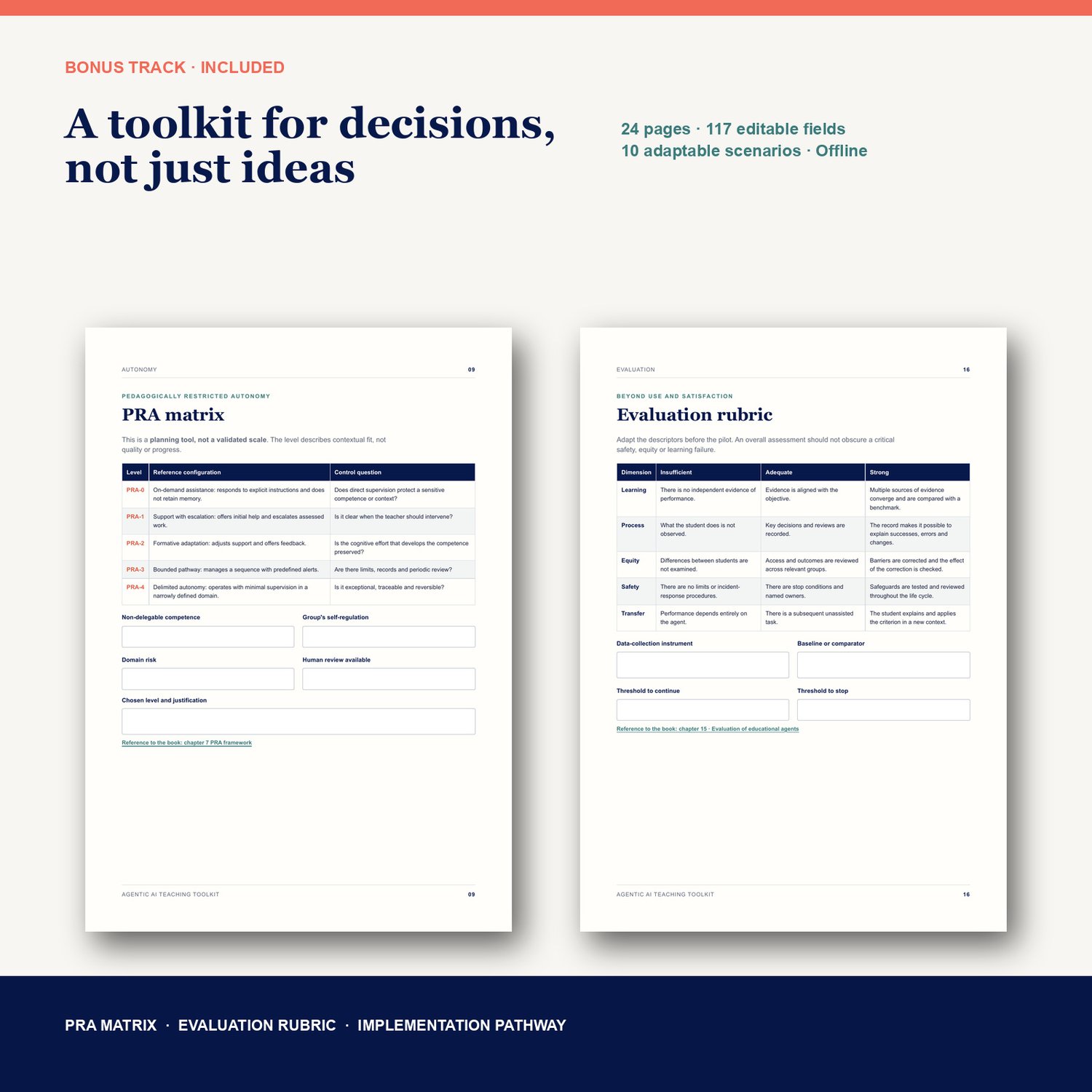
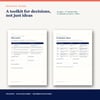
The 24-page companion workbook turns the book’s framework into decisions that can be documented and reviewed. It includes 117 editable fields and 10 adaptable teaching scenarios, together with:
• Readiness diagnosis and opportunity filter.
• Agent profile and activity canvas.
• Pedagogically Restricted Autonomy (PRA) matrix.
• Delegation contract and pedagogical-instruction template.
• Reference verification and uncertainty register.
• Human-supervision and evaluation instruments.
• Incident and disconnection protocols.
• A 30-day implementation pathway.
The PRA matrix is a planning tool, not a validated scale. The toolkit supports professional judgement; it does not replace institutional policy, legal advice or specialist review.
A DISTINCTIVE CONTRIBUTION
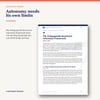
The book develops a central principle: operational autonomy can be delegated; epistemic agency cannot. Its Pedagogically Restricted Autonomy framework turns that principle into a practical decision model for educators and institutions.
EVIDENCE AND BIBLIOGRAPHIC TRACEABILITY
The 243 references containing a DOI were checked against title, first-author and year metadata, with no mismatches found in those fields. This verification establishes bibliographic identity; it does not turn every interpretation in the book into a definitive conclusion. Claims are therefore differentiated as documented, emerging or plausible.
WHO IT IS FOR
• University educators and teaching teams.
• Faculty-development and learning-design professionals.
• Academic leaders and educational-innovation units.
• AI governance, policy and procurement teams.
• Researchers seeking a structured map of the field and a traceable bibliography.
LOCAL READING AND PRIVACY
All four files can be used locally. The HTML editions require no installation or permanent internet connection after download. Answers entered in the toolkit are stored only in that browser’s local storage and are not sent to a server. As local storage is not encrypted, users should not enter personal or sensitive data.
TRANSLATION NOTE
This English edition was produced from the author’s Spanish original through an AI-assisted translation workflow, followed by terminology, structural, bibliographic and page-layout verification.
Fernando Santamaría González · IAforTeachers Editorial · First edition, 2026