
🌻 SENSORY REGULATION GUIDE
🌻 SENSORY REGULATION GUIDE
Understanding What Helps the Nervous System Feel Safer, Calmer and More Supported
💙 Research & Guidance-Informed Educational Poster | UK Edition
Sensory regulation is not about forcing a child to cope. It is about understanding their needs and supporting them in ways that work for them.
For some autistic children, everyday environments can involve intense or unpredictable sensory experiences.
Noise, bright lighting, crowds, transitions, movement and competing demands may gradually build sensory stress.
A child may appear to be managing initially, while their discomfort is increasing.
By the time adults notice visible distress, the child may already be overwhelmed.
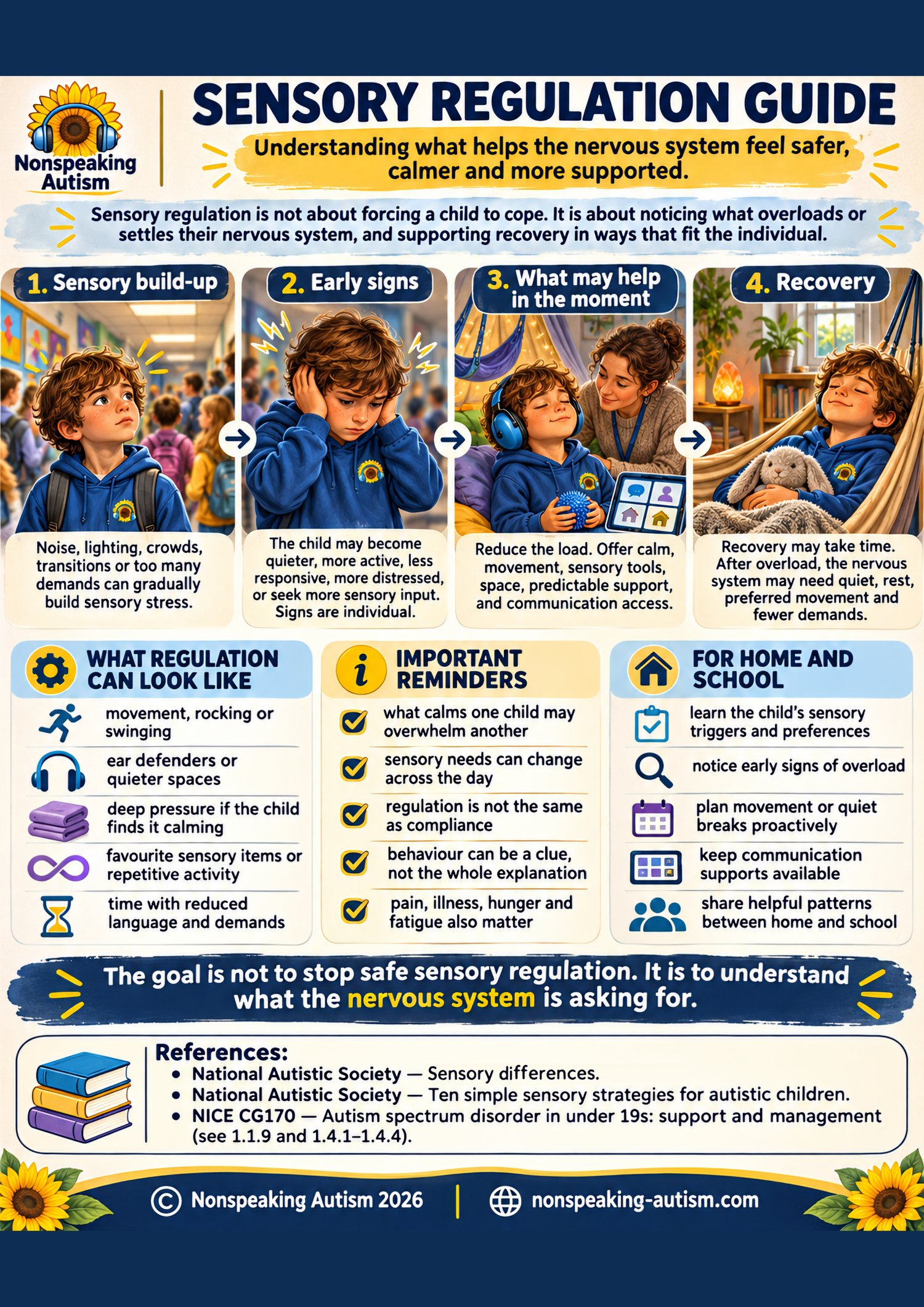
Sensory Regulation Guide is an illustrated educational poster designed to help parents, carers, educators and professionals recognise sensory build-up, notice early signs of overload, offer individualised support and understand why recovery may take time.
The guide encourages adults to reduce unnecessary pressure, respect sensory preferences and maintain communication access.
Rather than expecting every child to tolerate the same environment or use the same coping strategies, it promotes understanding, flexibility and proactive support.
The central message:
The goal is not to stop safe sensory regulation. It is to understand what the nervous system is asking for.
🧠 WHAT THIS POSTER EXPLORES
🌿 1. Sensory Build-Up
Sensory stress may develop gradually.
A child may be managing several experiences at once, including:
- Noise and competing conversations.
- Bright or uncomfortable lighting.
- Crowded environments.
- Movement and transitions.
- Unexpected changes.
- Multiple instructions or demands.
These experiences may become increasingly difficult to manage, particularly when a child is tired, anxious or already experiencing discomfort.
What adults can do:
Notice environmental demands and consider adjustments before distress becomes more intense.
💙 2. Recognising Early Signs
Early signs of sensory overload vary between children.
Some may become quieter or less responsive.
Others may show increased movement, distress or sensory-seeking behaviour.
Possible changes include:
- Covering ears or eyes.
- Withdrawing from activities.
- Becoming unusually quiet.
- Increased movement or repetitive activity.
- Difficulty responding to instructions.
- Seeking particular sensory experiences.
- Increased agitation or visible distress.
These signs are not specific to sensory overload and may have other explanations.
What adults can do:
Learn the child's individual patterns and respond to changes from their usual presentation.
🌻 3. What May Help in the Moment
When sensory demands become difficult, supportive adjustments may include:
- Reducing unnecessary noise.
- Lowering lighting where appropriate.
- Offering a quieter space.
- Reducing language and task demands.
- Allowing preferred movement.
- Providing familiar sensory tools.
- Keeping AAC and other communication supports available.
- Giving the child additional time and space.
The most helpful response depends on the individual.
Some children benefit from adult reassurance, while others prefer less interaction during distress.
Support should be responsive rather than imposed.
❤️ 4. Recovery After Sensory Overload
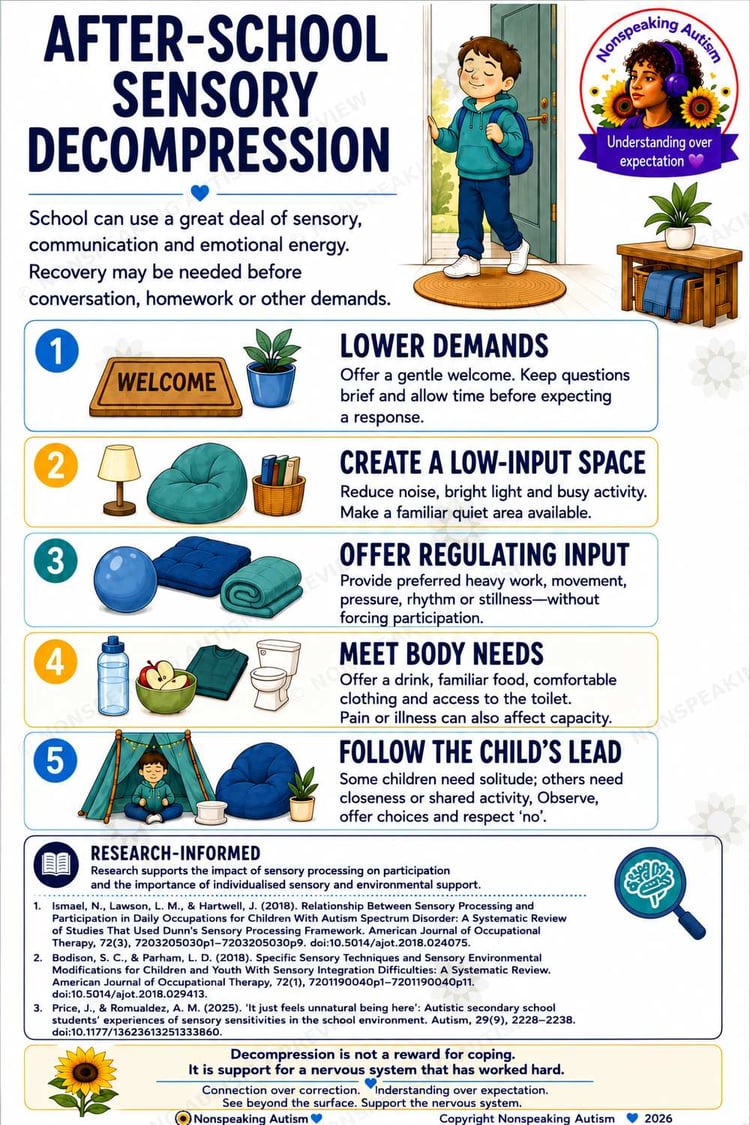
Recovery may continue after the immediate source of overload has been reduced.
Some children may need:
- Quiet time.
- Rest.
- Familiar comfort items.
- Preferred movement.
- Reduced expectations.
- Time without unnecessary conversation.
- Access to their usual communication methods.
A child appearing calmer does not necessarily mean they are ready for new demands.
What adults can do:
Allow recovery time and avoid rushing the child back into demanding activities.
🌈 WHAT SENSORY REGULATION CAN LOOK LIKE
Sensory regulation is individual.
The poster highlights several possible approaches.
Movement, Rocking or Swinging
Some children find repetitive movement enjoyable, organising or comforting.
Safe, self-directed movement may help them manage sensory experiences or express themselves.
Ear Defenders or Quieter Spaces
Reducing uncomfortable auditory input may improve comfort and participation for children who are sensitive to noise.
Ear defenders should be available according to individual preference and need, rather than used as a universal solution.
Deep Pressure
Some children find certain forms of pressure comforting.
However, responses vary, and the evidence supporting specific deep-pressure interventions is limited.
Pressure should never be forced. Any equipment or strategy must be appropriate, safe and acceptable to the child.
Favourite Sensory Items or Repetitive Activities
Familiar objects, movements or repetitive activities may provide enjoyment, predictability, emotional expression or self-regulation.
Safe stimming should not automatically be interrupted simply because it looks unusual.
Reduced Language and Demands
During distress, a child may find it harder to process additional instructions or communicate using their usual methods.
Reducing demands and maintaining communication access may help.
💛 FIVE IMPORTANT REMINDERS
1. What calms one child may overwhelm another.
There is no single sensory strategy that works for everyone.
2. Sensory needs can change throughout the day.
Sleep, health, fatigue, emotional demands and previous experiences may affect what a child can comfortably manage.
3. Regulation is not the same as compliance.
A child following instructions does not necessarily mean they feel comfortable or regulated.
4. Behaviour can be a clue, not the whole explanation.
Changes in behaviour may indicate distress or unmet needs, but they do not establish one specific cause.
5. Pain, illness, hunger and fatigue also matter.
Sensory needs should be considered alongside physical health, communication and other factors.
🏡 SUPPORTING SENSORY REGULATION AT HOME AND SCHOOL
Effective support often begins with understanding the child's individual preferences and patterns.
Learn the Child's Sensory Preferences
Notice which environments, activities and experiences the child enjoys, avoids or finds difficult.
Where possible, involve the child directly through their preferred communication methods.
Recognise Early Signs of Overload
Look for changes in movement, communication, participation or emotional presentation.
Respond before distress becomes severe where possible.
Plan Breaks Proactively
Some children may benefit from planned opportunities for quiet, movement or reduced demands.
These should be flexible and responsive rather than compulsory.
Maintain Communication Access
AAC, visual supports, gestures and other communication methods should remain available throughout the day.
Share Helpful Patterns
Families, carers and school staff can work together to identify:
- Environmental triggers.
- Preferred sensory supports.
- Early signs of discomfort.
- Helpful communication approaches.
- Recovery needs.
- Strategies that the child accepts or declines.
The aim is consistency in understanding, not forcing identical routines across every environment.
🔬 RESEARCH & GUIDANCE-INFORMED
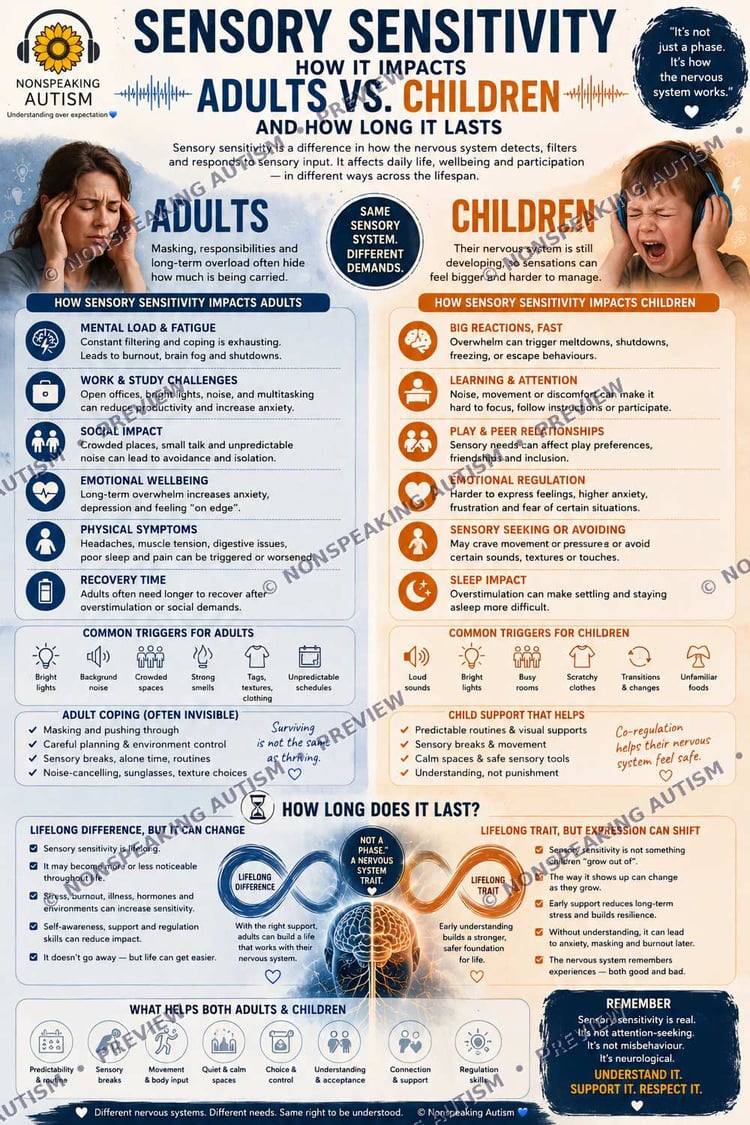
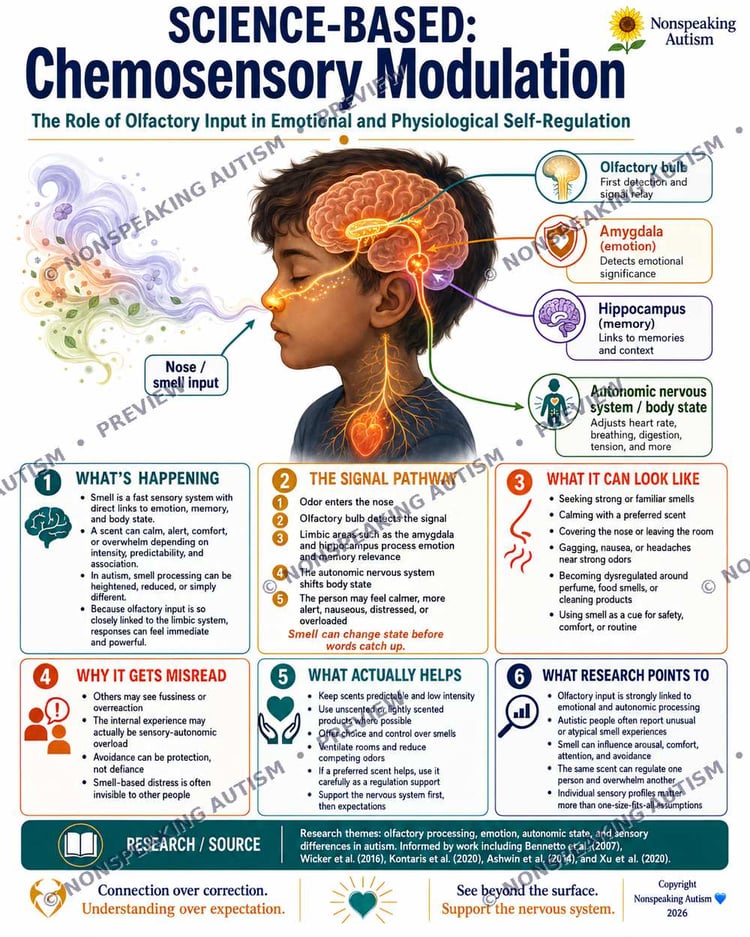
Sensory processing differences are recognised features of autism and may affect comfort, participation and everyday experiences.
UK autism guidance recommends considering sensory sensitivities, environmental factors, communication needs and physical health when planning support.
The National Autistic Society also provides practical information about sensory differences and strategies that may help autistic people manage their environments.
However, sensory interventions vary considerably in their research support.
Not every strategy has been shown to produce consistent benefits, and individual preferences should guide decisions.
A sensory regulation strategy should be judged by whether it supports the child's comfort, safety, autonomy and meaningful participation — not simply whether it reduces visible behaviour.
📚 SELECTED RESEARCH AND GUIDANCE
1. National Autistic Society.
Sensory differences.
Information about sensory experiences, sensitivities and individual needs in autistic people.
Website: https://www.autism.org.uk/
2. National Autistic Society.
Ten simple sensory strategies for autistic children.
Practical guidance concerning sensory environments and supportive adjustments.
Website: https://www.autism.org.uk/
3. National Institute for Health and Care Excellence (NICE). (2013; updated 2021).
Autism spectrum disorder in under 19s: support and management.
Clinical guideline CG170.
https://www.nice.org.uk/guidance/cg170
📖 IMPORTANT EVIDENCE LIMITATION
This poster is a simplified educational guide.
It does not provide a validated sensory assessment or a standardised treatment programme.
Different sensory strategies have different levels of research support.
The benefits of movement, deep pressure, sensory tools and environmental adjustments vary between individuals.
Strategies should be selected according to the child's preferences, safety, comfort and functional needs.
Sources:
- NAS – Ten simple sensory strategies for autistic children
- NICE CG170 guideline
- NICE CG170 full guideline PDF (mirror used to check the section numbers)
👨👩👧 WHO IS THIS RESOURCE FOR?
This poster may be useful for:
- Parents and carers of autistic children.
- Families of nonspeaking and minimally speaking children.
- Mainstream and specialist school staff.
- SENCOs and SEND teams.
- Teaching assistants and learning support workers.
- Occupational therapists.
- Speech and language therapists.
- Educational psychologists.
- Autism support workers.
- Paediatric and community professionals.
- Parent and carer support groups.
- Staff training and continuing professional development.
🏫 HOW THIS POSTER CAN BE USED
At home: To help families understand sensory build-up, individual preferences and recovery needs.
In classrooms: To encourage reasonable adjustments, accessible communication and proactive sensory support.
In therapy rooms: As an educational visual aid for discussing sensory preferences and regulation strategies.
During SEND training: To explain why sensory regulation is not the same as compliance and why strategies must be individualised.
In community settings: To encourage understanding and support for different sensory needs.
📦 WHAT YOU RECEIVE — FREE DOWNLOAD 💛
1 × Sensory Regulation Guide — UK Edition
🌻 FREE EDUCATIONAL RESOURCE
This free printable poster includes:
- Four illustrated stages: sensory build-up, early signs, support in the moment and recovery.
- Examples of sensory regulation strategies.
- Five important reminders about individual sensory needs.
- Practical suggestions for home and school.
- Research and guidance references.
- Nonspeaking Autism illustrations and branding.
Your free download includes:
✅ FREE digital download through Payhip.
✅ Clear, unwatermarked resource.
✅ No purchase required.
✅ UK English spelling and terminology.
✅ Suitable for printing at home, school or in professional settings.
Format: Digital printable poster.
Print size: A2 intended (420 × 594 mm); confirm the exported PDF page size before advertising it as A2 print-ready.
Digital download only — no physical product will be shipped.
©️ COPYRIGHT & PERMITTED USE
Copyright © 2026 Nonspeaking Autism. All rights reserved.
Although this resource is free, it remains protected by copyright.
You may download, print and display the poster for personal, educational, clinical, workplace or community use.
Redistribution, resale, commercial reproduction, public uploading, editing or removal of copyright information is not permitted without written permission.
Please direct others to the original Payhip listing to obtain their own free copy.
⚠️ IMPORTANT EDUCATIONAL DISCLAIMER
This resource is provided for educational and informational purposes only.
It is not a diagnostic tool, validated sensory assessment, individualised occupational therapy programme, clinical treatment or substitute for professional advice.
Sensory experiences and regulation needs vary between individuals.
Not every suggested strategy will be suitable or effective for every child.
Sensory equipment and movement activities must be used safely and in accordance with individual needs.
Deep pressure should never be forced, and restrictive or unsafe practices should be avoided.
Sudden, persistent or concerning changes in behaviour or wellbeing should prompt consideration of pain, illness and appropriate professional assessment.
©️ COPYRIGHT & PERMITTED USE
Copyright © 2026 Nonspeaking Autism. All rights reserved.
Permitted Use
Purchasers may print and publicly display this poster in:
- Homes and family settings.
- Schools and educational environments.
- Therapy rooms and clinical settings.
- Workplaces and staff training spaces.
- Community and support settings.
Printed copies may be used for personal understanding, educational discussion, awareness and professional training.
Not Permitted
Without prior written permission, purchasers may not:
- Resell or redistribute the digital PDF.
- Share the purchased digital file with third parties.
- Upload the poster to public websites or shared download platforms.
- Edit, rebrand or remove copyright information.
- Include the digital artwork in another commercial resource.
- Reproduce the design for resale.
Copyright and ownership remain with Nonspeaking Autism.
💛 THE MESSAGE BEHIND THIS RESOURCE
Sensory regulation is not about making every child tolerate the same environment.
It is not about forcing stillness.
It is not about stopping safe repetitive movements.
And it is not about expecting a child to cope without support.
It is about recognising when an environment is becoming too demanding.
Understanding the child's individual sensory preferences.
Making adjustments before distress escalates.
Respecting communication and autonomy.
And allowing time to recover.
The goal is not to stop safe sensory regulation. It is to understand what the nervous system is asking for.
🌻 Connection over correction. Understanding over expectation.
Nonspeaking Autism © 2026
Different needs. Equal belonging.