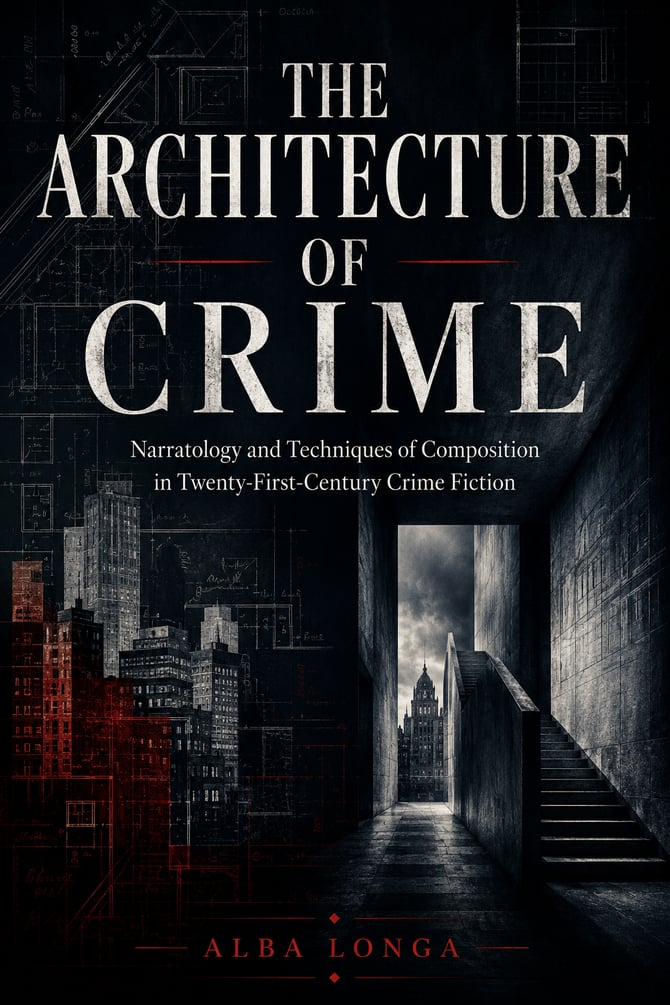
The Architecture of Crime
Crime fiction is often described through its plots: a body, a disappearance, a secret, an investigation, a culprit. But beneath those visible elements lies something far more intricate. Every crime narrative is an architecture of knowledge. Someone knows too much, someone knows too little, someone lies, someone remembers badly, and the reader is asked to move through a carefully designed structure of clues, absences, perspectives, expectations, and moral judgments.
The Architecture of Crime offers a comprehensive narratology specifically designed for twenty-first-century crime fiction. Moving beyond formula and genre labels, it examines how contemporary crime narratives are actually built: how they control information, organize time, construct clues, shape suspense, manipulate focalization, develop unreliable voices, and transform the act of investigation into a deeper inquiry into memory, identity, violence, power, and justice.
Drawing on the major traditions of narrative theory while remaining firmly attentive to the craft of fiction, the book explores the relationship between story and discourse, chronology and revelation, voice and focalization, curiosity and suspense, clue and evidence, victim and investigator, individual guilt and systemic responsibility. It also examines the wounded detective, the narrative construction of the antagonist, the body as evidence and memory, the moral geography of cities and borders, dialogue and interrogation, seriality, traumatic memory, cognitive bias, and the ethics of point of view.
The study is resolutely international. Its examples move across British and American traditions, French crime fiction, Nordic noir, Mediterranean noir, Latin American neopolicial fiction, Japanese mystery, Korean psychological crime fiction, African and South African traditions, historical crime fiction, domestic noir, eco-noir, espionage, and transnational hybrid forms. Writers such as Michael Connelly, Tana French, Fred Vargas, Keigo Higashino, Gillian Flynn, Leonardo Padura, Pierre Lemaitre, Don Winslow, Claudia Piñeiro, Deon Meyer, Ian Rankin, Denise Mina, Hideo Yokoyama, Attica Locke, S. A. Cosby, Natsuo Kirino, Mick Herron, and many others become points of departure for examining concrete narrative problems rather than objects of simple admiration.
This is not merely a book about reading crime fiction. It is also a book about writing it. Each theoretical question is connected to compositional choices: where should a novel begin? Who should perceive a scene? What should the reader know at a given moment? When does a clue become visible without becoming obvious? How can a twist surprise without cheating? How does one build a convincing red herring? When should violence be shown, omitted, or reconstructed? What makes an unreliable narrator legitimate rather than manipulative? How can a crime be solved without pretending that the harm itself has been repaired?
The volume concludes with a substantial practical apparatus: a reasoned glossary of narratological concepts applied to crime fiction, a chronology of the genre's major transformations since 2000, an international atlas of authors and traditions, a detailed narrative-analysis worksheet, and a composition template for planning a crime novel. Together, these materials turn theory into a working method for readers, critics, researchers, teachers, and writers.
At its deepest level, The Architecture of Crime asks what happens when narrative truth and moral truth no longer coincide. A case may be solved while justice remains incomplete. A culprit may be identified while an institution continues to function unchanged. A victim may recover a name while nothing can restore the life that was lost. The book therefore treats crime fiction not as a mechanical puzzle, but as one of the most powerful contemporary forms for examining how human beings construct, conceal, discover, and live with truth.
For anyone who wants to understand not only what crime fiction tells, but how it makes us suspect, fear, infer, remember, and finally know, The Architecture of Crime offers both a critical map and a practical set of tools.

 Save
Save
 Share
Share
 Tweet
Tweet