THE FREIGHT INVOICE AUDIT & REVENUE RECOVERY INTELLIGENCE SYSTEM
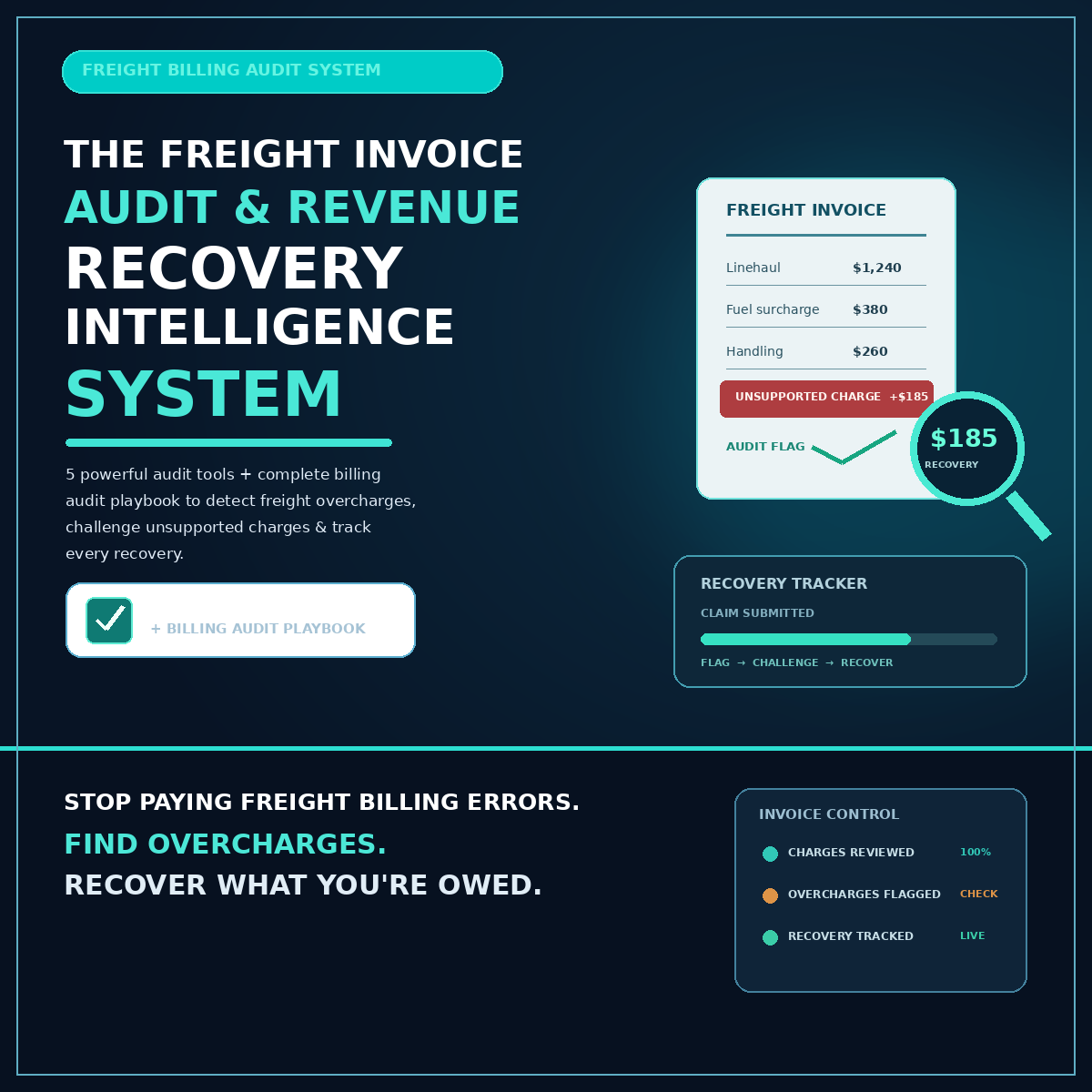
THE FREIGHT INVOICE AUDIT & REVENUE RECOVERY INTELLIGENCE SYSTEM
5 Powerful Audit Tools + Complete Billing Audit Playbook to Detect Freight Overcharges, Challenge Unsupported Charges & Track Every Recovery
STOP PAYING FREIGHT BILLING ERRORS. FIND OVERCHARGES. RECOVER WHAT YOU'RE OWED.
Are you certain that every freight invoice you approve matches your contracted rates, agreed surcharges, accessorial allowances, and actual shipments?
Freight invoices can contain incorrect rates, duplicate charges, unsupported accessorials, unexpected fuel surcharges, and even charges for shipments that were never dispatched.
These errors can quietly reduce your transportation budget and profitability.
The problem is that checking every invoice manually takes time, and many billing discrepancies go unnoticed until the dispute deadline has passed.
Introducing the FREIGHT BILLING & OVERCHARGE RECOVERY PACK — a professional collection of five integrated freight audit and recovery tools, supported by a practical eight-chapter Billing Audit Playbook.
From recalculating carrier invoices and checking accessorial charges to detecting duplicates, reconciling dispatched loads, and managing recovery claims, this toolkit helps you establish a structured freight invoice audit process.
No complicated software installation. No subscription. No internet connection required.
AUDIT. DETECT. DISPUTE. RECOVER.
GET INSTANT ACCESS — ONLY $11.99
5 Integrated Audit Tools | 8-Chapter Playbook | Works Offline | No Subscription
HOW MUCH MONEY IS LEAVING YOUR BUSINESS THROUGH UNCHECKED FREIGHT INVOICES?
Freight billing is more complicated than simply checking whether the invoice total looks reasonable.
Every carrier invoice should be evaluated against the applicable rate confirmation, transportation agreement, shipment details, and supporting evidence.
Yet many businesses approve invoices without performing a structured audit.
Consider these common situations:
- A carrier invoices a higher rate than the agreed contractual rate.
- Fuel surcharges are calculated using an incorrect percentage.
- Detention charges appear without supporting documentation.
- Layover charges exceed agreed allowances.
- A shipment is invoiced twice using different invoice references.
- An invoice is raised for a load that was never dispatched.
- A carrier bills a shipment above the agreed lane rate.
- Delivered shipments remain unbilled, creating reconciliation gaps.
- Valid overcharge claims are identified but never followed through.
- Dispute deadlines expire before the claim is formally submitted.
Each individual discrepancy may appear relatively small.
But when you process dozens or hundreds of freight invoices, repeated billing errors can create a significant financial exposure.
The challenge is not just finding an incorrect charge.
It is identifying the discrepancy, calculating the financial impact, preparing the dispute, tracking the claim, and following it through to resolution.
The Freight Billing & Overcharge Recovery Pack brings these activities into one connected audit and recovery workflow.
FIVE INTEGRATED TOOLS. ONE COMPLETE FREIGHT RECOVERY WORKFLOW.
The toolkit includes five specialized tools designed to work together.
TOOL 01 — FREIGHT INVOICE AUDIT CALCULATOR
RECALCULATE EVERY INVOICE AGAINST YOUR AGREED FREIGHT RATES
Do not rely solely on the amount shown on the carrier invoice.
Enter the contracted rate, shipment distance, and applicable fuel surcharge formula. Then enter the amounts billed by the carrier.
The calculator recomputes the expected invoice amount and identifies differences between the expected and billed charges.
Key capabilities:
- Enter contracted freight rates.
- Calculate expected linehaul charges.
- Apply fuel surcharge formulas.
- Compare expected and billed amounts.
- Identify invoice variances line by line.
- Generate a clean or dispute verdict.
- Produce ready-to-use dispute wording.
- Maintain an audit log.
- Export audit findings to CSV.
Business benefit: Identify rate discrepancies and obtain a structured financial basis for challenging incorrect invoices.
TOOL 02 — ACCESSORIAL-CHARGE CHECKER
CHALLENGE UNSUPPORTED ACCESSORIAL CHARGES
Freight invoices frequently contain additional charges beyond the basic transportation rate.
Examples include:
- Detention.
- Demurrage.
- Layover.
- TONU (Truck Ordered Not Used).
- Redelivery.
- Reweigh.
- Reclassification.
- Stop-off charges.
The Accessorial-Charge Checker includes a rulebook covering 15 charge types.
Evaluate each charge against your configured contractual caps, free-time allowances, and evidence requirements.
Key capabilities:
- Built-in rulebook with 15 charge types.
- Editable contract caps.
- Editable free-time allowances.
- Editable evidence requirements.
- Charge-by-charge evaluation.
- CONTRACTED, QUERY, or UNSUPPORTED classifications.
- Automatic calculation of claimable amounts.
Business benefit: Distinguish charges that should be paid from those requiring supporting evidence or formal dispute.
TOOL 03 — DUPLICATE INVOICE TRACKER
DETECT DUPLICATE BILLING BEFORE PAYMENT APPROVAL
Duplicate freight invoices are not always obvious.
A carrier may submit the same invoice twice, issue a replacement invoice with a different reference, or split billing across multiple invoice records.
The Duplicate Invoice Tracker helps identify suspicious billing patterns across your invoice register.
Key capabilities:
- Import invoice registers using CSV or TSV.
- Add invoices manually.
- Identify exact duplicate invoices.
- Flag re-numbered re-bills.
- Identify potential split-billing patterns.
- Group suspicious invoice records.
- Mark identified duplicates.
- Record recovery actions.
- Maintain a permanent recovery record.
Business benefit: Improve duplicate payment controls and identify potentially repeated billing before approving payment.
TOOL 04 — CARRIER BILLING RECONCILIATION SHEET
MATCH DISPATCHED SHIPMENTS AGAINST CARRIER INVOICES
A freight invoice should correspond to an actual shipment and the agreed commercial terms.
The Carrier Billing Reconciliation Sheet brings dispatched loads and carrier invoices together for comparison.
Key capabilities:
- Compare dispatched loads against billed invoices.
- Identify phantom shipments.
- Identify potentially overbilled lanes.
- Detect delivered but unbilled shipments.
- Compare billed amounts against contracted rates.
- Edit billed figures directly.
- Recalculate financial variances automatically.
Business benefit: Obtain better visibility into the relationship between shipment execution and carrier billing.
TOOL 05 — OVERCHARGE RECOVERY TRACKER
TURN IDENTIFIED BILLING ERRORS INTO TRACKED RECOVERY CLAIMS
Finding an overcharge is only the beginning.
You also need to submit the dispute, assign responsibility, monitor responses, escalate delays, and record the final resolution.
The Overcharge Recovery Tracker provides a structured claims pipeline.
Track each claim through four stages:
DETECTED → CLAIMED → ACKNOWLEDGED → RESOLVED
Key capabilities:
- Assign a unique claim reference.
- Record claim ownership.
- Monitor claim status.
- Calculate aging from invoice date.
- Identify claims approaching or exceeding important follow-up periods.
- Detect claims stalled for 21 days.
- Generate an escalation queue.
- Provide pre-written escalation actions.
- Create a one-page escalation brief.
Business benefit: Reduce the likelihood of losing track of valid claims and improve follow-up discipline throughout the recovery process.
THE BILLING AUDIT PLAYBOOK — YOUR GUIDE TO FINDING AND RECOVERING MONEY
The tools help you perform the calculations.
The Billing Audit Playbook explains how to organize the audit and recovery process.
This eight-chapter guide covers practical freight billing audit and dispute management topics.
What You Will Learn
1. Contract Clauses That Support Recovery
Understand the importance of rate confirmations, contractual allowances, fuel surcharge provisions, accessorial terms, and supporting documentation.
2. Common Freight Billing Errors
Recognize common discrepancies involving rates, fuel surcharges, additional charges, duplicate invoices, and shipment records.
3. Ready-to-Send Dispute Letter Templates
Use three dispute letter templates to structure communication when challenging freight billing discrepancies.
4. Dispute Deadline Management
Understand the importance of carrier dispute windows, including the commonly encountered 30-, 60-, and 90-day periods.
5. The Escalation Ladder
Follow a structured escalation approach, from the carrier account representative to more formal dispute and offset procedures where contractually permitted.
6. Evidence File Preparation
Understand how to organize rate confirmations, dispatch records, delivery documents, invoices, and other supporting evidence.
7. Claim Follow-up Management
Develop a consistent approach to monitoring outstanding claims, tracking responses, and escalating unresolved matters.
8. Building a Repeatable Freight Audit Process
Bring the tools and procedures together into a practical recurring invoice audit workflow.
Business benefit: You receive both the calculation tools and a written method for putting them into practice.
THE 30-MINUTE WEEKLY FREIGHT BILLING AUDIT
Freight invoice control does not have to become a full-time administrative exercise.
The toolkit supports a simple five-step weekly audit routine.
STEP 1 — RECONCILE
Compare dispatched loads with carrier invoices.
Identify potentially phantom shipments, overbilled lanes, and delivered but unbilled shipments.
STEP 2 — AUDIT FREIGHT RATES
Review selected invoices against your rate confirmations and agreed freight rates.
Use the Freight Invoice Audit Calculator to identify discrepancies.
STEP 3 — CHECK ACCESSORIAL CHARGES
Review additional charges against your contractual caps, free-time allowances, and evidence requirements.
Flag charges that need clarification or dispute.
STEP 4 — SCAN FOR DUPLICATES
Import your invoice register and review potential exact duplicates, re-bills, and split-billing patterns.
STEP 5 — WORK THE RECOVERY QUEUE
Review outstanding claims, monitor aging, follow up on delayed responses, and prepare escalation briefs where necessary.
A consistent audit routine helps ensure that potential discrepancies are identified and addressed within the applicable contractual dispute windows.
SEE HOW THE FREIGHT INVOICE AUDIT WORKS
Consider a worked example from the toolkit's demonstration data.
A carrier submits an invoice for 4,375.00.
You enter the contracted rate, shipment distance, and applicable fuel surcharge details into the Freight Invoice Audit Calculator.
The calculator identifies:
- An incorrect linehaul rate.
- An inflated fuel surcharge.
- A difference between the expected and billed invoice amounts.
Overcharge identified: 360.72
Overcharge percentage: 9.1%
Audit verdict: DISPUTE
The calculator also prepares dispute wording and starts the claim-tracking workflow.
Instead of simply approving the invoice, you now have a documented discrepancy to investigate and potentially recover.
This is the practical purpose of the toolkit: turn invoice checking into a structured financial control process.
PAYING INVOICES WITHOUT AN AUDIT VS USING THE RECOVERY PACK
Without a Structured Audit Process
- Carrier invoices are approved based primarily on the submitted amount.
- Accessorial charges are paid without checking contractual evidence.
- Duplicate invoices may go unnoticed.
- Phantom shipments can enter the payment process.
- Discrepancies are identified too late.
- Dispute communication is prepared manually.
- Recovery claims are difficult to monitor.
- Follow-ups depend on individual employees remembering what needs attention.
With the Freight Billing & Overcharge Recovery Pack
- Recalculate invoices against your agreed rates.
- Evaluate additional charges against editable contract rules.
- Identify duplicate and potentially repeated invoices.
- Reconcile actual dispatched loads against billed shipments.
- Generate structured dispute wording.
- Track every recovery claim.
- Monitor aging and stalled claims.
- Prepare escalation briefs.
- Maintain exportable audit and recovery records.
Move from reactive invoice approval to proactive freight billing control.
BUILT FOR REAL FREIGHT OPERATIONS
One-Click Demonstration Data
Each tool includes a realistic worked scenario that allows you to explore its functionality before entering your own information.
CSV Import and Export
Import invoice records from spreadsheets and export audit findings, claims, and reconciliation information for further analysis in Excel or other compatible systems.
Print-Ready Reports
Generate printable dispute worksheets, reconciliation sheets, and supporting documentation from the toolkit.
Local Data Storage
Your information is saved in your browser's local storage on your own computer.
Your invoices, freight rates, and claims are not uploaded to a central server by the tools.
Fully Offline Operation
Use the tools without requiring an internet connection after downloading.
Editable Contract Rulebook
Adjust accessorial caps, allowances, and evidence requirements to reflect your own carrier agreements.
No coding is required to configure the supported rules.
Integrated Tool-to-Tool Workflow
The tools are designed to work together.
Dispute wording generated by the invoice audit can feed into the recovery workflow. Reconciliation findings can also be used to initiate claims.
This reduces repetitive data entry and helps maintain continuity between invoice auditing and recovery management.
WHO SHOULD USE THIS FREIGHT BILLING AUDIT SYSTEM?
Shippers and Manufacturers
Businesses processing regular carrier invoices can use the toolkit to introduce more structured invoice verification and payment controls.
3PL Companies and Freight Brokers
Improve carrier invoice reconciliation before completing customer billing and financial settlement.
Logistics Managers
Monitor freight expenditure and identify potential cost leakage from incorrect rates and unsupported accessorial charges.
Finance and Accounts Payable Teams
Introduce a structured review process before approving transportation invoices for payment.
Freight Procurement Professionals
Evaluate carrier billing against agreed rates, contract terms, and commercial allowances.
Owner-Operators and Small Fleets
Review transportation invoices and identify discrepancies that could affect operating margins.
Freight Audit Consultants
Use a collection of structured audit and recovery tools when conducting freight billing reviews for clients.
WHY CHOOSE THE FREIGHT BILLING & OVERCHARGE RECOVERY PACK?
Five Specialized Audit and Recovery Tools
Access invoice auditing, accessorial verification, duplicate detection, reconciliation, and claims management in one package.
A Complete Eight-Chapter Playbook
Learn how to organize the audit process, prepare disputes, manage deadlines, and build supporting evidence.
Integrated Recovery Workflow
Move from identifying a discrepancy to tracking a claim through resolution.
Editable Contract Rules
Configure the accessorial rulebook to reflect the relevant commercial agreements.
Automatic Variance Calculations
Compare expected and billed figures without manually calculating every difference.
CSV Import and Export
Work with invoice registers and export your findings for further financial analysis.
Offline and Local Operation
Keep your freight billing information on your own device and work without an internet connection.
No Subscription or Account Registration
Pay once and use the downloaded tools without a recurring subscription.
WHAT YOU RECEIVE
Your purchase includes the Freight Billing & Overcharge Recovery Pack:
- Freight Invoice Audit Calculator.
- Accessorial-Charge Checker.
- Duplicate Invoice Tracker.
- Carrier Billing Reconciliation Sheet.
- Overcharge Recovery Tracker.
- Eight-Chapter Billing Audit Playbook.
- Pack Home and user guidance materials.
Product Format: Downloadable HTML tools and written playbook.
Tools: 5 integrated freight audit and recovery tools.
Playbook: 8 chapters.
Data Import: CSV and TSV support where applicable.
Data Export: CSV support.
Usage: Browser-based.
Internet Requirement: Not required after downloading.
Data Storage: Local browser storage.
Price: ONLY $11.99
FREQUENTLY ASKED QUESTIONS
1. What exactly is the Freight Billing & Overcharge Recovery Pack?
It is a digital freight invoice audit and recovery toolkit containing five specialized tools and an eight-chapter billing audit playbook.
2. Do I need to install any software?
No. Download the files and open the HTML tools using a compatible web browser.
3. Does the toolkit work offline?
Yes. The tools are designed to operate fully offline after downloading.
4. Do I need an account or subscription?
No. There is no account registration or recurring subscription required.
5. Where is my data stored?
The tools save information locally in your browser's storage on your computer. You can export supported records to CSV for backup and further analysis.
6. Do I need my carrier contracts to use the toolkit?
For the Freight Invoice Audit Calculator and Accessorial-Charge Checker, you need the relevant agreed rates, fuel surcharge terms, allowances, and contractual conditions.
The duplicate invoice tracker and carrier reconciliation tool can be used with your existing invoice and dispatch spreadsheets.
7. Can I use the toolkit for spot-market freight?
Yes. You can enter the agreed spot-market rate as the reference rate and compare the carrier invoice against the deal you actually made.
8. Can it identify duplicate invoices?
Yes. The Duplicate Invoice Tracker can flag exact duplicates, re-numbered re-bills, and potential split-billing patterns.
9. Can it identify unsupported accessorial charges?
Yes. The Accessorial-Charge Checker evaluates charges against its editable rulebook, including configured caps, free-time allowances, and evidence requirements.
10. What happens after an overcharge is identified?
The Freight Invoice Audit Calculator provides dispute wording. You can then record the claim in the Overcharge Recovery Tracker, assign ownership, monitor its status, and follow up until resolution.
11. What is the 60-day rule?
Some carrier agreements establish specific periods within which billing disputes must be submitted. Sixty days is one commonly encountered example, but actual deadlines vary by contract and carrier.
Always check the applicable agreement rather than assuming a universal 60-day deadline.
12. Can I import my existing freight invoice register?
Yes. The Duplicate Invoice Tracker supports CSV and TSV invoice-register imports. Other tools provide their own supported input and export functions.
13. Does this toolkit guarantee that every overcharge will be recovered?
No. It helps identify potential discrepancies, prepare disputes, organize supporting evidence, and track claims. Recovery depends on the contract, evidence, carrier response, and applicable dispute procedures.
14. Can multiple employees access the same records?
The tools use local browser storage rather than a centralized shared database. Each browser profile maintains its own workspace. Use CSV exports when you need to transfer or consolidate records.
STOP APPROVING FREIGHT INVOICES WITHOUT CHECKING THEM
Every freight invoice represents money leaving your business.
Before approving payment, you should understand whether the billed amount matches the agreed rate, whether additional charges are supported, whether the shipment actually took place, and whether the invoice has already been processed.
The Freight Billing & Overcharge Recovery Pack gives you a structured way to perform these checks.
Five integrated tools help identify potential billing discrepancies, prepare disputes, and monitor recovery claims.
The accompanying playbook provides a practical method for building a repeatable freight audit process.
FIND THE ERRORS. CHALLENGE THE CHARGES. TRACK EVERY RECOVERY.
GET THE FREIGHT BILLING & OVERCHARGE RECOVERY PACK TODAY
ONLY $11.99
5 Audit Tools. 8 Playbook Chapters. One Complete Freight Billing Control System.
Download instantly through Payhip and start auditing your freight invoices.
IMPORTANT DISCLAIMER
This toolkit is designed for freight invoice auditing, financial analysis, and claim management support. Results depend on the accuracy of the information entered and the contractual terms configured by the user. A flagged charge or variance does not automatically establish that a carrier has breached its agreement. Review the relevant rate confirmation, contract, shipment records, evidence requirements, and dispute deadlines before submitting claims. The toolkit does not guarantee refunds, credits, or recoveries and does not replace legal, accounting, or professional freight audit advice.