

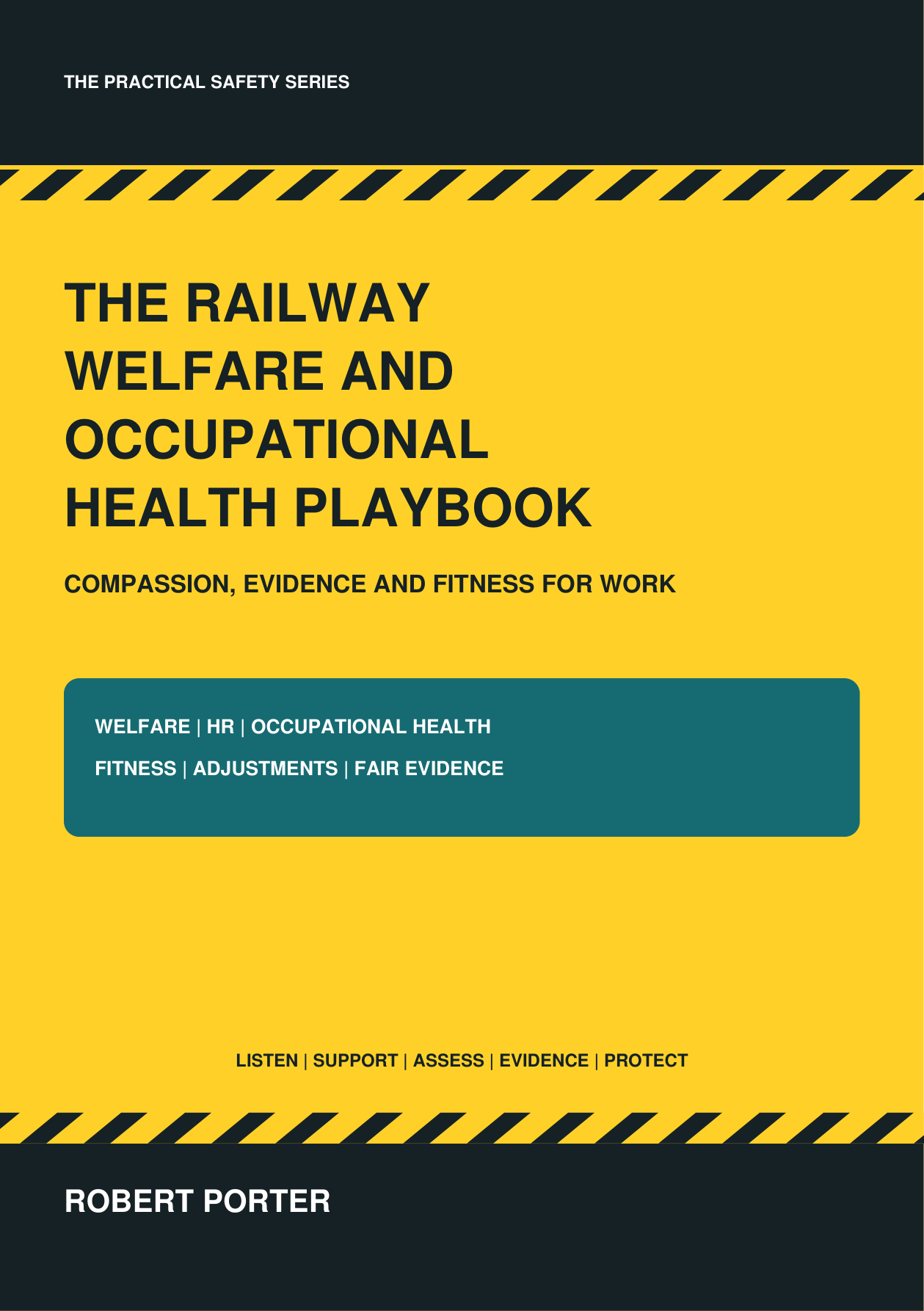
The Railway Welfare and Occupational Health Playbook Compassion, Evidence and Fitness for Work
LISTEN | SUPPORT | ASSESS | EVIDENCE | PROTECT
Railway welfare requires more than sympathy, policies or occasional wellbeing campaigns.
It requires managers, HR professionals and occupational-health teams to support people compassionately while making fair, evidence-led decisions about fitness, safety, adjustments and work.
The Railway Welfare and Occupational Health Playbook is a comprehensive guide to employee welfare, occupational health and fitness for work across the UK railway.
Written by Robert Porter, an experienced railway operational leader and Mental Health First Aider who has managed workforces of up to 200 people, the book connects the personal experience of the employee with the operational responsibilities of the railway.
It covers:
• The roles of managers, HR and occupational health
• Occupational-health professional qualifications
• HR and CIPD qualification pathways
• Occupational-health nursing and medicine
• Railway medical and psychological requirements
• Safety-critical fitness
• Train-driver medical requirements
• Welfare conversations
• Appropriate and sensitive questions
• Physical and remote assessment environments
• Occupational-health referrals
• Railway job-demand profiles
• Physical and mental-health concerns
• Neurodiversity
• Trauma and critical incidents
• Fatality and assault exposure
• Shift work, sleep and fatigue
• Medication and safety-sensitive duties
• Return-to-work planning
• Modified duties and phased returns
• Reasonable adjustments
• Adjustment passports
• Absence and capability management
• Consent and confidentiality
• UK GDPR and health information
• Medical reports
• Immediate mental or physical-health emergencies
• Suicide and self-harm concerns
• Violence, safeguarding and domestic abuse
• Workplace wellbeing
• Stress-risk assessment
• Case governance and assurance
The book deals directly with one of the most difficult welfare-management questions: what should happen when an account, document or observed activity does not appear consistent?
It does not encourage managers to assume that someone is lying.
A changing account, unusual absence pattern or apparent difference between a claimed restriction and observed activity may justify further review. It does not prove deception. Conditions fluctuate. People have good and bad days. Fear, medication, trauma, neurodivergence and misunderstanding can all affect how information is presented.
The correct response is to:
Protect immediate welfare and railway safety.
Record objective facts.
Avoid labels.
Give the employee an opportunity to explain.
Seek competent occupational-health advice.
Keep welfare and conduct processes separate.
Check personal bias.
Reach a decision using fair and proportionate evidence.
Every major subject is accompanied by a case-practice page. The guide also contains practical tools for welfare conversations, immediate safety screening, occupational-health referrals, job-demand profiles, return-to-work planning, adjustment reviews, fatigue escalation, trauma follow-up, consent, confidentiality and case chronology.
This is not a clinical diagnostic manual. It does not authorise managers or HR staff to make medical decisions or undertake railway medical examinations.
It is a practical guide for railway managers, HR teams, occupational-health professionals, wellbeing leads, Mental Health First Aiders, union representatives and anyone responsible for supporting railway employees through illness, injury, trauma, disability or workplace difficulty.
The principle is straightforward:
Treat every concern seriously when it is raised.
Protect the person and the railway.
Then establish the evidence fairly.
Compassion without assumption. Evidence without prejudice.