
SPECIALTY BEHAVIORAL HEALTH DOCUMENTATION TOOLKIT
Expand your documentation system beyond general outpatient care with specialized clinical resources designed for the distinct demands of diverse behavioral health services.
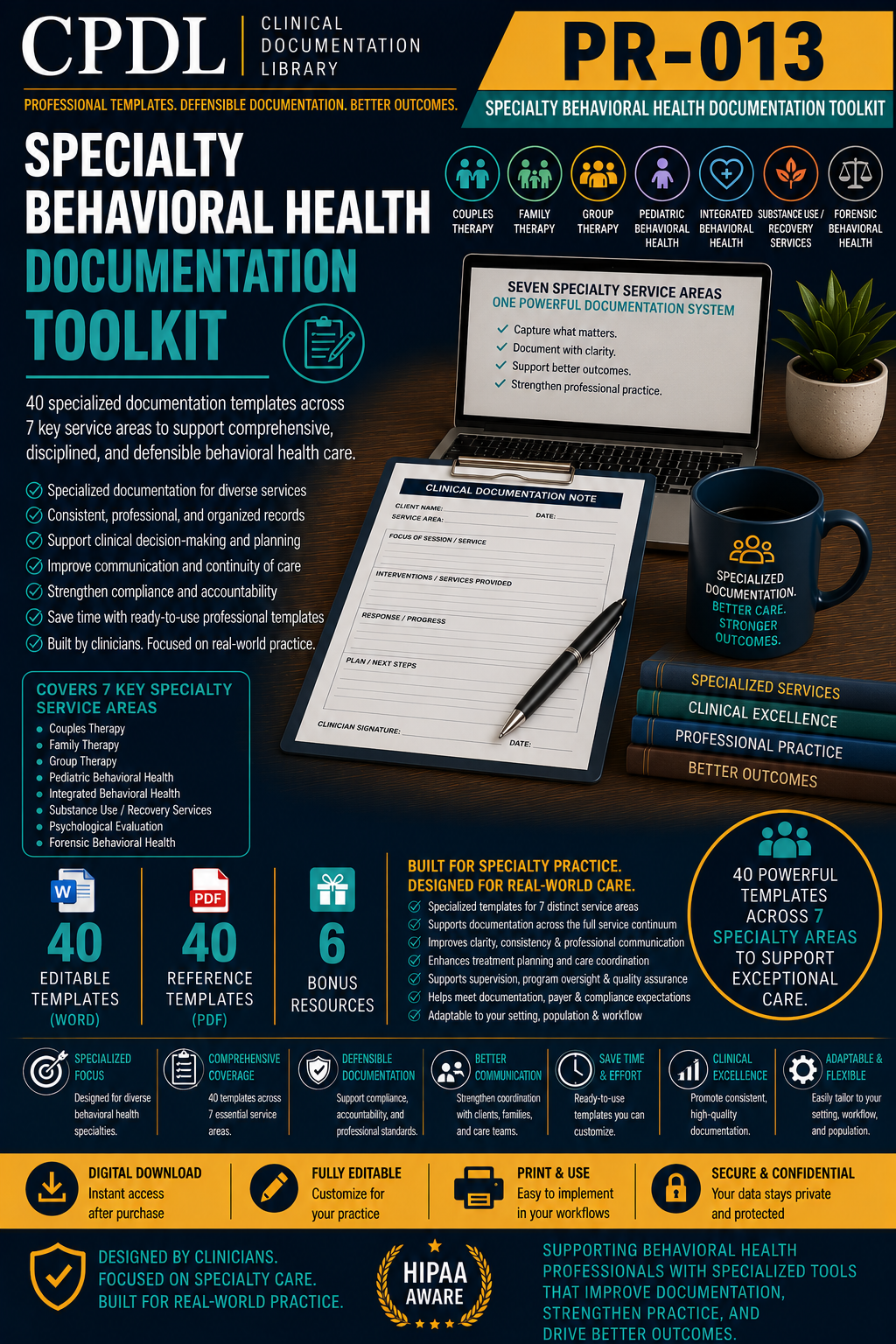
The CPDL Specialty Behavioral Health Documentation Toolkit (PR-013) provides behavioral health professionals and organizations with an extensive collection of editable documentation resources designed to support specialized services across couples therapy, family therapy, group therapy, pediatric behavioral health, integrated behavioral health, substance use and recovery services, psychological evaluation, and forensic behavioral health documentation.
With 40 professionally structured primary templates, PR-013 extends documentation infrastructure beyond generalized individual outpatient care. The toolkit provides specialized resources that account for the relational, developmental, systemic, interdisciplinary, evaluative, recovery-oriented, and professional considerations encountered across different behavioral health services.
What's Included
The toolkit includes 40 editable professional templates spanning specialty practice areas such as:
- Couples therapy documentation
- Relationship and relational assessment
- Couples treatment planning and progress
- Family therapy assessment and documentation
- Family-system and relational considerations
- Family treatment planning and progress
- Group therapy documentation
- Group participation and progress
- Group-process considerations
- Pediatric behavioral health assessment
- Child and adolescent clinical documentation
- Caregiver and family involvement
- Developmental and functional considerations
- Integrated behavioral health documentation
- Behavioral health consultation within interdisciplinary care
- Care coordination and provider communication
- Substance-use and recovery documentation
- Recovery-oriented assessment and planning
- Relapse-risk and recovery-support considerations
- Psychological evaluation documentation
- Evaluation planning and clinical synthesis
- Forensic behavioral health documentation
- Structured professional communication
- Specialty-service progress and continuity documentation
- Additional resources supporting complex behavioral health practice
Each primary resource is provided in both editable Microsoft Word format and corresponding reference PDF format, allowing clinicians and organizations to customize materials for their populations, specialty services, workflows, organizational requirements, documentation systems, and professional scope.
Plus 6 Bonus Resources
PR-013 also includes 6 supplemental resources designed to support implementation, documentation review, specialty-service selection, interdisciplinary coordination, and ongoing use of the toolkit:
- Specialty Services Workflow Guide
- Specialty Documentation Completion Checklist
- Specialty Service Selection Quick Reference
- Interdisciplinary Coordination Guide
- Specialty Documentation Quality Checklist
- Specialty Services Review Timeline
Together, these resources provide practical support for organizing specialty-service workflows, reviewing documentation completeness, selecting appropriate documentation resources, coordinating across disciplines and systems, evaluating documentation quality, and establishing a structured approach to ongoing specialty-service review.
Specialized Services. A More Adaptable Documentation System.
PR-013 can help clinicians and organizations:
- Develop more consistent documentation across specialty behavioral health services
- Reduce reliance on generalized forms that may not capture specialty-specific clinical needs
- Organize complex relational and systemic information
- Strengthen couples and family therapy documentation
- Support structured group-therapy documentation
- Address developmental, functional, caregiver, and family considerations in pediatric care
- Improve documentation within integrated and interdisciplinary settings
- Organize substance-use and recovery-related clinical information
- Support structured psychological evaluation documentation
- Strengthen professional documentation in forensic behavioral health contexts
- Improve communication and continuity across providers, disciplines, and systems
- Connect specialty assessment findings with treatment planning and clinical decision-making
- Create clearer records of specialized services
- Reduce time spent developing specialty documentation structures from scratch
- Customize documentation while maintaining a consistent professional framework
Who It's For
Designed for clinical social workers, counselors, marriage and family therapists, psychologists, behavioral health practices, clinical supervisors, group practices, integrated-care programs, substance-use and recovery programs, pediatric behavioral health services, psychological assessment settings, forensic behavioral health professionals, and other appropriately qualified practitioners.
PR-013 may be particularly useful for multiservice practices and organizations seeking documentation resources that extend beyond traditional individual outpatient psychotherapy and support multiple specialty behavioral health services within a more consistent documentation framework.
File Formats
Digital download includes:
- 40 editable Word templates
- 40 corresponding reference PDFs
- 6 bonus resources
- Supporting product and implementation materials
Important Use Notice
These resources are professional clinical documentation aids and do not replace independent clinical judgment, individualized assessment, diagnosis, treatment decisions, validated assessment procedures, professional supervision or consultation, specialty training, informed-consent requirements, or applicable professional standards.
Some specialty services represented in this toolkit—including psychological evaluation, substance-use treatment, pediatric services, integrated care, and forensic behavioral health—may be subject to additional professional, organizational, legal, regulatory, confidentiality, consent, credentialing, or jurisdiction-specific requirements.
Inclusion of a specialty documentation resource does not establish professional competence, authorization, credentialing, or scope of practice to provide that service. Users should employ only those materials appropriate to their education, training, licensure, credentialing, professional role, and authorized scope of practice.
Forensic documentation requires particular attention to the professional role, referral question, informed consent or notification, limits of confidentiality, objectivity, applicable professional standards, and the distinction between therapeutic and forensic functions.
Users are responsible for reviewing and adapting all materials to their professional discipline, client population, practice setting, organizational policies, payer requirements, applicable laws and regulations, privacy and security obligations, and jurisdiction.
Use of these materials does not independently establish legal, regulatory, payer, licensing, credentialing, accreditation, reimbursement, specialty-practice, or other compliance requirements.
Digital product. No physical item will be shipped.