
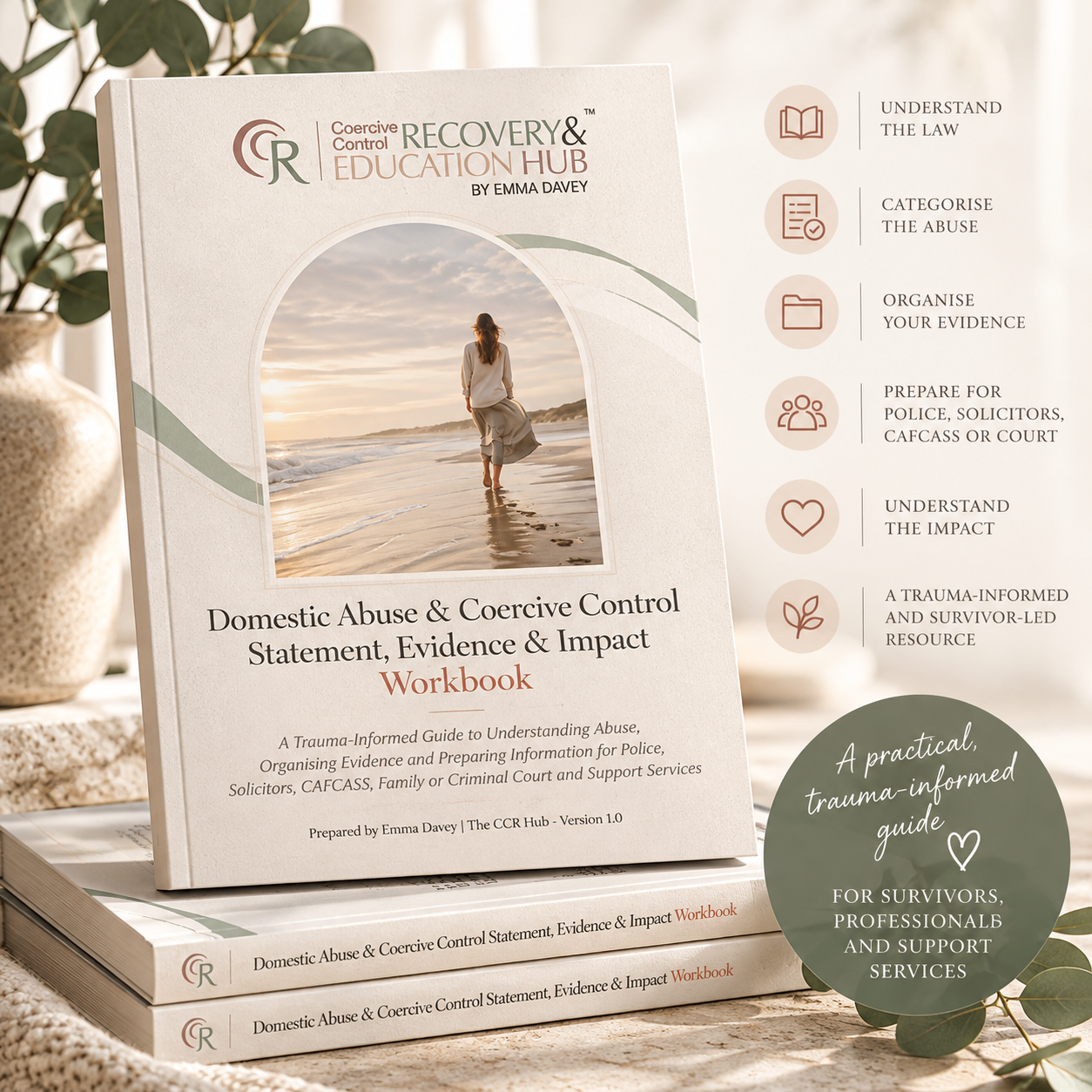


Domestic Abuse and Coercive Control Statement, Evidence and Impact Workbook
The Statement, Evidence & Impact Workbook
Domestic Abuse & Coercive Control
268 pages | Digital Download | Trauma-Informed Resource
Your experience deserves to be understood. Your evidence deserves to be heard. Your story deserves to be taken seriously.
One of the hardest parts of experiencing domestic abuse and coercive control isn't always recognising what happened. Sometimes, it's trying to explain it afterwards. How do you put months or years of manipulation, intimidation, gaslighting, financial control, isolation and psychological abuse into words? How do you explain something that happened gradually, when individual incidents might seem insignificant to someone who wasn't there? And how do you communicate the devastating impact of abuse when your memories feel fragmented, your confidence has been eroded, and you are struggling to know where to begin?
That's exactly why I created The Statement, Evidence & Impact Workbook.
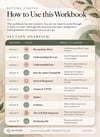
This comprehensive, 268-page, trauma-informed workbook has been developed to help survivors of domestic abuse and coercive control document, understand, categorise and organise their experiences. Drawing on six years of professional experience supporting survivors, including those navigating police investigations, criminal proceedings, family court, and safeguarding processes, I created a practical resource to help you turn overwhelming experiences into a structured, understandable account.
Because coercive control is not always one incident. It is a pattern of behaviour that can gradually take away your independence, freedom, confidence and sense of self.
And that pattern deserves to be seen.
What's Inside the Workbook?
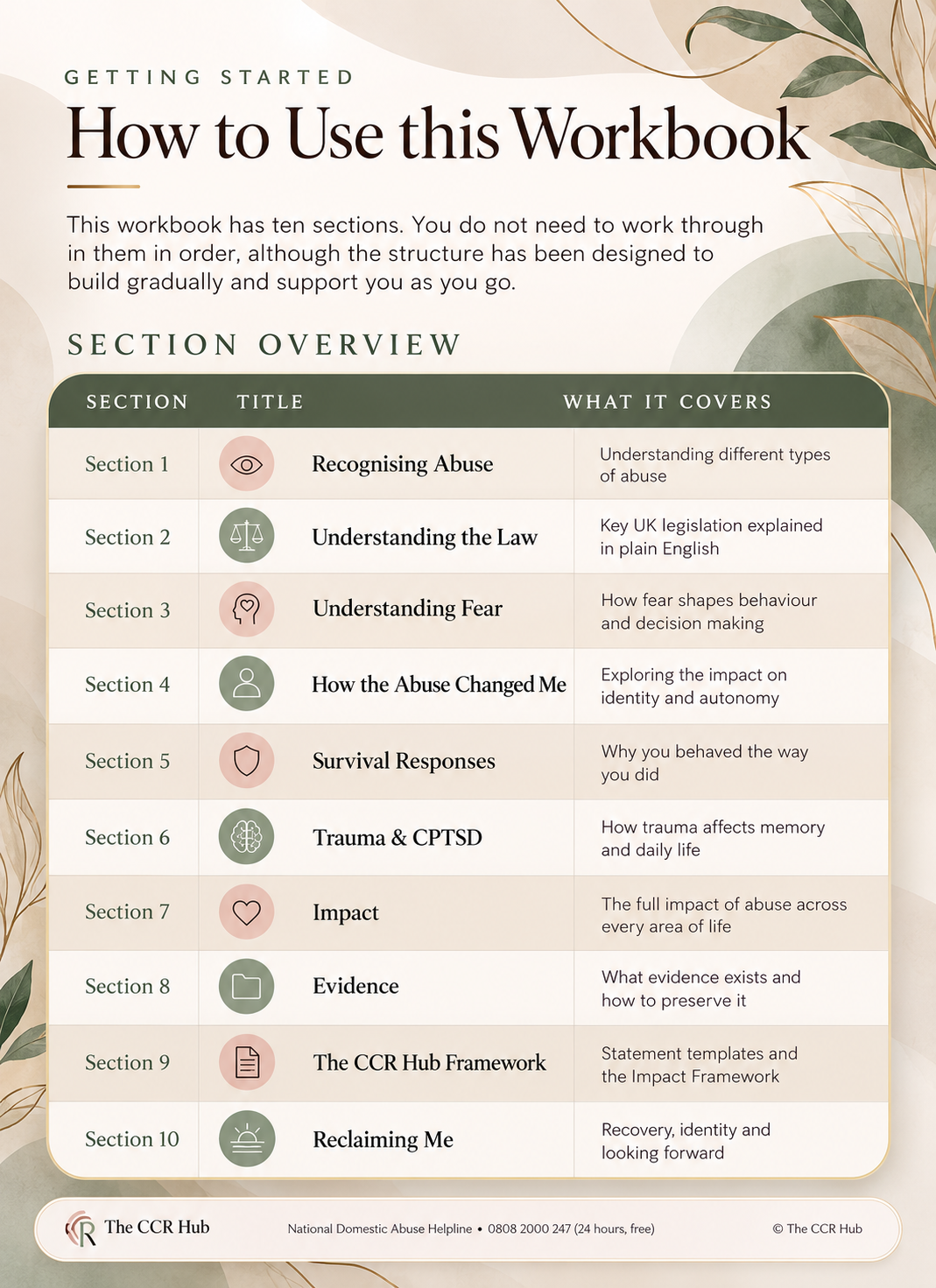
1. Understanding Domestic Abuse & Coercive Control
Learn to recognise the different behaviours that constitute domestic abuse and coercive control, including those that may have become normalised during your relationship.
2. Identifying and Categorising Abuse
Understand the different forms of abuse, including:
- Psychological and emotional abuse
- Gaslighting and manipulation
- Financial and economic abuse
- Isolation and social restriction
- Threats, intimidation and coercion
- Physical and sexual abuse
- Digital surveillance and monitoring
- Reproductive coercion
- Post-separation abuse
This helps you identify behaviours you may not previously have recognised as abusive.
3. Creating Your Timeline
Learn how to organise events chronologically, even when trauma has affected your memory, concentration or ability to recall dates.The workbook provides a structured approach to documenting what happened, when it happened and how incidents connect to a wider pattern.
4. Writing a Clear, Factual Statement
Learn to distinguish between what happened, what was said, what you remember, and how those experiences affected you. Develop a clearer, more structured account that professionals can follow and assess.
5. Gathering and Organising Evidence
Work through practical evidence checklists covering 14 categories to identify potentially relevant information, including messages, emails, financial records, photographs, medical information and professional correspondence. Understand how different pieces of evidence may help demonstrate a pattern of behaviour.
6. Explaining the Psychological and Emotional Impact
Coercive control is not simply about what somebody did to you. It is also about how those behaviours affected your everyday life. Explore changes to your confidence, independence, relationships, emotional wellbeing, physical health and sense of safety. Learn to communicate both the incidents and the wider impact they created.
7. Preparing Information for Professionals
Use the workbook to organise information that may be relevant when communicating with:
- Police and investigating officers
- Solicitors and legal representatives
- Family and criminal courts
- CAFCASS and social workers
- Domestic abuse support services
- Safeguarding professionals
- Therapists and other supporting professionals
Why This Workbook Matters
One of the greatest challenges with coercive control is that individual incidents do not always reveal the full extent of the abuse. A controlling comment, a cancelled bank card, a threat, a humiliating remark or a demand to know your whereabouts may appear isolated when viewed separately. But when you document these behaviours together, a much clearer picture can emerge.
The individual incidents are important. The pattern connecting them matters just as much.
This workbook helps you identify and communicate both.
It is designed to help you present your experiences in a structured, factual, and accessible way, so professionals can better understand the information you share. While no workbook can guarantee a particular police, safeguarding or court outcome, clear documentation can help you communicate your experience more effectively.
Who Is This Workbook For?
This workbook has been designed for:
- Women and men who have experienced domestic abuse or coercive control.
- Survivors preparing to report abuse to the police.
- Individuals navigating family or criminal court proceedings.
- People who are struggling to understand or explain what happened to them.
- Survivors experiencing ongoing post-separation abuse.
- Professionals and support services assisting individuals affected by domestic abuse.
You do not need to have reported the abuse, left the relationship or started legal proceedings to benefit from this workbook. You can use it at your own pace, in your own time, and in a way that feels manageable for you.
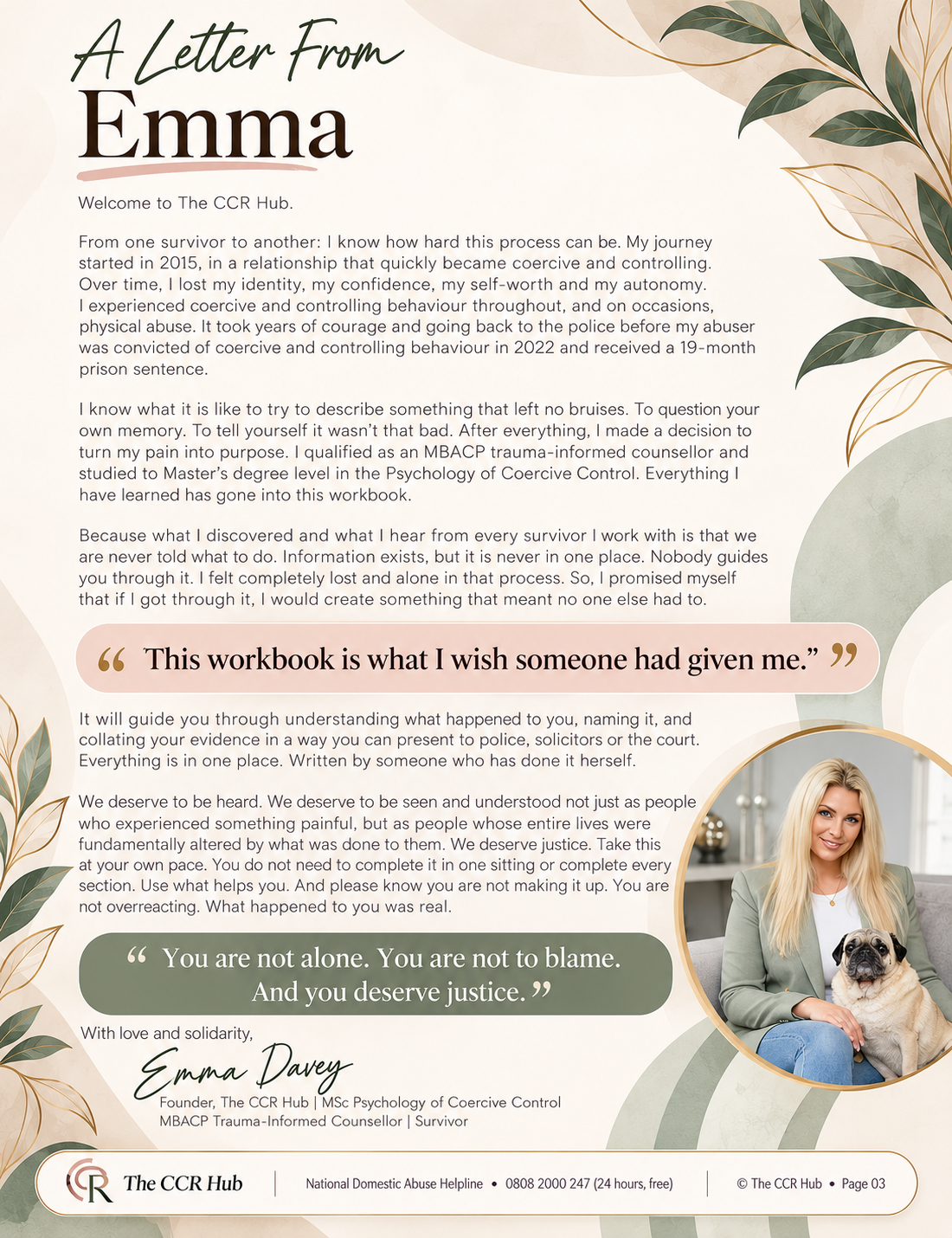
Created by Emma Davey
MBACP Trauma-Informed Therapist & Coercive Control / Domestic Abuse Specialist
Founder of the Coercive Control Recovery & Education Hub (The CCR Hub).
Drawing on my professional experience supporting survivors of domestic abuse and coercive control, I created this workbook because I have seen how difficult it can be for individuals to explain the full extent of what they have experienced. I wanted to create a resource that helps bridge the gap between experiencing abuse and being able to communicate it clearly. A resource that brings together education, understanding, practical guidance and the psychological impact of trauma.
Most importantly, I wanted survivors to feel less overwhelmed and more informed as they take the next steps in their journey.
Your Experience Matters. Your Voice Matters.
You may have spent months or years being told that you were overreacting, remembering things incorrectly or imagining what was happening. You may have questioned yourself so many times that you no longer know where to begin.
This workbook provides a place to start.
You do not have to explain everything perfectly. You just need a structured way to begin telling your story.
Start organising your experience today.
Purchase your digital copy of The Statement, Evidence & Impact Workbook and begin working through it at your own pace.
Important: This workbook is an educational and organisational resource. It does not replace independent legal advice, professional safeguarding assessments or specialist therapeutic support. Completing it does not guarantee that evidence will be admissible or that a particular legal outcome will follow.