



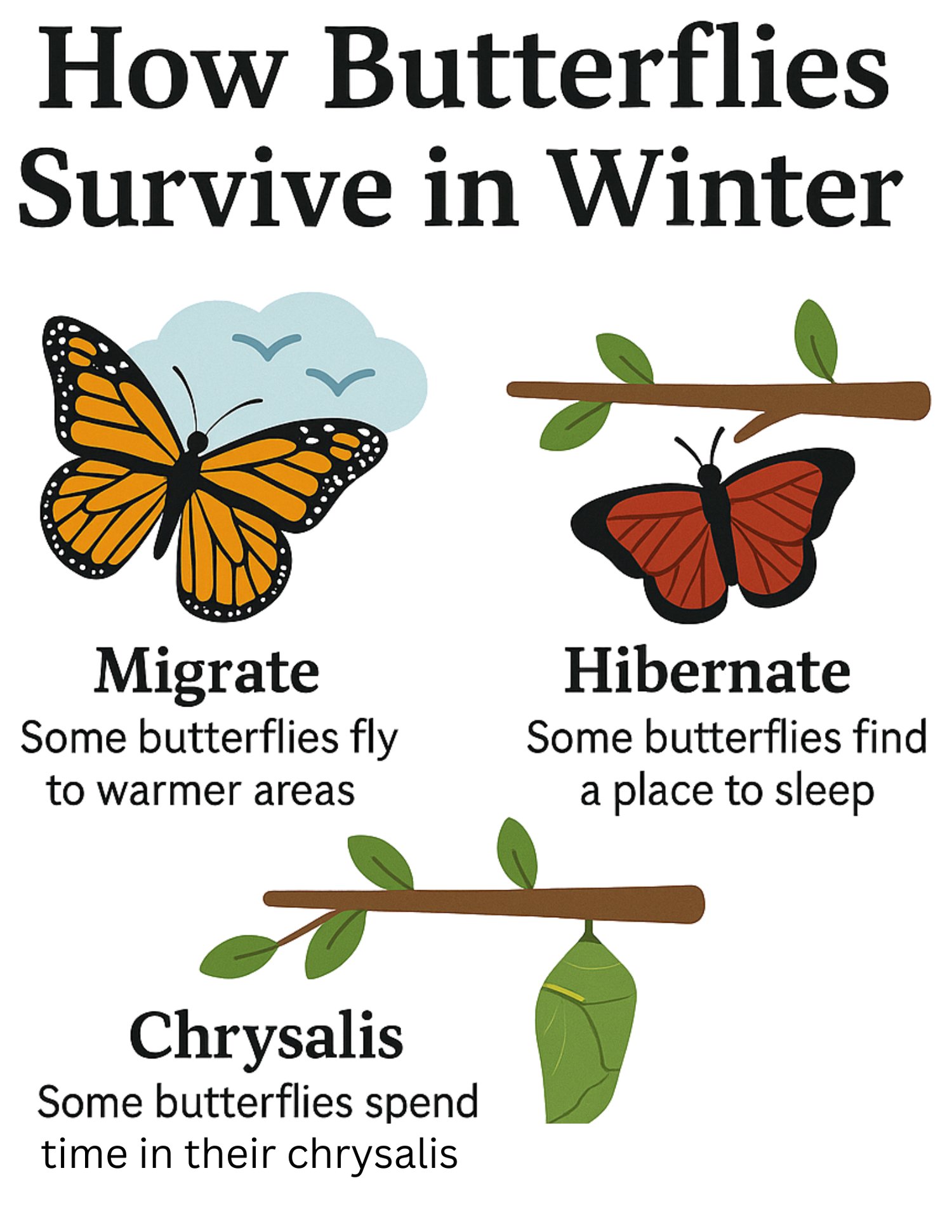

How Butterflies Survive in Winter | Life Cycle & Adaptation Infographic for K–3 Students
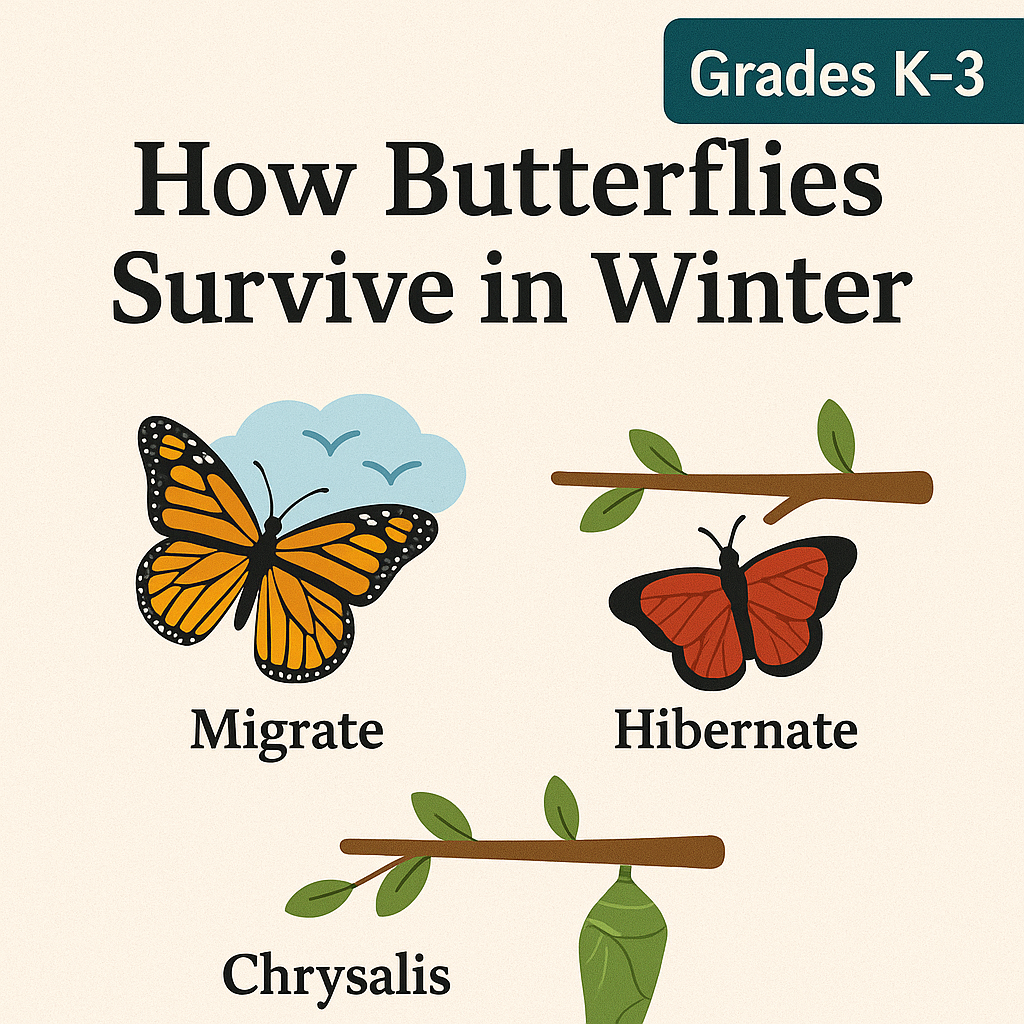
Bring science to life with this kid-friendly, colorful infographic that teaches students how butterflies survive during the cold winter months!
Perfect for grades K–3, this visual resource helps young learners understand migration, hibernation, and the chrysalis stage in a simple, engaging way. Students will discover how butterflies adapt to seasonal changes — all while learning key vocabulary and science concepts.
Pair this infographic with a short reading passage, quiz, or drawing activity for a complete mini-lesson on animal survival and life cycles!
🦋 Lesson Timing Breakdown
1. Warm-Up Discussion (5 minutes)
- Ask: “What do you think butterflies do in winter?”
- Show a butterfly photo and brainstorm ideas together.
2. Reading the Passage (8–10 minutes)
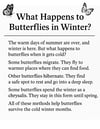
- Read the passage aloud once.
- Then, have students follow along and read parts together or independently (depending on grade).
3. Infographic & Discussion (5–7 minutes)
- Review the infographic explaining migration, hibernation, and chrysalis.
- Ask comprehension questions like:
- “What does migrate mean?”
- “Where might butterflies hide in winter?”
4. Quiz Activity (5–7 minutes)
- Students answer the 2–3 quiz questions visually or on paper.
- Discuss the answers as a class.
5. Wrap-Up (2–3 minutes)
- Review what they learned and connect it to spring or weather changes.
🦋 Aligned Learning Standards
🌿 Next Generation Science Standards (NGSS)
K-LS1-1 — Use observations to describe patterns of what plants and animals (including humans) need to survive.
→ Students observe that butterflies need warmth and food, and they change behavior (migrate, hibernate, or stay in chrysalis) to survive the cold.
1-LS3-1 — Make observations to construct an evidence-based account that young plants and animals are like, but not exactly like, their parents.
→ Students can connect life cycles (egg → caterpillar → chrysalis → butterfly) and discuss seasonal stages.
2-LS4-1 — Make observations of plants and animals to compare the diversity of life in different habitats.
→ Students explore how butterflies live in warm vs. cold environments and adapt their behavior.
3-LS4-3 — Construct an argument with evidence that in a particular habitat, some organisms can survive well, some survive less well, and some cannot survive at all.
→ Students understand how butterflies survive in warm habitats but cannot in cold ones.
📘 Common Core ELA Standards (Reading & Writing)
CCSS.ELA-LITERACY.RI.K.1 — With prompting and support, ask and answer questions about key details in a text.
CCSS.ELA-LITERACY.RI.1.2 — Identify the main topic and retell key details of a text.
CCSS.ELA-LITERACY.RI.2.1 — Ask and answer who, what, where, when, why, and how questions to demonstrate understanding.
CCSS.ELA-LITERACY.RI.3.1 — Ask and answer questions to demonstrate understanding of a text, referring explicitly to the text as the basis for the answers.
CCSS.ELA-LITERACY.W.1.8 / W.2.8 — Recall information from experiences or gather information from provided sources to answer a question.
🎯 Learning Objectives
By the end of this lesson, students will be able to:
- Describe how butterflies survive the winter.
- Identify the three main ways butterflies adapt to cold weather (migration, hibernation, chrysalis).
- Explain that animals have behaviors that help them survive seasonal changes.
- Answer comprehension questions about informational text using details from the passage.