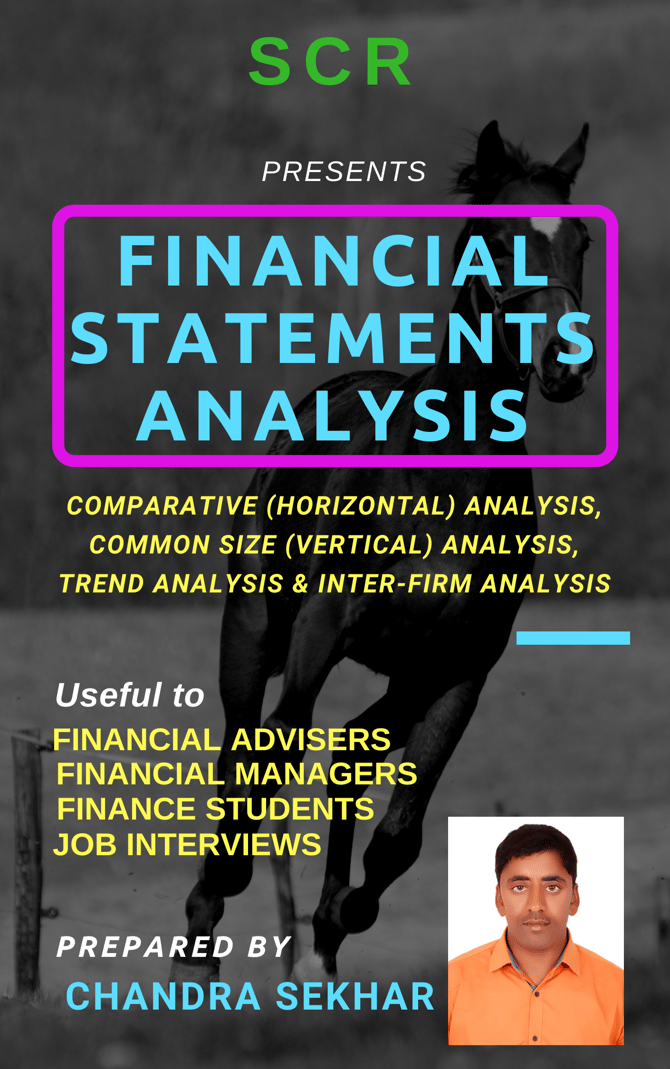
FINANCIAL STATEMENTS ANALYSIS
I wrote this book Financial Statements Analysis with the following objectives.
· To demonstrate to readers that the subject of Financial statements Analysis simple to understand, relevant in practice and interesting to learn.
· To help managers appreciate the logic for making better financial decisions.
· To explain the concepts and theories of Financial statements analysis in a simple way so readers could grasp them very easily and be able to put them in to practice.
· To provide a book that has a comprehensive coverage for financial statements and their analysis.
· To create a book that differentiates it self from other books in terms of coverage, presentation.
This book useful to Students, Job Interviews, Investors, Financial advisers, Financial analysts, Financial managers and Fund managers to relate theories, concepts and data interpretation to practice.
This book Financial Statements Analysis aims to assist the reader to develop a thorough understanding of the concepts and theories underlying financial management in a systematic way. To accomplish this purpose, the recent thinking in the field of finance has been presented in a most simple, and precise manner.
The main features of the book are simple understanding and key concepts.
The book contains a comprehensive analysis of topics on Financial statements and Financial statements analysis with a view that readers understand financial decisions thoroughly well and are able to evaluate their implications for share holders and the company.
This book begins with the discussion of concepts of Financial statements, Balance sheet, Non-current assets, Current assets, liabilities, Long-term liabilities, current liabilities, owner’s equity, profit & loss account, non-operating profits and expenses, operating profits and expenses, concepts of profits, Funds flow statement, Cash flow statement, Statement of changes in equity, Comparative analysis, Common size analysis, Trend analysis, Inter-firm analysis and finally FAQs about Financial statements. With this foundation, readers can easily understand the financial statements and its analysis, decision criteria necessary to manage the funds and create and enhance the value of the firm.
The text material has been structured to focus on financial statements analysis is in the financial decision making process.
The book discusses the theories, concepts, assumptions, underlying financial decisions i.e investment, financing, dividend and working capital management.
It is hoped that this will facilitate a better understanding of the subject matter.
CONTENTS
I FINANCIAL STATEMENTS
A. BALANCE SHEET
1. ASSETS
a. Non-Current assets
Tangible Fixed assets
Intangible fixed assets
b. Current assets
2. LIABILITIES
a. Long-term liabilities
b. Current liabilities
3. OWNER’S EQUITY
Proforma of Balance sheet
B. PROFIT AND LOSS ACCOUNT
Operating Income
Operating Expenses
Non-operating Income
Non-operating Expenses
Gross profit
Net Profit
EBITDA
EBIT
EBT
EAT
NOPAT
Proforma of Profit and loss account
C. STATEMENT OF CHANGES IN FINANCIAL POSITION
1. FUNDS FLOW STATEMENT
Forms of funds flow statement
Sources & uses of working capital
Schedule of changes in working capital
Sources of working capital
Funds from operations
Uses of working capital
Exercise with working notes (case study)
2. CASH FLOW STATEMENT
a. Sources of cash
b. Uses of cash
c. Categories of cash flow statement
Operating activities
Investing activities
Financing activities
Proforma of Cash flow statement
D. STATEMENT OF CHANGES IN EQUITY
Proforma of Retained earnings statement
II. FINANCIAL STATEMENT ANALYSIS
1. Comparative analysis
2. Common size analysis
3. Trend analysis
4. Inter-firm analysis
III. F A Q s
What is the Annual report
What is Annual General Meeting
What are 4 basic financial statements
What is the order of financial statements
How do we prepare the financial statements
What are the users of financial statements
What are the elements of financial statements
· To demonstrate to readers that the subject of Financial statements Analysis simple to understand, relevant in practice and interesting to learn.
· To help managers appreciate the logic for making better financial decisions.
· To explain the concepts and theories of Financial statements analysis in a simple way so readers could grasp them very easily and be able to put them in to practice.
· To provide a book that has a comprehensive coverage for financial statements and their analysis.
· To create a book that differentiates it self from other books in terms of coverage, presentation.
This book useful to Students, Job Interviews, Investors, Financial advisers, Financial analysts, Financial managers and Fund managers to relate theories, concepts and data interpretation to practice.
This book Financial Statements Analysis aims to assist the reader to develop a thorough understanding of the concepts and theories underlying financial management in a systematic way. To accomplish this purpose, the recent thinking in the field of finance has been presented in a most simple, and precise manner.
The main features of the book are simple understanding and key concepts.
The book contains a comprehensive analysis of topics on Financial statements and Financial statements analysis with a view that readers understand financial decisions thoroughly well and are able to evaluate their implications for share holders and the company.
This book begins with the discussion of concepts of Financial statements, Balance sheet, Non-current assets, Current assets, liabilities, Long-term liabilities, current liabilities, owner’s equity, profit & loss account, non-operating profits and expenses, operating profits and expenses, concepts of profits, Funds flow statement, Cash flow statement, Statement of changes in equity, Comparative analysis, Common size analysis, Trend analysis, Inter-firm analysis and finally FAQs about Financial statements. With this foundation, readers can easily understand the financial statements and its analysis, decision criteria necessary to manage the funds and create and enhance the value of the firm.
The text material has been structured to focus on financial statements analysis is in the financial decision making process.
The book discusses the theories, concepts, assumptions, underlying financial decisions i.e investment, financing, dividend and working capital management.
It is hoped that this will facilitate a better understanding of the subject matter.
CONTENTS
I FINANCIAL STATEMENTS
A. BALANCE SHEET
1. ASSETS
a. Non-Current assets
Tangible Fixed assets
Intangible fixed assets
b. Current assets
2. LIABILITIES
a. Long-term liabilities
b. Current liabilities
3. OWNER’S EQUITY
Proforma of Balance sheet
B. PROFIT AND LOSS ACCOUNT
Operating Income
Operating Expenses
Non-operating Income
Non-operating Expenses
Gross profit
Net Profit
EBITDA
EBIT
EBT
EAT
NOPAT
Proforma of Profit and loss account
C. STATEMENT OF CHANGES IN FINANCIAL POSITION
1. FUNDS FLOW STATEMENT
Forms of funds flow statement
Sources & uses of working capital
Schedule of changes in working capital
Sources of working capital
Funds from operations
Uses of working capital
Exercise with working notes (case study)
2. CASH FLOW STATEMENT
a. Sources of cash
b. Uses of cash
c. Categories of cash flow statement
Operating activities
Investing activities
Financing activities
Proforma of Cash flow statement
D. STATEMENT OF CHANGES IN EQUITY
Proforma of Retained earnings statement
II. FINANCIAL STATEMENT ANALYSIS
1. Comparative analysis
2. Common size analysis
3. Trend analysis
4. Inter-firm analysis
III. F A Q s
What is the Annual report
What is Annual General Meeting
What are 4 basic financial statements
What is the order of financial statements
How do we prepare the financial statements
What are the users of financial statements
What are the elements of financial statements

 Save
Save
 Share
Share
 Tweet
Tweet