The Threshold Guide (450 pages!)
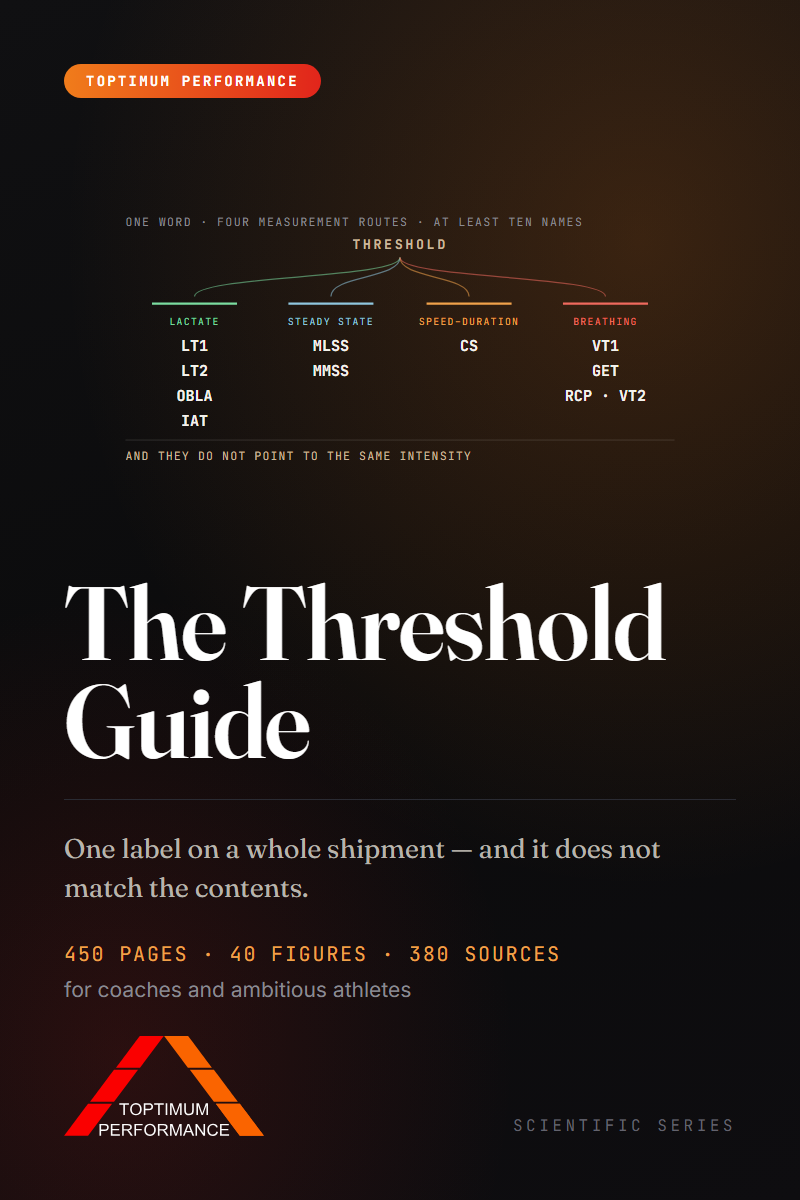
“Threshold” is one of the most widely used words in endurance sport, and one of the most ambiguous. LT1, LT2, OBLA, IAT, MLSS, critical speed, VT1, GET and RCP come from four different measurement routes; the MMSS is a construct. In practice, these ten names are often used interchangeably, as if they pointed to the same boundary.
This book places them side by side and shows what happens. In 10 well-trained men, the means of four common threshold measures are spread over 2.3 km/h. At group level, often no difference between the measures can be shown. In an individual runner, however, they do not coincide, and for the same measurement the result still shifts with the protocol, the model, the surface and the running already done. Every zone model built on such a boundary inherits that uncertainty, including in the percentages that follow from it.
That does not make threshold work worthless. It does show that the word suggests a precision the measurements do not deliver, and it answers the question that follows: so how can a coach work with it? The last four chapters offer a way of working that builds the uncertainty in, without false precision.
This book holds itself to a strict standard. Where the running-specific evidence is thin, it says so; where a figure comes from cycling research, that is noted; and where something has not been studied in runners, it is stated plainly, rather than filled in with data from another sport.
What's inside
• The conceptual framework — which boundaries exist, where each name comes from and whether they point to the same intensity.
• The windows — lactate, respiratory gases, heart rate, pace, perceived exertion, muscle oxygenation and heart rate variability: what each window sees, and what it does not.
• Measurement uncertainty — how repeatable each method is, what the protocol changes in the result, and how large an improvement has to be to count as more than noise.
• From threshold to zone — where the zone boundaries come from, what the counting method does to a percentage, and polarised or pyramidal.
• “Threshold training” under scrutiny — what the Norwegian primary sources call “threshold”, what the evidence supports and what a coach can take from it.
• The shifting threshold — the boundary during exercise, under the influence of heat, altitude and fuel status, and in the female runner.
• What a coach can do — from 800 metres to the ultra, with and without a laboratory, in youth and masters, and a way of working that builds the uncertainty in: choice of test, retest and decision rules.
With seven reference lists — one per part — and a glossary of 61 terms, each with the meaning it has in this book.
For whom
Coaches and ambitious athletes who work with thresholds or advise on them, and who want to know what their measured values really point to before they build a training plan on them. Not an introduction: this book assumes the reader knows what a lactate test is.
Extent
450 pages · 40 figures · 25 tables · 380 scientific sources (with DOI where available) · seven reference lists · glossary of 61 terms