
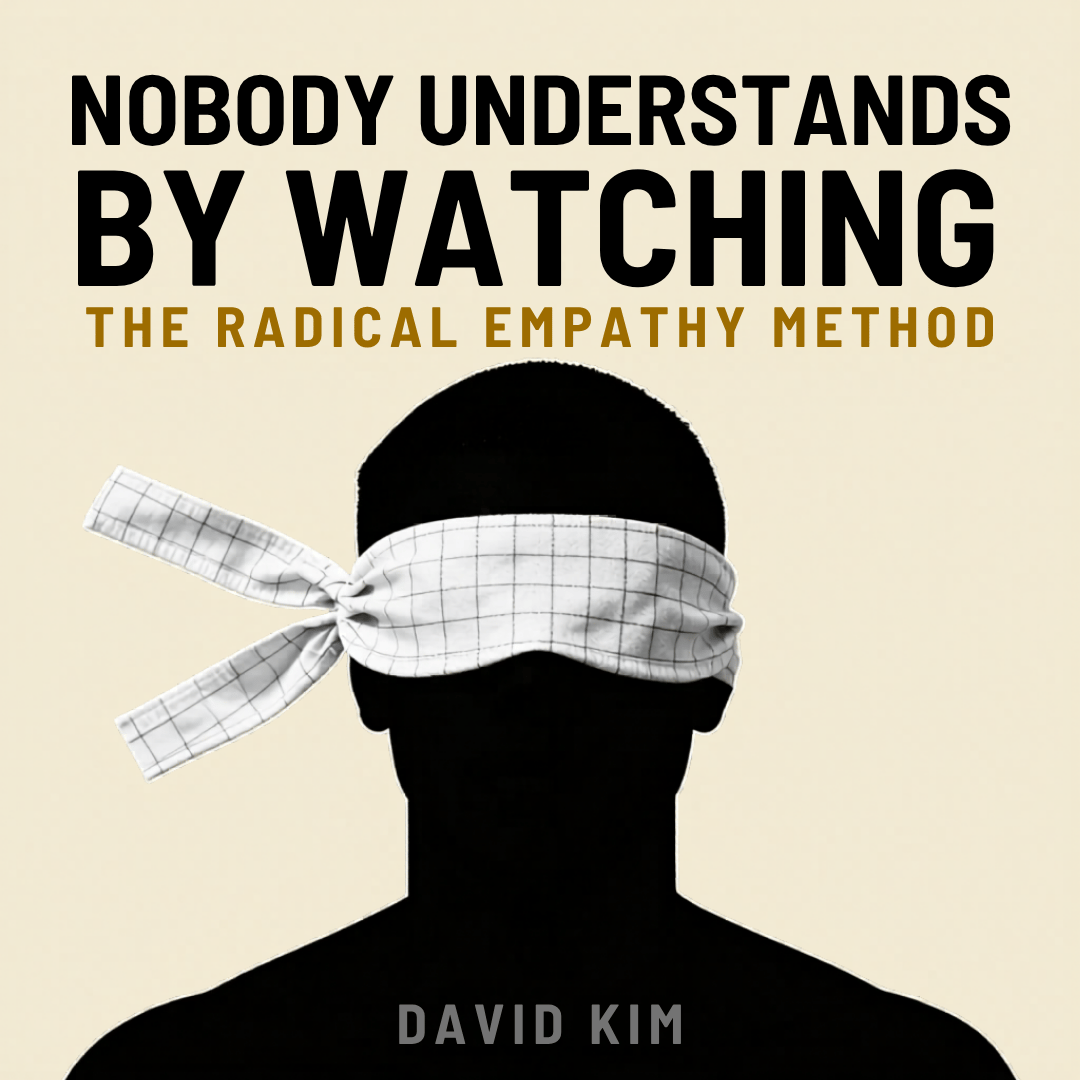
NOBODY UNDERSTANDS BY WATCHING
NOBODY UNDERSTANDS BY WATCHING
The Radical Empathy Method for Problems You Cannot See
A Field Edition Manifesto — David Kim
You ran the surveys. You built the dashboards. You hired the most credentialed team in the room.
And the market still quietly rejected you.
This is not a story about bad strategy. It is a story about a gap so universal, so deeply embedded in how modern organizations operate, that almost no one stops to question it — until the product fails, the expansion collapses, or the customer simply walks away without explanation.
The gap has a name: The Do Gap.
The problem is not what you think.
Most companies stop at hearing. The NPS score. The focus group. The six-figure research report. These are sophisticated, expensive forms of the weakest tier of human understanding — dressed up in the costume of scientific rigor.
A few go further and see — they watch customers in the wild.
Almost none cross the final boundary and do — stepping inside the customer's experience and living it from within.
That distance, between hearing about people and actually understanding them, is the single most expensive gap in modern business. Its cruelest feature: it hides most effectively inside the companies that believe themselves to be the most customer-focused of all.
The numbers are not soft.
McKinsey tracked 300 companies over five years. Those that designed around genuine human understanding outgrew peers by 32 percentage points in revenue and delivered 56 points higher shareholder return.
Capgemini found that 75% of organizations believed themselves customer-centric. Only 30% of their customers agreed.
78% of consumers globally do not believe businesses genuinely care about them.
That is not a marketing problem to be patched with a better campaign. It is the largest unguarded competitive opening of our time — sitting in plain sight.
What this Field Edition covers:
The Do Gap — why the smartest, best-capitalized companies keep failing in the same way, and why their intelligence is structurally unable to protect them from it
The Hear → See → Do Pyramid — where 90% of "customer-centric" companies actually operate, and what it costs them
The Evidence — the neuroscience of mirror neurons; the woman who disguised herself as an 80-year-old for three years and changed how the world designs products; why Satya Nadella calls empathy a leading indicator of success, not a soft skill
The Billion-Dollar Proof — Olive AI raised $902 million and dissolved in 2023. Not because the technology failed. Because no one had lived inside the workflow it was supposed to replace. Walmart. Uber China. eBay Japan. The pattern is always the same.
The Seven Rooms — the specific, recurring spaces where global expansion dies: the silent room, the translated room, the room that feels from the inside like an invasion. Seven scenes. One blind spot.
The Do Gap Audit — four questions to put to any room before a product launch, a market entry, or a pivot. The silence that follows question four is the finding.
This is a Field Edition.
Deliberately short. Designed to be read on a flight, argued with in the margins, finished before you land. No forty-step frameworks. One idea, pressed hard enough that you cannot un-see it, armed with enough evidence that you cannot easily dismiss it.
Everything in this book reduces to five words:
Study people first. Everything else follows.
About the author
David Kim has spent three decades at the intersection of capital, technology, and storytelling across Asia. Former managing director at GE Capital Korea. Founder of Northhead Capital. Columnist for e27 (Singapore), TechNode (China), and the Korea Economic Daily. Named one of e27's Top 27 Voices Shaping Asia's Startup Ecosystem in 2025.
This manifesto is the first in a series on radical empathy, human-experience design, localization, and value creation. It is first because everything else depends on it.
davidkim.media