
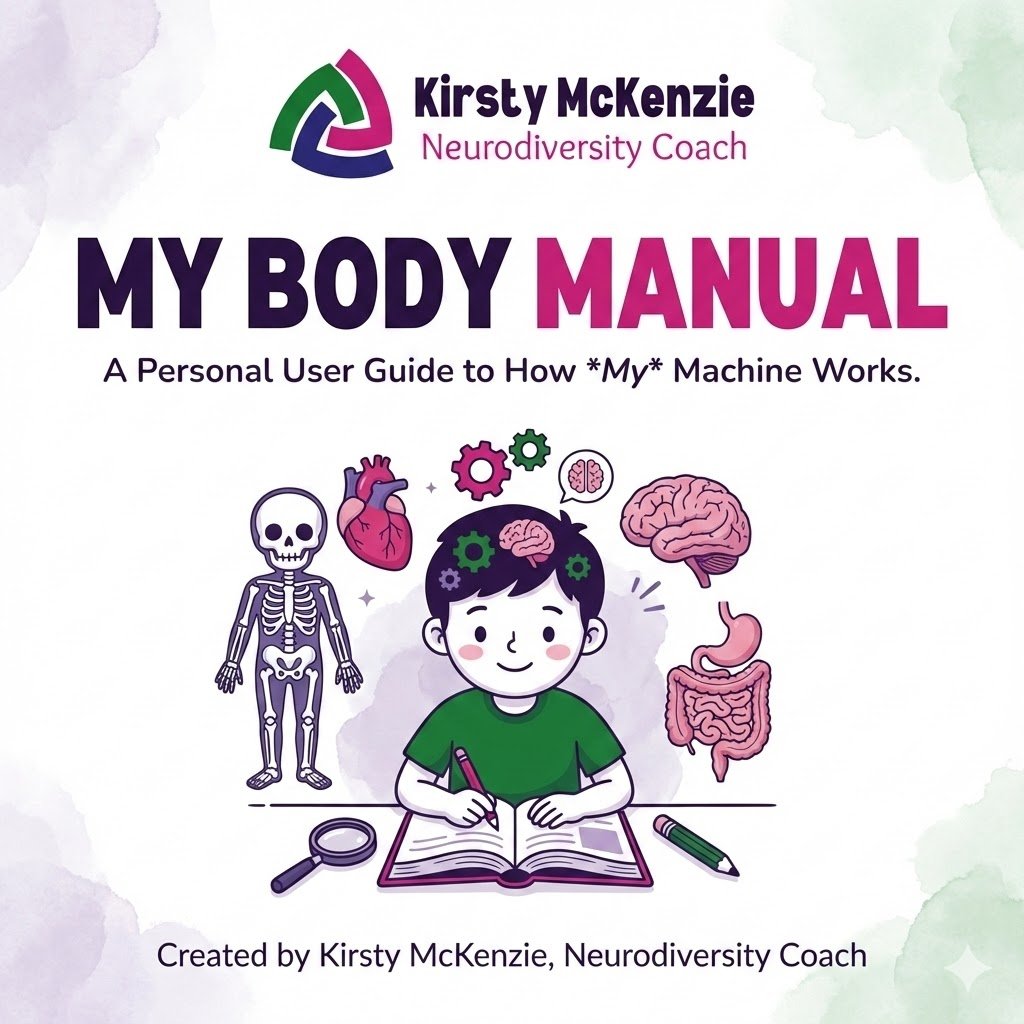
My Body Manual
The User Manual Your Child Didn't Come With.
Stop asking "Why are you behaving like this?" Start asking "How is your machine wired?"
If you are raising a neurodivergent (AuDHD, ADHD, Autistic) child or teen, you know the struggle. You read the standard parenting books, but the strategies don't work. You tell them to "sit still to listen," but they can only listen if they move. You tell them "eat your dinner," but their body treats the texture like a threat.
We spend years trying to force a Custom Operating System to run on a Standard Manual. It’s exhausted you, and it’s exhausted them.
It’s time to stop over-thinking the behavior, and start decoding the biology.
The Philosophy: Body First, Brain Later
The "Standard Model" of parenting relies on the brain. We ask our kids: "Why did you hit your brother?" or "Why can't you focus?"
But for AuDHD brains, the issue isn't usually a choice; it’s a physiological reaction.
- Anxiety isn't a thought; it's a "Red Butterfly" in the throat.
- Refusal isn't stubbornness; it's a "System Overheat."
- Fidgeting isn't naughtiness; it's "Charging the Battery."
The "Enough Thinking" Project is a series of interactive guides—one for Kids (The Explorers) and one for Teens (The System Engineers) coming soon—designed to help them map their own nervous systems.
We don't ask them to write essays about their feelings. We give them Control Panels, Checklists, and Cheat Codes.
What Is The "My Body Manual"?
This is not a textbook. It is a collaborative discovery tool for you and your child. It translates complex sensory concepts into language they actually understand.
For The Kids (Ages 5-10): The "Body Lab" Edition
- Theme: Robot/Explorer/Monster.
- The Goal: To help them communicate needs before they meltdown.
- Includes:
- The Sound Mixer: Mapping which noises hurt and which ones help.
- The Fuel Gauge: Understanding hunger signals beyond just "tummy rumbles."
- The Wiggles: Why moving helps us listen (and why sitting still drains our battery).
Why This Works
- It’s Non-Judgmental: There are no wrong answers. Only data points.
- It’s Low-Demand: We use "Check the Box" menus because AuDHD brains often struggle to retrieve information on the spot.
- It’s Retroactive Repair: For older kids, this process helps explain why things were hard when they were little, healing the narrative that they were "difficult" children.
Stop guessing. Stop fighting. Start reading the manual.