

Concrete Defects - Core Sampling and Petrography
Core Sampling & Petrography Guide —
Turn a field hunch into laboratory proof.
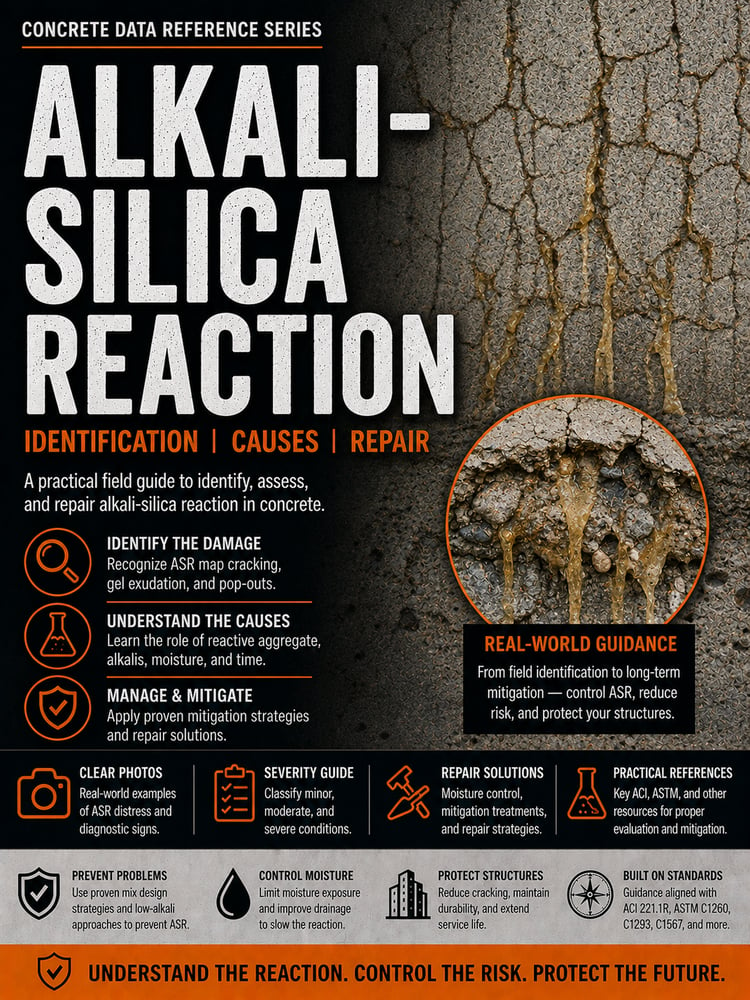
The Core Sampling & Petrography Guide is a practical field reference for concrete professionals who need to understand when, why, and how concrete cores are taken for laboratory testing. Core sampling gives the lab a real cross-section of the concrete, while petrographic examination helps identify what is actually happening inside the material — including ASR, sulfate attack, delayed ettringite formation, freeze-thaw damage, carbonation, cracking, reaction gel, air-void issues, and mix or placement problems.
This guide is built for inspectors, contractors, QC professionals, engineers, technicians, repair teams, and anyone involved in concrete investigation or troubleshooting. It explains how to plan core sampling, avoid reinforcement, select representative locations, label and document cores, patch core holes, ship samples to the lab, and request the correct testing program.
Instead of guessing at the cause of distress from the surface, this guide helps users understand how core sampling and petrography can confirm the real mechanism behind the problem.
What’s Included
- Clear explanation of core sampling and petrographic examination
- Guidance on when to use core sampling and petrography
- Explanation of what cores can reveal about strength, durability, and deterioration
- Step-by-step field procedure for planning, drilling, extracting, labeling, logging, patching, and shipping cores
- Guidance for selecting sound and distressed sample locations
- Direction on scanning for reinforcement, post-tensioning, utilities, and embedded items before coring
- Interpretation categories for sound, borderline, and deterioration-confirmed results
- Field decision path for choosing the correct laboratory test
- Guidance on compression cores, petrography, chloride profiles, air-void analysis, and combined lab programs
- Limitations and cautions for destructive testing
- Best practices for representative sampling and documentation
- Standards and reference list
- Core testing at-a-glance table
- Field checklist
Built for Real Concrete Investigations
This guide helps answer the questions that matter before cutting into concrete:
Are we trying to confirm a deterioration mechanism?
Do we need in-place compressive strength?
Are we investigating corrosion or chloride risk?
Do we need petrography, compression testing, chloride testing, air-void analysis, or a combined lab program?
How do we sample without damaging reinforcement or misrepresenting the structure?
The guide emphasizes defining the question first, scanning before drilling, choosing representative locations, preserving core orientation, documenting visible distress, patching core holes properly, and sending the lab a clear test request.
Best For
- Concrete inspectors
- Field technicians
- Ready-mix QC professionals
- Engineers and engineering support staff
- Concrete repair contractors
- Forensic concrete investigators
- Testing laboratories
- DOT, bridge, pavement, and infrastructure teams
- Facility maintenance and condition-assessment teams
- Anyone building a practical concrete diagnostics reference library
Why This Guide Matters
Surface observations can point you in the right direction, but they do not always prove the cause. Core sampling and petrography help confirm what is happening inside the concrete. A properly selected and documented core can support strength evaluation, durability assessment, repair planning, dispute resolution, and engineering decisions.
The Core Sampling & Petrography Guide helps users understand the process before the drill starts, so the sampling plan is safer, cleaner, better documented, and more useful once the cores reach the lab.
Important Note
Core sampling is destructive and localized. Reinforcement, post-tensioning, conduits, and utilities must be avoided unless specifically approved. One or two cores rarely represent an entire structure, and final interpretation should be handled by qualified personnel using laboratory results, engineering judgment, and applicable standards.
Cut with purpose. Test with confidence. Prove what’s happening inside the concrete.