

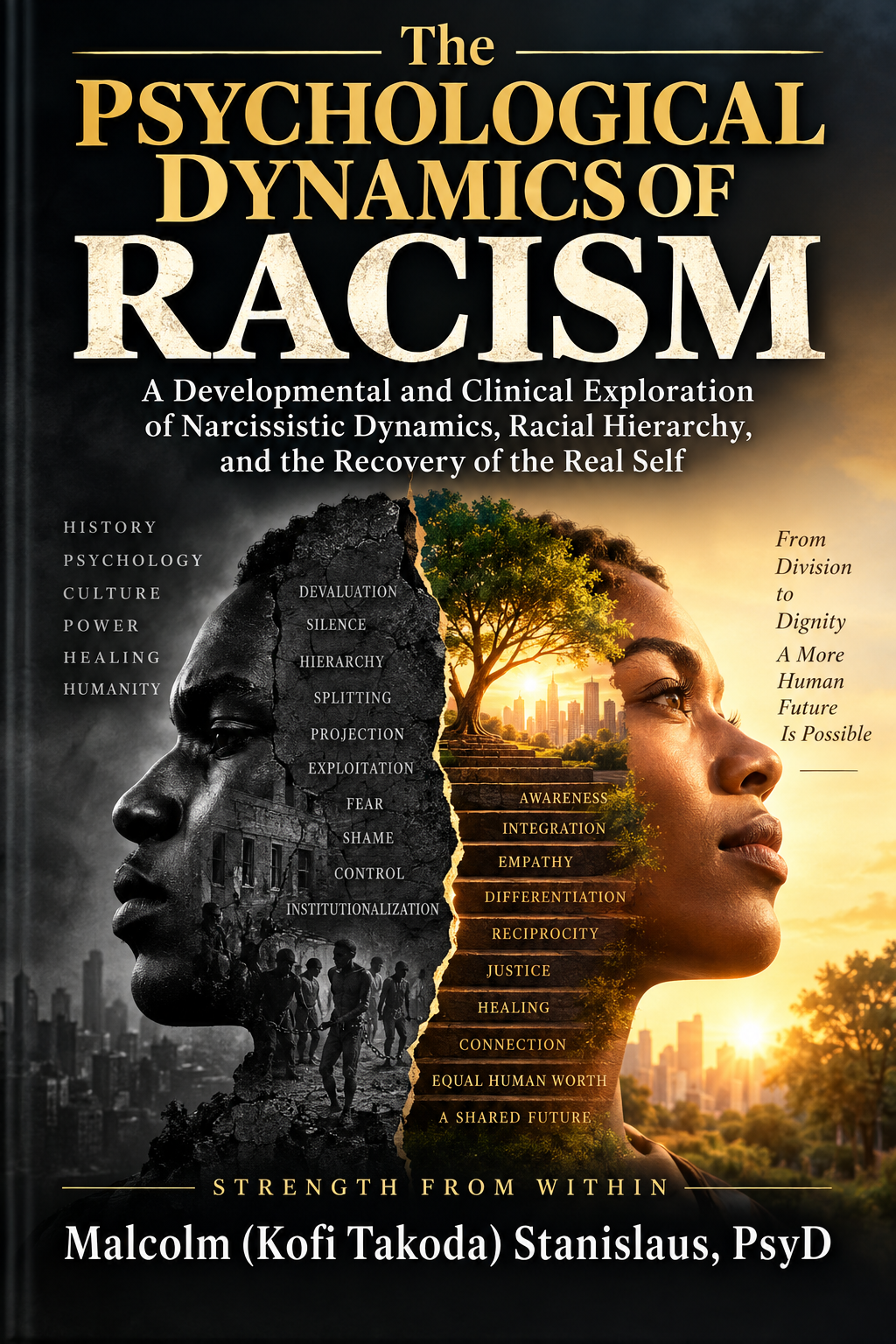
The Psychological Dynamics of Racism
Brief Summary — The Psychological Dynamics of Racism
The Psychological Dynamics of Racism examines racism as a psychological, relational, cultural, and institutional process. Drawing primarily upon James F. Masterson’s developmental understanding of the Self, the book explores how narcissistic dynamics—including grandiosity, entitlement, splitting, projection, devaluation, shame, impaired empathy, and the need for superiority—can contribute to racial hierarchy and domination.
The book distinguishes between exhibitionistic narcissistic dynamics, expressed through overt superiority and entitlement, and closet narcissistic dynamics, in which a person may derive significance and specialness through identification with an idealized racial, cultural, national, or institutional group. It then traces how these psychological patterns can move from individuals into relationships, group narratives, cultural beliefs, and institutions, where they may be transmitted and reinforced across generations.
The book also distinguishes the psychology supporting domination from the psychological adaptations of people surviving domination, incorporating the perspectives of Fanon, Bradshaw, and the historical trauma framework.
Ultimately, the book is about healing rather than merely identifying pathology. It proposes a developmental movement away from splitting, superiority, devaluation, projection, and domination toward reality perception, emotional integration, differentiation, empathy, mature trust, reciprocal relationships, equal human worth, and power without domination.
Its central psychological principle is simple:
“I do not need you to be less for me to be enough.”