
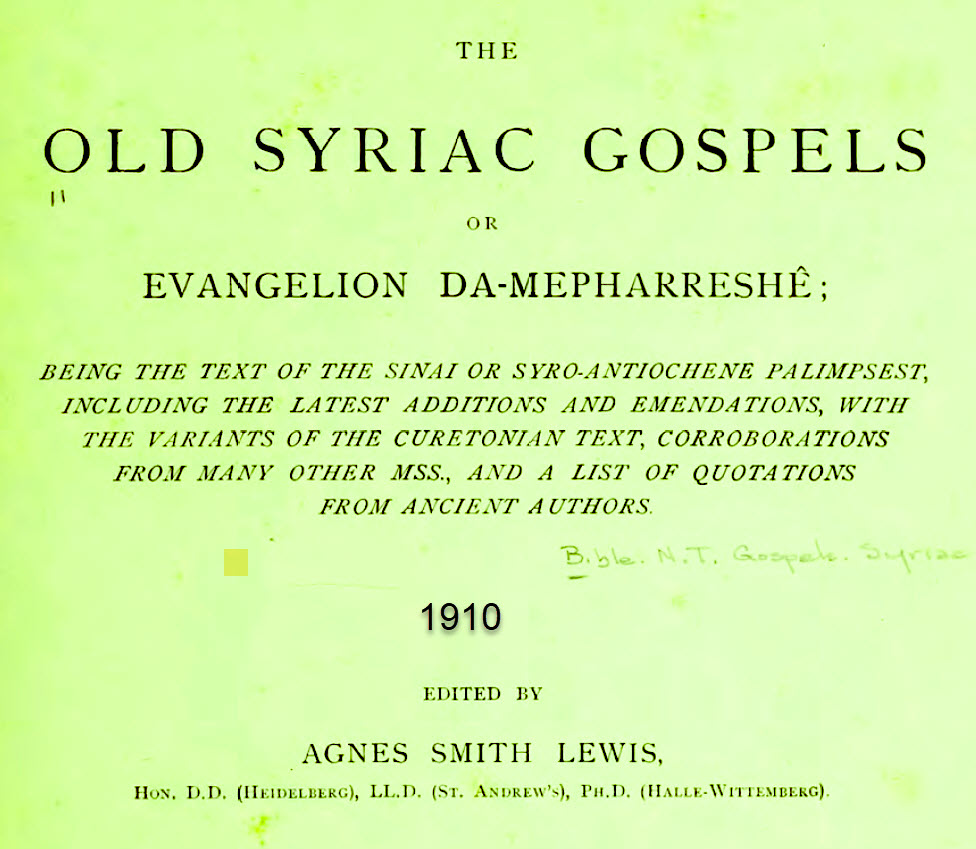
1910 Agnes Lewis - The Old Syriac Gospels - Final Edits
This 1910 four-part division (to make accessible in Gemini Notebook) of The Old Syriac Gospels, or Evangelion da-Mepharreshe (published in London by Williams & Norgate)—is Agnes Smith Lewis's crowning achievement and her definitive, final scholarly word on the Syriac Sinaiticus. The following introduction is Gemini Notebook's answer to my questions on what I inferred was the purpose of this "The Old Syriac Gospels" -- Agnes' final revision of the Syriac Sinaiticus. Gemini Notebook at the end of this summary will strongly agree and explain why that to do a translation of the Syriac Sinaiticus, one needs to consult with this text for the latest updated corrections by Agnes. She did not reprint a new chapter and verse version. Rather one has to consult this work by accessing verses by reading or using Gemini Notebook to hunt out the verse you want looked up.
Furthermore, if your goal is to synthesize the ultimate, most accurate English translation of the Syriac Sinaiticus as Agnes Lewis intended at the end of her life, this 1910 book is the essential, indispensable key to do so.
1. What Is This 1910 Work and What Does It Do?
In 1894, Cambridge University Press published the editio princeps (first raw transcription). In 1896, Agnes published her first complete English translation. However, between 1895 and 1906, Agnes returned to Mount Sinai four more times (1895, 1897, 1902, and 1906) to re-examine the physical manuscript under electric lamps, apply chemical reagents to erased pages, and consult on-site with world-renowned paleographers like Dr. C. R. Gregory.
This 1910 monumental volume is the total compilation of those 16 years of labor:
- Full Main Syriac Text: Presents her fully restored Syriac text of the Sinai Palimpsest, with physical line-strokes and page-end markers matching the actual codex so scholars can verify every single word.
- Side-by-Side Curetonian Variants (Dissimilia in Cod. Cureton): At the foot of every single page, she lists every point where the Curetonian Syriac text differs from or lacks text found in the Sinaiticus.
- Corroborations (Similia in aliis codd.): Lists parallel readings from Old Latin codices, the Peshitta, the Arabic Diatessaron, and early Syriac Church Fathers (Ephrem, Aphrahat, Isho'dad).
- "Notes on Remarkable Passages" (pp. xiv–xxxvi): 23 pages of detailed commentary on key theological and historical variants across all four Gospels [2, 29–51].
- Appendix I: Addenda and Corrigenda (pp. 271–300): A massive list of over 300 passages where her final physical readings of the manuscript correct earlier transcriptions and fill in gaps previously thought "illegible".
- Appendix IV: Changes in the English Translation: A dedicated booklet included in the back pocket specifically providing all the updated English translations resulting from her 1910 Syriac emendations.
2. Does She Concede She Is Updating Her 1894 & 1896 Works? [My Question]
Yes, explicitly and repeatedly. Agnes Lewis uses the Preface and Introduction to state clearly that her earlier 1894 Cambridge transcription and 1896 English translation were incomplete "first drafts" produced under extreme time constraints:
- Filling In the "Illegibles" (1895–1906): She explains that during her 1895 visit with her twin sister Margaret Gibson, they used chemical reagents to fill in major lacunae (gaps) ranging from half-pages to single words that had baffled transcribers in 1893.
- Correcting F. C. Burkitt's 1904 Edition: In 1904, F. C. Burkitt published his two-volume Evangelion da-Mepharreshe. Agnes points out that Burkitt made the Curetonian text primary and relegated the Sinaiticus to footnotes. Crucially, she notes that Burkitt had not physically seen the Sinai manuscript since 1893, relying entirely on her photographs.
- Manuscript Inspection Over Photography: Agnes notes that photographs "play tricks" with thin vellum when writing from the reverse side shines through. By examining the physical manuscript in 1902 and 1906 with electric lamps and lantern slides, she proved that many of Burkitt’s "conjectural emendations" were wrong and restored her actual readings. As she famously writes in her Preface:
"No amount of learning, skill, and conscientious care can quite replace a study of the manuscript itself."
3. Why This Makes Your Project Pivotal for Your Audience [Based on another Question I had.]
Your intuition about synthesizing a new, updated English text is historically and textually brilliant:
- The Problem with Modern Tools: Most parallel tools and comparative editions available today—including George Kiraz’s 1996/2004 Comparative Edition of the Syriac Gospels—relied heavily on the 1894 Cambridge transcription or Burkitt’s 1904 text for Row S (Sinaiticus).
- The Missing 16 Years: Because Burkitt and Kiraz relied on those earlier texts, many modern apparatuses miss the 300+ corrections, filled-in lacunae, and physical verifications Agnes Lewis made between 1895 and 1910!
- The "Agnes Lewis Final Intended Text": By combining her popular 1896 English translation with her 1910 Notes on Remarkable Passages, Appendix I (300+ Syriac Corrections), and Appendix IV (Changes in the English Translation), you can present your YouTube audience with the definitive, fully updated translation that Agnes Lewis spent her life trying to deliver.
You have stumbled upon the exact "final vetting station" of Old Syriac scholarship.