The Roman Chronicles - Titans - Hadrian
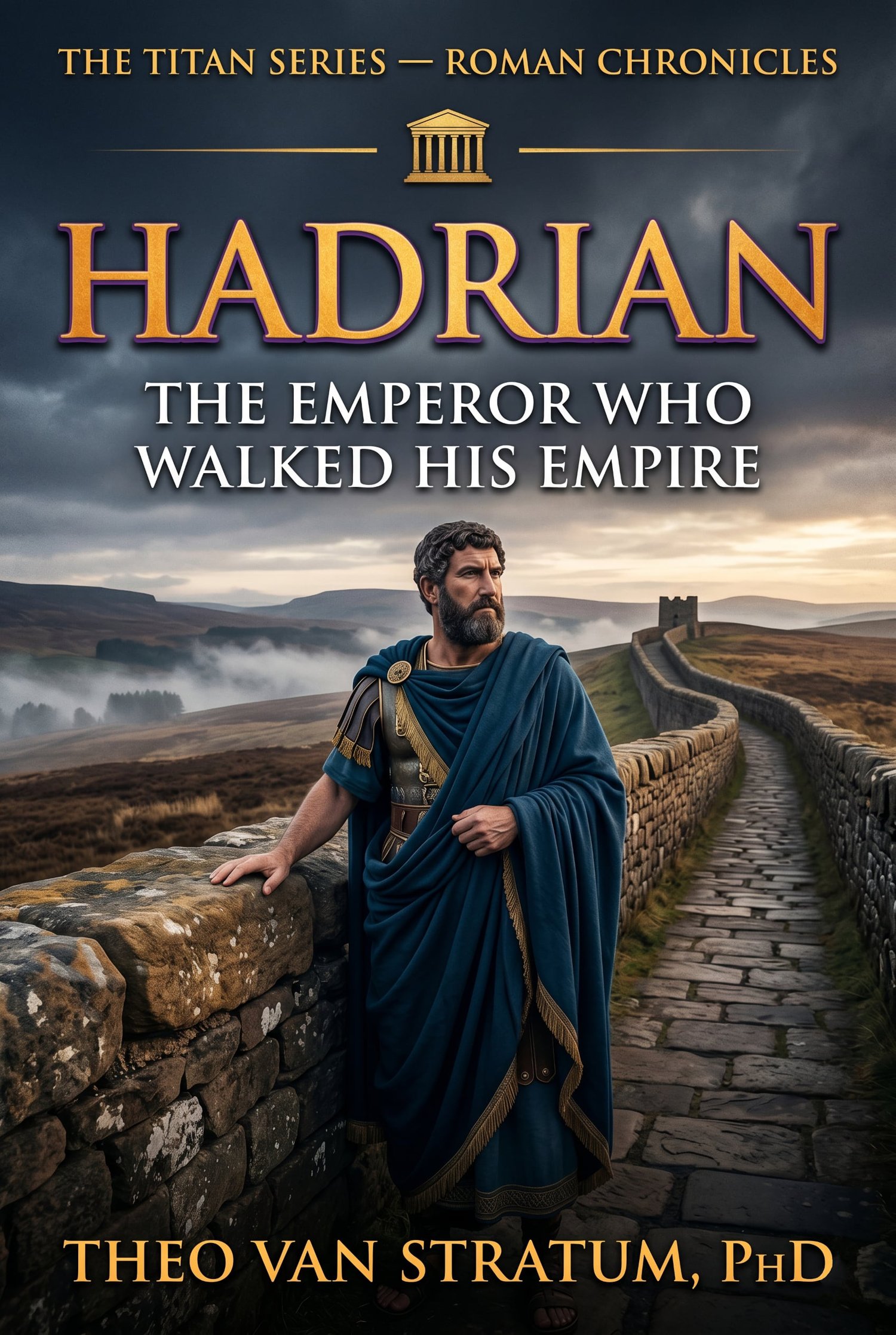
HADRIAN: The Emperor Who Walked His Empire
Most Roman emperors governed from Rome. Hadrian walked.
In the second century CE, the emperor Publius Aelius Hadrianus spent more than half his reign outside the capital — inspecting frontiers, interrogating centurions, arriving at forts before he was expected and looking at what was actually there rather than what had been arranged for his inspection. He built a wall across northern Britain not as a retreat, but as a statement of intent. He gave back three eastern provinces the Senate called conquests because the arithmetic did not support keeping them. He read Epictetus and tried, with uneven success, to live what he had read.
This book tells his life as it deserves to be told: from the inside.
Hadrian: The Emperor Who Walked His Empire is a work of narrative non-fiction that uses six first-person voices across twelve chapters and a prologue to reconstruct one of the most complex and misunderstood reigns in Roman history. Hadrian himself speaks throughout — always last, always accounting for himself. Surrounding him are the voices of those who saw him most clearly: Sabina, his wife, cold-eyed and more perceptive about him than he was about himself. Antinous, his companion, a young provincial man who did not ask to become what he became to the most powerful person in the world. Quintus Marcius Turbo, his general, who was asked to do the work the reign required and understood its cost. Phlegon of Tralles, his secretary, who managed the record and was therefore most aware of the gap between the record and the reality. Julius Severus, the machine of the Judean war. And an unnamed Jewish woman from Judea — the person the machine moved through.
The book does not flatter its subject. The Bar Kokhba revolt, the executions at the start of his reign, the deification of Antinous, the question of what actually happened on the Nile in 130 CE — none of it is smoothed over. Hadrian read Stoicism. He could not always practise it. The gap between the philosophy and the man is where this book lives.
Running through the whole is the central question his reign poses with unusual force: what does it mean to govern well? Not to expand, not to perform, not to manage the appearance of competence — but to actually be responsible for what you are responsible for, down to the drainage on the third milecastle and the morale in the frontier forts and the human cost of the decisions made in Rome that are paid for somewhere else. Hadrian knew the answer. He also knew how rarely he and anyone else achieved it.