

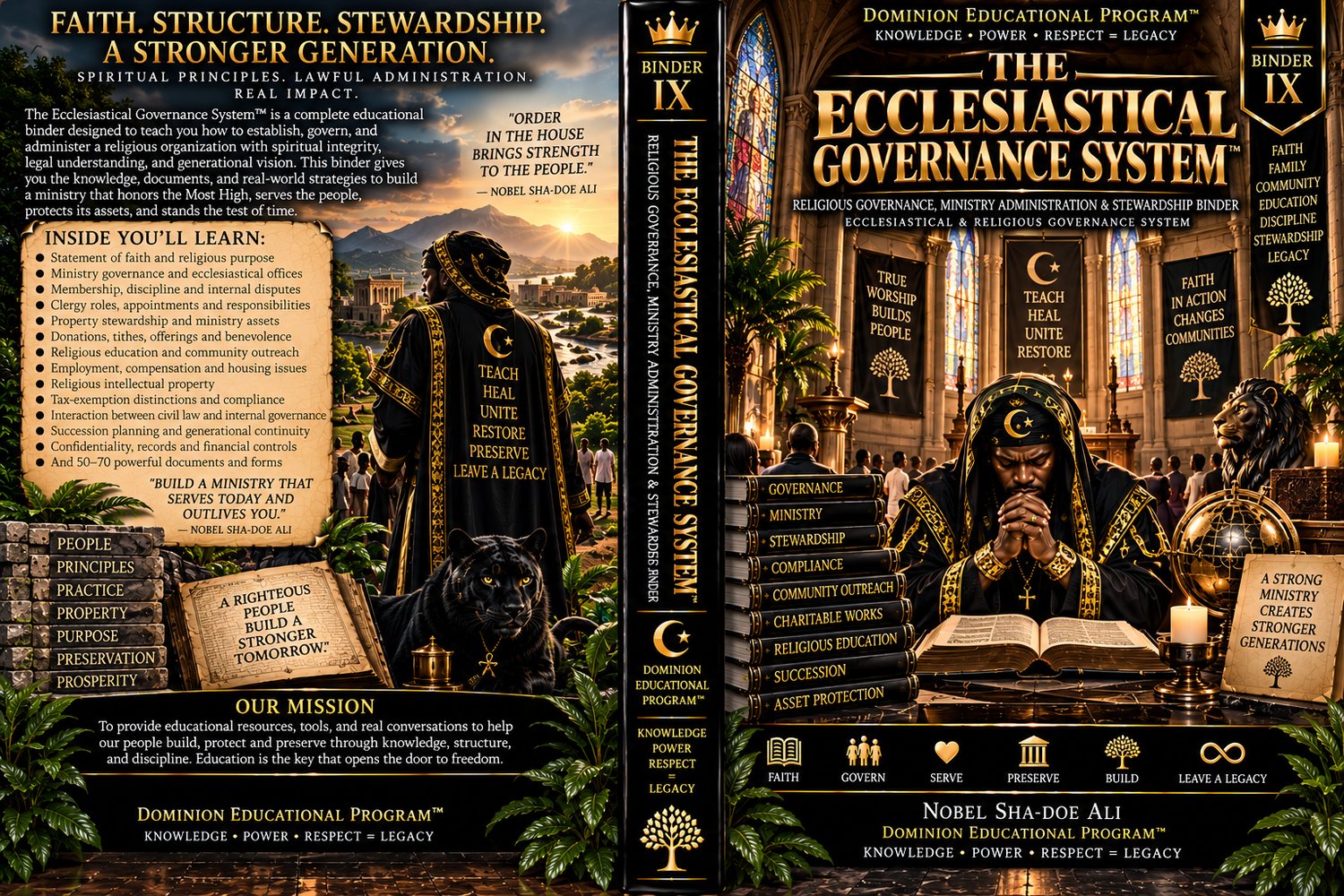
THE DOMINION ECCLESIASTICAL GOVERNANCE METHOD™
THE ECCLESIASTICAL GOVERNANCE SYSTEM™
Religious Governance, Ministry Administration & Stewardship Binder
Ecclesiastical & Religious Governance System
Binder IX — Dominion Estate Architecture Series™
By NobEL Sha-doe Ali
“Faith establishes the mission. Governance protects the stewardship. Knowledge preserves the legacy.”
The Ecclesiastical Governance System™ is a comprehensive educational system for building, administering, documenting, and preserving a religious or ministry organization with both spiritual integrity and lawful administration.
This expanded edition grows from the foundation established in the original Dominion Private Ecclesiastical Trust material, which recognized sincerely held religious beliefs and spiritual principles while also expressly recognizing the authority of governing documents and applicable fiduciary duties.
But this is no longer simply a trust manual.
It is a complete religious governance and ministry administration system.
FAITH + GOVERNANCE + STEWARDSHIP
Students learn how to construct the internal architecture of a religious body:
STATEMENT OF FAITH → RELIGIOUS PURPOSE → CONSTITUTION → GOVERNANCE → ECCLESIASTICAL OFFICES → MEMBERSHIP → MINISTRY → STEWARDSHIP → RECORDS → SUCCESSION
The system covers:
Statement of Faith • Religious Purpose • Ecclesiastical Constitution • Bylaws • Ministry Charters • Religious Offices • Clergy • Ministers • Membership • Councils • Boards • Trustees • Property • Donations • Benevolence • Religious Education • Financial Controls • Intellectual Property • Confidentiality • Employment • Compensation • Housing • Tax Exemption • UBIT • Disputes • Succession • Annual Compliance
ECCLESIASTICAL DOES NOT MEAN “OUTSIDE THE LAW”
One of the most important lessons in this book is also one of the simplest:
CALLING SOMETHING “ECCLESIASTICAL” DOES NOT AUTOMATICALLY REMOVE CIVIL LAW OR TAXATION.
The original Dominion framework already moved in the correct direction by describing the trust as serving lawful religious, charitable, educational, and stewardship purposes while administering property according to its governing documents and applicable law.
Binder IX takes that principle much further.
Students learn to separate:
INTERNAL RELIGIOUS GOVERNANCE
from
EXTERNAL CIVIL ADMINISTRATION
Questions involving doctrine, worship, religious belief, membership, spiritual leadership, and ecclesiastical discipline are not automatically the same as questions involving property, contracts, employment, taxes, banking, compensation, fiduciary duties, or outside transactions.
That distinction runs throughout the entire system.
BUILDING THE RELIGIOUS GOVERNANCE STRUCTURE
Students learn how the major governing documents work together:
Statement of Faith
↓
Religious Purpose
↓
Ecclesiastical Constitution
↓
Bylaws / Governance Instrument
↓
Ministry Charters
↓
Leadership Appointments
↓
Council & Board Resolutions
↓
Administrative Records
The objective is to answer fundamental questions:
What does the ministry believe?
Why does it exist?
Who holds spiritual authority?
Who holds civil authority?
Who controls property?
Who can sign contracts?
Who can authorize spending?
How are leaders selected?
How are disputes handled?
Who succeeds current leadership?
What records prove everything?
ECCLESIASTICAL OFFICES & RELIGIOUS LEADERSHIP
The book examines:
Clergy • Ministers • Elders • Teachers • Religious Officers • Ecclesiastical Councils • Directors • Trustees • Employees • Contractors • Volunteers
Students learn an essential distinction:
A SPIRITUAL TITLE AND A CIVIL OFFICE ARE NOT AUTOMATICALLY THE SAME THING.
Someone can possess genuine ecclesiastical authority without automatically possessing authority over a corporation, trust, bank account, contract, or piece of real estate.
Likewise, someone holding corporate authority does not automatically possess religious authority.
Binder IX teaches students to document both correctly.
MEMBERSHIP, COVENANT & DISCIPLINE
Students learn how to establish:
Membership Standards • Membership Covenants • Membership Registers • Religious Expectations • Resignation Procedures • Discipline • Removal • Restoration • Internal Appeals
The system distinguishes religious expectations from ordinary civil contractual obligations instead of pretending every religious covenant automatically functions as an enforceable commercial contract.
PROPERTY & MINISTRY ASSET STEWARDSHIP
Religious property still requires stewardship.
Students examine:
Real Estate • Houses of Worship • Ministry Housing • Land • Vehicles • Equipment • Books • Technology • Ceremonial Property • Financial Accounts • Intellectual Property
The central question becomes:
WHO OWNS IT, WHO CONTROLS IT, WHO MAY USE IT, AND WHAT DOCUMENT PROVES IT?
Students build asset schedules, property registers, custody records, use policies, authorization records, and stewardship systems.
DONATIONS, OFFERINGS & BENEVOLENCE
Binder IX teaches students to properly distinguish:
Offerings • Donations • Restricted Gifts • Benevolence • Program Funds • Grants • Ministry Revenue
Religious money should not simply disappear into a bank account.
Students learn:
RECEIVE → CLASSIFY → RESTRICT → DEPOSIT → RECORD → AUTHORIZE → SPEND → RECONCILE → REPORT
Benevolence receives dedicated treatment because helping people should still involve a coherent process for determining charitable or religious purpose, eligibility, authorization, distribution, and documentation.
RELIGIOUS INTELLECTUAL PROPERTY
A modern ministry may own far more than land.
It can create:
Sermons • Books • Courses • Music • Recordings • Videos • Logos • Curriculum • Websites • Archives • Research • Religious Publications
Binder IX teaches students to inventory and administer religious intellectual property instead of allowing valuable ministry assets to become confused with the personal property of individual leaders.
CONFIDENTIALITY, COUNSELING & RECORDS
Students examine:
Pastoral Communications • Counseling Records • Membership Records • Disciplinary Records • Donation Records • Clergy Records • Volunteer Records • Governance Minutes
A critical distinction is taught:
A MINISTRY CONFIDENTIALITY POLICY IS NOT AUTOMATICALLY THE SAME AS A LEGALLY RECOGNIZED PRIVILEGE.
Legal privileges, mandatory-reporting requirements, privacy obligations, and evidentiary rules can depend on jurisdiction and circumstances.
The system therefore teaches students to research the applicable law rather than relying on a blanket declaration of privacy.
CLERGY, EMPLOYMENT & COMPENSATION
Religious service does not necessarily mean unpaid service.
Students examine:
Employees • Independent Contractors • Ministers • Religious Workers • Volunteers • Payroll • Reimbursements • Compensation • Conflicts • Documentation
The book teaches students to distinguish legitimate compensation for actual services from improper diversion of ministry assets.
MINISTER HOUSING
Binder IX includes a dedicated section on clergy housing issues.
Students study the framework surrounding:
Housing Allowances • Parsonages • Formal Designation • Actual Housing Expenses • Fair Rental Value • Utilities • Reasonable Compensation • Self-Employment Tax Considerations • Annual Review
The lesson is specifically not:
“Call somebody a minister and make their housing tax-free.”
Instead, students learn to identify the actual requirements and limitations that apply before relying upon minister-specific tax treatment.
CHURCH STATUS & §501(c)(3)
The system examines the differences among:
Religious Body • Ministry • Religious Organization • Church • State Nonprofit Entity • Trust • Federal 501(c)(3) Status
Students learn why those terms should not be casually treated as interchangeable.
A qualifying church can receive special federal treatment, including exemption from the ordinary requirement to file Form 1023 for recognition, but that does not mean simply adopting the word “church” creates the status.
Binder IX therefore teaches a facts-and-circumstances analysis rather than label-based planning.
UNRELATED BUSINESS ACTIVITIES
Another misconception is addressed directly:
RELIGIOUS PURPOSE DOES NOT MAKE EVERY BUSINESS ACTIVITY TAX-FREE.
Students learn to examine:
Mission-Related Revenue • Books • Tuition • Events • Facilities • Services • Business Activities • UBIT • Form 990-T Considerations • Separate-Entity Analysis
Revenue is classified according to what actually happened—not simply according to what the ministry calls it.
INTERNAL RELIGIOUS DISPUTES
The binder establishes procedures for:
Doctrine Disputes • Membership Disputes • Leadership Disputes • Discipline • Reconciliation • Mediation • Removal • Restoration
But it does not teach that an internal religious procedure automatically destroys every person's civil rights or eliminates every court's authority.
Students instead learn to identify where ecclesiastical governance ends and a separate civil issue begins.
SUCCESSION — BUILDING BEYOND THE FOUNDER
A religious institution should not collapse because one leader becomes sick, dies, resigns, or can no longer serve.
Binder IX separates:
SPIRITUAL SUCCESSION
from
CIVIL SUCCESSION
Students learn to transition:
Ecclesiastical Authority • Directors • Officers • Trustees • Bank Signers • Property Custodians • Intellectual Property • Passwords • Records • Contracts • Ministry Assets
The goal is continuity.
64-DOCUMENT MINISTRY GOVERNANCE VAULT
The system contains 64 ministry governance and stewardship documents, including models and worksheets for:
Statement of Faith • Religious Purpose • Ecclesiastical Constitution • Bylaws • Ministry Charter • Leadership Appointments • Clergy Records • Membership • Discipline • Councils • Minutes • Resolutions • Trustees • Conflicts • Property • Asset Schedules • Donations • Restricted Gifts • Benevolence • Banking • Ledgers • Budgets • Religious Education • Intellectual Property • Confidentiality • Records • Worker Classification • Compensation • Reimbursements • Clergy Housing • Church/Religious Organization Classification • Form 1023 Decision Analysis • Annual Filing Review • UBIT • Internal Disputes • Succession
The documents are not presented as magical paperwork.
Students are taught to ask:
WHY DOES THIS DOCUMENT EXIST?
WHO HAS AUTHORITY TO SIGN IT?
WHAT DOES IT ACTUALLY CONTROL?
WHAT LAW OR GOVERNING DOCUMENT APPLIES?
WHAT HAPPENS AFTER IT IS SIGNED?
WHERE DOES IT BELONG IN THE RECORD?
THE DOMINION ECCLESIASTICAL GOVERNANCE METHOD™
FAITH → PURPOSE → GOVERNANCE → STEWARDSHIP → SERVICE → RECORDS → CIVIL COMPLIANCE → SUCCESSION
The Ecclesiastical Governance System™ is ultimately about building a religious institution capable of preserving its faith, mission, property, knowledge, leadership, service, and records across generations.
DON'T USE FAITH TO ESCAPE RESPONSIBILITY.
USE KNOWLEDGE TO BECOME A BETTER STEWARD.
DOMINION EDUCATIONAL PROGRAM™
Knowledge • Power • Respect = Legacy