
The Science Behind Special Interests
The Science Behind Special Interests — Educational Infographic (Printable, A2)
You will receive the printable unwatermarked version of this infographic
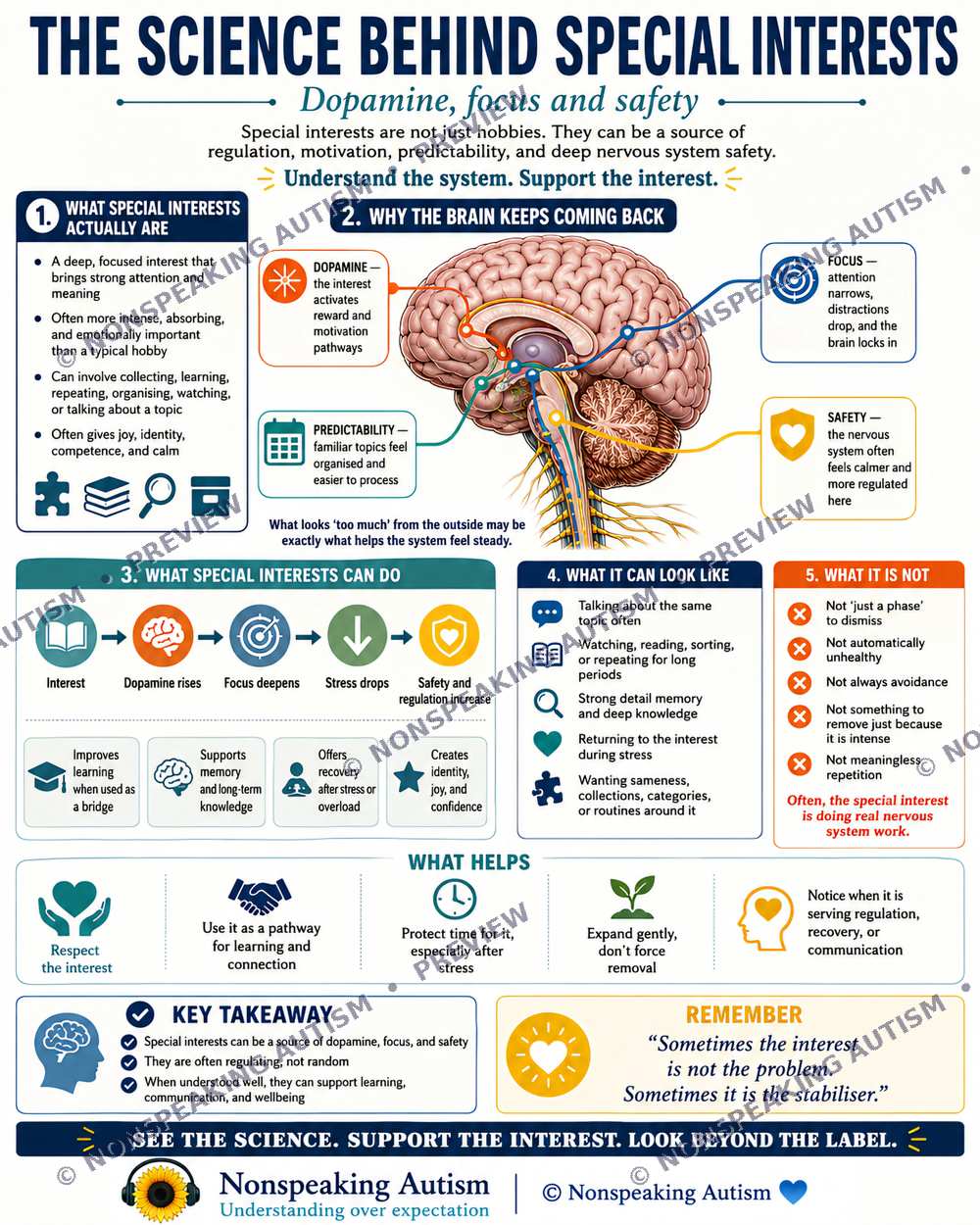
A visual deep-dive into why special interests matter — dopamine, focus, and safety, not "just hobbies."
This infographic covers:
- What special interests actually are: deep, focused, emotionally important, often giving joy, identity, competence, and calm
- Why the brain keeps coming back: dopamine (reward and motivation), focus (attention narrows), predictability (organised and easier to process), safety (nervous system feels calmer)
- What special interests can do: improve learning, support memory, offer recovery after stress, create identity and confidence
- What it can look like: talking about the same topic, strong detail memory, returning to the interest during stress, wanting sameness or collections
- What it is not: not a phase to dismiss, not automatically unhealthy, not always avoidance, not meaningless repetition
- What helps: respect the interest, use it as a pathway for learning and connection, protect time for it, expand gently
What you get:
- High-resolution PDF, print-ready and scalable up to A2 (420 × 594mm)
- Instant digital download
Perfect for: SEND and workplace training, therapy rooms, staff CPD, parent carer forums, and personal understanding.
For personal, classroom, and professional educational use. Not for resale or redistribution.
© Nonspeaking Autism
Disclaimer:
This resource is intended for educational and informational purposes only. It is designed to support understanding of autism, sensory processing, nervous system regulation, and behaviour from a neurodevelopmental perspective.
The information provided is not medical, psychological, therapeutic, or legal advice and should not be used as a substitute for assessment, diagnosis, or treatment by a qualified healthcare professional.
Every autistic person is unique. Strategies and supports should always be tailored to the individual's needs, strengths, and circumstances.
If a child displays a sudden change in behaviour, severe distress, signs of illness, injury, or behaviours that place themselves or others at risk, seek appropriate medical advice or emergency assistance where necessary.
While every effort has been made to ensure the information is accurate and reflects current understanding, knowledge in autism and neuroscience continues to evolve.
This resource is for the purchaser's personal, educational, or professional use only. It may not be copied, redistributed, resold, edited, shared publicly, or reproduced in whole or in part without prior written permission.
© Nonspeaking Autism 💙