

🌻 COMMUNICATION IS INDIVIDUAL
🌻 COMMUNICATION IS INDIVIDUAL
Recognising Changes in Movement, Interaction, Facial Expression and AAC Use
💛 FREE EDUCATIONAL RESOURCE | UK EDITION | NO WATERMARK
Communication is not always spoken. Sometimes the most important information comes from noticing what has changed.
An autistic child may not always be able to explain that they are overwhelmed, anxious, confused, tired or experiencing pain.
Instead, adults may notice changes in the child's usual communication, movement, facial expression, interaction or use of augmentative and alternative communication (AAC).
A child who is usually interactive may become quieter. A child who normally uses their AAC device confidently may respond more slowly or use it less during a difficult moment. Another child may pace, withdraw, seek movement or need additional processing time.
These changes do not automatically tell us what the child is experiencing, but they can provide valuable clues.
Communication Is Individual is a free illustrated educational poster from Nonspeaking Autism, designed to help parents, carers, teachers and professionals recognise individual communication patterns and respond with understanding rather than assumptions.
The central message:
Notice what is different for the individual child. Keep communication accessible. Respond with compassion.
🧠 WHAT THIS POSTER EXPLORES
🌿 1. Communication Is More Than Speech
Communication can happen through many different methods, including:
- Spoken language.
- AAC devices and communication apps.
- Pictures, symbols and communication boards.
- Gestures and pointing.
- Facial expressions.
- Body movements and changes in posture.
- Changes in interaction or participation.
- Individual behaviours and established communication signals.
Nonspeaking children may communicate in meaningful and complex ways without relying on speech.
Not every movement or behavioural change is an intentional message. However, changes may provide information about comfort, distress, preferences, communication access or unmet needs.
The important question is not simply whether a child is speaking, but whether their communication is being recognised and supported.
🏫 2. In the Classroom
The poster illustrates a child who is present in the classroom but appears quieter and less interactive than usual.
Adults may notice:
- Reduced interaction.
- Changes in attention or engagement.
- Different facial expressions.
- Reduced energy.
- Slower responses.
- Changes in usual communication patterns.
These observations do not establish a cause.
The child may be tired, overwhelmed, uncomfortable, concentrating or experiencing another difficulty.
Rather than assuming disinterest or non-compliance, adults can consider the child's usual patterns and the demands of the environment.
🔄 3. During Transitions
Moving between rooms, activities or environments can involve changes in:
- Noise and lighting.
- Movement and sensory input.
- Social expectations.
- Instructions and communication demands.
- Familiarity and predictability.
The poster illustrates a child becoming more tense, pacing and pulling back in a busy hallway.
These responses may indicate that additional support is needed.
Some children may benefit from reduced sensory demands, predictable routines, additional processing time or a quieter route.
The most appropriate response depends on the individual.
💬 4. Changes in AAC Use
A child may use their AAC device less frequently or respond more slowly during a demanding situation.
Possible contributing factors include:
- Increased sensory or cognitive demands.
- Fatigue.
- Anxiety or uncertainty.
- Difficulty accessing the device.
- Motor demands.
- Reduced opportunities or support to communicate.
Reduced AAC use does not mean the child has nothing to communicate.
Adults should continue to make AAC available and avoid removing communication tools because a child is distressed or using them differently.
Communication support should remain accessible across environments, including during transitions, distress and recovery.
💙 5. At Home or in a Calm Space
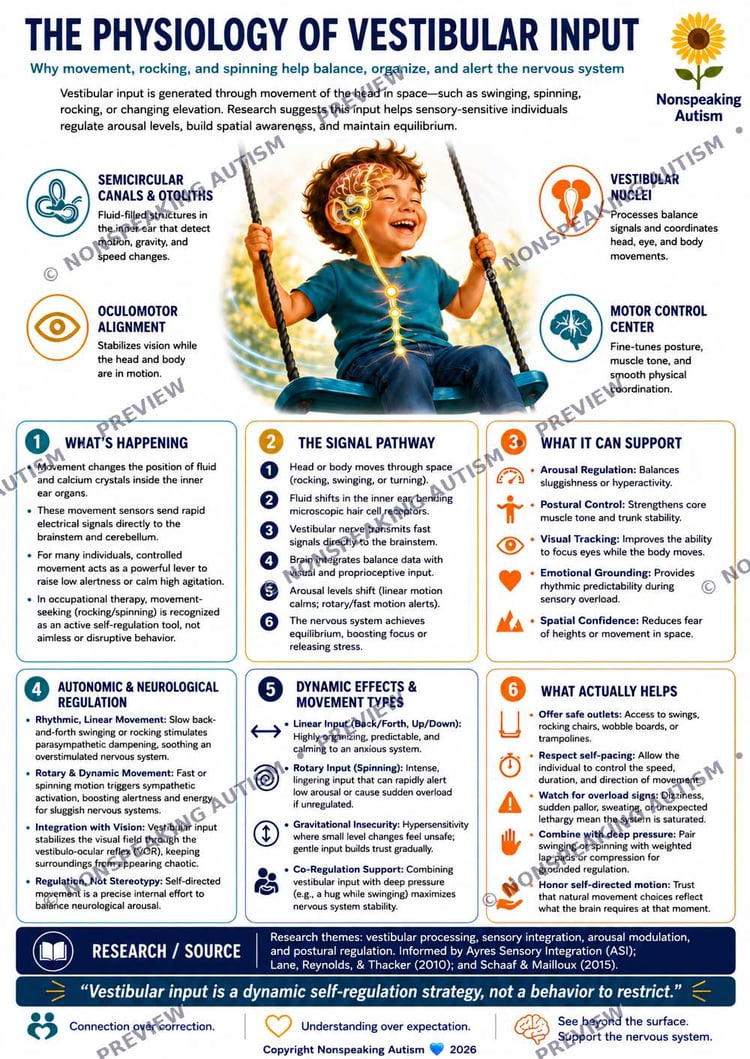
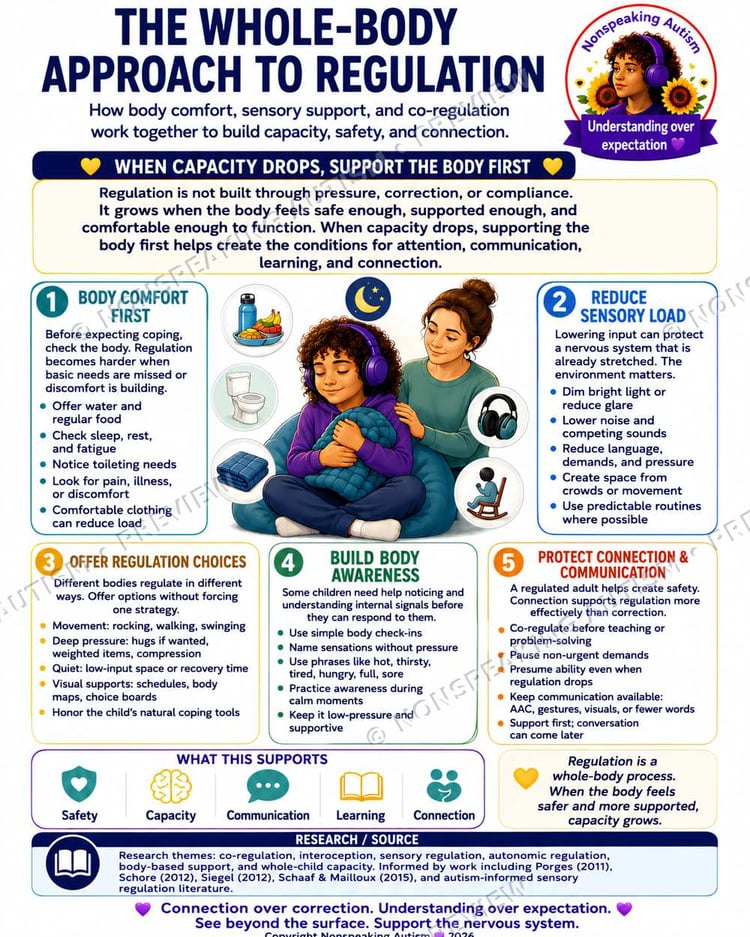
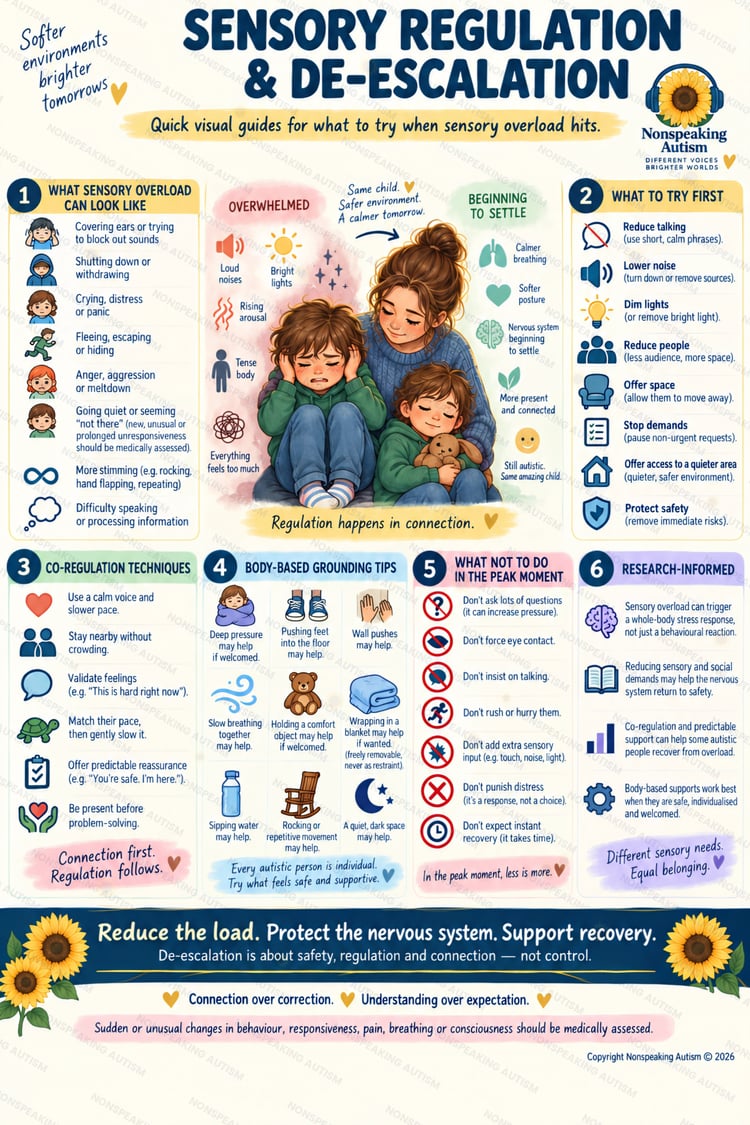
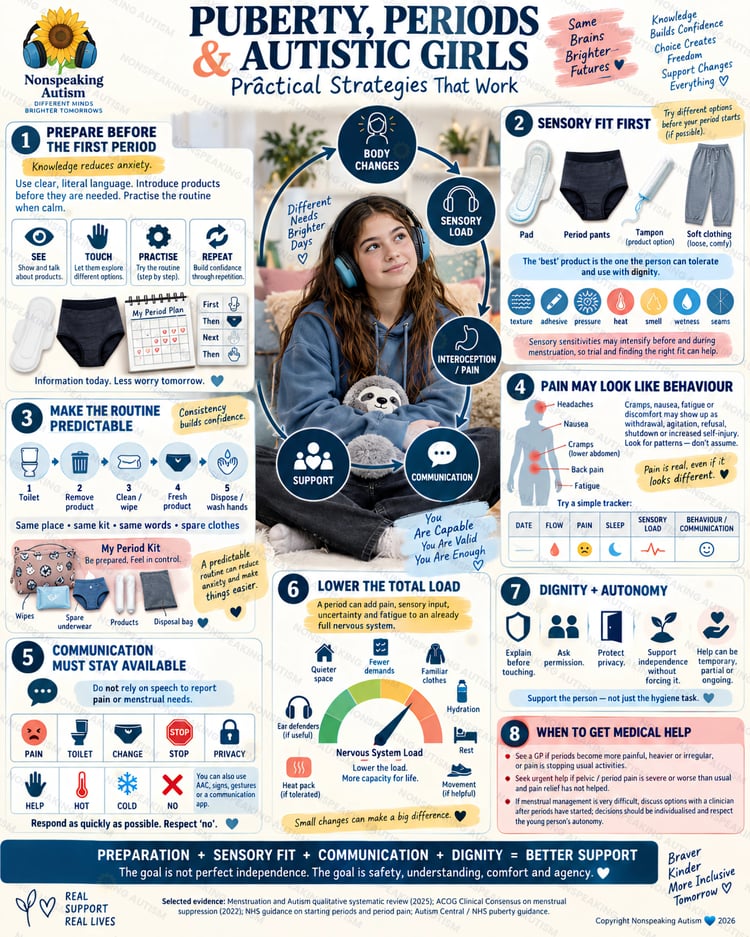
The final illustration shows the child in a quieter environment, using a familiar sensory item while an adult offers calm support.
For some children, a familiar space, preferred movement, reduced demands or a comforting activity may support recovery.
Adults can observe:
- Whether movement changes.
- Whether the child begins interacting more.
- Whether familiar communication methods become easier to access.
- Whether the child appears more comfortable.
- Whether additional recovery time is needed.
A calmer outward appearance does not necessarily mean that every difficulty has resolved.
The child's own preferences and communication should guide ongoing support.
🔍 WHAT TO LOOK FOR
The poster encourages adults to notice changes from the child's individual baseline rather than comparing them with other children.
Possible clues include:
Changes in interaction
The child may become less interactive, seek more contact or respond differently to familiar people.
Changes in facial expression or energy
The child may appear more tired, tense, withdrawn or animated than usual.
Changes in movement
Pacing, withdrawing, slowing down or seeking movement may be worth noticing.
Changes in communication
AAC use, gestures, response times or other familiar communication methods may change.
Changes across settings
A child may communicate differently at home, in school, during transitions or when recovering from a demanding activity.
These observations are starting points for understanding, not diagnoses.
❤️ WHAT MAY HELP?
1. Notice Patterns Across Settings
Consider what happens before, during and after changes in communication.
2. Keep AAC Available
Ensure the child can access their preferred communication methods throughout the day.
3. Reduce Unnecessary Pressure
Use clear language, reduce competing demands and allow time for responses.
4. Respect Individual Communication
Recognise gestures, AAC, facial expressions, movement and other meaningful communication methods.
5. Consider Physical and Sensory Needs
Pain, illness, tiredness, hunger, thirst and sensory discomfort may affect participation or communication.
6. Support First, Problem-Solve Later
During distress, prioritise safety, communication access and appropriate support rather than demanding immediate explanations.
🌻 WHY THIS MATTERS FOR NONSPEAKING CHILDREN
Nonspeaking does not mean non-understanding.
It does not mean a child lacks thoughts, feelings, preferences or opinions.
And it does not mean that communication is absent.
A child may understand an instruction but find it difficult to respond at that moment.
Another child may need an AAC device, visual support, gesture or alternative method to communicate their needs.
Communication access is a fundamental part of dignity, autonomy and participation.
Adults should not mistake difficulty responding for an absence of understanding or an unwillingness to communicate.
🔬 RESEARCH & GUIDANCE-INFORMED
This resource draws on established guidance about autism, communication differences, AAC and individualised support.
NICE guidance emphasises considering communication needs and relevant factors when supporting autistic children and young people.
The American Speech-Language-Hearing Association (ASHA) provides professional information about AAC, including the use of communication methods beyond speech.
The National Autistic Society provides information about educational support and the importance of meeting individual autistic children's needs.
Research and clinical guidance support individualised communication access, but changes in facial expression, movement or AAC use cannot independently establish a child's emotional or medical state.
📚 SELECTED REFERENCES
1. National Institute for Health and Care Excellence (NICE).
Autism spectrum disorder in under 19s: support and management. Clinical guideline CG170.
https://www.nice.org.uk/guidance/cg170
2. American Speech-Language-Hearing Association (ASHA).
Augmentative and Alternative Communication (AAC). Practice Portal.
https://www.asha.org/practice-portal/professional-issues/augmentative-and-alternative-communication/
3. National Autistic Society.
What can my autistic child get support with at school?
National Autistic Society educational information.
Sources:
- NICE CG170 full guideline PDF (mirror used to check 1.3.1 and 1.4.1)
- NICE QS51, Quality statement 7
- ASHA – Augmentative and Alternative Communication (AAC)
- NAS – What can my autistic child get support with at school?
Further Resources
- National Autistic Society – What can my autistic child get support with at school?: https://www.autism.org.uk/advice-and-guidance/education/extra-help-at-school/what-can-my-autistic-child-get-support-with-at-school
- NICE CG170 – Autism spectrum disorder in under 19s: support and management: https://www.nice.org.uk/guidance/cg170
- NICE QS51, Quality statement 7: Assessing possible triggers for behaviour that challenges: https://www.nice.org.uk/guidance/qs51/chapter/Quality-statement-7-Assessing-possible-triggers-for-behaviour-that-challenges
- ASHA – Augmentative and Alternative Communication (AAC): https://www.asha.org/practice-portal/professional-issues/augmentative-and-alternative-communication/
📖 RESEARCH LIMITATION
The illustrations are educational examples, not validated indicators of a particular emotional or neurological state.
Not every autistic child communicates in the same way, and the same change in behaviour may have different explanations.
Individual observations should be interpreted alongside the child's communication, preferences, physical health, environment and wider circumstances.
👨👩👧 WHO IS THIS FREE RESOURCE FOR?
This educational poster may be helpful for:
- Parents and carers.
- Families of nonspeaking and minimally speaking children.
- Autistic children and young people, where appropriate.
- Teachers and teaching assistants.
- SENCOs and SEND teams.
- Mainstream and specialist schools.
- Speech and language therapists.
- Occupational therapists.
- Educational psychologists.
- Autism support workers.
- Healthcare and social care professionals.
- Parent and carer support groups.
- Staff training and professional development.
🏡 USING THIS RESOURCE AT HOME AND SCHOOL
At home: Use the poster to help recognise individual communication patterns and changes that may indicate a need for support.
At school: Display it as a reminder that reduced interaction or slower responses do not automatically mean refusal or lack of understanding.
During transitions: Encourage adults to consider how environmental changes may affect communication access.
In professional training: Use it to discuss AAC, observation, individual differences and respectful support.
In collaborative planning: Encourage families, schools and professionals to share helpful observations while respecting confidentiality and the child's wishes.
📦 WHAT YOU RECEIVE — FREE DOWNLOAD 💛
1 × Communication Is Individual — UK Educational Poster
The resource includes:
- An illustrated explanation of individual communication differences.
- Classroom and transition examples.
- Changes in AAC use.
- Signs adults may wish to notice.
- Practical communication support suggestions.
- Selected research and guidance references.
- Nonspeaking Autism branding and illustrations.
💛 YOUR FREE RESOURCE
✅ 100% FREE — £0.00
✅ CLEAR AND UNWATERMARKED
✅ UK English spelling and terminology.
✅ Suitable for home, school and educational settings.
✅ Digital download — no physical product.
Format: Digital JPG poster.
Print note: The supplied image is a social-media-style poster; A2 print readiness should be confirmed separately before advertising it as an A2 printable.
⚠️ IMPORTANT EDUCATIONAL DISCLAIMER
This poster is for educational and informational purposes only.
It is not a diagnostic tool, communication assessment, medical evaluation or substitute for individualised professional
advice.
Changes in communication, movement, interaction or facial expression can have many possible explanations.
They should not automatically be attributed to autism, sensory overload or anxiety.
Sudden, persistent or concerning changes may require assessment by an appropriate healthcare professional, particularly where pain, illness or other physical health concerns are possible.
Communication support should be individualised and developed with the child, their family and relevant professionals where appropriate.
©️ COPYRIGHT & PERMITTED USE
Copyright © 2026 Nonspeaking Autism. All rights reserved.
This resource is provided free of charge for educational use.
You may download, print and display the poster in homes, schools, therapy rooms, clinical settings, workplaces and community education settings.
Redistribution or resale of the digital file, editing or rebranding the artwork, removing copyright information, or uploading it to other websites or download platforms is not permitted without written permission.
Please direct others to the original Payhip listing to obtain their own free copy.
💛 THE MESSAGE BEHIND THIS RESOURCE
A child may be quieter today.
They may be moving differently.
They may be using their AAC less.
They may need more time, more space or a different way to communicate.
None of these changes should automatically be interpreted as refusal, disinterest or a lack of understanding.
Communication is individual.
Notice the patterns.
Respect the differences.
Keep communication accessible.
Listen to what the child communicates in their own way.
🌻 Connection over correction. Understanding over expectation.
Nonspeaking Autism © 2026