
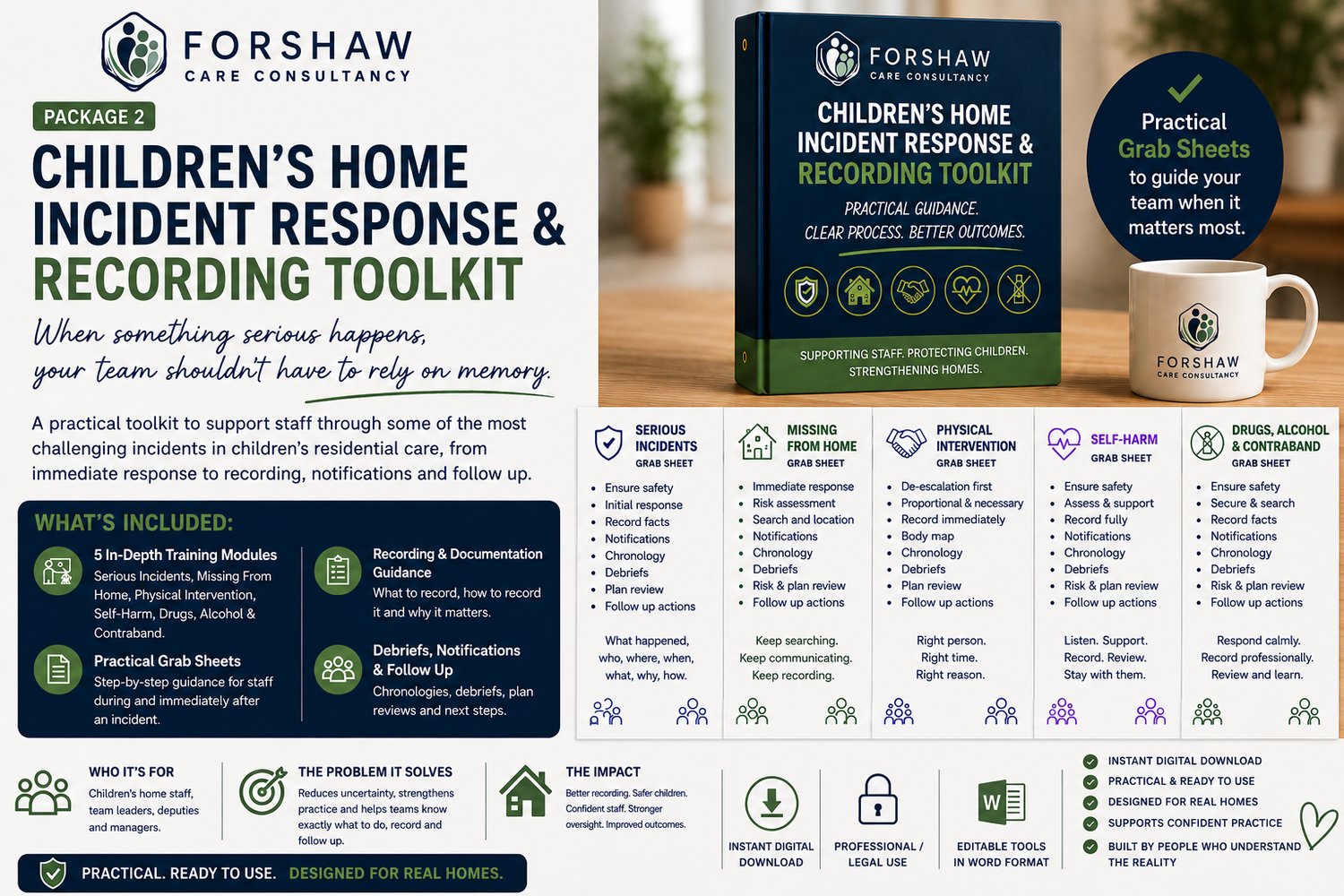
Children’s Home Incident Response & Recording Toolkit
Children’s Home Incident Response, Recording & Guidance Toolkit
Five dedicated incident toolkits. Staff training. Practical grab sheets. Step-by-step guidance for when you’re not there.
As a Registered Manager, you can train your team, supervise their practice and set clear expectations — but you cannot physically be in the home every time something serious happens.
That is exactly why this toolkit was created.
The Children’s Home Incident Response, Recording & Guidance Toolkit gives your staff structured training across five significant areas of residential childcare practice, alongside practical grab sheets and printable guidance they can physically turn to if an incident happens when you’re not there.
Five dedicated incident toolkits
Rather than one generic incident guide, your team receives dedicated training and practical guidance covering:
- Serious Incidents
- Missing From Home
- Physical Intervention
- Self-Harm
- Drugs, Alcohol & Contraband
Each area has been developed around the actual journey staff may need to work through — not simply what to do in the immediate moment.
Train them beforehand. Guide them when it happens.
The real value of this package is the combination of training + practical guidance.
Your staff can work through the training beforehand, helping them understand what good practice looks like while things are calm.
Then the accompanying grab sheets and printable resources can be kept accessible within the home, giving staff something practical to pick up and work through if one of those incidents actually occurs.
So when you're not physically there, your team has guidance available to help them consider:
What do we need to do immediately?
Is everyone safe?
What needs recording?
Do we need a chronology?
Who needs informing?
What notifications need considering?
What does the child need afterwards?
Have debriefs been considered?
Do plans or risk assessments need reviewing?
Is restorative work appropriate?
What follow-up actions remain?
What needs to be handed over to management?
What can we learn from what happened?
The aim is to help make sure the whole journey following an incident is considered, rather than staff dealing with the immediate situation, completing an incident form and unintentionally overlooking something important afterwards.
Built to give Registered Managers greater reassurance
This is one of the biggest reasons I created the toolkit.
As an RM, there is always that responsibility sitting in the background when you're away from your home.
If something happens tonight, does my team genuinely know what to do?
Not just how to make the immediate situation safe — but what needs to happen afterwards.
Have they recorded it properly?
Have the right people been informed?
Has the child's voice been captured?
Has a chronology been completed where needed?
Have debriefs happened?
Have plans and risks been considered?
Have outstanding actions been identified?
No toolkit can remove a manager's responsibility or replace professional judgement, individual care plans, risk assessments or your home's own policies and procedures.
But it can help you prepare your team properly.
The purpose is to give you as much reassurance as reasonably possible that your staff have been trained, have clear expectations and — importantly — have something physically available to guide them step by step when you aren't standing beside them.
Not just another training folder
I didn't want to create training that gets completed once, signed off and forgotten about.
The resources are designed to remain useful after the training has finished.
Print the grab sheets.
Keep them somewhere staff can access quickly.
Use the training during induction, team meetings, supervision and refresher sessions.
Bring the resources back out following incidents and use them to reflect on whether everything that should have happened actually did.
That turns training into knowledge in practice.
From immediate response to learning afterwards
Across the five toolkits, staff are supported to think about the wider incident journey, including:
Immediate safety → safeguarding response → recording → chronology → notifications → child support → debriefs → restorative work → risk and plan reviews → follow-up actions → management oversight → reflection and learning.
Because good incident management doesn't finish when everyone is safe.
And it certainly doesn't finish when somebody clicks “complete” on an incident form.
The recording should tell the safeguarding story, the child should remain at the centre of the response, and what happened should contribute to better practice afterwards.
Designed for real children's homes
This package has been created to help develop:
Better-prepared staff. Clearer responses. Stronger recording. More consistent follow-up. Greater RM reassurance. Better learning from incidents.
Most importantly, it helps give your staff a practical answer when you're not there and they're thinking:
“Right… what do we need to do next?”
They don't have to rely solely on memory.
They have the training. They have the grab sheet. They have the steps.
NOT YOUR STANDARD TRAINING. KNOWLEDGE IN PRACTICE.