



50 Silent Career Killers
Get your UX career moving again 👉 50 hidden patterns diagnosed with the specific moves to interrupt each one
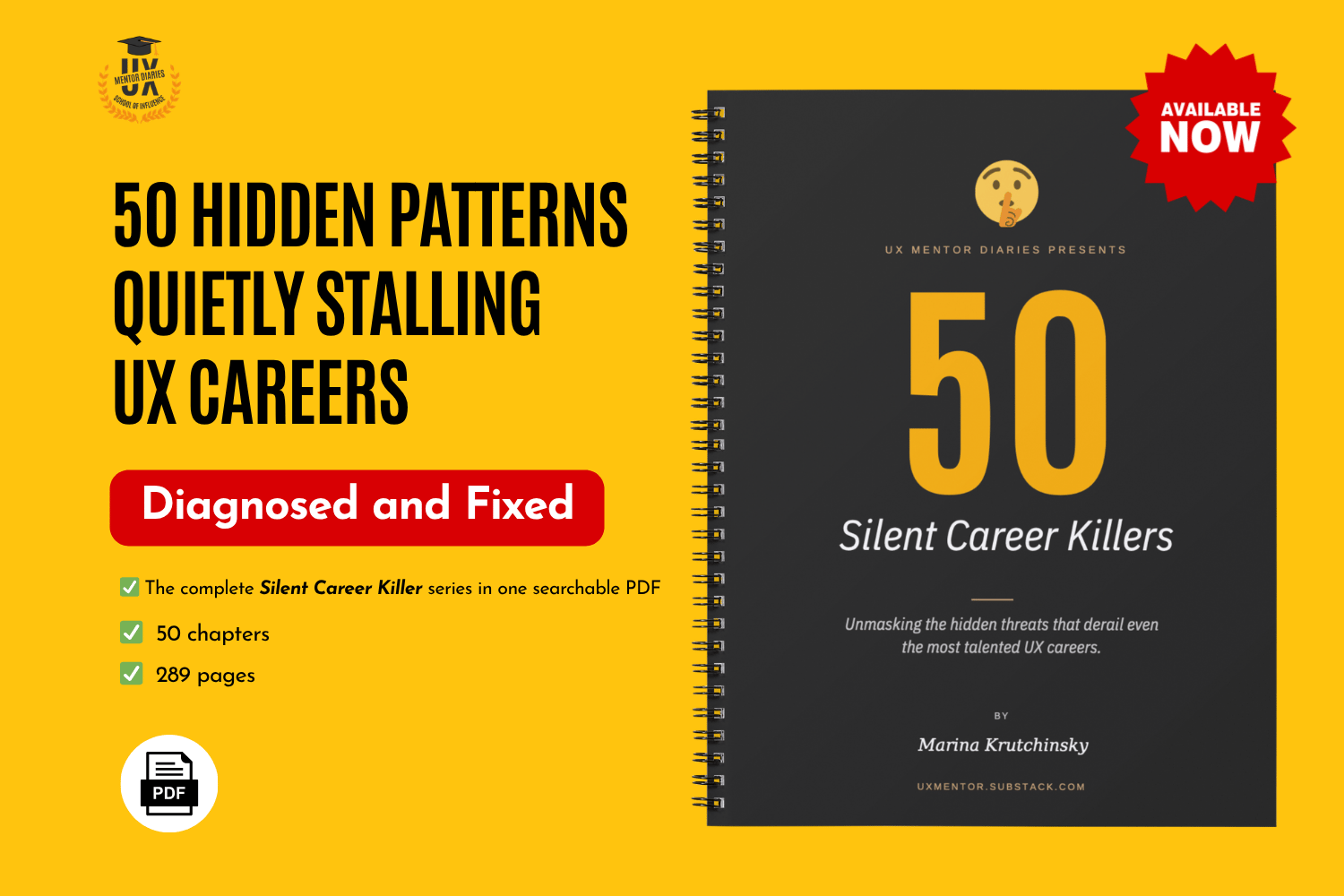
The same diagnostic series that became the longest and highest-engagement run UX Mentor Diaries has ever published. 289 pages. Every chapter follows the same structure: name the pattern, show how it manifests in your work, lay out the specific interrupt, and what to do instead.
Your career probably isn't stuck because of your work.
Most senior/lead UXers who feel stuck are doing strong work, i.e portfolio holds up, projects ship, peer feedback is genuinely positive.
So why has the same career stalled for 2 cycles while colleagues with less experience keep moving up?
Pattern recognition, mostly.
There are about 50 dynamics inside organizations quietly deciding who moves and who doesn't. Most of them operate below conscious awareness - by design.
They're hidden by exactly the instincts and assumptions that made you a strong UXer in the first place.
📖 In one weekend of reading, you'll have names for things that have been happening in your career for years that you couldn't put your finger on.
Every cycle spent trying harder at the wrong things is another year your career stays in the same place. The patterns don't fix themselves — they compound.
Real results
"I'd been hitting the same Senior ceiling for three years and couldn't articulate why. Chapter 32 ('Mistaking Strategic Fluency for Strategic Power') was the moment it clicked. I realized I'd been confusing 'sounding strategic in meetings' with actually having strategic influence. I ran Marina's interrupt frame in my next three 1:1s with my VP. Three months later I was leading the platform redesign I'd been quietly excluded from for two cycles." — Sarah K., Senior Product Designer → Lead
"I'd been a paid UX Mentor Diaries subscriber since 2024, reading issues weekly. Reading them in sequence in the book was a completely different experience, I could see three patterns running simultaneously in my career that I'd missed week-to-week. Naming all three at once changed how I went into my year-end." — Anonymous, Lead UX Designer at a Fortune 500
"I was a finalist for a Director role and lost it. Feedback was vague, something about 'culture fit,' 'communication style.' Chapter 45 ('Expertise without Executive Presence') gave me language for what was actually being assessed. I worked through Marina's three interrupt prompts before my next interview cycle. Got the next Director role I interviewed for, at a bigger company." — Anonymous, Director of Design at a SaaS company
The problem it solves
Most senior UXers in this position experience:
- The strange dissonance of getting positive feedback while their career sits still
- A vague sense that something is "off" with no one able to tell them what
- The exhausting cycle of trying harder at the visible parts of the job, hoping that will be the thing that finally moves things
- Watching peers with less obvious skill land the opportunities they wanted — and never being able to articulate why
- Quiet resentment building toward managers, organizations, and themselves
That dissonance has a source.
It's just one you can't see from inside it.
The patterns derailing UX careers operate below conscious awareness (by design).
They're hidden by the same instincts that made you good at your job.
The Solution → 50 chapters that diagnose AND prescribe
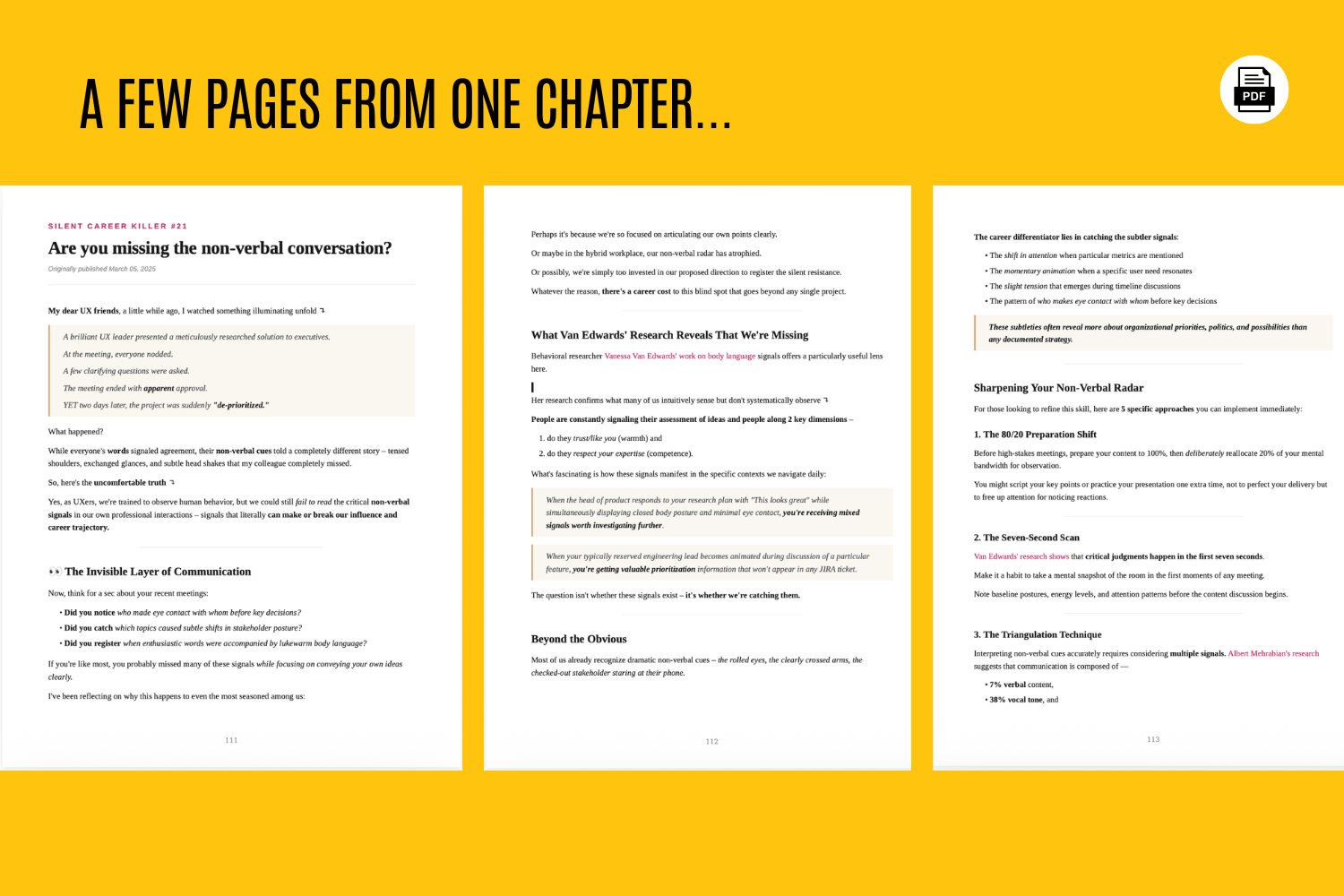
This book gives you both halves of the work in every chapter: the pattern named (so you can finally see what's been happening), and the specific move to interrupt it (so you can actually do something different the next week).
✅ Every chapter follows the same structure: pattern named → how it manifests → why it's costly → the specific interrupt → what to do instead
✅ Concrete scripts, frames, and prompts you can use in 1:1s, calibrations, hiring conversations, exec meetings, project handoffs, and performance reviews (the same week you read the chapter)
✅ Compounding insight from reading in sequence: the patterns connect to each other in ways the weekly format obscures
This is the same diagnostic frame I've used with my UX career mentees at Netflix, Capital One, and JPMorgan Chase to break through ceilings they'd been hitting for years.
What you'll get inside
✅ 289-page PDF → every chapter, fully formatted, professionally typeset
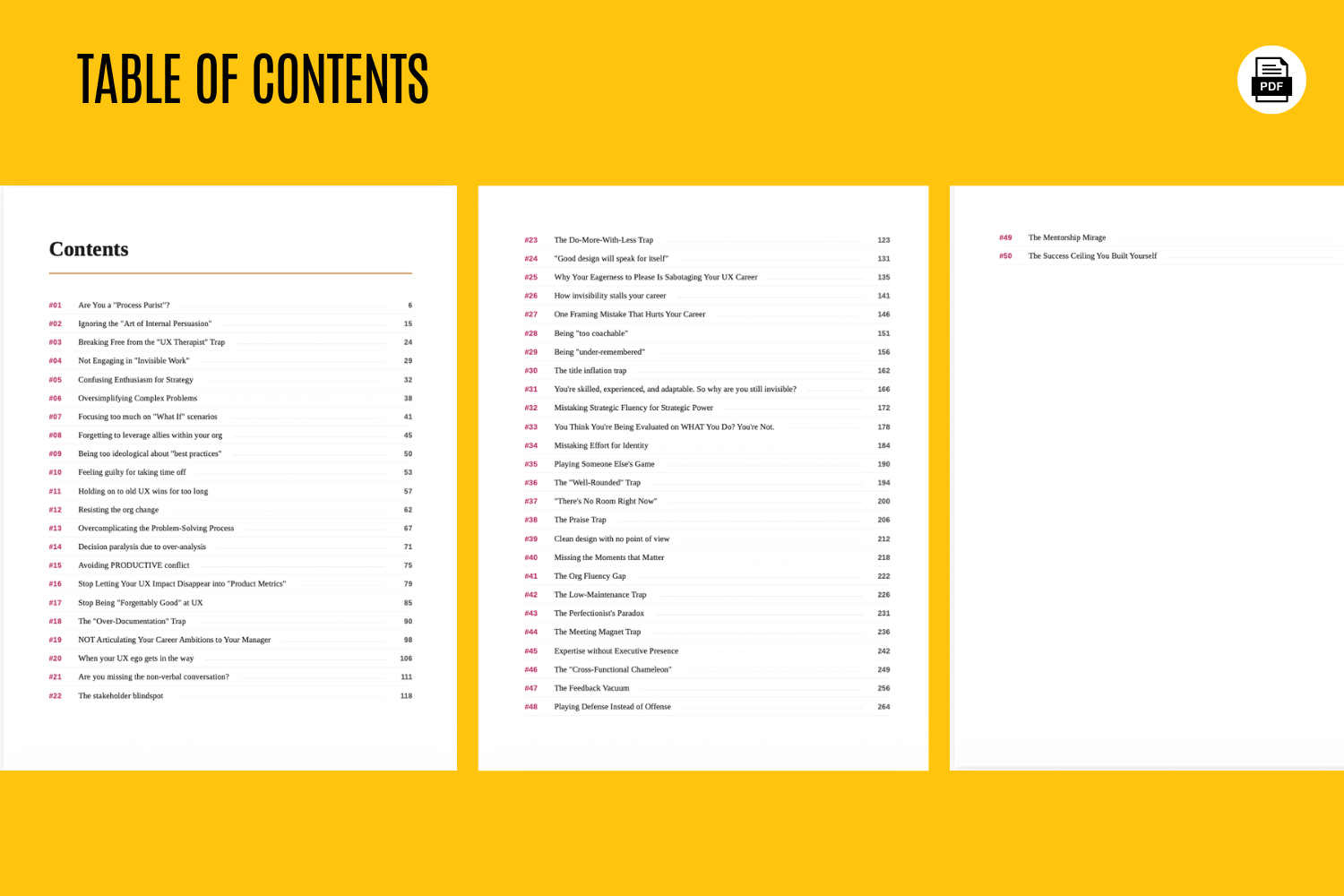
✅ 50 chapters in order from #1 to #50 → read straight through or jump to whichever pattern is hitting closest right now
✅ Clickable table of contents → every entry hyperlinked to its chapter
✅ Searchable file → find any pattern by name in seconds
✅ Mobile, tablet, and desktop ready → read it however you read
Why it works
Pattern recognition is half of the work. The other half is knowing what move to run instead — and that's what each chapter gives you alongside the diagnosis.
THE TRANSFORMATION FORMULA: Pattern Named + Mechanism Made Visible + Specific Interrupt = A Different Career Trajectory
The fixes are deceptively concrete. Most aren't big strategic moves. They're small tactical shifts in how you show up in specific high-stakes moments, the kind of shifts that change perception within weeks because they change what your manager, your VP, your skip-level, and your hiring committees are actually evaluating.
This is for you if...
✓ You're a Senior or Lead UXer with the strange feeling that something invisible is keeping you stuck
✓ You've been doing strong work that isn't translating into the next title or the next opportunity
✓ You watch less experienced colleagues move into roles you wanted and can't articulate why
✓ You're tired of trying harder at the visible parts of your job, hoping it'll fix something
✓ You're an aspiring UX Leader who senses the next career step requires a different kind of awareness, not a different portfolio
Common Questions
"Will reading this actually change anything?"
That depends on you. The book gives you names for patterns and frames for spotting them in your own behavior. What you do with that recognition is your work to do. Most readers tell me the real unlock is realizing that several patterns they'd been blaming themselves for weren't actually theirs - they were dynamics happening at the org level. Once those have names, you can stop personalizing them.
"Will I get the same content if I subscribe to your Substack?"
Yes. Each chapter follows the same structure: pattern named, mechanism shown, specific interrupt prescribed, alternative move spelled out. You get the diagnosis and the fix in the same chapter. Most readers tell me the fixes are deceptively concrete - mall tactical shifts in 1:1s, exec conversations, project framings, and feedback exchanges that produce visible perception changes within 2–4 weeks. The work is in actually running them. The book gives you the moves; the running is yours.
"Do I need to read it in order?"
No. Each chapter stands alone. Most readers skim the table of contents and start with whichever pattern is hitting closest to home right now. Reading in sequence does surface connections you'd miss going week-by-week, though.
"How is this different from your other paid newsletter content?"
UX Mentor Diaries paid subscribers get weekly deep-dives across six influence-building tracks. This book is just the Silent Career Killer series - the highest-engagement run I've ever published, in one place.
"What if I'm not in a corporate UX role?"
The patterns operate in any setting where people work in groups, get evaluated by other people, and compete for opportunities. Agency, consultancy, in-house, freelance, startup - the dynamics are the same. The contexts differ.
"I'm in my first three years of UX. Is this for me?"
Probably not yet. Most of the patterns require enough organizational experience to recognize them in yourself. The free UX Mentor Diaries archive will serve you better at this stage.
Here's what happens without this book
- Another year of working harder at the wrong things
- Another cycle of vague positive feedback that doesn't move you forward
- Another quiet recalibration of your expectations downward
- The slow, almost invisible drift into "experienced senior" - the career zone where nobody quite knows why you haven't moved up, and nobody's championing you either
- Years of self-blame for things that were never about your effort or your skill
The cost of staying unaware is your sense of agency over your own career.
Stop running your career on patterns you can't see.
📄 Format: PDF (1.4 MB)
📏 Length: 289 pages, 50 chapters
🔗 Navigation: Clickable table of contents, every chapter hyperlinked
⏱️ Time to first insight: 15 minutes per chapter, ~6 hours straight through
🎯 Outcome: Walk into your next career conversation with a vocabulary for what's been happening to you
Get instant access now
The patterns deciding your career already have names.
The moves that interrupt them are concrete.
This book gives you both.