










Section 20 Planner — Consultation Dates & Notices for Leaseholder Major Works (England)
For RTM companies, residents' management companies and small landlords in England who have to run a Section 20 consultation on major works.
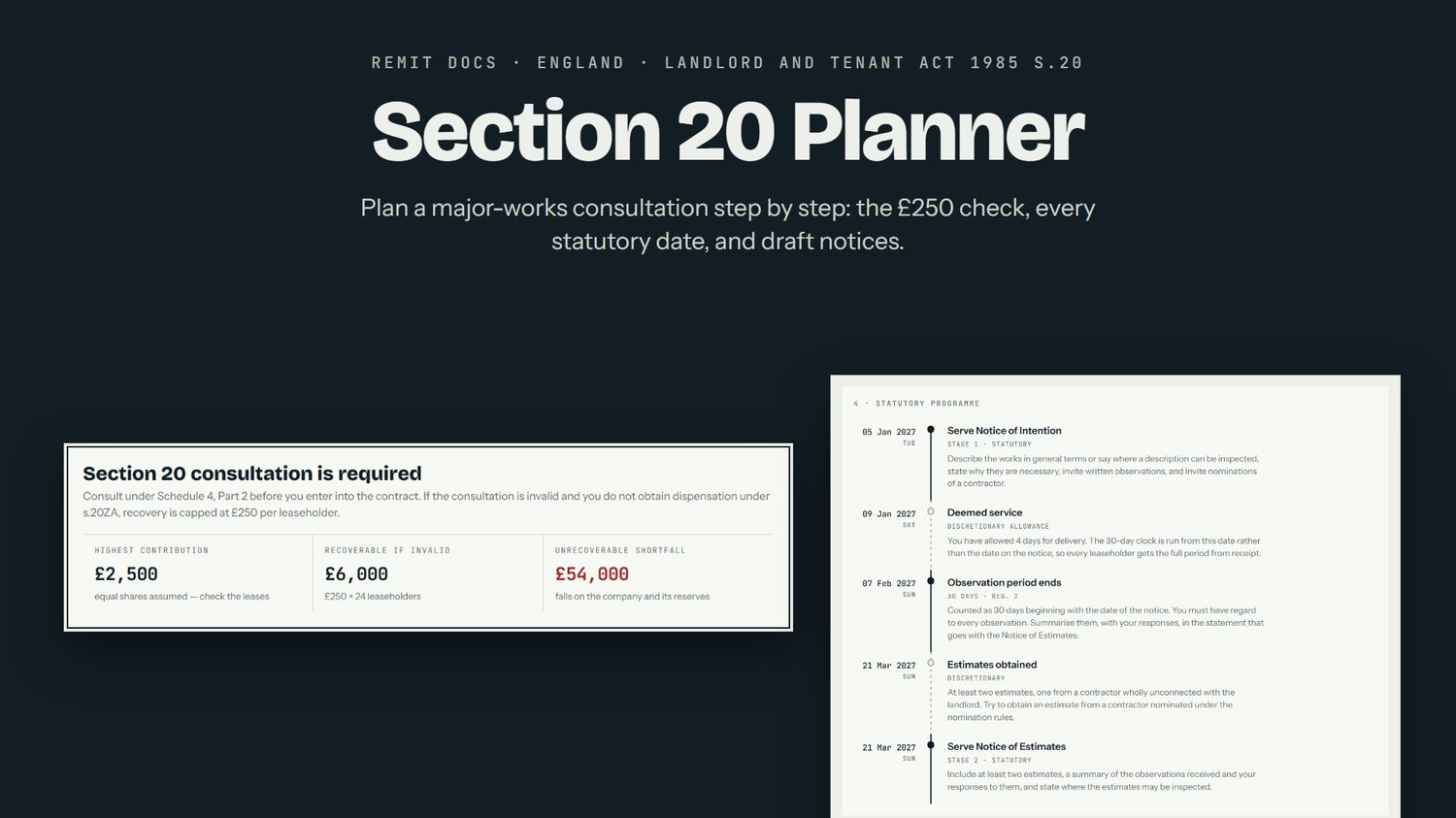
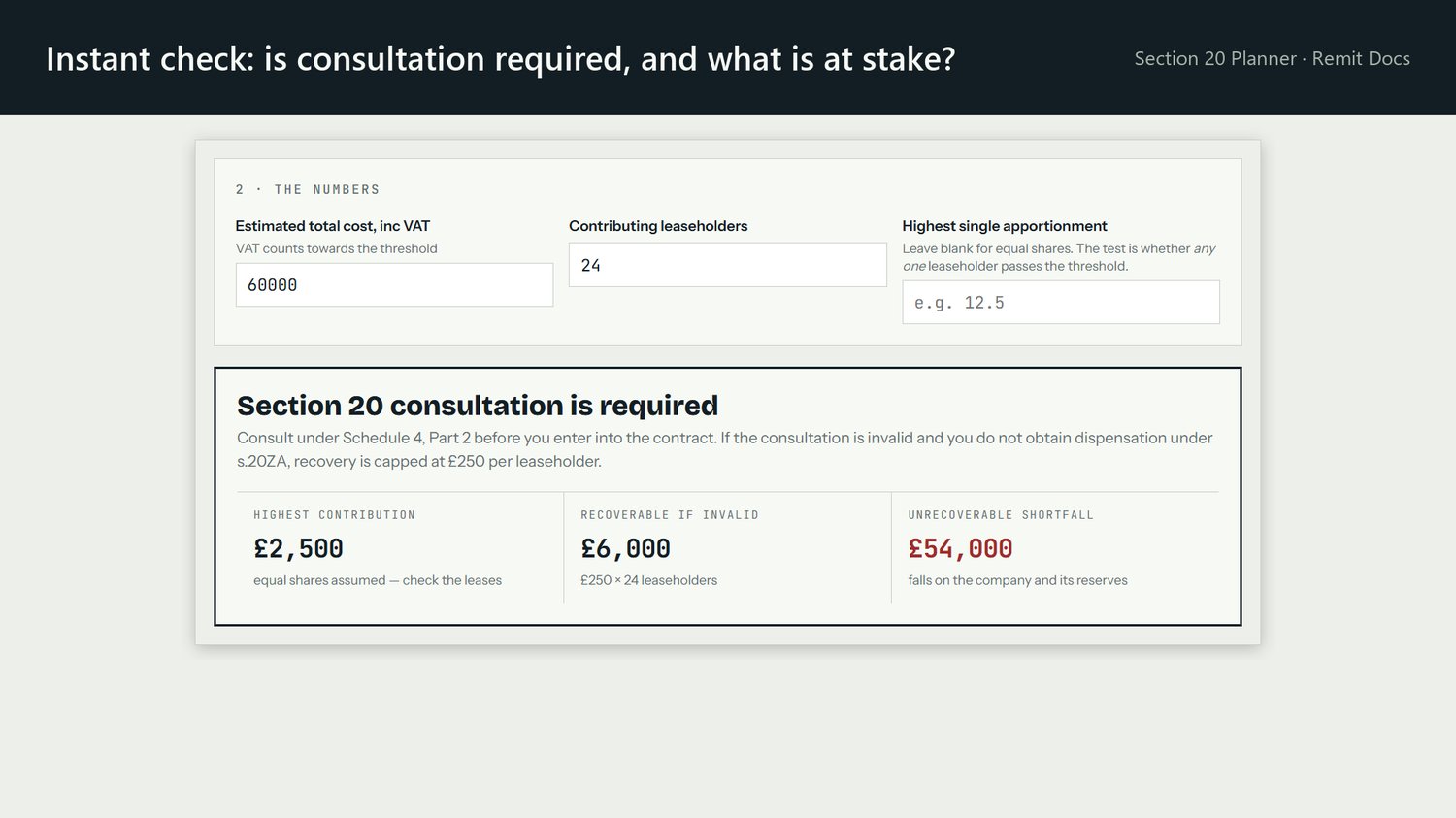
If one leaseholder's share of a job is more than £250, the law says you must consult before you sign the contract. Get it wrong and, unless the First-tier Tribunal grants a dispensation, you can recover only £250 from each leaseholder. On a £60,000 roof shared between 24 flats, that leaves £54,000 you cannot collect. The Section 20 Planner works out whether you have to consult, the date of every stage, and drafts the notices for you.
What you get for £99
- The Section 20 Planner (interactive, runs in your web browser). You open it on your own computer. There is no account, no sign-up and nothing to install, and what you type is not sent anywhere. It does four things:
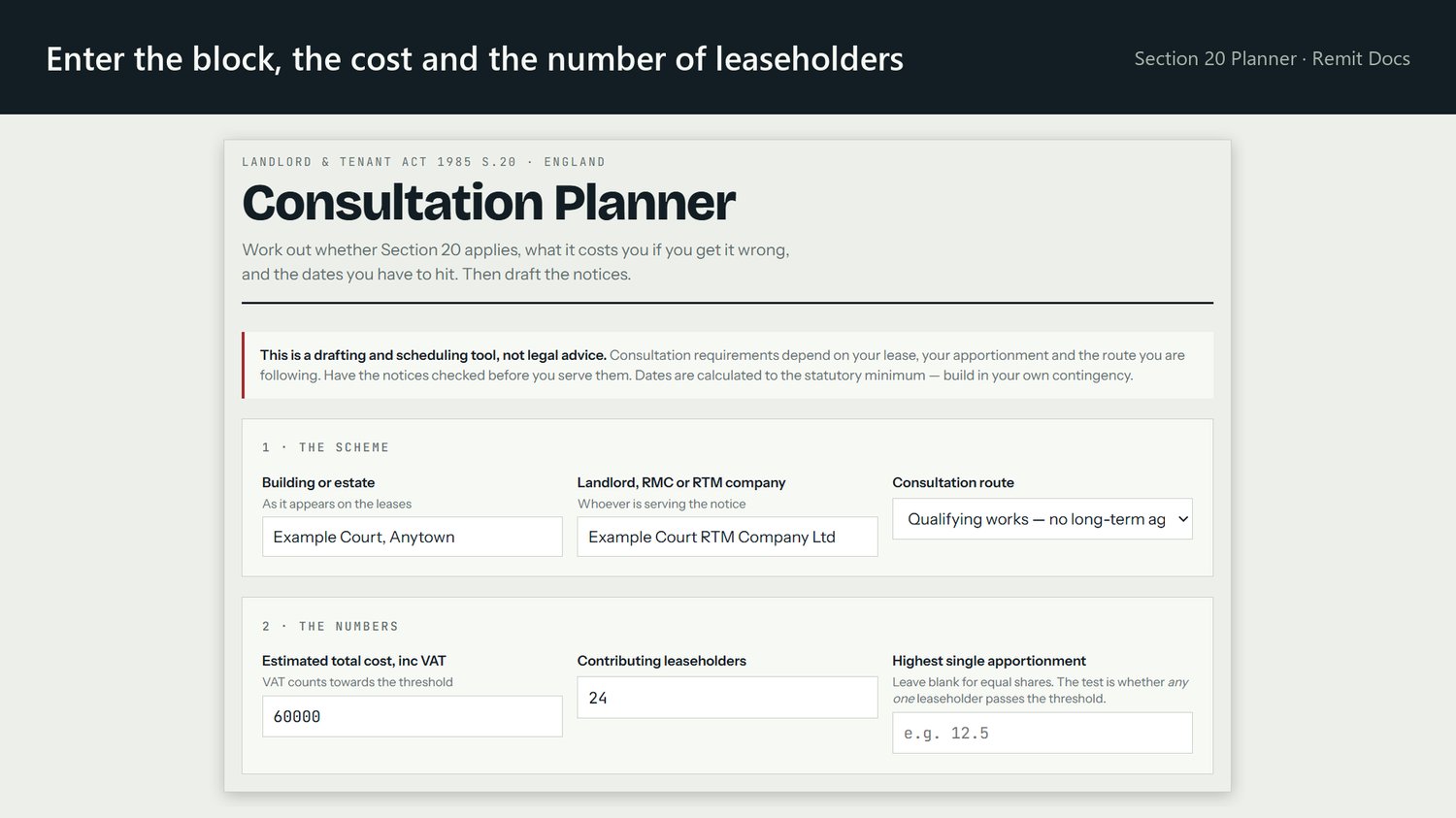
- The £250 check. Enter the total cost (including VAT), the number of leaseholders and, if shares are unequal, the largest share. It tells you whether consultation is required and shows how much could not be recovered if the consultation failed.
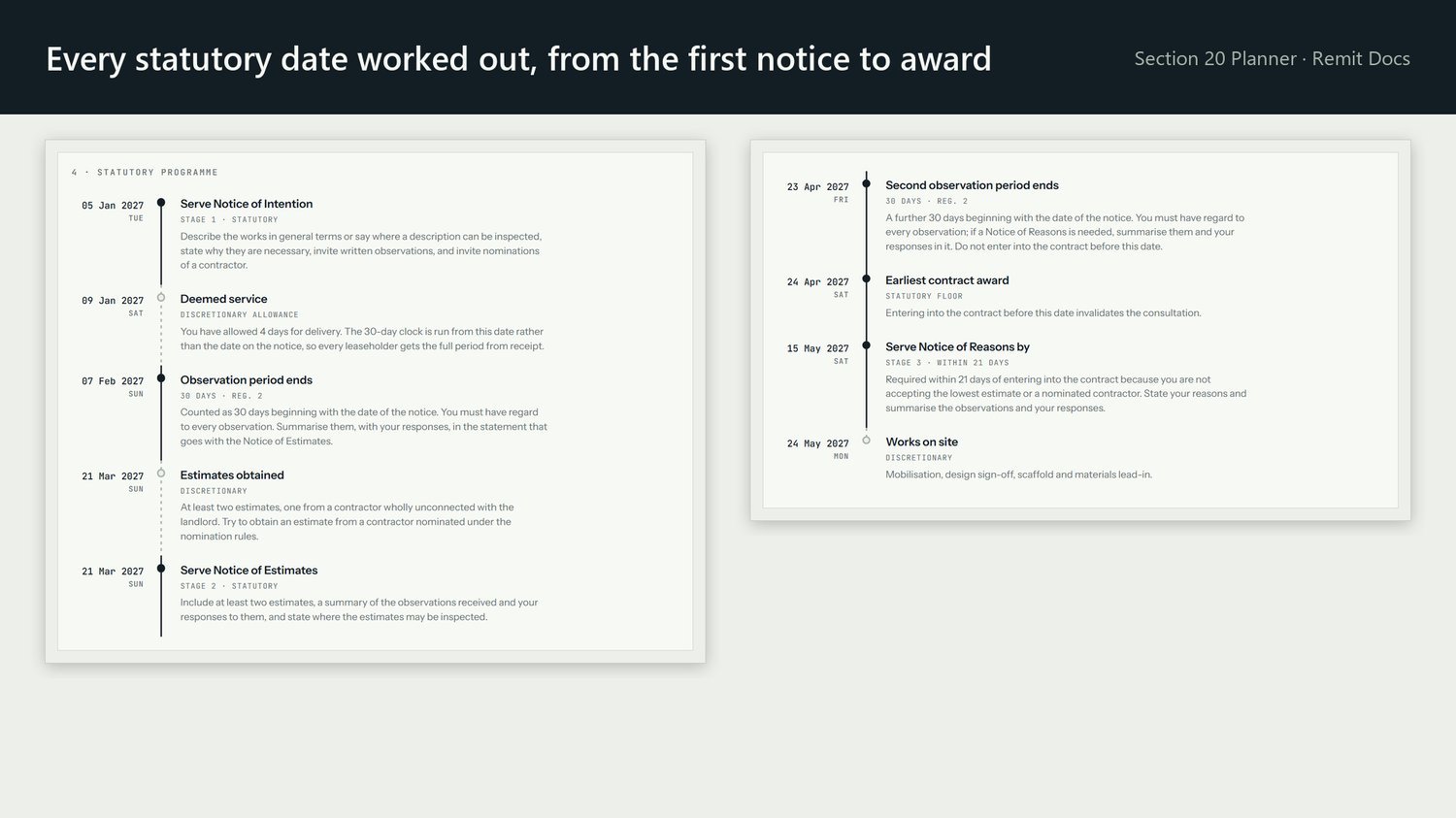
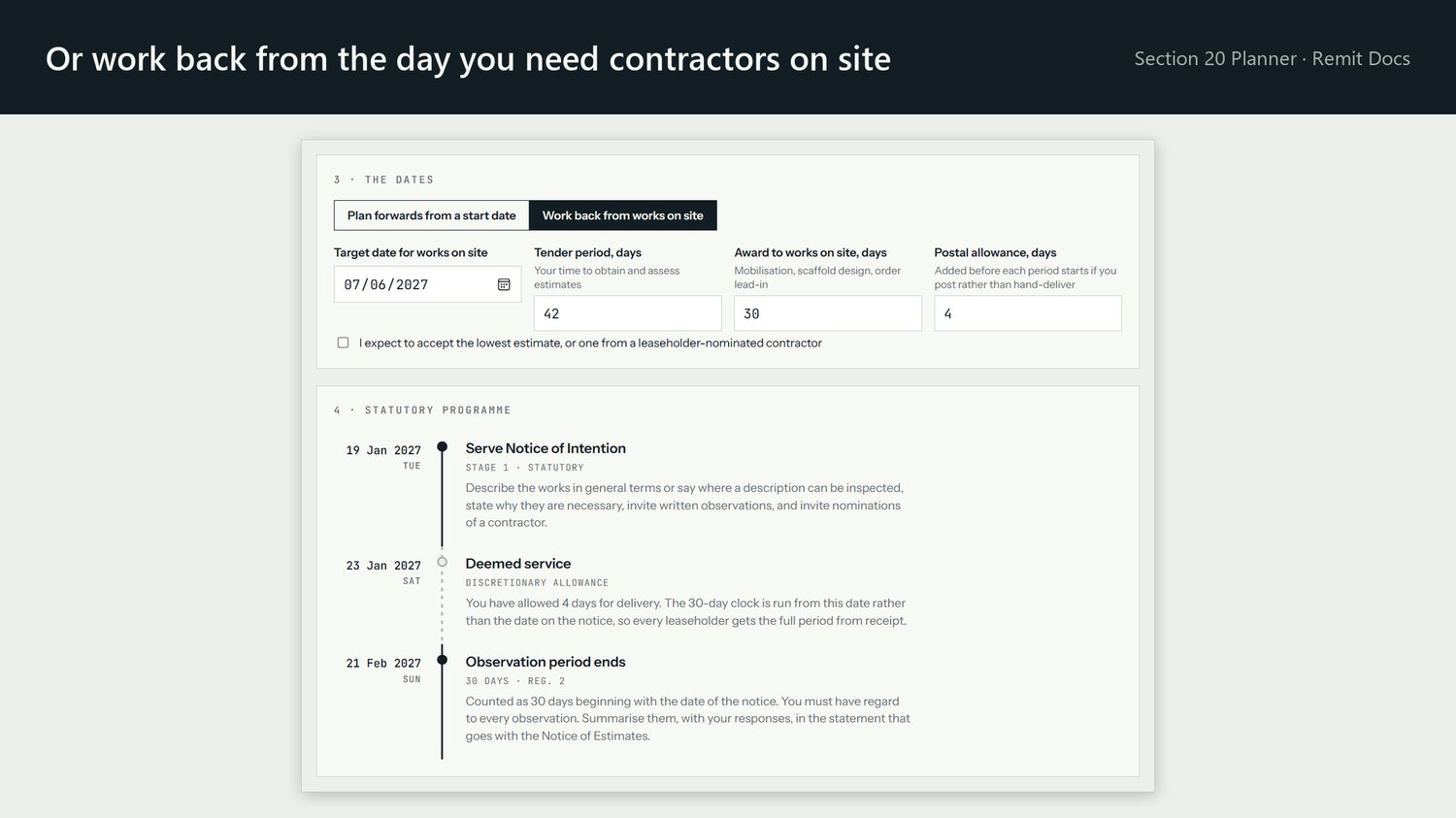
- The statutory programme. It lists every date in order: the Notice of Intention, the end of the 30-day observation period, the Notice of Estimates, the end of the second 30-day period, the earliest date you can sign the contract, the deadline for the Notice of Reasons, and works on site. You can plan forwards from the day you serve the first notice, or work back from the day you need contractors on site. You set your own tender period, mobilisation time and postal allowance.
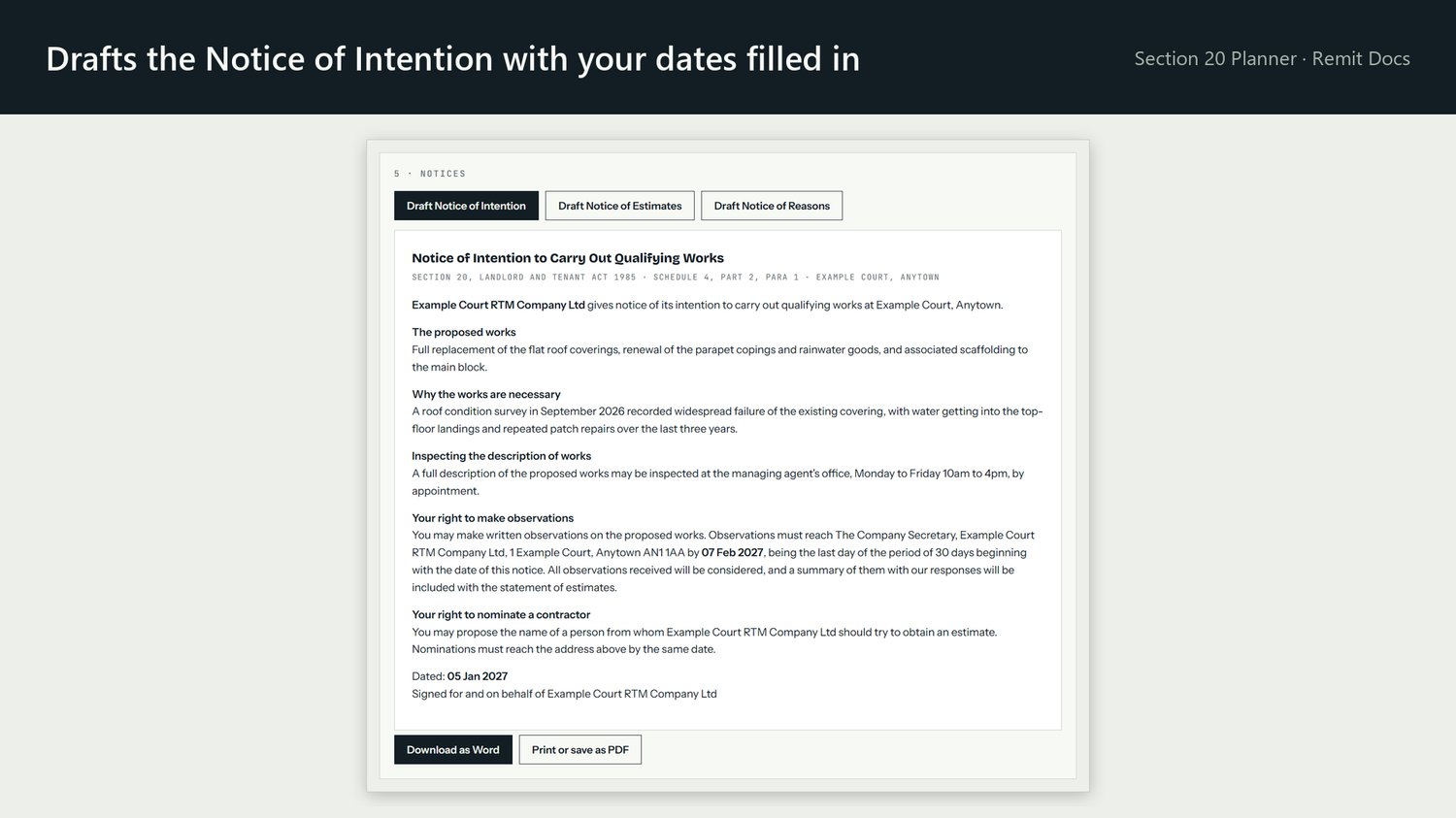
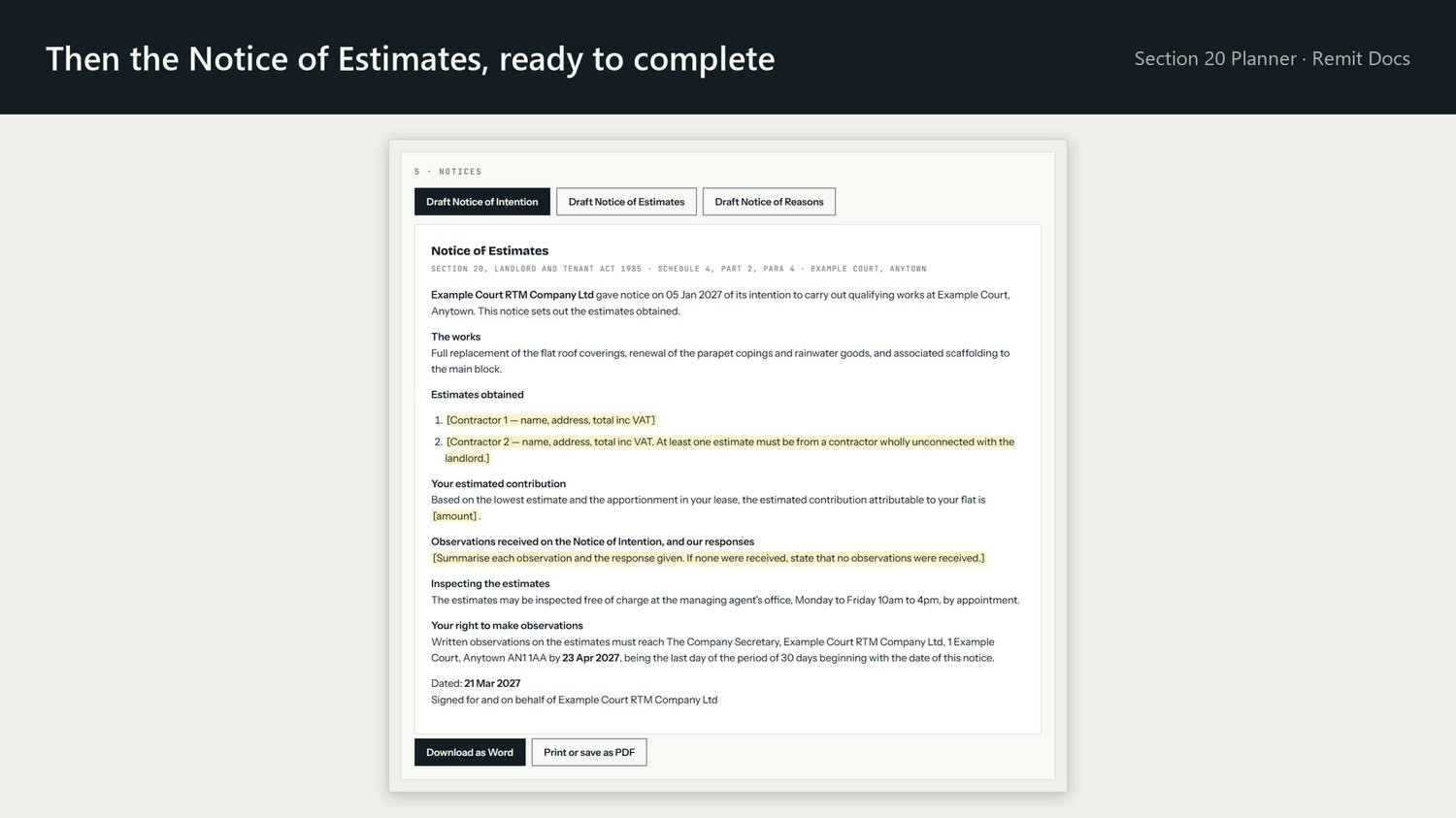
- Draft notices. It drafts the Notice of Intention, the Notice of Estimates and the Notice of Reasons with your block, your company and your dates filled in. The parts only you can supply are highlighted.
- Word or PDF. You can download each notice as a Word file to edit, or print it or save it as a PDF.
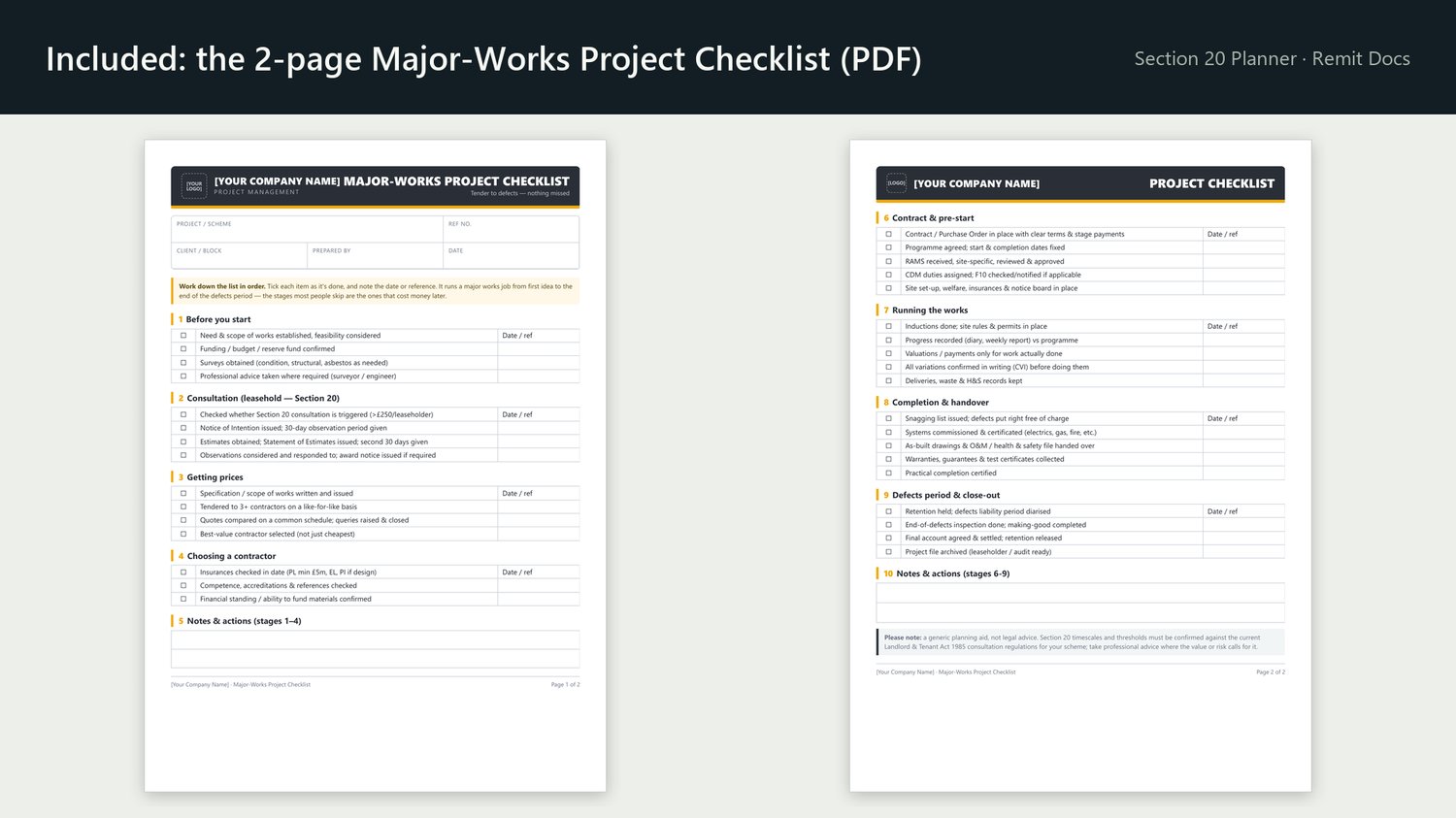
- The Major-Works Project Checklist (2-page PDF). This covers the whole job from first idea to the end of the defects period: surveys and budget, the Section 20 stages, tendering, checking contractors, the contract, running the works, handover and closing the account. Add your own logo and company name.
How it works
- Open the planner in your browser and enter the block, the cost and the number of leaseholders.
- Choose your start date, or your target date for works on site. Every statutory date appears on a timeline.
- Add a description of the works and the reasons for them, then draft each notice when you reach that stage. Check it, complete the highlighted parts and serve it.
The stages it plans (Schedule 4, Part 2 of the 2003 Regulations)
- Stage 1: Notice of Intention. Sent to every leaseholder and to any recognised tenants' association. It describes the works, gives your reasons and invites written observations and contractor nominations within 30 days, counted from the date of the notice.
- Estimates. You need at least two, and one must come from a contractor wholly unconnected with the landlord. You must also try to get an estimate from a contractor that leaseholders nominate.
- Stage 2: Notice of Estimates. It sets out at least two of the estimates, summarises the observations you received and your responses, and says where all the estimates can be inspected. A second 30-day period for observations follows.
- Contract. You can sign only after the second period ends.
- Stage 3: Notice of Reasons. This is due within 21 days of signing the contract, unless you chose the lowest estimate or a contractor that leaseholders nominated.
The planner adds an optional postal allowance before each 30-day period starts, so that leaseholders get the full period after your notice arrives.
Who it is not for
- Blocks in Wales, Scotland or Northern Ireland. Wales has its own regulations.
- Qualifying long-term agreements and works carried out under one, such as multi-year maintenance contracts.
- Works that need a public notice under public procurement rules (Schedule 4, Part 1).
- Anyone who needs advice on a disputed consultation, a dispensation application or what their lease allows. Speak to a specialist for these.
Important: the Section 20 Planner is a planning and drafting tool, not legal advice. It gives you a structured starting point based on the statute: the dates, the order of the stages and draft notices. You review it and adapt it to your own leases and scheme before you serve anything. The dates are the statutory minimum, so build in your own contingency.
Based on section 20 and section 20ZA of the Landlord and Tenant Act 1985 and the Service Charges (Consultation Requirements) (England) Regulations 2003 (SI 2003/1987). Checked against legislation.gov.uk on 14 November 2026.
Not sure yet? Try the free Section 20 Quick-Check first.