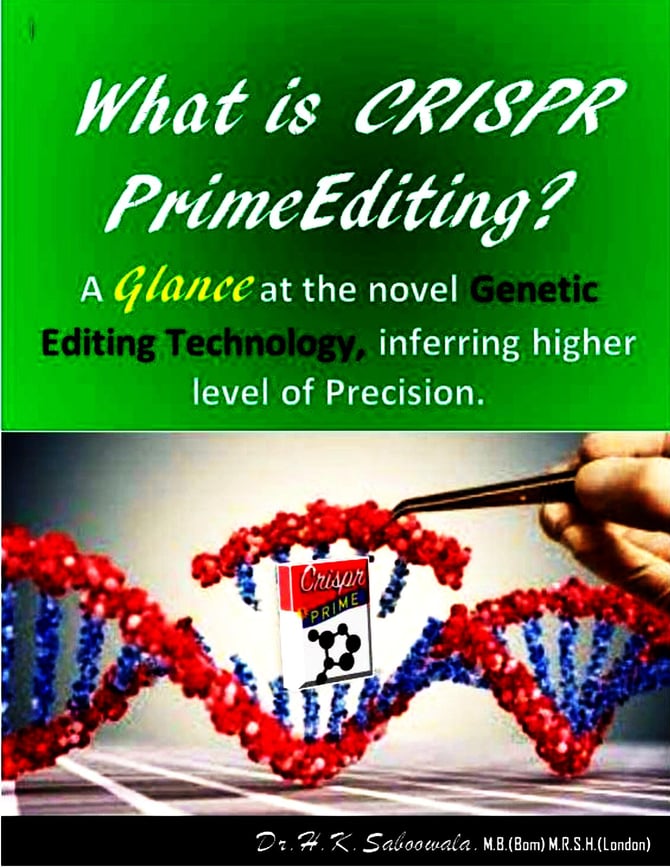
“What is CRISPR Prime Editing?” A Glance at the Novel Genetic Editing Technology, inferring higher level of Precision.
The CRISPR toolbox is stuffed with refinements that have been developed in the 7 years since researchers first described the powerful genome editor.
But now, a new one called "prime editing" is turning heads because it steers around a few central shortcomings of its predecessor.
CRISPR cuts the double-stranded DNA at precise locations in the genome and then let's the cell repair mechanism take over, which can easily cripple a gene.
Researchers can also engineer CRISPR to introduce new DNA at the cut site.
But CRISPR is sloppy, often creating unwanted off-target mutations.
And it's not very efficient at intentionally introducing specific DNA bases, the As, Cs, Ts, and Gs that make up the double helix.
Prime editing, which builds on CRISPR's basic components, promises to get around these problems.
· First, it does not cut the double helix, but only "nicks" open one strand of the DNA at a targeted site of the genome.
o The CRISPR machinery then introduces changes by shuttling over a research-designed stretch of RNA coupled to an enzyme, reverse transcriptase, that can read the code and transcribe it into complimentary DNA, which gets edited in at the nick site.
An attempt has been made in this Booklet to describe precisely a new gene editing technique called “prime editing”, tested in human and mouse cells, rewrites DNA by only cutting a single strand to add, remove, or replace base pairs.
It has worked remarkably well in more than 175 edits in different human and mouse cells.
If it pans out, it could address many genetic diseases that the current CRISPR toolbox cannot.
…. Dr. H. K. Saboowala. M.B.(Bom) M.R.S.H. (London).
But now, a new one called "prime editing" is turning heads because it steers around a few central shortcomings of its predecessor.
CRISPR cuts the double-stranded DNA at precise locations in the genome and then let's the cell repair mechanism take over, which can easily cripple a gene.
Researchers can also engineer CRISPR to introduce new DNA at the cut site.
But CRISPR is sloppy, often creating unwanted off-target mutations.
And it's not very efficient at intentionally introducing specific DNA bases, the As, Cs, Ts, and Gs that make up the double helix.
Prime editing, which builds on CRISPR's basic components, promises to get around these problems.
· First, it does not cut the double helix, but only "nicks" open one strand of the DNA at a targeted site of the genome.
o The CRISPR machinery then introduces changes by shuttling over a research-designed stretch of RNA coupled to an enzyme, reverse transcriptase, that can read the code and transcribe it into complimentary DNA, which gets edited in at the nick site.
An attempt has been made in this Booklet to describe precisely a new gene editing technique called “prime editing”, tested in human and mouse cells, rewrites DNA by only cutting a single strand to add, remove, or replace base pairs.
It has worked remarkably well in more than 175 edits in different human and mouse cells.
If it pans out, it could address many genetic diseases that the current CRISPR toolbox cannot.
…. Dr. H. K. Saboowala. M.B.(Bom) M.R.S.H. (London).

 Save
Save
 Share
Share
 Tweet
Tweet